Independent journal on economy and transport policy
06:26 GMT+2
TRADE
This year, the continuing conflict in the Middle East could accentuate the expected slowdown in world trade
The economists of the World Trade Organization envisage two scenarios
Ginevra
March 19, 2026
The conflict in the Middle East, if it were to prolong with a
consequent increase in energy prices, would accentuate the
expected slowdown in world trade that will follow
Higher-than-expected growth in 2025 driven by the surge
of exchanges of products that support artificial intelligence.
This was highlighted today by the World Trade Organization in the latest
report "Global Trade Outlook and Statistics" explaining
that the current situation of war crisis, if it were to continue,
It would also put pressure on food supplies and the
trade in services due to disruptions in travel and
transport. However, the outlook could improve if the
conflict ended quickly and the boom in spending on
artificial intelligence continued.
In particular, the report presents a growth scenario of
that excludes energy price shocks and envisages a
slowing growth in global trade in goods, which
would stand at +1.9% in 2026 compared to +4.6% in 2025, as
Normalization of trade is expected following the surge
AI-related products and import anticipation
to avoid new duties. In addition, it is estimated that the volume of trade
of world goods will grow by +2.6% in 2027. Relatively
to trade in services, the WTO's forecasting analysis relating to
in the baseline scenario estimates that their growth will slow
to +4.8% in 2026 after the increase of +5.3% recorded in 2025, due to
then accelerate again to +5.1% in 2027. Overall, it is
expects trade in goods and services to grow by +2.7% in 2014
2026 compared to +4.7% in 2025. It is also envisaged that the
World gross domestic product growth will moderate
slightly from +2.9% in 2025 to +2.8% both in 2026 and
in 2027.
In the baseline scenario, Asia is expected to record
The fastest growth in goods imports in 2026
(+3.3%), followed by Africa (+3.2%), South America (+2.5%), Europe
(+1.3%) and the Middle East (+1.0%). In this scenario, imports
of goods from North America would remain stable (+0.3%), while
those of the Commonwealth of Independent States
would contract (-2.0%). On the goods export front,
Asia is expected to experience the fastest growth in Europe again.
all regions (+3.5%), as well as South America (+3.5%),
followed by North America (+1.4%), CIS (+1.3%) and Africa (+1.2%).
On the other hand, exports of goods from the Middle East would slow down
sharply (+0.6%), while European ones would continue to
stagnate (+0.5%). In 2026, the least developed countries would record
a growth in imports of goods of +4.5% and a growth in
of goods exports by +2.9%.
A second scenario outlined by the WTO is based on
on the assumption that crude oil and natural gas prices
remain high throughout 2026 and this - explains
the ratio - would reduce by 0.3 percentage points the forecast of the
GDP for 2026. This in turn would reduce by 0.5 points
percentages the forecast of trade in goods for this year and
up to one percentage point for regions dependent on
energy imports. This would mean that, in the
Against a backdrop of high energy prices, this year the volumes of
world trade in goods would grow by only +1.4%. Even the
trade in services would grow at a slower rate equal to
to +4.1% in 2026.
The WTO report highlights that the blockade of the Strait of
Hormuz, with a maritime traffic that crosses it that is
collapsed from 138 merchant ships a day to almost zero, as well as
crude oil and LNG, has also disrupted the supply of
essential for global agriculture, causing
an increase in price. The Persian Gulf region, in fact, is
a major exporter of both energy and fertilizers and -
notes the document - a prolonged interruption of supplies
could have knock-on impacts on food systems,
exacerbating the effect of pre-existing restrictions
export. In addition to Iran - the report specifies - the States
such as Bahrain, Qatar and Saudi Arabia export together
significant amounts of fertilizers, including urea and
ammonia, with about a third of the world's supply transiting through
through the Strait of Hormuz. Some important manufacturers
agricultural farmers are therefore particularly exposed to this crisis.
The interruption of natural gas exports and the consequent
price increases - the document specifies - could also
affect the production of ammonia, which is a compound
essential for the production of nitrogen fertilizers throughout the
world.
The report highlights that major manufacturers
Agricultural industries such as India, Thailand and Brazil depend on the Gulf
40%, 70% and 35% of their imports respectively
of urea. In addition, the ongoing conflict in the region represents a
challenge also for the food supplies of the Member States
Gulf that are dependent on imports that are
it averages 75% for rice and exceeds 90% for corn, soybeans and
Vegetable oils: raw materials that would suffer an increase in costs
having to be found through alternative routes.
In the scenario of high energy prices, regions
net importers of fuels, such as Asia and Europe, including
high energy price scenario and baseline would be
those that would suffer the greatest cuts in the growth of the
imports of goods. Net export economies
fuels that are still able to export would enjoy in
higher revenues and therefore higher growth in
imports.
WTO economists explained that, however, there is a
growth potential if the conflict were to be
short duration and whether the expenditure related to artificial intelligence
should remain high throughout 2026 and 2027. In that case,
Growth in trade in goods could increase by 0.5 points
percentages reaching an increase of +2.4% this year and
+2.7% in 2027. But it is also possible that both
upside and downside risks, with energy prices
that remain high and with AI-enabling goods trading
which continues to grow. In this case, in 2026 the growth of the
trade in goods could approach the baseline scenario.
"The prospects - commented the director general of World Trade
Organization, Ngozi Okonjo-Iweala - reflect the resilience of the
global trade, supported by trade in high-quality products
technology and digital services, from the adaptations of the
and avoiding reciprocal retaliation on duties.
However, this basic prediction is put to the test by the
conflict in the Middle East. A prolonged price increase
energy costs could increase risks to global trade,
with potential spill-over effects on food security and pressure on
costs for consumers and businesses. Nevertheless, the members of the WTO -
stressed - can help mitigate the impact and
Alleviate the economic burden on people around the world
maintaining predictable trade policies and strengthening the
resilience of supply chains".
- Via Raffaele Paolucci 17r/19r - 16129 Genoa - ITALY
phone: +39.010.2462122, fax: +39.010.2516768, e-mail
VAT number: 03532950106
Press Reg.: nr 33/96 Genoa Court
Editor in chief: Bruno Bellio No part may be reproduced without the express permission of the publisher






 The conflict in the Middle East, if it were to prolong with a
consequent increase in energy prices, would accentuate the
expected slowdown in world trade that will follow
Higher-than-expected growth in 2025 driven by the surge
of exchanges of products that support artificial intelligence.
This was highlighted today by the World Trade Organization in the latest
report "Global Trade Outlook and Statistics" explaining
that the current situation of war crisis, if it were to continue,
It would also put pressure on food supplies and the
trade in services due to disruptions in travel and
transport. However, the outlook could improve if the
conflict ended quickly and the boom in spending on
artificial intelligence continued.
The conflict in the Middle East, if it were to prolong with a
consequent increase in energy prices, would accentuate the
expected slowdown in world trade that will follow
Higher-than-expected growth in 2025 driven by the surge
of exchanges of products that support artificial intelligence.
This was highlighted today by the World Trade Organization in the latest
report "Global Trade Outlook and Statistics" explaining
that the current situation of war crisis, if it were to continue,
It would also put pressure on food supplies and the
trade in services due to disruptions in travel and
transport. However, the outlook could improve if the
conflict ended quickly and the boom in spending on
artificial intelligence continued.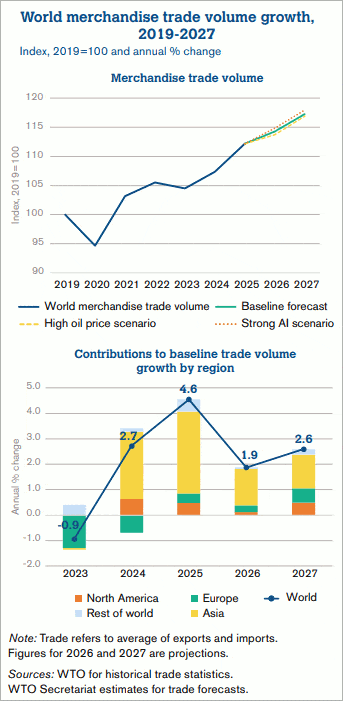








 - Via Raffaele Paolucci 17r/19r - 16129 Genoa - ITALY


