
April 2000
DEVELOPING COUNTRIES' MERCHANDISE EXPORTS IN 1999 EXPANDED
BY 8.5% -
ABOUT TWICE AS FAST AS THE GLOBAL AVERAGE
Developing countries' merchandise exports in 1999 expanded by
8.5 per cent or about two times faster than the global average.
Throughout the 1990s, developing countries' exports rose faster
than world trade, with the exception of 1998. In 1999, the share
of developing countries was 27.5 per cent for merchandise exports
and 23 per cent for commercial services exports, both being more
than 4 percentage points higher than in 1990.
Among the least-developed countries, merchandise export growth
differed sharply again in 1999. Exporters of manufactured goods
like Bangladesh, Cambodia and Haiti expanded their exports faster
than world trade. Oil exporters, such as Angola and Yemen, benefitted
from the oil price hike and increased their exports by more than
one third. While, non-fuel commodity exporters, faced with declining
commodity prices, tended to record lower export values.
Global commercial services trade accelerated only slightly in
1999, as the recovery in Asia and higher growth in North America
were partly offset by lower growth in Western Europe and an import
contraction in Latin America and the transition economies.
These are among the findings of the WTO's preliminary report
on trade developments in 1999 and the outlook for this year (full
report is attached). Other highlights include the following:
- Global output and trade strengthened considerably in the
second half of 1999, thereby improving the prospects for higher
growth in the current year. The recovery in Asia and continued
high demand growth in North America contributed most to global
trade expansion last year.
- World commodity output in 1999 increased by 1.5 per cent,
the same as in 1998. A fall in mining sector output (in particular
oil) contrasted with stronger growth in the manufacturing sector
(e.g. electronic goods and automobiles). The global output of
services industries exceeded commodity output growth. World
GDP growth increased from 2 in 1998 to 3 per cent in 1999.
- Trade benefitted from the stronger economic activity.
Although for the year as a whole merchandise trade expanded in
volume terms at the same rate as in 1998 (4.5 per cent), the pace
of the expansion in the fourth quarter exceeded the average rate
of 6.5 per cent recorded in the nineties.
- International capital markets remained buoyant. Global
FDI flows surged to a new record level of 800 billion dollars,
driven by an exceptionally large value of cross border mergers
and acquisitions. The sharp rise in global capital flows was
largely concentrated among developed countries. Private net capital
flows to emerging markets are estimated to have stagnated in 1999
at about 150 billion dollars.
- Nominal and real effective exchange rates recorded major
variations, leaving their mark on trade flows. While the
euro and most European currencies weakened vis-à-vis
the US dollar, many East Asian currencies, in particular the Japanese
yen, the Korean won and the Thai baht, appreciated markedly.
- Average prices of internationally traded goods declined
slightly. The weakness of the Euro contributed largely to
the fall in Western Europe's dollar export prices and a decrease
in the prices of manufactured goods. Non-fuel commodity prices
continued to weaken further, thus affecting the earnings of many
raw material exporters. Oil prices, which had fallen sharply
in 1998, recovered strongly in 1999 due to a cutback in oil output
and an increase in global demand.
- World merchandise trade value increased by 3.5 per cent
in 1999, faster than commercial services trade. Nevertheless
for the 1990-99 period as a whole, commercial services trade still
expanded slightly faster than merchandise trade.
- Thanks to oil price developments, the highest export
value growth of all regions in 1999 was recorded in the Middle
East and Africa. However, this strong expansion last year did
not fully offset the declines recorded in 1998.
- Merchandise imports grew at double-digit rates in North
America and Asia, stagnated in Western Europe and Africa and
decreased by about 10 per cent in the transition economies and
in Latin America (excluding Mexico).
- Merchandise export growth among the LDCs differed sharply
again in 1999. Oil exporters such as Angola and Yemen benefitted
from the oil price hike and increased their exports by more than
one-third. Exporters of manufactured goods like Bangladesh,
Cambodia, Haiti and Myanmar expanded their exports faster than
world trade. Non-fuel commodity exporters faced with declining
commodity prices tended to record lower export values.
- Developing countries' merchandise exports expanded by 8.5
per cent or about two times faster than the global average.
Throughout the 1990s developing countries' exports rose faster
than world trade, with the exception of 1998. In 1999, the share
of developing countries was 27.5 per cent for merchandise exports
and 23 per cent for commercial services exports, both being more
than 4 percentage points higher than in 1990.
- Commercial services trade accelerated only slightly in
1999, as the recovery in Asia and higher growth in North America
were partly offset by lower growth in Western Europe, and an import
contraction in Latin America and the transition economies.
WORLD TRADE DEVELOPMENTS
Main Features
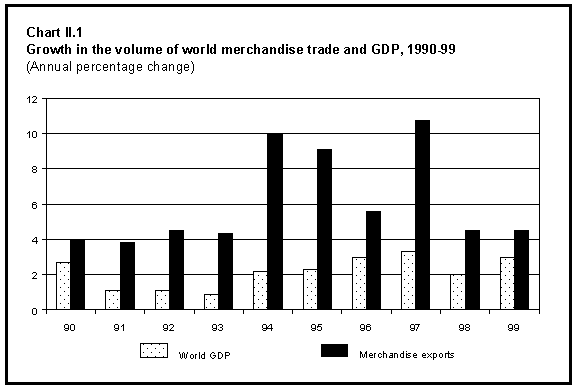
A strengthening of world economic output in 1999 reversed the
slowdown of world trade in the first half of 1999 and led to a
dynamic expansion of trade in the second half. For the year as
a whole, the real growth of world trade remained unchanged from
the preceding year and was below the average trade expansion recorded
throughout the 1990s. Although trade growth continued to exceed
both the growth in world commodity output and world GDP, the excess
margin between the growth rates remained smaller in 1999 than
those observed during the 1990-1997 period.
Demand in the United States and the Asian recovery were the motors
of the global trade expansion in 1999. The outstanding strength
of United States investment and private consumption benefitted
not only the NAFTA region, but also sustained the recovery in
Asia and to a lesser extent output in Western Europe. A major
factor behind the excellent performance of the United States economy
and the unprecedented length of the current expansion has been
the high level of investment in information technology, the backbone
of the "new economy". Excitement about the growth potential
of the new economy has attracted large capital inflows and contributed
to an extraordinary boom in the creation and valuation of high-tech
companies. While the high rate of investment has increased production
capacity and stimulated productivity growth of the United States
economy, the question arises for how long high output and demand
growth can be sustained without leading to inflationary pressures.
A further risk to the strong economic expansion in the United
States could arise from the widening of the current account deficit,
which points to the increasing role of foreign savings in sustaining
United States demand growth. An erosion of investor confidence
in the outlook for the United States economy could lead to lower
capital inflows and trigger a correction in the dollar rate and
the stock markets.
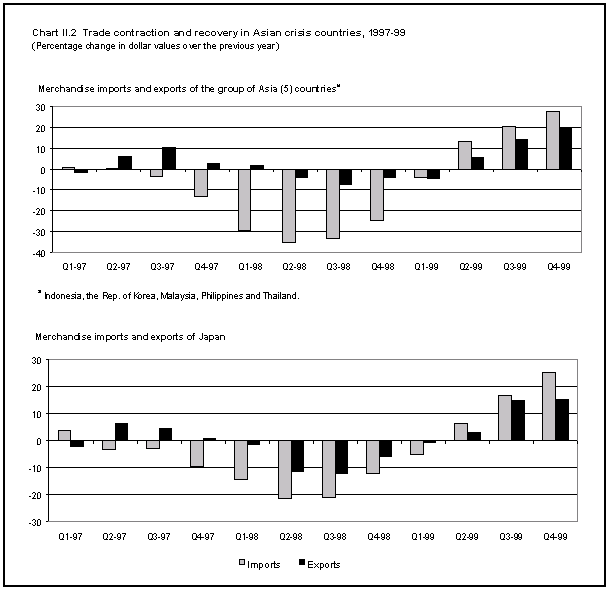
The recovery in Asia was stronger than expected and led to double-digit
real import growth in 1999. GDP growth was uneven among the economies
in the region, ranging from 11 per cent in the case of the Republic
of Korea to stagnation in the case of Indonesia. In many countries
economic growth was sustained by fiscal stimulus, replenishment
of inventories and a rebound in the global demand for electronic
goods.
|
The information technology sector and the automobile industry
both recorded strong global output growth. Within the information
technology sector, the unit sales of personal computers rose by
22 per cent to 114 million units, and the dollar value of global
sales of semi-conductors expanded by 18 per cent, to a new record
level of 160 billion dollars. One of the most dynamic branches
of the global information technology industry in 1999 was mobile
phones. It is estimated that world-wide sales of cellular mobile
phones reached 283 million units, an increase of two-thirds over
1998 sales. New registrations of passenger cars are estimated
to have expanded by 5.5 per cent, lifting the production of passenger
cars to a new all time high of 48.6 million units in 1999. Although
trade data by product group are still incomplete, there is no
doubt that exports of automotive products and of office and telecom
equipment have expanded significantly faster than the global average.
Developments in world financial markets continued to influence
global trade developments through shifts in the direction of international
capital flows and their impact on exchange rate changes. Global
FDI flows have surged by about 25 per cent, to some 800 billion
dollars. FDI inflows in Asia stagnated or rose only
marginally, while the United States recorded net FDI inflows of
130 billion dollars. The main factor behind the increase in global
FDI flows was the exceptional wave of cross-border mergers and
acquisitions.
While the United States attracted an unprecedented level of capital
inflows, which financed its widening current account deficit,
net private capital flows to the major emerging markets are estimated
to have stagnated at 150 billion dollars in 1999.
The increase in the United States current account
deficit caused by increased imports can be seen as a positive
cyclical element in the world economy as it allows output and
employment to be sustained in foreign export industries facing
excess capacity. At the same time, the deficit eases inflationary
pressures in the United States where labour and productive capital
are increasingly scarce. However, what is beneficial in a certain
cyclical situation might be difficult to sustain in the medium
term.
In particular, a large current account surplus of the developing
countries vis-à-vis the United States (or any other
high income country) is hardly a desirable feature over a longer
period. Why is this so when most governments seem to favour a
current account surplus over a deficit? A current account surplus
implies that net capital (= savings) from the developing countries
flows to other countries where it supports investment and/or consumption.
A more desirable situation for the developing countries is a
current account deficit (and a rising trade volume), and a concurrent
inflow of capital that is used to enlarge (profitable) production
capacity. If the capital inflow is used primarily for consumption,
increased debt and debt servicing costs are unlikely to be sustainable.
The present large net capital inflows into the United States
reflect, on the one hand, that foreign investors expect investment
returns to be higher in the United States than elsewhere, and
on the other, that United States consumers are spending an historically
high share of current income (encouraged by its increased financial
wealth), while United States companies maintain a high level of
capital spending. A reversal in foreign investors' appreciation
of future earnings in the United States or a cutback in United
States consumption or investment growth could rapidly change the
size of the United States current account deficit, which in 1999
was equivalent to 3.7 per cent of GDP - a historic record level.
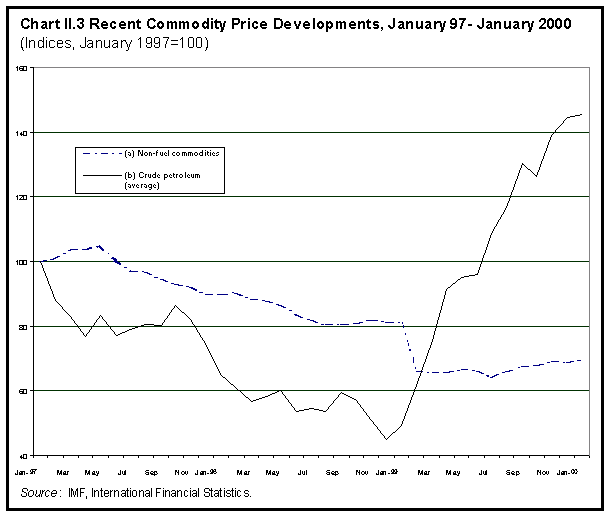
Prices of internationally traded goods decreased slightly
as the increase in oil prices was offset by a further decrease
in the prices of non-fuel commodities and manufactured goods.
Among the non-fuel commodities, prices of food and beverages
decreased by more than 15 per cent while those of agricultural
materials and metals remained roughly unchanged, although they
started to strengthen in the second half of 1999. Despite this
partial price recovery, the annual average prices of non-fuel
commodities fell to a ten year low. The decrease in the dollar
price of manufactured goods can be attributed to the fall in prices
of office and telecom equipment as well as the strength of the
United States dollar vis-à-vis the euro and the
near absence of inflation in the goods sector of all major economies.
Given that oil prices tripled from 10 dollars per barrel in February
1999 to 30 dollars in the first quarter of 2000, concerns about
a resurgence of consumer prices are understandable. However,
the marked reduction in the oil intensity of output in the industrial
countries - by about 40 per cent since the first oil price hike
more than 25 years ago - has reduced this risk considerably.
The increased role of natural gas in world fuels trade has also
contributed to moderate the increase in import prices of fuels.
While the impact of the rebounding oil prices have been small
on consumer prices in 1999, the impact was dramatic on the export
revenues of the oil exporters. The Middle East recorded export
growth in excess of 20 per cent in 1999, but this did not fully
offset a corresponding decline in 1998.
|
WORLD TRADE IN 1999
1. Global trade and output developments
While the negative impact of the financial crisis in Asia and
Latin America on output and trade flows were initially underestimated,
the more sober projections for 1999 turned out to be too pessimistic.
Output of developing countries in Asia rebounded by 6 per cent,
Russian GDP recovered by 3 per cent and Brazil's economy achieved
positive growth for the full year of 1999. The United States
economy again provided a major stimulus to world trade last year
as domestic demand grew by 5.5 per cent. By contrast, the Japanese
economy stagnated and Western Europe's GDP growth decelerated
to 2 per cent.
On a sectoral basis, preliminary data suggest that mining output
decreased as crude oil production was cut back by 1.5 per cent
and agricultural output rose for the second year in a row by only
about 1 per cent. Manufacturing output recovered and expanded
by about 2.5 per cent. The highly divergent growth rates of regional
demand and sectoral output left their mark on global trade flows,
which also differed strongly by region and sector.
The value of world merchandise trade rose by 3.5 per cent in
1999 and amounted to 5.45 trillion dollars. Average trade prices
decreased for the third year in a row, although the decrease in
1999 was much smaller than in preceding years.
Trade in commercial services rose by 1.5 per cent in 1999 and
thereby less rapidly than merchandise trade. Price data for United
States commercial services point to a moderate increase in prices
for internationally traded services. This implies that the expansion
of exports of commercial services has probably also lagged behind
merchandise export growth in volume terms.
| World exports of merchandise and commercial services, 1997-99 |
| | Value | Annual change |
| | 1999 | 1997 | 1998 | 1999 |
| |
| Merchandise | 5460 | 3.5 | -1.5 | 3.5 |
| |
| Commercial services | 1340 | 4.0 | 0.0 | 1.5 |
2. Merchandise trade
A detailed review of world merchandise trade by product group
in 1999 is not yet feasible at the time of writing this report.
However, partial information indicates that rebounding oil prices
have led to an increase of world fuels exports in excess of 20
per cent. Above average growth was also recorded for office and
telecom equipment and automotive products. Primary products,
other than fuels, on average experienced price declines in 1999.
Taking into account moderate demand growth, the global value
of non-fuel primary products has probably stagnated or changed
only very little from the preceding year.
Preliminary data on merchandise trade by region are
provided in Tables II.2 and II.3. The large variations in import
volumes by region largely reflect the differences in regional
demand and output growth. As can be seen from Table II.2, North
America and Asia recorded import growth slightly above 10 per
cent or two times faster than the global average. While for North
America this was the third year in a row in which import growth
exceeded 10 per cent, the developments in Asia illustrate the
strength of the region's recovery, which offset the sharp import
contraction in the preceding year. While imports of Asia recovered,
those of Western Europe recorded a marked deceleration. The transition
economies as a group recorded a 10 per cent contraction due to
the sharp cut back of imports into Russia and the Ukraine. Imports
of Africa and the Middle East changed little in real terms in
1999, also reflecting poor export earnings in recent years.
| Table II.2 |
| Growth in the volume of world merchandise trade by selected region, 1997-99 |
| (Percentage change) |
| | | | |
| | Exports | | Imports |
| | | | | | | | |
| | 1997 | 1998 | 1999 | | 1997 | 1998 | 1999 |
| | | | | | | | |
| World a | 10.5 | 4.5 | 4.5 | | … | … | … |
| North America | 11.0 | 3.5 | 4.5 | | 13.0 | 10.5 | 10.5 |
| Latin America | 11.5 | 7.5 | 7.0 | | 22.5 | 8.5 | -2.0 |
| Mexico | 19.5 | 11.0 | 13.5 | | 28.0 | 15.5 | 15.0 |
| Other Latin America | 6.5 | 5.5 | 2.0 | | 20.0 | 4.5 | -12.0 |
| Western Europe | 9.5 | 5.5 | 3.5 | | 9.0 | 8.5 | 3.5 |
| European Union (15) | 9.5 | 6.0 | 3.5 | | 8.5 | 8.5 | 4.0 |
| Transition economies | 10.5 | 5.0 | -3.0 | | 13.5 | 5.0 | -10.0 |
| Asia | 13.0 | 3.5 | 6.0 | | 5.5 | -8.5 | 9.0 |
| Japan | 12.0 | -1.5 | 2.0 | | 1.5 | -5.5 | 9.5 |
| Asia (5) b | 16.5 | 13.0 | 11.5 | | 3.0 | -22.5 | 17.5 |
|
a Average of export and import growth. |
| b Indonesia, the Republic of Korea, Malaysia, Philippines and Thailand. |
|
Note: Separate volume data are not available for Africa and the Middle East, although estimates for these regions have been made in order to calculate a world total. |
The variation among regional export growth rates in 1999 was
smaller than for imports. Despite sharply lower intra-regional
trade, Latin America recorded the highest export expansion of
all regions. Asian export growth exceeded the global average
as Japan's exports recovered and the five Asian developing countries
affected most by the 1997/98 financial crisis achieved double-digit
export growth. North America's exports accelerated somewhat thanks
to the dynamic performance of intra-trade. The deceleration of
West European economic activity in 1999 led to markedly lower
growth of intra-trade. While intra-European Union exports expanded
two times faster than world trade in 1998, its growth in 1999
fell below that of world trade. The transition economies and
the Middle East both recorded a contraction of their export volume.
|
Turning to developments in value terms, the Middle East
reports the highest regional export growth rate despite its reduction
in export volume. Africa's export growth was, at 8 per cent,
the second highest among all regions. This was largely due to
the sharp recovery of shipments from the region's oil-exporting
countries. However, it should be recalled that for both Africa
and the Middle East, the 1999 rise did not fully offset the decrease
recorded in the preceding year. Latin America's exports rose
by a strong 6 per cent, as the higher growth of Mexico's and some
Caribbean countries' exports more than offset the sharp declines
reported for all South American countries. A recovery of intra-Asian
trade supported by stronger regional growth and appreciating currencies
led Asian exports to regain their pre-crisis peak level. North
American exports expanded by 4 per cent in 1999, following a small
contraction in 1998. The marginal decline in Western Europe's
export value was due to a deceleration in volume growth but above
all, to a fall of nearly 4 per cent in the region's dollar export
prices. The weaker export prices are principally due to the depreciation
of the Euro vis-à-vis the US dollar. The sluggishness
of Western Europe's import growth, together with the sharp contraction
of Russia's imports, contributed to a further decrease in the
export value of transition economies in 1999.
| Table II.3 |
| Growth in the value of world merchandise trade by region, 1997-99 |
| (Billion dollars and percentage change) |
| | | | |
| | Exports (f.o.b.) | | Imports (c.i.f.) |
| | | | | | | | |
| | Value | | Annual percentage change | | Value | | Annual percentage change |
| | | | | | | | | | | | |
| | 1999 | | 1997 | 1998 | 1999 | | 1999 | | 1997 | 1998 | 1999 |
| | | | | | | | | | | | |
| World | 5460 | | 3.5 | -1.6 | 3.5 | | 5725 | | 3.5 | -0.8 | 4.0 |
| North America | 934 | | 9.2 | -0.7 | 4.0 | | 1281 | | 10.3 | 4.4 | 11.5 |
| Latin America | 292 | | 10.2 | -1.2 | 6.0 | | 329 | | 18.5 | 4.8 | -4.0 |
| Mexico | 137 | | 15.0 | 6.4 | 16.5 | | 148 | | 22.6 | 13.9 | 13.5 |
| Other Latin America | 156 | | 7.2 | -6.2 | -2.0 | | 181 | | 16.4 | -0.1 | -14.5 |
| Western Europe | 2349 | | -0.6 | 3.4 | -0.5 | | 2417 | | -0.3 | 5.9 | 0.5 |
| European Union (15) | 2176 | | -0.5 | 3.8 | -0.5 | | 2233 | | -0.5 | 6.3 | 1.0 |
| Extra-EU (15) trade | 799 | | 1.8 | -0.3 | -1.5 | | 851 | | -0.3 | 6.2 | 2.5 |
| Transition economies | 212 | | 4.1 | -4.6 | -1.5 | | 211 | | 6.5 | -1.8 | -13.0 |
| Central/Eastern Europe | 101 | | 6.3 | 9.5 | 0.0 | | 129 | | 5.6 | 10.8 | -2.0 |
| Russian Federation | 74 | | -0.4 | -15.9 | 0.0 | | 41 | | 6.7 | -19.8 | -30.5 |
| Africa | 113 | | 1.9 | -15.5 | 8.0 | | 132 | | 5.5 | 1.2 | 0.5 |
| South Africa a | 27 | | 6.2 | -9.0 | 1.5 | | 27 | | 9.5 | -9.3 | -8.5 |
| Major fuel exporters b | 41 | | -0.1 | -31.4 | 24.0 | | 30 | | 9.6 | -0.8 | 5.5 |
| Middle East | 169 | | 4.7 | -22.4 | 22.0 | | 152 | | 8.1 | -3.2 | 4.0 |
| Asia | 1390 | | 5.4 | -6.1 | 7.5 | | 1201 | | 0.4 | -17.8 | 10.5 |
| Japan | 419 | | 2.4 | -7.8 | 8.0 | | 311 | | -3.0 | -17.2 | 11.0 |
| China | 195 | | 21.0 | 0.6 | 6.0 | | 166 | | 2.5 | -1.5 | 18.0 |
| Asia (5) c | 371 | | 5.1 | -3.5 | 9.5 | | 292 | | -3.1 | -30.9 | 15.5 |
|
a Beginning 1998, figures refer to South Africa and no longer to the South African Common Customs Area. |
| b Angola, Algeria, Congo, Gabon, Libyan Arab Yamahiriya and Nigeria. |
| c Indonesia, the Republic of Korea, Malaysia, Philippines and Thailand. |
3. Commercial services trade
The global export value of commercial services recovered in 1999
after stagnating in 1998. Preliminary data by major services
categories indicate that all categories recorded positive growth.
Transportation services are estimated to have expanded less than
the average growth rate of 1.5 per cent despite the increase in
fuel costs. Travel services and the residual grouping of Other
business services have both expanded by about 2 to 3 per cent.
|
The commercial services trade data by region shown in Table II.4
indicate that the most dynamic export and import growth in 1999
was in North America and Asia. While North America's services
import growth exceeded its export growth, thereby reducing its
traditional surplus in commercial services, Asia's imports and
exports expanded at about the same rate (4-5 per cent). The rebound
in Asian services trade is much weaker than for Asian merchandise
trade, in particular for exports. In contrast to the developments
in North America and Asia, Western Europe's services trade expanded
less favourably in 1999 than in the preceding year. Available
data for the transition economies point to a sharp contraction
of both services exports and imports.
| Table II.4 |
| Growth in the value of world trade in commercial services by selected region, 1997-99 |
| (Billion dollars and percentage change) |
| |
| | Exports | | Imports |
| |
| | Value | | Annual change | | Value | | Annual change |
| |
| | 1999 | | 1997 | 1998 | 1999 | | 1999 | | 1997 | 1998 | 1999 |
| | | | | | | | | | | | |
| World | 1340 | | 4 | 0 | 2 | | 1335 | | 3 | 1 | 3 |
| North America | 284 | | 8 | 2 | 5 | | 219 | | 10 | 6 | 9 |
| United States | 252 | | 9 | 2 | 5 | | 182 | | 11 | 8 | 10 |
| Latin America | 54 | | 7 | 9 | -2 | | 60 | | 13 | 4 | -9 |
| Mexico | 12 | | 5 | 6 | -3 | | 14 | | 19 | 7 | 9 |
| Other Latin America | 42 | | 8 | 10 | -2 | | 47 | | 12 | 4 | -13 |
| Western Europe | 630 | | 2 | 6 | 0 | | 600 | | 0 | 7 | 1 |
| European Union (15) | 565 | | 1 | 5 | 1 | | 555 | | 0 | 7 | 2 |
| Transition economies | 47 | | 0 | 2 | -10 | | 44 | | 0 | 1 | -8 |
| Asia | 267 | | 5 | -15 | 4 | | 337 | | 2 | -11 | 5 |
| Japan | 60 | | 3 | -9 | -3 | | 114 | | -5 | -9 | 3 |
| Hong Kong, China | 35 | | 1 | -10 | 3 | | 22 | | 5 | -2 | -2 |
| China | 27 | | 19 | -2 | … | | 32 | | 34 | -4 | … |
| Asia (5) a | 62 | | 7 | -23 | 3 | | 73 | | 5 | -25 | 5 |
|
aIndonesia, the Republic of Korea, Malaysia, Philippines and Thailand |
| Note: Separate reliable data are not available for Africa and the Middle East, although estimates for these regions have been made to calculate a world total. |
4. Trade by region and country
The outstanding high investment and consumption growth in the
United States resulted in an expansion of imports of goods and
services of more than 10 per cent in both nominal and real terms.
Over the last two years United States import demand sustained
world trade remarkably. Excluding shipments to the United States,
the nominal value of world merchandise and services trade in 1999
would have still been below its 1997 level and the volume expansion
of world merchandise trade would have been limited to 6 per cent
instead of 9 per cent. The share of the United States in world
merchandise imports rose to 18 per cent, the highest US share
ever. Strong domestic growth was also one reason why United States
merchandise exports in real terms lagged behind global trade growth.
All countries having strong trade ties with the United States
benefitted from this development, and in particular Canada, which
expanded its merchandise exports to the United States over the
last two years by about 18 per cent, or twice the rate of global
trade growth.
Commercial services' imports of the United States rose by 10
per cent and two times faster than exports. Canada's import growth
of commercial services recovered to 5.5 per cent, but remained
for the fifth year in a row behind the expansion of its services
exports. Although the expansion of United States commercial services'
imports has exceeded that of exports since 1997, the United States
surplus in services in 1999 still amounted to US$68 billion.
In 1999, Latin America recorded its worst annual economic
performance for the last decade, as regional output stagnated
and the volume of merchandise imports decreased by 2 per cent.
At least eight economies recorded lower output in 1999 than in
the preceding year. As in 1998, there is a striking difference
in output and trade growth between Mexico and all the other Latin
American countries combined. While Mexico's merchandise exports
and imports rose over the last two years by more than 20 per cent,
other Latin American countries combined reported a fall in exports
of nearly 8 per cent and in imports of nearly 15 per cent.
A large part of the divergent performance can be attributed to
differences in the export structure. Manufactured goods account
for 85 per cent of Mexico's exports, but only 40 per cent for
Latin America excluding Mexico. Manufactures enjoyed more stable
prices than non-fuel commodities. In addition, Mexico's exports
are destined largely to the booming North American market (nearly
90 per cent) while the other Latin American countries ship less
than 30 per cent of their exports to North America. Mercosur
experienced a contraction of its intra-trade by about one quarter,
as output of its member countries declined or stagnated.
For commercial services imports, one can observe a similar divergency,
as Mexico's imports rose by 15 per cent, while those of the other
Latin American countries contracted by nearly 10 per cent over
the last two years. Only for commercial services exports, Mexico
reports a stronger decrease than the other Latin American countries
in 1999. The somewhat surprising decline reported for Mexico's
commercial services exports is attributed to a decrease in revenues
from both travel and other business services.
The slowdown in Western Europe's output growth to 2 per
cent in 1999 contributed to a markedly lower trade growth in volume
terms. As more than two-thirds of Western Europe's trade is intra-regional,
weak consumption growth affected both exports and imports. As
regards merchandise trade, it is estimated that exports and imports
grew in volume terms by about 3.5 per cent and thereby less than
world trade. As the Euro and other European currencies weakened
vis-à-vis the US dollar, the region's dollar export
and import prices decreased on average by about 4 per cent, leading
to a stagnation of their trade dollar values in 1999. Austria,
France and Sweden were among the West European countries which
recorded only moderate import growth, while Norway and Turkey
even experienced a contraction of their import volumes in 1999.
Spain, Portugal and Ireland, however, continued to be the most
dynamic traders in Western Europe, with imports and exports expanding
much faster than the European average.
Although output in the transition economies recovered
by about 2 per cent, growth remained disappointingly low in the
tenth year of transition. Poland is the only country in the region
in which the output level in 1999 was above the level attained
ten years ago. The sluggishness in Western Europe's economy together
with a dramatic shrinkage of Russian imports depressed the region's
trade in 1999. Merchandise and commercial services trade were
both shrinking in dollar value and volume terms. Most of the
decline was concentrated in the CIS member countries. Central
and Eastern Europe's merchandise trade slowed down sharply but
continued to show positive real growth in 1999. Hungary continued
to record the highest trade growth among the Central/East European
countries. In 1999, its merchandise exports and imports expanded
by about 9 per cent in dollar terms. A major contribution to
this strong trade performance was made by the expansion of intra-industry
trade in office and telecom equipment and automotive products.
Africa and the Middle East recorded one of their weakest
annual GDP growth performances in the 1990s. The rebound in their
merchandise exports was largely due to the recovery in oil prices.
Africa's merchandise exports rose by 8 per cent in 1999. The
major fuel exporters recorded an increase of about one-quarter,
which did not fully offset the decline recorded in 1998. South
Africa and other non-fuel exporting African countries recorded
an increase in their export earnings of less than 2 per cent.
African imports stagnated in dollar terms for the second year
in a row, as sharp declines in South Africa's imports were offset
by increases by African developing countries.
Economic growth patterns differed widely in Asia in 1999.
While GDP growth in the two most populous countries in the region,
China and India, was about 7 per cent, the output in Japan, the
largest economy in Asia, stagnated. Among the five Asian countries
severely affected by financial crisis, the Republic of Korea recorded
an outstanding recovery with double digit growth, while Indonesian
output stagnated. Asian developing countries as a group recorded
an output expansion of 6 per cent, at least two times faster than
any other developing region.
One of the outstanding developments of Asian trade in 1999 was
the double digit trade volume growth of the five Asian countries
most affected by financial crises in 1997-98. Their export expansion
remained very strong (11.5 per cent) and imports rebounded sharply
without offsetting fully the contraction of the preceding year.
The regional recovery and the cyclical recovery in the electronic
goods industry contributed largely to this dynamic growth. For
the Republic of Korea and Malaysia, exports of office and telecom
equipment accounted for more than 80 per cent of the overall increase
of their export value in 1999.
Japan's merchandise trade recovery was strong, taking into account
its stagnating economy. However, export and import values did
not regain their pre-crisis peak levels. Japan's commercial services
exports continued to shrink, while imports picked-up after a marked
decrease in 1997-98. China's merchandise imports expanded by
18 per cent while those of Hong Kong, China decreased for the
second consecutive year. A notable feature in Asia's trade is
the steady decline of the share of Hong Kong, China in Asia's
merchandise trade. Hong Kong, China's domestic exports and retained
imports had by 1999 fallen below their 1990 level. This decline
has to be seen in the context of the relocation of Hong Kong,
China's manufacturing industry to China, which in turn has greatly
enhanced its share in world exports. In respect to commercial
services, however, Hong Kong, China maintains its position as
the leading developing country exporter. For the Asian region,
exports of commercial services decreased more strongly in 1998
and recovered by far less in 1999 than did merchandise exports.
For imports of commercial services, the recovery in 1999 was
also far smaller than for merchandise trade.
Looking at trade performance by country, the following
features emerge for 1999 trade developments (see Appendix Tables).
First, the United States consolidated its leading position in
world merchandise imports and world commercial services exports.
Its share in world merchandise imports reached, at 18 per cent,
its highest level ever. Second, oil-exporting countries recorded
in general the highest export growth in 1999 (at least 16 of them
recorded export increases ranging from 15 per cent to 50 per cent).
For most of them the increase in 1999 did not fully offset the
declines recorded in the preceding year. Third, exporters of
office and telecom equipment benefitted from the recovery in the
global electronic goods industry. The double digit export growth
of the Republic of Korea, Malaysia, the Philippines, Costa Rica
and Israel was largely due to office and telecom equipment exports.
Fourth, a large number (at least 24) of South American and transition
economies recorded double-digit decreases in their imports and
often also a fall in their export values. The main causes of
these bleak developments include the steep fall of intra-regional
trade and the low prices of non-fuel commodities. Fifth, the
four largest traders in Western Europe (France, Germany, Italy
and the United Kingdom) all recorded a small decline in their
merchandise export values and minimal changes in their imports.
5. Processing trade contributes to exceptional trade expansion
in selected developing countries
Over the last fifteen years, the outstanding high trade growth
recorded by a selected number of developing countries can be partly
attributed to the expansion of their "processing trade".
Beside multilateral and regional trade liberalization, an increasing
number of countries have modified their import regime by granting,
under certain conditions, duty-free access to those imports which
are bound for the processing and assembling of goods destined
for exports. This preferential tariff treatment was initially
limited to trade which went through specific areas (e.g. the Special
Economic Zones in China or the maquiladoras zones in Mexico) but
often extended thereafter to companies located outside these specifically
designated areas. While the number of export processing zones
has risen to about 850, their success in expanding employment
and trade is mixed. In several countries employment in these zones
rose sharply and trade was growing rapidly while in many other
countries the creation of special zones granting tariff preferences
to processing trade had a negligible impact on both trade and
employment. In the 1990's the most dynamic processing traders
among the developing countries are to be found in Asia and Latin
America.
A comprehensive appreciation of the contribution of "processing
trade" to the expansion of developing countries' merchandise
exports and imports is not attempted here, as the data on processing
trade are not as readily available as standard trade statistics.
However, the examples given below show that the "processing
trade" has gained in importance and often played a crucial
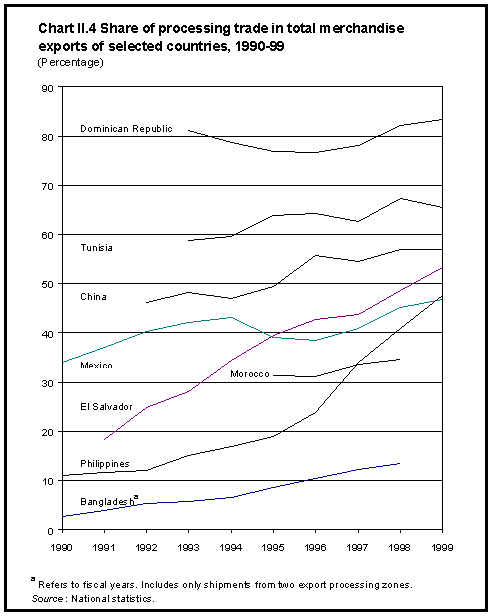
part in these countries' overall trade performance. All the eight
countries presented in Chart II.4 have recorded an expansion of
exports well ahead of the global average in the last decade.
Five of them recorded average annual export growth rates around
15 per cent, which is about three times faster than the global
trade expansion of 5.5 per cent.
|
Preferential tariff treatment to "processing trade"
is not only a feature of trade regimes in the developing countries.
Industrial countries too are often providing duty exemption or
reduction on imported goods if these products have been manufactured
abroad with materials/components from the importing country.
While the value of these imports can be relatively important in
bilateral trade flows, their share in total imports is at present
rather moderate. For the United States and the European Union
the share of imports benefitting from this specific duty exemption
amounted to 8 per cent in the US and to 2 per cent in the EU
(excluding intra-trade) in 1998. In the United States the share
of processing trade in total imports declined markedly as trade
with Mexico and Canada became increasingly tariff free with the
implementation of NAFTA.
| Table II-5 |
| Processing trade and export performance of selected countries, 1990-99 |
| (Billion dollars and percentage) |
| | Total export | Share of | Value of |
| | growth | processing trade | processing exports |
| Country | 1990-1999 | 1998 | 1998 |
| | (percent) | (percent) | (billion $) |
| |
| Dominican Republic a | n.a. | | 82.2 | | 4.1 | |
| Tunisia | 5.9 | | 67.4 | | 4.0 | |
| China | 13.5 | | 56.9 | | 104.6 | |
| El Salvadorb | 16.8 | | 48.6 | | 1.2 | |
| Philippines | 16.5 | | 40.9 | | 12.1 | |
| Mexico | 14.4 | | 45.2 | | 53.1 | |
| Morocco | 6.4 | | 34.7 | | 2.6 | |
| Bangladesh c | 15.2 | | 13.4 | | 0.7 | |
| Memorandum item: | | | | | | |
| World total | 5.4 | | … | | … | |
| |
| a Between 1993 and 1998 exports grew by 9.2% and world exports by 7.7% annually. |
| b Refers to years 1991-1999. |
| c Refers to fiscal years. |
| Source: National Statistics |
6. Outlook
Global economic output is expected to accelerate from 3 per cent
in 1999 to about 3.5 per cent in 2000. The volume of world merchandise
trade growth should reach 6.5 per cent. Higher trade growth is
possible, in particular, if the demand in Western Europe and Japan
pick up more strongly than currently projected.
In 2000, GDP growth of industrial countries could expand by 3
per cent or one half per cent faster than in 1999 as moderately
lower growth in the United States is more than offset by higher
growth in Western Europe and Japan. Latin America and the Middle
East should see a strong pick-up in their GDP growth after experiencing
a stagnation of output in 1999. Higher growth is also projected
for the transition and African economies. GDP growth of the Asian
developing countries is projected to remain unchanged as the impact
of the expansionary fiscal policies and the rebuilding of inventories
will be less important in 2000 than in 1999, but offset by a strengthening
of fixed investment and private consumption.
More robust growth of the world economy in 2000, together with
the carry-over effect due to the trade acceleration in the second
half of 1999 is projected to lead to export volume growth of at
least 6.5 per cent. Most of this higher growth is expected to
come from Western Europe and to a lesser extent from Latin America,
the Middle East and the transition economies. North America and
the developing countries in Asia, which recorded double digit
import growth in 1999, are likely to expand their imports less
rapidly in 2000, and the projected deceleration of North America's
final demand should lead to less dynamic import growth in 2000.
The projections above assume that the oil price will recede from
its US$30 per barrel level in the first quarter back to a range
of US$20 to US$25 and that major financial market turbulence -
in particular a sudden sharp correction of stock markets and the
dollar rate - can be avoided in the remaining months of the year.
A sharp correction of the stock markets, together with a marked
slowing down of United States demand and imports, could alter
the trade forecast significantly. Note, for example, that at
nearly 350 billion dollars, the United States merchandise trade
deficit in 1999 exceeded the total imports of Japan. A disruptive
adjustment of the current external imbalances would imply a major
risk to trade growth in the near future.
| Appendix Table 1 |
| Leading exporters and importers in world merchandise trade, 1999 |
| (Billion dollars and percentage) |
| |
| | Annual | | Annual |
| | percentage | | percentage |
| Exporters | Value | Share | change | | Importers | Value | Share | change |
| | 1998 | 1999 | | 1998 | 1999 |
| |
| United States | 695.0 | 12.4 | -1 | 2 | | United States | 1059.9 | 18.0 | 5 | 12 |
| Germany | 540.5 | 9.6 | 6 | 0 | | Germany | 472.6 | 8.0 | 6 | 0 |
| Japan | 419.4 | 7.5 | -8 | 8 | | United Kingdom | 320.7 | 5.5 | 2 | 2 |
| France | 299.0 | 5.3 | 5 | -2 | | Japan | 310.7 | 5.3 | -17 | 11 |
| United Kingdom | 268.4 | 4.8 | -3 | -2 | | France | 286.1 | 4.9 | 7 | -1 |
| Canada | 238.4 | 4.2 | 0 | 11 | | Canada | 220.2 | 3.7 | 3 | 7 |
| Italy | 230.8 | 4.1 | 1 | -5 | | Italy | 216.0 | 3.7 | 3 | 0 |
| Netherlands | 204.1 | 3.6 | 4 | 2 | | Netherlands | 188.9 | 3.2 | 5 | 1 |
| China | 194.9 | 3.5 | 1 | 6 | | Hong Kong, China | 181.7 | 3.1 | -12 | -3 |
| Belgium-Luxembourg | 184.1 | 3.3 | 6 | 3 | | retained imports a | 29.2 | 0.5 | -30 | -20 |
| | | | | | | Belgium-Luxembourg | 169.4 | 2.9 | 7 | 2 |
| |
| Hong Kong, China | 174.8 | 3.1 | -7 | 0 | | China | 165.7 | 2.8 | -1 | 18 |
| domestic exports | 22.2 | 0.4 | -10 | -10 | | Mexico | 148.2 | 2.5 | 14 | 13 |
| Korea, Rep. of | 144.2 | 2.6 | -3 | 9 | | Spain | 145.0 | 2.5 | 8 | 9 |
| Mexico | 136.7 | 2.4 | 6 | 16 | | Korea, Rep. of | 119.7 | 2.0 | -35 | 28 |
| Taipei, Chinese | 121.6 | 2.2 | -9 | 10 | | Taipei, Chinese | 111.0 | 1.9 | -8 | 6 |
| Singapore | 114.6 | 2.0 | -12 | 4 | | Singapore | 111.0 | 1.9 | -23 | 9 |
| domestic exports | 68.6 | 1.2 | -13 | 8 | | retained imports a | 65.0 | 1.1 | -31 | 18 |
| Spain | 109.4 | 2.0 | 5 | 0 | | Switzerland | 80.1 | 1.4 | 5 | 0 |
| Malaysia | 84.5 | 1.5 | -7 | 15 | | Australia | 69.0 | 1.2 | -2 | 7 |
| Sweden | 84.5 | 1.5 | 2 | 0 | | Sweden | 68.2 | 1.2 | 4 | 0 |
| Switzerland | 80.6 | 1.4 | 4 | 2 | | Austria | 67.8 | 1.2 | 5 | 0 |
| Russian Fed. b | 74.3 | 1.3 | -16 | 0 | | | | | | |
| |
| Ireland | 69.6 | 1.2 | 20 | 8 | | Malaysia | 65.5 | 1.1 | -26 | 12 |
| Austria | 62.0 | 1.1 | 7 | -1 | | Brazil | 51.8 | 0.9 | -7 | -15 |
| Thailand | 58.4 | 1.0 | -5 | 7 | | Thailand | 50.6 | 0.9 | -32 | 18 |
| Australia | 56.1 | 1.0 | -11 | 0 | | Ireland | 45.6 | 0.8 | 14 | 2 |
| Saudi Arabia | 50.5 | 0.9 | -35 | 27 | | Poland | 44.8 | 0.8 | 11 | -5 |
| Indonesia | 48.5 | 0.9 | -9 | -1 | | India | 44.6 | 0.8 | 3 | 4 |
| Brazil | 48.0 | 0.9 | -4 | -6 | | Denmark | 43.3 | 0.7 | 4 | -6 |
| Denmark | 47.8 | 0.9 | -1 | -1 | | Russian Fed. b | 41.1 | 0.7 | -20 | -30 |
| Norway | 44.9 | 0.8 | -18 | 13 | | Turkey | 39.2 | 0.7 | -5 | -15 |
| Finland | 41.5 | 0.7 | 6 | -4 | | Portugal | 37.6 | 0.6 | 5 | 2 |
| |
| Total of above c | 4927.0 | 87.8 | - | - | | Total of above c | 4976.0 | 84.7 | - | - |
| World c | 5610.0 | 100.0 | -2 | 3 | | World c | 5875.0 | 100.0 | -1 | 4 |
| |
| a Retained imports are defined as imports less re-exports. |
| b Includes trade with the Baltic States and the CIS. |
| c Includes significant re-exports or imports for re-export. |
|
| Leading exporters and importers in world merchandise trade (excluding intra-EU trade), 1999
| (Billion dollars and percentage) |
| |
| | Annual | | Annual |
| | percentage | | percentage |
| Exporters | Value | Share | change | | Importers | Value | Share | change |
| | 1998 | 1999 | | 1998 | 1999 |
| |
| European Union(15) | 798.6 | 18.9 | 0 | -1 | | United States | 1059.9 | 23.6 | 5 | 12 |
| United States | 695.0 | 16.4 | -1 | 2 | | European Union (15) | 851.2 | 18.9 | 6 | 3 |
| Japan | 419.4 | 9.9 | -8 | 8 | | Japan | 310.7 | 6.9 | -17 | 11 |
| Canada | 238.4 | 5.6 | 0 | 11 | | Canada | 220.2 | 4.9 | 3 | 7 |
| China | 194.9 | 4.6 | 1 | 6 | | Hong Kong, China | 181.7 | 4.0 | -12 | -3 |
| Hong Kong, China | 174.8 | 4.1 | -7 | 0 | | retained imports a | 29.2 | 0.6 | -30 | -20 |
| domestic exports | 22.2 | 0.5 | -10 | -10 | | China | 165.7 | 3.7 | -1 | 18 |
| Korea, Rep. of | 144.2 | 3.4 | -3 | 9 | | Mexico | 148.2 | 3.3 | 14 | 13 |
| Mexico | 136.7 | 3.2 | 6 | 16 | | Korea, Rep. of | 119.7 | 2.7 | -35 | 28 |
| Taipei, Chinese | 121.6 | 2.9 | -9 | 10 | | Taipei, Chinese | 111.0 | 2.5 | -8 | 6 |
| Singapore | 114.6 | 2.7 | -12 | 4 | | Singapore | 111.0 | 2.5 | -23 | 9 |
| domestic exports | 68.6 | 1.6 | -13 | 8 | | retained imports a | 65.0 | 1.4 | -31 | 18 |
| |
| Malaysia | 84.5 | 2.0 | -7 | 15 | | Switzerland | 80.1 | 1.8 | 5 | 0 |
| Switzerland | 80.6 | 1.9 | 4 | 2 | | Australia | 69.0 | 1.5 | -2 | 7 |
| Russian Fed. b | 74.3 | 1.8 | -16 | 0 | | Malaysia | 65.5 | 1.5 | -35 | 12 |
| Thailand | 58.4 | 1.4 | -5 | 7 | | Brazil | 51.8 | 1.2 | -7 | -15 |
| Australia | 56.1 | 1.3 | -11 | 0 | | Thailand | 50.6 | 1.1 | -32 | 18 |
| Saudi Arabia | 50.5 | 1.2 | -35 | 27 | | Poland | 44.8 | 1.0 | 11 | -5 |
| Indonesia | 48.5 | 1.1 | -9 | -1 | | India | 44.6 | 1.0 | 3 | 4 |
| Brazil | 48.0 | 1.1 | -4 | -6 | | Russian Fed. b | 41.1 | 0.9 | -20 | -30 |
| Norway | 44.9 | 1.1 | -18 | 13 | | Turkey | 39.2 | 0.9 | -5 | -15 |
| India | 36.5 | 0.9 | -4 | 9 | | Norway | 33.8 | 0.8 | 1 | -7 |
| |
| Philippines | 35.0 | 0.8 | 18 | 19 | | Israel | 33.2 | 0.7 | -5 | 13 |
| United Arab Emirates | 29.5 | 0.7 | -13 | 15 | | Philippines | 32.6 | 0.7 | -18 | 4 |
| Czech Rep. | 26.8 | 0.6 | 16 | 2 | | Saudi Arabia | 30.0 | 0.7 | 4 | 0 |
| Poland | 26.8 | 0.6 | 10 | -5 | | United Arab Emirates | 28.9 | 0.6 | -9 | 6 |
| South Africa c | 26.7 | 0.6 | -9 | 1 | | Czech Rep. d | 28.9 | 0.6 | 6 | 0 |
| Turkey | 26.2 | 0.6 | 3 | -3 | | Hungary | 27.7 | 0.6 | 21 | 8 |
| Israel | 25.3 | 0.6 | 2 | 10 | | South Africa c | 26.8 | 0.6 | -9 | -8 |
| Hungary | 24.6 | 0.6 | 20 | 7 | | Argentina | 25.5 | 0.6 | 3 | -19 |
| Argentina | 23.3 | 0.6 | 0 | -12 | | Indonesia | 23.9 | 0.5 | -34 | -13 |
| Venezuela | 18.9 | 0.4 | -21 | 10 | | Egypt | 16.2 | 0.4 | 22 | 0 |
| |
| Total of above e | 3884.0 | 91.8 | - | - | | Total of above e | 4073.0 | 90.7 | - | - |
| World (excl. intra-EU trade) e | 4232.0 | 100.0 | -4 | 4 | | World (excl. intra-EU trade) e | 4494.0 | 100.0 | -3 | 5 |
| |
| a Retained imports are defined as imports less re-exports. |
| b Includes trade with the Baltic States and the CIS. |
| c Beginning 1998, figures refer to South Africa and no longer to the South African Common Customs Area. |
| d Imports are valued f.o.b. |
| e Includes significant re-exports or imports for re-export. |
| Appendix Table 3 |
| Leading exporters and importers in world trade in commercial services, 1999 |
| (Billion dollars and percentage) |
| | | | | | | | | |
| | | | Annual | | | | | Annual |
| | | | percentage | | | | | percentage |
| Exporters | Value | Share | change | | Importers | Value | Share | change |
| | | | 1998 | 1999 | | | | | 1998 | 1999 |
| | | | | | | | | | | |
| United States | 251.7 | 18.8 | 2 | 5 | | United States | 182.3 | 13.7 | 8 | 10 |
| United Kingdom | 101.4 | 7.6 | 7 | 2 | | Germany | 127.2 | 9.5 | 3 | 2 |
| France | 79.3 | 5.9 | 5 | -6 | | Japan | 113.9 | 8.5 | -9 | 3 |
| Germany | 76.8 | 5.7 | 3 | -3 | | United Kingdom | 81.4 | 6.1 | 11 | 4 |
| Italy | 64.5 | 4.8 | 0 | -3 | | Italy | 62.7 | 4.7 | 7 | 0 |
| Japan | 59.8 | 4.5 | -9 | -3 | | France | 59.2 | 4.4 | 5 | -9 |
| Spain | 54.1 | 4.0 | 12 | 11 | | Netherlands | 46.5 | 3.5 | 4 | 0 |
| Netherlands | 53.1 | 4.0 | 3 | 3 | | Canada | 37.1 | 2.8 | -4 | 5 |
| Belgium-Luxembourg | 37.6 | 2.8 | 6 | 4 | | Belgium-Luxembourg | 35.5 | 2.6 | 8 | 4 |
| Hong Kong, China | 35.4 | 2.6 | -10 | 3 | | China | 32.1 | 2.4 | -4 | … |
| | | | | | | | | | | |
| Austria | 32.6 | 2.4 | 9 | 3 | | Spain | 30.9 | 2.3 | 13 | 12 |
| Canada | 32.4 | 2.4 | 2 | 7 | | Austria | 29.5 | 2.2 | 6 | -2 |
| Switzerland | 27.2 | 2.0 | 5 | 5 | | Korea, Rep. of | 26.7 | 2.0 | -19 | 14 |
| China | 26.6 | 2.0 | -2 | … | | Ireland | 23.5 | 1.8 | 32 | 18 |
| Korea, Rep. of | 25.0 | 1.9 | -6 | 5 | | Taipei, Chinese | 23.2 | 1.7 | -4 | 0 |
| Singapore | 22.9 | 1.7 | -40 | 25 | | Sweden | 22.8 | 1.7 | 11 | 5 |
| Sweden | 18.0 | 1.3 | 1 | 2 | | Hong Kong, China | 22.4 | 1.7 | -2 | -2 |
| Australia | 17.2 | 1.3 | -13 | 9 | | Singapore | 19.3 | 1.4 | -7 | 8 |
| Denmark | 16.0 | 1.2 | 6 | 8 | | Australia | 18.0 | 1.3 | -8 | 6 |
| Turkey | 16.0 | 1.2 | 21 | -31 | | India | 17.3 | 1.3 | 16 | 22 |
| | | | | | | | | | | |
| Taipei, Chinese | 14.8 | 1.1 | -2 | -11 | | Denmark | 16.2 | 1.2 | 13 | 5 |
| Thailand | 14.1 | 1.1 | -16 | 8 | | Switzerland | 15.7 | 1.2 | 8 | 3 |
| Norway | 13.7 | 1.0 | -3 | -2 | | Norway | 15.4 | 1.2 | 4 | 2 |
| India | 13.2 | 1.0 | 24 | 19 | | Thailand | 13.9 | 1.0 | -31 | 17 |
| Mexico | 11.6 | 0.9 | 6 | -3 | | Mexico | 13.7 | 1.0 | 7 | 9 |
| Malaysia | 10.8 | 0.8 | -24 | … | | Malaysia | 13.0 | 1.0 | -24 | … |
| Greece | 10.5 | 0.8 | 6 | … | | Indonesia | 12.7 | 0.9 | -28 | 8 |
| Israel | 10.3 | 0.8 | 8 | 14 | | Russian Fed. | 11.7 | 0.9 | -14 | -27 |
| Poland | 9.8 | 0.7 | 21 | -10 | | Brazil | 11.6 | 0.9 | 9 | -26 |
| Russian Fed. | 9.7 | 0.7 | -9 | -25 | | Israel | 10.7 | 0.8 | 5 | 12 |
| | | | | | | | | | | |
| Total of above | 1165.0 | 87.1 | - | - | | Total of above | 1145.0 | 85.9 | - | - |
| World | 1340.0 | 100.0 | 0.0 | 1.5 | | World | 1335.0 | 100.0 | 0.5 | 2.5 |
|





















 - Via Raffaele Paolucci 17r/19r - 16129 Genoa - ITALY


