ESPO
ANNUAL REPORT 2006-2007
2. The container market
2.1 Volumes shipped and world container port throughput
Container shipping has been the fastest growing sector of the maritime industries during the last two decades. As outlined by Drewry Shipping Consultants (2006) a number of fundamental drivers underlie demand growth in container shipping. First of all, organic growth is spurred by increasing economic activity, trade liberalisation, reduced import tariffs, globalisation and outsourcing. This organic growth is compounded by the fact that breakbulk cargo is increasingly being carried in containers (substitution effect), by changes in carriers' scheduling strategies (for example an increased focus on transhipment) and by port development. Finally, "incidental" demand growth can be triggered by regional variations in import and export activity (for example related to exchange rate swings) causing imbalances in directional containerised trade flows.
According to Dynamar (2007) the total number of full containers shipped on worldwide trade routes reached an estimated 110.2 million teu in 2006. This is nearly twice as high as the 60.5 million teu in 2000, corresponding to an average annual growth rate of 10.5%. For 2007 a further double-digit increase to 121.5 million teu is forecasted. Similarly, UNESCAP (2005) forecasts a figure of 177.6 million teu for 2015 (excluding transhipment). More specifically, container volumes shipped on worldwide trade routes are expected to develop as follows (see also Global Insight et al., 2005):
- Volumes on the east-west trades (i.e. Transpacific, Transatlantic and Asia/Europe) are expected to increase from 34 million teu in 2002 to 70 million teu in 2015, representing an average annual growth rate of nearly 6%;
- Volumes on the north-south trades (linking the major production and consumption centres of Asia, North America and Europe with developing countries in the Southern Hemisphere) are expected to show a similar average growth rate, increasing from about 17 million teu in 2002 to about 36 million teu in 2015;
- Intra-regional trades
, however, are expected to show significantly higher growth during the same period. Mainly as a result of booming intra-Asian trades, they are expected to surge from 28 million teu in 2002 to no less than 72 million teu in 2015, corresponding to an average annual growth rate of 7.5%.
Table 6 gives an overview of the estimated 2006 and forecast 2007-2008 full container trade on the three arterial East-West trades. As this table indicates, both the Far East-Europe and Transpacific trade have enjoyed healthy 8-9% growth in 2006, and this is expected to continue throughout 2007-2008 as well. Compared to these two trade routes, the Transatlantic market is significantly smaller (albeit still very important) and also has much lower annual growth rates.
|
2 |
A large part of the Europe-Latin America trade involves trade with Brazil. As an example, the North Europe-Brazil trade is estimated at 712,000 full teu in 2006 (some 17% higher than in 2004), of which 447,000 teu northbound and 265,000 teu southbound. |
|
|
Apart from the arterial East-West trades, the container trade between Europe and Latin America (including Central America, the Caribbean and South America) also involves significant volumes. According to Global Insight, volumes on this trade route increased from about 2.85 million teu in 2004 to 3.30 million teu in 2006, representing an increase of nearly 16% in two years time. Just like the Far East-Europe and Transpacific trade, the trade between Europe and Latin America is characterized by a major imbalance: the northbound volumes (2.32 million teu) were more than double the southbound volumes (0.98 million teu) in 20062. In addition, the Europe-Africa trade is estimated at 2.98 million teu in 2006 (some 17% higher than in 2004), of which 1.71 million teu southbound and 1.27 million teu northbound. Similarly, trade between Europe and the Middle East increased from 2.30 million teu in 2004 to 2.65 million teu in 2006 (+15%), of which 1.83 million teu eastbound and 0.82 million teu westbound. Hence, contrary to the Far East-Europe trade, the eastbound leg is the dominant leg on the trade between Europe and the Middle East.
Finally, the intra-European containerized trade (including shortsea and feedering) is estimated at some 7.72 million teu in 2006, some 19% higher than in 2004. Volumes between North Europe and the Mediterranean reached 2.44 million teu in 2006, of which 1.33 million teu southbound and 1.12 million teu northbound (Dynamar, 2007).
Table 6: Overview of main East-West container trades (full teu)
| |
2006 |
2007 |
2008 |
|
Far East/Europe |
|
|
|
|
westbound |
12,240,000 |
3,916,000 |
5,347,000 |
|
eastbound |
5,747,000 |
5,995,000 |
6,235,000 |
|
total |
17,987,000 |
19,911,000 |
21,582,000 |
|
growth |
9% |
11% |
8% |
|
Transatlantic |
|
|
|
|
westbound |
4,250,000 |
4,240,000 |
4,260,000 |
|
eastbound |
2,670,000 |
2,870,000 |
3,030,000 |
|
total |
6,920,000 |
7,110,000 |
7,290,000 |
|
growth |
5% |
3% |
3% |
|
Transpacific |
|
|
|
|
westbound |
4,720,000 |
5,040,000 |
5,330,000 |
|
eastbound |
15,340,000 |
16,900,000 |
18,510,000 |
|
total |
20,060,000 |
21,940,000 |
23,840,000 |
|
growth |
8% |
9% |
9% |
Source: Global Insight
In view of the above, it is hardly surprising that container traffic has been the driving force behind the growth in cargo handling in many seaports around the world. Drewry Shipping Consultants (2006) estimates that the total throughput handled by the world's container ports (not to be confounded with the trade route volumes mentioned above) increased from about 236 million teu in 2000 to an estimated 399 million teu in 2005 (including empties and transhipment), representing an average annual growth rate of 11%. As Table 7 indicates, transhipment traffic has clearly been the driving force behind growth in container handling in the last decade. As far as the near future is concerned, worldwide container handling is expected to increase further to 627.7 million teu in 2010 (nearly 60% above the 2005 level), of which 356.7 million teu port-to-port full containers, 91.2 million teu port-to-port empty containers and 179.8 million teu transhipment.
Table 7: World container port traffic and its components for selected years (teu)
| |
Total Port
Handling |
Port-to-port
Full |
Port-to-port
Empty |
Trans-
shipment |
|
1990 |
87.9 |
57.4 |
14.6 |
16.0 |
|
1995 |
145.1 |
92.1 |
20.8 |
32.3 |
|
2000 |
235.6 |
136.7 |
36.8 |
62.1 |
|
2005 (e)* |
399.2 |
231.3 |
59.7 |
108.2 |
|
2010 (f)* |
627.7 |
356.7 |
91.2 |
179.8 |
|
2005 vs 1995 |
+175% |
+151% |
+187% |
+235% |
|
2010 vs 2005 |
+57% |
+54% |
+53% |
+66% |
Source: Drewry Shipping Consultants (2006)
* (e) estimated (f) forecasted
2.2 Container traffic handled in European seaports
|
3 |
Table 8 only includes ports with an annual throughput of at least 3000 teu, but does not take into account ports along inland waterways. Some of these latter ports, however, handled substantial volumes of container traffic in 2005. The inland port of Duisburg (Germany) is a prime example of this. With a throughput of 712,000 teu it outperformed most seaports listed in Table 8. In addition, the inland ports of Vienna, Germersheim, Mannheim and Dortmund each handled (well) in excess of 100,000 teu in 2005. |
|
|
Table 8 provides an overview of container traffic handled in selected geographical areas in Europe. The total sample consists of 132 individual seaports3 which together handled 73.73 million teu in 2005 (transhipment included). At an estimated average weight of 11 tons per teu, this boils down to some 800 million tons. The figure of 73.73 million teu represents about 18% of the estimated world container port traffic of 399.2 million teu for 2005, as mentioned above. Table 8 is divided into two parts. The first part covers Northern Range ports (including Northern Europe and Scandinavia/Baltic) while the second part focuses on Southern Range ports (covering the Western Mediterranean, Iberian Peninsular and Eastern Mediterranean/Black Sea).
2.2.1 Northern Range ports
About 56% of the total European container traffic was handled by ports in Northern Europe (37 ports in total), registering a combined throughput of 41.70 million teu in 2005. Rotterdam, Hamburg and Antwerp handled a staggering 23.86 million teu in 2005 or 32% of the European total and nearly 60% of the Northern European container throughput. In 2006 their combined throughput increased further to 25.57 million teu (+7.2%). The main volume drivers were intra-European flows and Chinese traffic, mainly in Rotterdam and Hamburg. Chinese cargo (including Hong Kong) in Hamburg far exceeded 2 million TEU in 2005 with Rotterdam also approaching the 2 million TEU mark. Hamburg continues to develop its hub role for the Baltic and Central and Eastern Europe, while Rotterdam and Antwerp strongly capitalize on strong cargo generating centres in the extending 'blue banana' of Western Europe combined with a high density of European distribution centres in the Benelux, Northern France and parts of Germany.
Besides these three mainports, Northern Europe also counted five other "teu millionaires" (of which two in the UK). The 29 remaining (small and mid-sized) ports handled a combined throughput of 6.3 million teu in 2005. Most of them handled less than half a million teu.
Although the Scandinavia/Baltic region includes no less than 45 container ports, volumes handled are far less than in Northern Europe. The total throughput in 2005 reached 6.44 million teu, more than half of which was handled by the top-5 ports St-Petersburg, Aarhus, Gothenburg, Helsinki and Gdynia. However, expressed in percentage terms, many ports in the Scandinavia/Baltic region have grown considerably faster than their big counterparts in Northern Europe in recent years. A prime example is St-Petersburg, which handled only 0.58 million teu in 2002 (i.e. about half its throughput of 2005). A similar picture applies to Aarhus (0.40 million teu in 2002), Gdynia (0.25 million teu) and Klaipeda (0.07 million teu).
Hence, the total Northern Range (82 ports) accounted for 48.14 million teu in 2005, i.e. about 65% of the total port sample included in Table 8.
2.2.2 Southern Range ports
The second biggest container port region in Europe is the West-Mediterranean (27 ports) which, consisting predominantly of Spanish and Italian ports, accounted for 19.32 million teu in 2005. Three Spanish, three Italian and one Maltese port handled in excess of 1 million teu, with Marseilles (Southern France) following closely behind. The 19 remaining (small and mid-sized) ports together handled about 3.6 million teu. Most of them handled less than half a million teu.
Next, the 15 ports in the East-Mediterranean/Black Sea region (excluding ports in Egypt, Israel, Turkey or Lebanon) handled a combined throughput of 4.62 million teu in 2005. Only Piraeus handled in excess of 1 million teu. Finally, the 8 ports on the Atlantic Coast of the Iberian Peninsular accounted for only 1.66 million teu in 2005. The biggest of them (Lisbon and Bilbao) handled about half a million teu each.
Hence, the total Southern Range (50 ports) accounted for 25.59 million teu in 2005, i.e. about 35% of the total port sample included in Table 8.
The West-Mediterranean has witnessed a remarkable development since the mid 1990s. From that moment on, transhipment hubs emerged in the region (e.g. Algeciras, Gioia Tauro, Marsaxlokk, Taranto, Cagliari) which gave impetus to shipping lines to reconfigure their service networks and to have more services calling in Mediterranean ports. Although most transhipment hubs still record healthy growth, growing Mediterranean volumes have generated a mounting interest of shipping lines to have direct calls in mainland Med ports, supported by dedicated Asia/China-Med liner services. An example is the successful development of the Spanish ports of Valencia and Barcelona. This development has made some transhipment hubs to reorient their focus towards feeder flows to the East Mediterranean.
Table 8: Container port throughput for Northern Range ports (2005)
|
Region |
Port |
Total TEU |
Region |
Port |
Total TEU |
|
Northern Europe |
Rotterdam |
9,288,349 |
Scandinavian/Baltic
(continued) |
Kotka |
366,667 |
|
Hamburg |
8,087,545 |
Esbjerg* |
295,000 |
|
Antwerp |
6,482,029 |
Klaipeda |
214,307 |
|
Bremen/Bremerhaven |
3,735,574 |
Oslo |
170,506 |
|
Felixstowe* |
2,730,000 |
Riga |
168,978 |
|
Le Havre |
2,118,509 |
Helsingborg |
162,000 |
|
Zeebrugge |
1,407,933 |
Hamina |
159,783 |
|
Southampton |
1,375,000 |
Copenhagen Malmo |
155,000 |
|
Tilbury |
677,902 |
Tallinn |
127,585 |
|
Thamesport* |
650,000 |
Rauma |
118,776 |
|
Liverpool |
626,000 |
Kaliningrad |
112,528 |
|
Dublin |
590,250 |
Gavle |
84,555 |
|
Dartford* |
495,000 |
Bergen |
72,489 |
|
Immingham |
433,547 |
Gdansk |
70,014 |
|
Hull |
361,240 |
Pori |
61,048 |
|
Teesport |
318,077 |
Aalborg |
55,960 |
|
Belfast |
270,000 |
Hanko |
52,351 |
|
Reykjavik |
269,359 |
Norrkoping |
43,349 |
|
Grangemouth |
224,000 |
Fredrikstad |
41,944 |
|
Dunkirk |
204,563 |
Kristiansand |
38,942 |
|
Rouen |
202,429 |
Stockholm |
38,122 |
|
Waterford |
181,419 |
Szczecin-Swinoujscie |
36,453 |
|
Cork |
164,336 |
Kemi |
29,127 |
|
Nantes St-Nazaire* |
125,000 |
Halmstad |
21,864 |
|
Goole |
116,000 |
Oulu |
19,744 |
|
Bristol |
114,390 |
Kiel |
19,029 |
|
Ipswich |
74,670 |
Ahus |
18,715 |
|
Amsterdam |
65,844 |
Wallhamn |
18,449 |
|
Harwich* |
61,500 |
Sodertalje |
18,261 |
|
Cardiff |
54,663 |
Turku |
16,717 |
|
Bordeaux* |
49,500 |
Varberg |
14,051 |
|
Drogheda |
48,490 |
Fredericia |
12,000 |
|
Warrenpoint |
40,510 |
Umea |
11,213 |
|
Ghent |
30,529 |
Tornio |
10,151 |
|
Limerick |
9,288 |
Raahe |
7,640 |
|
Ostend |
8,890 |
Lysekil |
7,221 |
|
Dover* |
6,000 |
Lappeenranta |
5,708 |
|
Total Northern Europe (37) |
41,698,335 |
Skelleftea |
4,949 |
|
Scandinavian/Baltic |
St Petersburg |
1,119,346 |
Kokkola |
3,698 |
|
Aarhus |
803,000 |
Liepaja |
3,144 |
|
Gothenburg |
771,679 |
Total Scandinavia/Baltic (45) |
6,441,972 |
|
Helsinki |
459,744 |
|
|
|
|
Gdynia |
400,165 |
NORTHERN RANGE PORTS (82) |
48,140,307 |
Source: Containerisation International and respective port authorities
* Estimate
Container port throughput for Southern Range ports (2005)
|
Region |
Port |
Total TEU |
Region |
Port |
Total TEU |
|
West-Mediterranean |
Algeciras |
3,179,614 |
East-Mediterranean/
Black Sea |
Piraeus |
1,394,512 |
|
Gioia Tauro |
3,160,981 |
Constantza |
771,126 |
|
Valencia |
2,409,821 |
Taranto |
716,856 |
|
Barcelona |
2,071,481 |
Thessaloniki |
365,925 |
|
Genoa |
1,624,964 |
Limassol |
320,130 |
|
Marsaxlokk |
1,321,000 |
Venice |
289,860 |
|
La Spezia |
1,024,455 |
Trieste |
198,319 |
|
Marseilles |
908,000 |
Koper |
179,745 |
|
Leghorn |
658,506 |
Ravenna |
168,588 |
|
Cagliari |
631,435 |
Varna |
84,400 |
|
Salerno |
418,205 |
Rijeka |
76,258 |
|
Naples |
373,706 |
Bourgas |
25,685 |
|
Malaga |
247,451 |
Heraklion |
18,593 |
|
Vado Ligure* |
223,000 |
Bari |
10,008 |
|
Savona |
219,876 |
Larnaca |
4,732 |
|
Alicante |
159,501 |
Total East-Med/Black Sea (15) |
4,624,737 |
|
Palma de Mallorca |
155,582 |
Iberian Peninsular
(Atlantic Coast) |
Lisbon |
513,061 |
|
Cadiz |
138,441 |
Bilbao |
503,804 |
|
Seville |
115,669 |
Leixoes |
340,641 |
|
Valletta |
61,410 |
Vigo |
205,057 |
|
Civitavecchia |
44,615 |
Sines |
50,994 |
|
Castellon de la Plana |
43,773 |
Marin |
32,128 |
|
Cartagena |
37,406 |
Aviles |
10,851 |
|
Palermo |
27,984 |
Gijon |
5,048 |
|
Mahon |
22,725 |
Total Iberian Peninsular (Atl.) (8) |
1,661,584 |
|
Ibiza |
13,025 |
|
|
|
|
Tarragona |
9,857 |
|
|
|
|
Total West Mediterranean (27) |
19,302,483 |
SOUTHERN RANGE PORTS (50) |
25,588,804 |
| |
|
|
|
|
|
|
TOTAL EUROPEAN PORTS (132) |
73,729,111 |
Source: Containerisation International and respective port authorities
* Estimate
At the time of writing (March 2007), final traffic figures for 2006 were not yet available for all seaports listed in Table 8. Those seaports for which this was the case are included in Table 9. This table again includes only those seaports handling more than 3000 teu on an annual basis. This resulted in a (provisional) sample of 56 different ports, handling a combined throughput of 66.12 million teu. This represents an increase of 8.6% compared to the year before. However, as Table 9 indicates, growth rates varied considerably between ports and geographical regions.
Table 9: Comparison of 2006 and 2005 container traffic for selected ports (teu)
|
Port |
2006 |
2005 |
Growth |
Port |
2006 |
2005 |
Growth |
|
Rotterdam |
9,690,052 |
9,288,349 |
4.3% |
Klaipeda |
231,548 |
214,307 |
8.0% |
|
Hamburg |
8,861,545 |
8,087,545 |
9.6% |
Trieste |
220,661 |
198,319 |
11.3% |
|
Antwerp |
7,018,799 |
6,482,029 |
8.3% |
Dunkirk |
204,853 |
204,563 |
0.1% |
|
Bremen/Bremerhaven |
4,449,624 |
3,735,574 |
19.1% |
Helsingborg |
200,000 |
162,000 |
23.5% |
|
Algeciras |
3,244,640 |
3,179,6 |
412.0% |
Rauma |
168,952 |
120,234 |
40.5% |
|
Felixstowe |
3,000,000 |
2,730,000 |
9.9% |
Hamina |
168,192 |
159,783 |
5.3% |
|
Gioia Tauro |
2,938,176 |
3,160,981 |
-7.0% |
Copenhagen Malmo |
164,300 |
155,000 |
6.0% |
|
Valencia |
2,612,139 |
2,409,821 |
8.4% |
Palma de Mallorca |
156,000 |
155,582 |
0.3% |
|
Barcelona |
2,317,368 |
2,071,48 |
11.9% |
Tallinn |
152,399 |
127,585 |
19.4% |
|
Le Havre |
2,130,000 |
2,118,509 |
0.5% |
Sines |
121,956 |
50,994 |
39.2% |
|
Genoa |
1,657,000 |
1,624,964 |
2.0% |
Bristol |
115,000 |
114,390 |
0.5% |
|
Zeebrugge |
1,653,493 |
1,407,933 |
17.4% |
Rijeka |
96,000 |
76,258 |
25.9% |
|
Marsaxlokk |
1,450,000 |
1,309,000 |
10.8% |
Ipswich |
75,000 |
74,670 |
0.4% |
|
Southampton |
1,516,000 |
1,375,000 |
10.3% |
Aalborg |
59,000 |
55,960 |
5.4% |
|
St-Petersburg |
1,449,958 |
1,119,346 |
29.5% |
Hanko |
54,256 |
52,351 |
3.6% |
|
Piraeus |
1,400,000 |
1,394,512 |
0.4% |
Valletta |
47,920 |
61,410 |
-22.0% |
|
La Spezia |
1,137,000 |
1,024,455 |
11.0% |
Pori |
42,137 |
61,048 |
-31.0% |
|
Constantza |
1,075,000 |
768,099 |
40.0% |
Oulu |
30,338 |
19,744 |
53.7% |
|
Marseilles |
941,400 |
908,000 |
3.7% |
Kemi |
23,645 |
29,127 |
-18.8% |
|
Gothenburg |
820,000 |
771,679 |
6.3% |
Heraklion |
21,963 |
18,593 |
18.1% |
|
Cagliari |
690,392 |
631,435 |
9.3% |
Turku |
20,257 |
16,717 |
21.2% |
|
Kotka |
461,876 |
366,667 |
26.0% |
Ventspils |
16,077 |
900 |
1686.3% |
|
Gdynia |
461,170 |
400,165 |
15.2% |
Tornio |
11,976 |
10,151 |
18.0% |
|
Helsinki |
416,667 |
459,744 |
-9.4% |
Raahe |
6,975 |
7,640 |
-8.7% |
|
Thessaloniki |
376,940 |
365,925 |
3.0% |
Liepaja |
6,054 |
3,144 |
92.6% |
|
Leixoes |
372,611 |
340,641 |
9.4% |
''''''''''''''''''''''''''''''''''''''''''''''''' |
|
Hull |
360,000 |
361,240 |
-0.3% |
Northern Europe |
39,374,366 |
36,045,646 |
9.3% |
|
Limassol |
356,723 |
320,130 |
.4% |
West Mediterranean |
17,742,035 |
17,007,194 |
4.3% |
|
Amsterdam |
305,722 |
65,844 |
355.6% |
East Med/Black Sea |
3,547,287 |
3,141,836 |
12.9% |
|
Malaga |
300,000 |
247,451 |
21.2% |
Scandinavia/Baltic |
4,965,777 |
4,313,292 |
15.1% |
|
Vado Ligure |
250,000 |
223,000 |
12.1% |
Iberian Peninsular |
494,567 |
391,635 |
26.3% |
| |
|
|
|
Total port sample |
66,129,754 |
60,899,603 |
8.6% |
Source: Containerisation International and respective port authorities
The Northern European seaports included in Table 9 handled a combined throughput of 39.38 million teu in 2006. Compared to the 36.05 million teu of the year before, this represents a healthy 9.3% increase. The biggest percentage increases were registered by Amsterdam, Bremen/Bremerhaven and Zeebrugge. The ports of Felixstowe, Hamburg, Southampton and Antwerp also performed well, while Rotterdam scored below average. Finally, volumes at Le Havre, Dunkirk, Bristol, Ipswich and Hull were quasi-stagnant.
Secondly, the Western Mediterranean seaports included in Table 9 saw their combined traffic increase by a mere 4.3% to 17.74 million teu in 2006. Star performers with double-digit increases in traffic levels included Malaga, Vado Ligure, Barcelona and La Spezia. The ports of Marsaxlokk, Cagliari and to a lesser extent Marseilles, Genoa and Algeciras also performed well, while Gioia Tauro and Valetta saw a significant drop in volumes. Traffic at Palma de Mallorca remained quasi-stagnant.
Thirdly, ports in the Eastern Mediterranean/Black Sea region handled a combined throughput of 3.55 million teu. This is a healthy 12.9% increase compared to the year before. Constantza enjoyed a whopping 40% increase and breached the 1 million teu barrier. Rijeka and Heraklion also registered double digit growth of 25.9% and 18.1%, respectively. Trieste and Limassol each notched a nice 11% increase in volumes, while traffic at Thessaloniki increased by a mere 3% and volumes Piraeus remained quasi-stagnant.
Finally, the Scandinavian/Baltic seaports included in Table 9 notched a nice 15.1% increase to 4.97 million teu in 2006. This nice result is largely due to St-Petersburg's 30% increase to nearly 1.5 million teu. The port of Ventspils registered a massive 1686% increase, albeit from a very low cargo base in 2005. Liepaja, Oulu, Rauma, Helsingborg, Kotka and Turku each witnessed a growth rate of (well-)above 20%. Most other Scandinavian/Baltic ports also performed well, with the exception of Helsinki, Pori, Kemi and Raahe which each saw a (significant) drop in volumes.
An overview of the Top-15 European container ports for selected years is given in Table 10. As this table indicates, Rotterdam, Hamburg and Antwerp have assumed the top-3 positions in Europe since 995, while Felixstowe dropped from fourth position in 2000 to sixth position in 2006. Expressed in percentage terms, by far the biggest growth between 1995 and 2006 was enjoyed by the port of Gioia Tauro. In 1995 this port handled a mere 16,000 teu as port operations just started up. Other ports with substantial increases in volumes include the Spanish ports of Valencia, Algeciras and Barcelona as well as Zeebrugge, Hamburg, Antwerp and Bremerhaven. On the other hand, ports with belowaverage growth over the period considered include Rotterdam, Felixstowe, Le Havre and La Spezia.
Table 10: Top- 5 European container ports for selected years (teu)
| |
1995 |
|
2000 |
|
2005 |
|
2006 |
2006
vs
1995 |
|
Rotterdam |
4,786,577 |
Rotterdam |
6,280,000 |
Rotterdam |
9,288,349 |
Rotterdam |
9,690,052 |
+102% |
|
Hamburg |
2,890,181 |
Hamburg |
4,248,247 |
Hamburg |
8,087,545 |
Hamburg |
8,861,545 |
+207% |
|
Antwerp |
2,329,135 |
Antwerp |
4,082,334 |
Antwerp |
6,482,061 |
Antwerp |
7,018,799 |
+201% |
|
Felixstowe |
1,898,201 |
Felixstowe |
2,853,074 |
Bremerhaven |
3,735,574 |
Bremerhaven |
4,449,624 |
+192% |
|
Bremerhaven |
1,526,421 |
Bremerhaven |
2,712,420 |
Algeciras |
3,179,614 |
Algeciras |
3,244,640 |
+234% |
|
Le Havre |
1,154,714 |
Gioia Tauro |
2,652,701 |
Gioia Tauro |
3,160,981 |
Felixstowe* |
3,000,000 |
+58% |
|
Algeciras |
970,426 |
Algeciras |
2,009,122 |
Felixstowe* |
2,730,000 |
Gioia Tauro |
2,938,176 |
+18461% |
|
La Spezia |
965,483 |
Genoa |
1,500,632 |
Valencia |
2,409,821 |
Valencia |
2,612,139 |
+284% |
|
Barcelona |
703,807 |
Le Havre |
1,464,901 |
Le Havre |
2,118,509 |
Barcelona |
2,317,368 |
+229% |
|
Leghorn |
689,324 |
Barcelona |
1,387,570 |
Barcelona |
2,071,481 |
Le Havre* |
2,130,000 |
+84% |
|
Valencia |
681,080 |
Valencia |
1,308,010 |
Genoa |
1,624,964 |
Genoa |
1,657,000 |
+169% |
|
Tilbury |
67 ,827 |
Piraeus |
1,161,099 |
Zeebrugge |
1,407,933 |
Zeebrugge |
1,653,493 |
+213% |
|
Genoa |
6 5,242 |
Southampton |
1,060,708 |
Piraeus |
1,394,512 |
Marsaxlokk* |
1,450,000 |
+182% |
|
Southampton |
600,137 |
Marsaxlokk |
1,033,052 |
Southampton |
1,375,000 |
Southampton |
1,516,000 |
+153% |
|
Zeebrugge |
528,478 |
Zeebrugge |
965,345 |
Marsaxlokk |
1,309,000 |
Piraeus* |
1,400,000 |
+45% |
| |
|
|
|
|
|
|
|
|
|
Top-3 |
10,005,893 |
Top-3 |
14,610,581 |
Top-3 |
23,857,955 |
Top-3 |
25,570,396 |
+156% |
|
Top-10 |
17,914,269 |
Top-10 |
29,191,001 |
Top-10 |
43,263,935 |
Top-10 |
46,262,343 |
+158% |
|
Top-15 |
21,011,033 |
Top-15 |
34,719,215 |
Top-15 |
50,375,344 |
Top-15 |
53,938,836 |
+157% |
Source: ITMMA based on figures CI Online and respective port authorities
* Estimate
|
Table 11 lists some of the strongest growers in Europe in 2006, both in percentage terms and absolute volume terms. In relative terms, Amsterdam was the star performer with a nearly five-fold increase in 2006. The Dutch port started to see the full impact of the Grand Alliance loops calling at the Ceres Paragon Terminal (owned by NYK). Similarly, the PSA-operated container terminal in the port of Sines (Portugal), which opened in May 2004, got a significant traffic boost through MSC. Constanza is rapidly becoming a major gateway to Eastern Europe and Black Sea states, while volumes in Gdynia and Tallinn are also witnessing high growth rates. The Finnish ports of Kotka and Rauma saw a sharp increase in 2006, but total container throughput in the Finnish ports saw a more moderate increase of 7.7%, mainly due to a 9.4% traffic decline in Helsinki (figures Finnish Ports Association). In Northern Europe, Zeebrugge witnessed healthy growth, although the new APM Terminals facility (opened in the Summer of 2006) will only have its full effect on traffic volumes in 2007. Finally, Bremerhaven marked one of the highest growth rates both in teu and percentage terms, mainly as a result of Maersk Line shifting cargo to Bremerhaven and increased traffic from MSC. In absolute volume terms, the ports of Hamburg and Bremerhaven added a remarkable 1.5 million teu in 2006, significantly more than the combined 930,000 teu throughput increase of their large Benelux competitors.
Table 11: European container ports characterized by strong growth in 2006
| |
2005 |
2006 |
TEU
growth |
%
growth |
|
Amsterdam |
65,844 |
305,722 |
239,878 |
364.3% |
|
Sines |
50,994 |
121,956 |
70,962 |
139.2% |
|
Rauma |
120,234 |
168,952 |
48,718 |
40.5% |
|
Constanza |
768,099 |
1,075,000 |
306,901 |
40.0% |
|
Kotka |
366,667 |
461,876 |
95,209 |
26.0% |
|
Tallinn |
127,585 |
152,399 |
24,814 |
19.4% |
|
Bremerhaven |
3,735,574 |
4,449,624 |
714,050 |
19.1% |
|
Zeebrugge |
1,407,933 |
1,653,493 |
245,560 |
17.4% |
|
Gdynia |
400,165 |
461,170 |
61,005 |
15.2% |
| |
|
|
|
|
| |
2005 |
2006 |
TEU
growth |
%
growth |
|
Hamburg |
8,087,545 |
8,861,804 |
774,259 |
9.6% |
|
Bremerhaven |
3,735,574 |
4,449,624 |
714,050 |
19.1% |
|
Antwerp |
6,482,029 |
7,018,799 |
530,770 |
8.2% |
|
Rotterdam |
9,288,349 |
9,690,052 |
403,295 |
4.3% |
|
Constanza |
768,099 |
,075,000 |
306,90 |
40.0% |
|
Felixstowe (*) |
2,730,000 |
3,000,000 |
270,000 |
9.9% |
|
Barcelona |
2,071,481 |
2,317,368 |
245,887 |
11.9% |
|
Zeebrugge |
1,407,933 |
1,653,493 |
245,560 |
17.4% |
|
Amsterdam |
65,844 |
305,722 |
239,878 |
364.3% |
|
Valencia |
2,409,821 |
2,612,139 |
202,318 |
8.4% |
|
Marsaxlokk (*) |
1,309,000 |
1,450,000 |
142,000 |
10.8% |
|
Southampton |
1,375,000 |
1,526,000 |
142,000 |
10.3% |
(*) estimate for 2006
Source: ITMMA based on figures of the respective port authorities
Northern ports, in particular Hamburg, are benefiting the most from the last round of EU enlargement, whereas new development opportunities are arising for secondary port systems in the Baltic Sea and the Black Sea. An increasing number of ports gain direct hinterland access to the 'blue banana' area. On the one hand, this development has broadened container port competition and altered spatial hierarchy, in the sense that the load centres in the Hamburg-Le Havre range are increasingly facing competition from container ports in other European port ranges (Baltic and Med), primarily for serving hinterland regions in the periphery of the core of the EU. On the other hand, the rise of economic centres in Eastern and Central Europe creates opportunities for the Hamburg-Le Havre range to develop shortsea shipping services and water- and land-based hub-feeder networks to these areas.
Finally, as far as the hinterland traffic of containers is concerned, road transport is still by far the dominant transport mode in most of Europe's seaports. In this respect, Table 12 provides an overview of the modal split for a selection of 10 large seaports in Northern Europe. In all ports except for Amsterdam, Dunkirk and Bremerhaven road transport has a market share of at least 50% (and even 80% in the large UK ports). Rail transport has a (very) important market share in Bremerhaven, Dunkirk, Zeebrugge, Hamburg and Felixstowe, while barge transport enjoys a strong position in Rotterdam, Antwerp and Amsterdam (although the latter port has a much smaller cargo base than its three Benelux counterparts).
Table 12: Modal split for container transport in selected Northern European ports
| |
Road |
Rail |
Barge |
|
Rotterdam |
51% |
13% |
36% |
|
Hamburg |
70% |
29% |
1% |
|
Antwerp |
59% |
8% |
33% |
|
Bremerhaven |
15% |
70% |
15% |
|
Felixstowe |
79% |
21% |
0% |
|
Le Havre |
86% |
8% |
6% |
|
Zeebrugge |
62% |
36% |
2% |
|
Thamesport |
83% |
17% |
0% |
|
Dunkirk |
33% |
55% |
12% |
|
Amsterdam |
44% |
12% |
44% |
Source: Dynamar (2007)
While most ports have achieved a considerable modal shift in hinterland container transport, rail and inland navigation still have not reached their maximum potential. Modal shift policies are implemented throughout Europe and these policies are starting to pay off on some multimodal inland corridors. Antwerp and Rotterdam have always had a strong position in container transport by barge in Europe. In the last ten years, their barge volumes have seen strong growth by the development of numerous inland terminals in the Benelux and Northern France, sustained growth in the Rhine basin and massive container exchanges between the two mainports. However, container transport by barge is also becoming more important in other navigation areas (e.g. Seine axis, Elbe, Rhône) and this has led to significant growth in barge transport in ports such as Hamburg, Le Havre and Marseilles.
Container transport by rail has seen a spectacular development in German ports (in particular Hamburg), while other both small and large ports are implementing strategies (backed up by infrastructure and rail liberalisation) to significantly increase the market share of rail in the modal split in the medium term. The organizational focus on rail implied the spatial development of extensive hinterland corridors, at first instance with a North-South orientation, but the last ten years also with a West-East orientation.
Hinterland connections of smaller seaports and new load centres in a start-up phase remain rather precarious. Smaller ports and new terminals often find themselves confronted with a vicious circle in the organization of hinterland transportation. The small-scale container volumes do not allow to install frequent block and shuttle trains to the more distant hinterlands. Because of the inability to serve a substantial hinterland, the major shipping lines do not include these ports in their liner services.
2.3 Consolidation in the container industry
In many respects, the period 2005-2006 has been truly eventful for the container industry. Above all, it will undoubtedly be remembered as the era of major consolidation. Indeed, substantial take-over activity took place both on the shipping lines' side (where mergers have created a handful of gigantic companies controlling several hundred ships, and where a handful of European shortsea operators turned out to be in a very acquisitive mood) as on the side of the container terminal operators. This is illustrated with some key facts and figures in the sections below.
2.3.1 Shipping lines
As far as the shipping lines are concerned, AP Moller-Maersk started the wave of consolidation with a successful 2.3 billion euro takeover bid for P&O Nedlloyd in August 2005, adding nearly half a million teu slots to its fleet. A couple of months later, TUI AG (Hapag-Lloyd's parent company) responded with a USD 2.1 billion purchase of CP Ships, while French line CMA CGM acquired the shipping interests of compatriot industrial group Bolloré (including Delmas, OTAL, Setramar and Sudcargos) for a reported USD 600 million. Finally, Hamburg-Süd took full control of Ybarra y Compania Sudamericana S.A. of Barcelona in early 2006, by acquiring the 50% stake previously held by CMA CGM. This was followed by an announcement in March 2006 that Hamburg-Süd had reached agreement with Fesco Ocean Management Limited (FOML), a subsidiary of the Far Eastern Shipping Company (FESCO), to acquire the assets of FOML and its affiliates that relate to FOML's cross trades between Australia/New Zealand and Asia as well as North America. The deal was finalized in early July 2006. These two acquisitions follow the 15 or so takeovers by Hamburg-Süd during 1990-2005.
|
4 |
Fluctuations in market shares between 2005 and 2006 are obviously not only related to take-overs, but also reflect endogenous fleet growth through the addition of new vessels in the course of 2005. |
|
|
As Table 13 indicates, the acquisition of P&O Nedlloyd enabled Maersk to substantially increase its market share (based on the number of teu slots deployed) from about 12.4% at the beginning of 2005 to more than 18% at the beginning of 2006. Its cellular fleet capacity of nearly 1.7 million teu was more than double the fleet size of runner-up MSC and more than three times the fleet size of CMA CGM. Between them, these three carriers controlled about 20% of the cellular ships in service and more than 30% of the cellular teu-capacity at the beginning of 2006. Similarly, the take-over of CP Ships more than doubled the size of the Hapag-Lloyd cellular fleet and catapulted the German shipping line from 17th to 5 th position in the global league table. Finally, given the relatively small size of the Delmas/OTAL cellular fleet at the time of the acquisition by CMA CGM, the impact on the latter's market share was rather limited4.
Table 13 also shows that during 2006 and the first couple of months of 2007 the cellular fleet of Maersk Line has grown considerably slower than that of its nearest rivals. Between January 2006 and mid-March 2007 Maersk Line added less than 100,000 teu slots to its cellular fleet, representing an increase of just 5.6%. This is significantly less than the fleet increases of MSC (+297,000 teu or +37.8%) and CMA CGM (+238.000 teu or +46.9%). In fact, with the exception of Hanjin/Senator (+4.9%), APL (+3.5%), Wan Hai Lines (+1.8%) and RCL (-4.4%), Maersk Line witnessed the lowest percentage increase of the entire top-25 during the period considered. As a result, its market share decreased to 16.4% in Mid-March 2007.
|
Table 13: Top-25 container shipping lines for selected dates
| |
Situation as at 01/01/2005 |
Situation as at 01/01/2006 |
Situation as at 15/03/2007 |
| |
|
ships |
teu |
share |
|
ships |
teu |
share |
|
ships |
teu |
share |
|
1 |
Maersk-Sealand |
377 |
1,015,908 |
12.4% |
Maersk Line |
586 |
1,665,272 |
18.2% |
Maersk Line |
539 |
1,758,857 |
16.4% |
|
2 |
MSC |
245 |
637,358 |
7.8% |
MSC |
276 |
784,248 |
8.6% |
MSC |
332 |
1,081,005 |
10.1% |
|
3 |
Evergreen Group |
153 |
443,938 |
5.4% |
CMA CGM Group |
242 |
507,954 |
5.6% |
CMA CGM Group |
310 |
746,185 |
6.9% |
|
4 |
P&O Nedlloyd |
155 |
428,666 |
5.2% |
Evergreen Group |
155 |
477,911 |
5.2% |
Evergreen Group |
166 |
566,271 |
5.3% |
|
5 |
CMA CGM Group |
182 |
408,131 |
5.0% |
Hapag-Lloyd Group |
131 |
412,344 |
4.5% |
Hapag-Lloyd |
138 |
467,030 |
4.3% |
|
6 |
APL |
99 |
310,745 |
3.8% |
CSCL |
123 |
346,493 |
3.8% |
CSCL |
135 |
417,337 |
3.9% |
|
7 |
Hanjin/Senator |
77 |
283,664 |
3.5% |
APL |
104 |
331,437 |
3.6% |
COSCO |
131 |
391,527 |
3.6% |
|
8 |
NYK |
103 |
278,893 |
3.4% |
Hanjin/Senator |
84 |
328,794 |
3.6% |
NYK |
127 |
353,832 |
3.3% |
|
9 |
COSCO |
115 |
276,506 |
3.4% |
COSCO |
126 |
322,326 |
3.5% |
Hanjin/Senator |
87 |
345,037 |
3.2% |
|
10 |
CSCL |
105 |
253,999 |
3.1% |
NYK |
118 |
302,213 |
3.3% |
APL |
107 |
342,899 |
3.2% |
|
11 |
OOCL |
65 |
218,140 |
2.7% |
MOL |
80 |
241,282 |
2.6% |
OOCL |
75 |
303,864 |
2.8% |
|
12 |
K-Line |
73 |
207,584 |
2.5% |
OOCL |
65 |
234,141 |
2.6% |
K-Line |
88 |
283,076 |
2.6% |
|
13 |
ZIM |
89 |
202,472 |
2.5% |
CSAV Group |
86 |
234,002 |
2.6% |
MOL |
93 |
281,447 |
2.6% |
|
14 |
MOL |
64 |
199,558 |
2.4% |
K-Line |
75 |
227,872 |
2.5% |
Yang Ming Line |
82 |
253,104 |
2.4% |
|
15 |
CSAV Group |
77 |
199,118 |
2.4% |
ZIM |
85 |
201,432 |
2.2% |
CSAV Group |
85 |
250,436 |
2.3% |
|
16 |
CP Ships Group |
78 |
|
0.0% |
Yang Ming Line |
69 |
188,206 |
2.1% |
ZIM |
103 |
248,922 |
2.3% |
|
17 |
Hapag-Lloyd |
50 |
190,000 |
2.3% |
Hamburg-Süd Group |
87 |
184,438 |
2.0% |
Hamburg-Sud Group |
96 |
222,907 |
2.1% |
|
18 |
Yang Ming Line |
62 |
181,594 |
2.2% |
HMM |
39 |
|
0.0% |
HMM |
39 |
168,966 |
1.6% |
|
19 |
Hamburg-Süd Group |
79 |
152,991 |
1.9% |
PIL |
101 |
134,362 |
1.5% |
PIL |
104 |
146,174 |
1.4% |
|
20 |
HMM |
39 |
148,681 |
1.8% |
Wan Hai Lines |
68 |
114,346 |
1.3% |
Wan Hai Lines |
71 |
116,439 |
1.1% |
|
21 |
PIL |
100 |
128,313 |
1.6% |
UASC |
32 |
74,004 |
0.8% |
UASC |
35 |
86,608 |
0.8% |
|
22 |
Wan Hai Lines |
64 |
94,066 |
1.2% |
IRIS Lines |
58 |
53,512 |
0.6% |
MISC |
25 |
68,257 |
0.6% |
|
23 |
UASC |
33 |
73,764 |
0.9% |
RCL |
41 |
48,604 |
0.5% |
IRIS Lines |
58 |
62,753 |
0.6% |
|
24 |
Delmas Group |
51 |
61,066 |
0.7% |
Grimaldi (Napoli) |
36 |
44,363 |
0.5% |
Grimaldi (Napoli) |
66 |
58,859 |
0.5% |
|
25 |
IRIS Lines |
56 |
53,532 |
0.7% |
MISC |
18 |
40,543 |
0.4% |
RCL |
39 |
46,466 |
0.4% |
| |
|
|
|
|
|
|
|
|
|
|
|
|
| |
Top-5 |
1,112 |
2,934,001 |
35.9% |
Top-5 |
1,390 |
3,847,729 |
42.1% |
Top-5 |
1,485 |
4,619,348 |
43.0% |
| |
Top-10 |
1,611 |
4,337,808 |
53.1% |
Top-10 |
1,945 |
5,478,992 |
60.0% |
Top-10 |
2,072 |
6,469,980 |
60.2% |
| |
Top-25 |
2,591 |
6,448,687 |
78.9% |
Top-25 |
2,885 |
7,500,099 |
82.1% |
Top-25 |
3,131 |
9,068,258 |
84.4% |
| |
TOTAL |
5,107 |
8,168,396 |
100% |
TOTAL |
5,380 |
9,136,632 |
100% |
TOTAL |
5,768 |
10,747,128 |
100% |
Source: AXS-Alphaliner website (consulted on 15/03/2007)
|
|
5 |
In fact, CMA CGM was originally thought to be eyeing a takeover of Taiwanese Wan Hai Lines. With a fleet of 71 vessels for a combined capacity of some 116,000 teu slots, Wan Hai Lines ranked number 20 in the worldwide league table at the beginning of March 2007 (see Table 13). Being one of the largest intra-Asian carriers with also an (albeit relatively small-scaled) presence on the Asia/Europe and Transpacific trades, Wan Hai Lines carried an estimated 2.5 million teu during 2006. However, the takeover rumours were quickly quashed by Wan Hai Lines. |
|
6 |
Dansk Equities also foresees a USD 15 billion investment programme in sister company APM Terminals over the next couple of years, which could well catapult the company to the position of the world's largest container terminal operator by 20 0. In 2006 APM Terminals (43m teu) ranked third among the global terminal operators, behind Hutchison Port Holdings (58m teu) and PSA International (51.3m teu). |
|
7 |
In fact, the AP Moller-Maersk Group net profit from container shipping and related activities (including Maersk Line, Safmarine, APM Terminals and Maersk Logistics) dropped from USD 1.3 billion in 2005 to a loss of USD 568 million in 2006. Many other container shipping lines also saw a significant drop in financial results in 2006, due to spiraling fuel costs coupled with a decline in freight rates on major trade routes (despite strongly growing volumes and ships sailing nearly full). |
|
|
The consolidation trend on the shipping line's side continued in 2007, albeit on a much smaller scale than the two years before. At the end of February 2007 it was announced that CMA CGM had made its (much-anticipated) offer for Taiwanese owner Cheng Lie Navigation Co (CNC Line) for a reported USD 159 million. At the beginning of March the French line had already secured agreement for over 80% of the shares. The acquisition was primarily aimed at giving CMA CGM a stronghold in the fast-growing intra-Asia feeder and shortsea trades5. At the beginning of March 2007, the CNC Line fleet counted 9 ships (of which 2 owned and 7 chartered) for a total capacity of some 11,000 teu slots.
Some industry observers argue that we could be on the verge of further consolidation in the liner shipping industry in the years to come. For example, an in-depth assessment of AP Moller-Maersk's prospects by Dansk Equities during 2006 stated that the Danish company could well be targeting a 25% market share in container shipping by 2010, through a massive USD 15 billion fleet expansion programme6. It suggests this ambition could embrace the takeover of another major rival. However, as the integration costs related to the takeover of P&O Nedlloyd turned out to be higher than expected (forcing Maersk to significantly lower its profit expectations for 20067), one could question whether the Danish carrier is ready for a next big move in the short term. Moreover, a single carrier with a market share of 25% would be unlikely to escape the scrutiny of regulatory bodies such as the European Commission. Last but not least, it also remains to be seen what the reaction of customers would be when being faced with such a dominant market player.
Table 13 also reveals that, following the consolidation activity in 2005 and massive organic growth during 2006, the top-5 container shipping lines (four of which are European) controlled 43% of the total teu-capacity deployed on worldwide trade routes at mid-March 2007. This obviously gives them enormous bargaining power vis-à-vis terminal operators and port authorities.
As a matter of fact, in an effort better to control costs and operational performance and as a measure to remedy against the effects of everdecreasing schedule integrity (cf. infra), container shipping lines have been very active in securing (semi-)dedicated terminal capacity in strategic locations in recent years. As Table 14 indicates, this trend towards more carrier involvement in terminals has not escaped the European port scene, quite to the contrary. Nowadays a substantial number of container terminals in North and South Europe feature a shipping line among their shareholders (in most cases as a minority shareholder). In particular MSC and CMA CGM, the world's second and third biggest container shipping lines, are very active in this field, with involvements in 15 and 10 container terminals, respectively. This is a significantly bigger portfolio than the one of Maersk Line, which has a stake in only 1 terminal in Europe. However, it has to be noted that Maersk Line's parent company, AP Moller-Maersk, operates a large number of container terminals in Europe (and abroad) through its subsidiary APM Terminals. Although this Netherlands-headquartered company advertises itself as "an independent company within the A.P. Moller-Maersk Group, with an independent board and operating common user terminals for all container ship lines in Europe", it currently still mainly handles traffic of sister company Maersk Line. In fact, it does so in an ever-increasing number of European ports: APM Terminals is currently involved in the management of container terminals in the ports of Aarhus, Bremerhaven, Rotterdam, Zeebrugge, Dunkirk, Gioia Tauro, Algeciras and Constantza. It has also been awarded a new terminal in Le Havre's Port 2000 complex (to be opened in early 2008), as well as a new terminal on the future Maasvlakte-2 in Rotterdam and in the future JadeWeserPort in Wilhelmshaven (the latter one in 30/70 joint-venture with Eurogate).
Table 14: Container terminals in Europe where shipping lines currently hold, or will hold, a (minority) share
|
Shipping Line |
Terminal |
Port |
Country |
| |
|
|
|
|
MSC |
MSC Home Terminal |
Antwerp |
Belgium |
|
Terminal de l'Océan, Bougainville Quay |
Le Havre |
France |
|
Port 2000 |
Le Havre |
France |
|
Fos 2XL |
Marseille |
France |
|
MSC Gate Bremerhaven |
Bremerhaven |
Germany |
|
Calata Bettolo |
Genoa |
Italy |
|
La Spezia Container Terminal |
La Spezia |
Italy |
|
TDT Livorno |
Livorno |
Italy |
|
Molo Bausan Container Terminal |
Naples |
Italy |
|
Nuova Darsena di Levante |
Naples |
Italy |
|
Terminal Contenitori Ravenna |
Ravenna |
Italy |
|
Terminal Intermodale Veneziana |
Venice |
Italy |
|
OPCSA, Leon y Castillo |
Las Palmas |
Las Palmas |
|
Abra Terminales Maritimas |
Bilbao |
Spain |
|
MSC Terminal (Muelle de Fangos) |
Valencia |
Spain |
| |
|
|
|
|
CMA CGM |
Antwerp Gateway |
Antwerp |
Belgium |
|
Container Handling Zeebrugge |
Zeebrugge |
Belgium |
|
Nord France Terminal International |
Dunkirk |
France |
|
Terminal de France |
Le Havre |
France |
|
Europe Terminal |
Le Havre |
France |
|
Americas Terminal |
Le Havre |
France |
|
Eurofos Terminal |
Marseille |
France |
|
Fos 2XL |
Marseille |
France |
|
Mourepiane Container Terminal |
Marseille |
France |
|
Malta Freeport Terminals |
Marsaxlokk |
Malta |
| |
|
|
|
|
Maersk Line |
Cagliari International Container Terminal |
Cagliari |
Italy |
| |
|
|
|
|
Hapag-Lloyd |
Container Terminal Altenwerder |
Hamburg |
Germany |
| |
|
|
|
|
Evergreen |
Taranto Container Terminal |
Taranto |
Italy |
| |
|
|
|
|
Cosco |
Molo Bausan Container Terminal |
Naples |
Italy |
|
Nuova Darsena di Levante |
Naples |
Italy |
| |
|
|
|
|
NYK |
Ceres Paragon Terminal |
Amsterdam |
Netherlands |
Source: Dynamar (2005), Ocean Shipping Consultants (2006), Drewry Shipping Consultants (2006)
As Table 15 indicates, the top-20 container shipping lines carried an estimated 87.77 million full teu during 2006, some 8% more than the year before. This represents about 80% of the estimated world total of 110.20 million full teu that year. In view of the above, it comes as no surprise that Maersk Line, MSC and CMA CGM took the number 1, 2 and 3 spots, respectively, with combined carryings of nearly 30 million full teu in 2006. It is, however, surprising to see that Maersk Line actually carried slightly less containers than in 2005 while MSC and CMA CGM both registered a massive 16-17% increase in carryings. In fact, their percentage increase in 2006 was only exceeded by China Shipping Container Lines', which saw volumes jump nearly 20%. This enabled them to leapfrog Evergreen, which only enjoyed a modest 7% growth in volumes carried. The same situation applies to COSCO and Hapag-Lloyd, although the difference in carryings between these two shipping lines is very small. Between them, the top-7 shipping lines carried more than 50 million teu in 2006, i.e. some 45% of the world total. This once again illustrates the dominance of the top liner shipping companies.
Table 15: Carryings of the top-20 container shipping lines in 2005 and estimated volumes for 2006 (full teu)
| |
2005 |
2006 (est) |
growth |
|
2005 |
2006 (est) |
growth |
|
Maersk Line |
16.000.000 |
15.800.000 |
-1.25% |
K-Line |
2.650.000 |
2.900.000 |
9.43% |
|
MSC |
6,500,000 |
7,600,000 |
16.92% |
MOL |
2,351,000 |
2,733,000 |
16.25% |
|
CMA CGM |
5,200,000 |
6,050,000 |
16.35% |
Yang Ming |
2,416,000 |
2,650,000 |
9.69% |
|
CSCL |
4,597,000 |
5,500,000 |
19.64% |
Wan Hai |
2,400,000 |
2,500,000 |
4.17% |
|
Evergreen |
5,000,000 |
5,350,000 |
7.00% |
RCL |
2,291,000 |
2,400,000 |
4.76% |
|
COSCO |
4,535,000 |
5,100,000 |
12.46% |
CSAV |
2,087,000 |
2,200,000 |
5.41% |
|
Hapag-Lloyd |
4,876,000 |
5,005,000 |
2.65% |
PIL |
2,100,000 |
2,200,000 |
4.76% |
|
APL |
3,891,000 |
4,193,000 |
7.76% |
Hyundai |
2,138,000 |
2,160,000 |
1.03% |
|
OOCL |
3,523,000 |
3,894,000 |
0.53% |
ZIM |
1,934,000 |
2,100,000 |
8.58% |
|
Hanjin |
3,629,000 |
3,880,000 |
6.92% |
Total top-20 |
81,378,000 |
87,765,000 |
7.85% |
|
NYK |
3,260,000 |
3,550,000 |
8.90% |
World total (est) |
102.000.000 |
110.200.000 |
8.04% |
Source: Dynamar (2007)
Apart from the deepsea segment, the period 2005-2006 has also been a very remarkable one for the intra-European (shortsea) container trades, as indicated in the overview below. In fact, 2006 witnessed an acceleration of the consolidation momentum which took off in 2005, with two Icelandic (Eimskip and Samskip) and one Belgian company (Delphis) leading the game for door-to-door container services. In addition, Grimaldi Lines became a leader on the pan-European trade running from the upper Baltic to the Eastern Mediterranean with its successful bid on Finnlines. Finally, North Sea RoRo-operators DFDS Tor Line and Cobelfret were also in an acquisitive mood, while AP Moller-Maersk offloaded its intra-Europe door-to-door container businesses Portlink and Norfolkline Containers. Table 16 provides an overview of the five largest intra-European container operators as at early March 2007.
Table 16: Top-five intra-European container operators (March 2007)
|
Company |
Brands |
Vessels |
TEU cap, |
|
Unifeeder |
Unifeeder |
39 |
26,129 |
|
Delphis |
Delphis, Team Lines |
32 |
22,123 |
|
Eimskip |
Eimskip, CoNor, Euro Container Line, Faeroe Ship, Kursiu Linija |
22 |
14,556 |
|
Samskip |
Samskip, GNSL, Seawheel, TECO, Van Dieren Maritime |
25 |
12,251 |
|
ICG |
Eucon, Eurofeeder, Feederlink |
18 |
8,491 |
Source: AXS Alphaliner (2007)
Overview of main deals and developments in the
intra-European container trades during 2005-2006
|
Samskip (Iceland)
Bought Dutch intermodal operator Geest North Sea Line (GNSL) in March 2005.
Bought UK-based shortsea shipping operator Seawheel Ltd. in July 2005.
Established its own organization in Spain in September 2006, taking over all shortsea activities from its existing partner Odiel Bilbao SA.
Dropped the GNSL brand in September 2006 and applied the Samskip brand to its entire European shipping network, covering all of North-West Europe (including the UK and Baltic).
Eimskip (Iceland)
Bought a 50% equity stake in Kursiu Linija (Lithuania) in May 2006 and took control of the whole company in September 2006. Eimskip reportedly paid around USD 13 million for the deal. Kursiu Linija offers door-to-door services in the Baltic States, Poland, Russia, the United Kingdom and Northern Europe.
Took control of Finnish carrier Containerships OY in September 2006, through a joint venture under the name Containerships Group (CS). CS is headquartered in Helsinki and covers trades between Finland, Germany and the UK. Kursiu Linija has since been integrated within CS operations.
Delphis (Belgium)
Bought Germany-based Team Lines in July 2006 from Finnlines. Team Lines, the second largest intra-Europe feeder operator after Denmark's UniFeeder, provides transportation and feedering services between North Sea ports and the Scandinavia and Baltic area.
Bought Portlink NV in August 2006 from Safmarine Container Lines NV, itself a division of the A.P. Møller-Maersk Group. Portlink operated regional door-to-door services between the Benelux-UK-Le Havre area and Iberia, a sector already covered by Delphis.
Delphis has since extended the 'Team Lines' brand to its other intra Europe operations, i.e. the former Portlink services and the Delphis original services.
DFDS
Took full-control of Lys-Line (offering liner services between Scandinavia and the Netherlands, Belgium, Germany, the United Kingdom, Spain and Ireland) in December 2005.
Bought Norfolk Line Containers B.V. (operating container shipping activities between the Continent and Ireland) from Norfolk Holdings B.V., a division of the A.P. Møller-Maersk Group, in August 2006. The entity has been renamed DFDS Container Line BV and allows DFDS Tor Line to strengthen its market position within the lo-lo container shipping segment, thereby obtaining synergies between the existing DFDS Tor Line container activities in DFDS Lys Line and DFDS Suardiaz Line, connecting the North Sea, the Irish Sea and Spain.
Other significant deals and developments (non-exhaustive)
In November 2005 Spliethoff (the Netherlands) took full control of multi-purpose RoRo operator Transfennica.
In January 2006 Cobelfret (Belgium) bought the cross-Channel ferry business Dart Line from South Africa-based Bidvest Group for a reported USD 105 million. Dart Line offers container services between Flushing, Zeebrugge and Dartford. The sale reportedly includes the four Dart Line ships and the RoRo terminal in Dartford. Cobelfret operates some 10 RoRo crossings per day on the North Sea/Baltic. Ports of call include Zeebrugge, Rotterdam, Flushing, Purfleet, Killingholme and Gothenburg.
In April 2006 Tallink took over the intra-Baltic services of Superfast Ferries from Attica. Next, in June 2006, Tallink took over Silja Line from Sea Containers for a reported USD 570 million plus five million shares.
- In September 2006 Tschudi Shipping Company AS (Norway) acquired full ownership of the shortsea liner company TECO Lines AS, through its fully owned subsidiary Estonian Shipping Company AS (ESCO). ESCO purchased the remaining 50% shares in TECO Lines AS from Samskip. TECO Lines offers door to door services between the UK-Continent and the Baltic Sea.
- At the end of December 2006 Grimaldi Lines, the Naples-based RoRo and container vessel operator, became the majority shareholder in Finnlines when it acquired 1.5m shares. The move gave Grimaldi 50.1% of the Finnish company, a stake that is divided among its subsidiaries Grimaldi Compagnia di Navigazione (37.44%), Industria Armamento Meridionale (7.35%) and Atlantic Container Line (5.32%). The acquisition also gave Grimaldi control of Finnsteve (the leading port operator in the Finnish ports of Helsinki, Turku and Kotka) and Norsteve.
- During 2006 UK-based 3A Marine Holdings (founded in 2004) purchased Contaz Line (NW Europe-Greece-Turkey) and set up Europe Line (Rotterdam-Ireland - together with Johnson Stevens Agencies UK) and Balticon Line (Antwerp-Baltic).
- In 2006 DFDS Lys Line and Vapores Suardiaz set up DFDS Suardiaz Line. The joint venture line operates a shortsea box service connecting Bilbao (Spain) with Avonmouth (England), Dublin (Ireland) and Greenock (Scotland) with 2 x 750 teu vessels.
- Through its acquisitions of Clydeport and Mersey Docks and Harbour Company in 2006, the Peel Ports Group took control of the intra-European feeder and regional cargo services of those two companies. As from early 2007, the Peel Ports shipping division will include BG Freight Line (9 ships operating between Antwerp, Rotterdam, Felixstowe, Southampton, Belfast, Cork, Dublin and Greenock), BG Freight Line East Coast Service (formerly known as Concorde Container Line) (3 ships operating between Antwerp, Rotterdam, Teesport and Grangemouth), Clydeport Feeder Service (managed by BG Freight Line) (2 vessels operating between Southampton, Liverpool, Manchester, Greenock, Belfast and Dublin) and Coastal Container Line (3 ships operating between Cardiff, Liverpool, Dublin and Belfast).
- As 1 from January 2007, German ports and forwarding concern Rhenus assumed full control of compatriot intra-Europe shortsea operator Rhein-, Maas- und See Schiffahrtskontor (RMS) of Duisburg. RMS mainly offers services between Duisburg and seaports in Germany, the Netherlands, Belgium, the Baltic, Scandinavia, UK, France, Portugal and Spain. Its fleet consists of 75 vessels (of which 42 river-sea going units) and transports more than 7 millions tons of cargo per year.
Source: AXS-Alphaliner (2007), Dynamar (2006, 2007) and various trade press articles
|
2.3.2 Terminal Operators
Not only the liner shipping industry, but also the container terminal operating industry has witnessed an increased amount of consolidation during 2005-2006. A front-runner in this respect was DP World, through the acquisition of the terminal portfolios of CSX World Terminals (2005) and P&O Ports (2006) for a total amount of more than 8 billion US Dollars. These two acquisitions have given DP World a significant presence on the container handling scene in China, Hong Kong, South (East) Asia, Australia, the Americas and Europe. In fact, DP World now has a very balanced terminal portfolio covering most of the world's trading regions, which should protect it against the risk of a downturn in any one particular region (Drewry Shipping Consultants, 2006).
Apart from DP World's acquisitions, another major deal was PSA's acquisition of a 20% stake in Hutchison Port Holding's global terminal portfolio for a reported USD 4.93 billion, following its earlier purchase of strategic shareholdings in a number of other Hong Kong operations (HIT, Cosco-HIT, Container Terminal 3 and Container Terminal 8) in 2005. In addition, quite a number of terminal operators took shareholdings or increased their existing stakes in individual terminal businesses during 2005 and 2006. It is beyond the scope of this Report to list all these transactions in detail. For an overview, the reader is referred to Drewry Shipping Consultants (2006).
Hence, whereas a few years ago the container handling sector was still rather fragmented and characterized by about 10 big players, the picture looks drastically different today. Table 17 provides an overview of the top-10 global terminal operators for the years 2001 and 2005 (the latest year for which detailed statistics are available). Whereas the volume handled by the top-10 players amounted to 103 million teu in 2001, for a market share of 42%, these figures had risen to about 220 million teu and 55%, respectively, in 2005.
Table 17: Throughput of the top- 0 global container terminal operators for selected years
|
2001 |
2005 |
|
Operator |
m teu |
share |
Operator |
m teu |
share |
|
Hutchison |
29.3 |
11.8% |
Hutchison |
51.8 |
13.0% |
|
PSA |
19.5 |
7.9% |
APM Terminals |
40.4 |
10.1% |
|
APM Terminals |
13.5 |
5.5% |
PSA |
40.3 |
10.1% |
|
P&O Ports |
10.0 |
4.0% |
P&O Ports |
23.8 |
6.0% |
|
Eurogate |
8.6 |
3.5% |
Cosco |
14.7 |
3.7% |
|
DPA |
4.7 |
1.9% |
DP World |
12.9 |
3.2% |
|
Evergreen |
4.5 |
1.8% |
Eurogate |
12.1 |
3.0% |
|
Cosco |
4.4 |
1.8% |
Evergreen |
8.7 |
2.2% |
|
Hanjin |
4.2 |
1.7% |
MSC |
7.8 |
2.0% |
|
SSA Marine |
4.0 |
1.6% |
SSA Marine |
7.3 |
1.8% |
|
Top-10 |
102.7 |
41.5% |
Top-10 |
219.8 |
55.1% |
Source: Drewry Shipping Consultants (2003. 2006)
|
8 |
Dynamar (2007) estimates the combined throughput of the top-4 operators at more than 192 million teu in 2006. This represents some 43% of the estimated 441.8 million teu world container port throughput that year. |
|
|
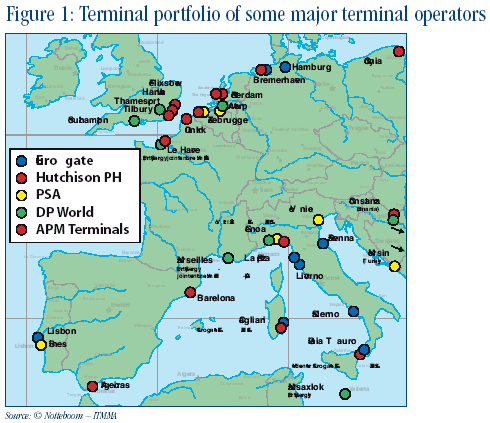
As Table 17 indicates, a significant throughput gap existed between the top-3 players and the rest of the league in 2005. As stated before, this situation was compounded by the take-over of P&O Ports by DP World in early 2006, such that the container handling industry is nowadays dominated by four worldwide operating companies with an enormous lead over their rivals in terms of throughput and market share. When the P&O Ports portfolio is added to DP World's, the combined throughput of the top-4 operators amounted to nearly 170 million teu in 2005, representing some 42% of total worldwide container handling. To put this in perspective, in 2001 the market share of the top-4 operators was still below 30%. Hence, as far as the concentration of market power is concerned, the current situation in the terminal operating sector8 is somewhat comparable to that of the liner shipping industry, where the four largest shipping lines also control some 40% of the market (expressed in the number of teu slots deployed). The current European portfolio of leading container terminal operators is presented in Figure 1. The financial involvement varies between full ownership to minority shareholdings.
|
9 |
According to industry pundits, "terminal operators can enjoy a 15% or more internal rate of return on any project (depending on the risk), with typical profit margin targets of about 20%. This is dramatically different from the liner shipping industry, which has more downs than ups" (American Shipper, 2006: 22). |
|
|
Given the fact that there are no really "big" companies left to acquire nowadays, it can be expected that the top-4 players will maintain their lead over the other operators for quite a number of years to come. As a matter of fact, some industry observers even predict that, spurred by the shortage of port capacity to handle the ever-growing volumes of container traffic (making existing terminals very attractive for investors), as well as high profitability levels enjoyed by terminal operators9, M&A activity in the container handling sector is likely to continue in the years to come, albeit on a smaller scale than witnessed recently. In this respect, one should not forget that building or extending container terminal capacity nowadays requires huge capital investments, which only very few players can afford. Moreover, while their business had thus far grown mainly organically, APM Terminals announced in mid-2006 that they were also looking at the acquisition of existing facilities, in order to reduce dependency on Maersk Line and strengthen their common-user business. It is believed that Maersk Line traffic nowadays accounts for about 65% of APMT business worldwide, down from 90% some five years ago.
However, in early 2007 the prospect of further consolidation among the major players was somewhat put on hold by the decision of the City of Hamburg concerning the sale of a stake in local terminal operator HHLA. At the end of 2006 the City of Hamburg requested Expressions of Interest for a stake of up to 49.9% in HHLA, mainly aimed at funding the '1.2 billion investment programme (amongst other things to increase box handling capacity to over 12 million teu in 2015). At the beginning of 2007 six companies were shortlisted by the Hamburg Municipality, one of which was DP World. However, in a surprise move, the Hamburg Senate announced in early March 2007 that the shortlist was reduced to two bidders, namely Hochtief and Macquarie. This, in turn, was followed by rallying protests from HHLA staff fearing a negative impact on working conditions when a 49.9% stake would be sold to either of the two companies. As a result, the Hamburg Senate decided to stop the bidding process for HHLA altogether and agreed to a part-floatation of the terminal operator for 30% of the shares.
In fact, the interest being shown by players such as Macquarie for investments in port operations is something that has only been witnessed in recent months. Indeed, as mentioned by Dynamar (2007:21), "when it comes to takeovers of ports, terminals or terminal operators, more and more financial suitors (banks, hedge funds, private equity groups, investors) are directly taking part in the bidding, a completely new development also seen in other lines of business". Examples of recent deals involving such players are listed in Table 18. The total value of the 10 deals listed exceeds USD 13 billion.
Table 18: Takeovers of port operations involving financial suitors
|
Company |
Took over |
Price |
|
American International Group |
Activities of P&O USA, including 6 container terminals (Dec. 2006) |
USD 1.01 bn |
|
Ontario Teachers Pension Plan Board |
4 OOIL Terminals in North America (Nov. 2006) |
USD 2.35 bn |
|
RREEF Infrastructure (Deutsche Bank) |
49% share of Peel Ports UK (Nov. 2006) |
USD 1.43 bn |
|
Macquarie Infrastructure |
Halterm Halifax (Nov. 2006) |
USD 0.15 bn |
|
Macquarie Infrastructure |
40% share of 6 Hanjin terminals in Japan and the USA (Sept. 2006) |
USD 0.85 bn |
|
Admiral (Goldman Sachs, GIC) |
Associated British Ports UK (Aug. 2006) |
USD 5.30 bn |
|
Montauban (Cobelfret) |
Remaining 53% of Simon Group UK (Jul. 2006) |
USD 0.18 bn |
|
Babcock & Brown |
PD Ports UK (Dec. 2005) |
USD 0.46 bn |
|
Peel Ports |
Clyde Ports UK (Nov. 2005) |
USD 0.29 bn |
|
Peel Ports |
Mersey Dock and Harbour Company UK (MDHC) (Jun. 2005) |
USD 1.38 bn |
Source: Dynamar (2007)
2.4 Container terminal capacity in Europe: a growing mismatch between supply and demand
As a result of strong growth on the arterial container trade routes in recent years, and in order to anticipate on future volume increases, many shipping lines have embarked upon ambitious expansion plans to upgrade the capacity of their ship fleets. According to AXSAlphaliner (2007), 2622 cellular containerships were deployed on worldwide trade routes at the beginning of 2000, providing a total slot capacity of about 4.51 million teu (see Table 19). By the beginning of 2007 these figures had increased to 3950 ships and 9.58 million teu, respectively. Hence, the total capacity provided by cellular containerships more than doubled in just seven years time, representing an average annual increase of 11.3%. Moreover, based on shipping lines' orderbooks as at 01/03/2007, the number of cellular containerships deployed on worldwide trade routes is expected to further increase to about 5200 units by 01/01/2010, providing a total slot capacity of 14.07 million teu. This equals a massive increase of nearly 50% in just three years time, or 13.5% per year. To put this in perspective, the capacity increase of 4.50 million teu during 2007-2009 means that a stunning 125,000 teu slots will be added to the worldwide cellular fleet every month.
Given the relentless search for cost savings at sea (cf. economies of scale), it is hardly surprising to see that many shipping lines' expansion plans are heavily focused towards large post-panamax (i.e. 5000+ teu) containerships. Whereas 78 of such ships provided a total slot capacity of just 464,000 teu at the beginning of 2000, these numbers already amounted to 504 units and 3.3 million teu, respectively, at the beginning of 2007 and are expected to further increase to 820 units and nearly 5.7 million teu by the beginning of 2010. This equals a more than 12-fold increase of the teu-capacity in a time span of ten years, or an average increase of nearly 30% per year. Whereas 5000+ teu ships provided just 10% of the total cellular fleet capacity at the beginning of 2000, their share will have increased to 40% at the beginning of 2010.
Table 19: Composition of the cellular containership fleet for selected dates
| |
01/01/2010* |
01/01/2007 |
01/01/2000 |
01/01/1995 |
|
size range |
no., |
teu |
no. |
teu |
no. |
teu |
no. |
teu |
|
>7500 teu |
293 |
2,631,348 |
147 |
1,250,003 |
10 |
80,822 |
0 |
0 |
|
5000/7499 teu |
527 |
3,085,113 |
357 |
2,070,373 |
68 |
383,415 |
0 |
0 |
|
4000/4999 teu |
518 |
2,284,181 |
346 |
1,529,854 |
156 |
682,428 |
79 |
345,351 |
|
3000/3999 teu |
362 |
1,230,169 |
282 |
956,165 |
227 |
770,410 |
164 |
541,516 |
|
2000/2999 teu |
810 |
2,055,784 |
648 |
1,630,850 |
389 |
960,443 |
255 |
637,502 |
|
1500/1999 teu |
618 |
1,051,374 |
466 |
786,591 |
327 |
552,003 |
198 |
339,511 |
|
1000/1499 teu |
776 |
924,068 |
595 |
705,600 |
484 |
565,073 |
367 |
433,533 |
|
500/999 teu |
924 |
689,004 |
722 |
525,853 |
539 |
381,630 |
336 |
239,439 |
|
100/499 teu |
386 |
122,792 |
387 |
122,944 |
422 |
132,484 |
343 |
107,046 |
|
TOTAL |
5.214 |
14,073,833 |
3,950 |
9,578,233 |
2,622 |
4,508,708 |
1,742 |
2,643,898 |
|
Average vessel size |
|
2,699 teu |
|
2,425 teu |
|
1,720 teu |
|
1,518 teu |
|
Source: AXS-Alphaliner (2007)
* Figures for 2010 are based on the orderbook as at 01/03/2007, They should be treated with care, On the one hand, many shipyards can still accept orders for (small) ships to be delivered during 2009, On the other hand, the figures assume that no ships are scrapped between 01/03/2007 and 01/01/2010, Taking into account the age profile of the current containership fleet (with many ships built prior to 1975), this is not very realistic,
|
|
10 |
According to APL Logistics, the average vessel size for the Far East - Europe trade will even reach 12,000 teu in 2015. |
|
|
The massive influx of new tonnage in the coming years, and the cascading-down effect triggered by the introduction of large post-panamax ships on the arterial trade routes, will obviously invoke a significant increase in average vessel sizes on the main trade routes. For example, Ocean Shipping Consultants (2006) expects the size of a typical container vessel deployed on the Far East - Europe trade to increase from 4500-5500 teu in 2000 to 8000-9000 teu in 2010 (i.e. +70%) and no less than 10,500 teu in 2015 (i.e. +110%). The increases in average vessel sizes for the other deepsea trades and the feeder trades are somewhat lower, albeit still remarkable10 (see Table 20).
Table 20: Average vessels sizes (in teu) on major container trade routes for selected years
| |
2000 |
2005 |
2010 |
2015 |
2010 vs
2000 |
2015 vs
2000 |
|
Deepsea east/west |
|
|
|
|
|
|
|
Far East - Europe |
4,500-5,500 |
5,500-7,000 |
8,000-9,000 |
10,500 |
+70% |
+110% |
|
Transpacific |
4,500-5,000 |
5,500-6,500 |
7,000 |
8,500 |
+47% |
+79% |
|
Transatlantic |
3,500 |
4,000 |
5,000 |
6,500 |
+43% |
+86% |
| |
|
|
|
|
|
|
|
Deepsea north/south |
2,500 |
3,000 |
3,000 |
3,500 |
+20% |
+40% |
| |
|
|
|
|
|
|
|
Feeder |
550 |
650 |
700 |
850 |
+27% |
+55% |
Source: Ocean Shipping Consultants (2006)
Whereas shipping lines, through massive expansion plans for their ship fleets, have clearly prepared themselves to handle the expected increase in container volumes in the short term, the development of additional container handling capacity to meet this demand has clearly lagged behind in some parts of the world. Specifically with respect to North Europe, Drewry Shipping Consultants (2005) found significant delays in many expansion projects related to container handling. In France, for example, the originally proposed date for the opening of the "Le Havre Port 2000" complex was delayed for three years (from 2003 until 2006). Analogously, operations at the Deurganckdok in the port of Antwerp (Belgium) only started in late 2005, while this date was originally intended to be 2001. A similar four-year delay is experienced by the Euromax terminal in the port of Rotterdam (from 2004 to 2008) and the JadeWeserPort in Wilhelmshaven (from 2006 to 2010), while yet even bigger delays are being faced by the Westerschelde Container Terminal in Flushing (at least five years delay, if the terminal will be built at all) and the Maasvlakte II project in Rotterdam (start date of operations postponed from 2002 to 2013 at the earliest). In the UK, Hutchison Port Holdings' 'Felixstowe South Reconfiguration' obtained government approval in early 2006 and is expected to be taken into operation in 2008, i.e. two years behind schedule. Hutchison was also recently given the formal go-ahead for the development of a new container terminal at Bathside Bay in the port of Harwich. Construction work on the first phase of the project is expected to start in 2009 at the earliest, implying a significant delay to the proposed start date of operations of 2004. Finally, DP World's plans for the London Gateway terminal (originally scheduled to open in 2006) were still awaiting final approval in early 2007, while Associated British Ports' plans to develop a new container terminal at Dibden Bay in Southampton (scheduled to open in 2000) have even been cancelled altogether.
The delays or cancellations of the above-mentioned projects have a number of different causes, ranging from internal politics within the port, environmental objections, legal technicalities and objections, investigations by the European Commission into market share implications, to political wrangling over funding, court cases, or to public enquiries and subsequent government considerations of their findings. Overall, the estimated total cost of the approval processes of the different terminal projects listed above is well in excess of half a billion euro. If all these proposed projects had been realised in accordance with the original time schedule, an extra capacity of no less than 11.4 million teu would have been available in North European ports in 2005. To put this in perspective, this is nearly one third of the total capacity offered by these ports in 2004 (34.8 million teu).
|
11 |
Similar figures characterized the situation in Western Mediterranean (83%), Central Mediterranean (78%) and Eastern Mediterranean/Black Sea (89%) ports in 2004. |
|
|
In view of the above, it should come as no surprise that terminal operators active in major European container ports have been witnessing increasing utilization levels of their facilities in recent years. According to estimates by Ocean Shipping Consultants (2006), 'North Continent East' (=German) and 'North Continent West' (=Benelux and Northern French) container ports experienced utilization levels of +90% and +80% respectively in 2004, obviously resulting in severe congestion problems during peak periods11. This is confirmed by HVB Group/Drewry Shipping Consultants (2005), who state that "arguably, 2004 was the worst year on record for congestion at the world's container ports" and who indicated in particular the major Benelux ports and some UK ports as European 'congestion hotspots' during 2004. Appleton (2005) argues that, as 90% utilization levels are exceeded, carriers experience a significant loss in terminal flexibility. In this respect it is important to note that, without the planning delays of the above-mentioned projects, average utilization levels at European deepsea terminals in 2004 would have hovered around 68%, significantly lower than the 86.6% experienced in reality.
Although many new container terminal projects in European seaports have faced significant delays, stevedores have not been sitting on their laurels. Indeed, in recent months and years substantial investments have been made to increase the capacity of existing container terminals. According to Cargo Systems Magazine, 69 ship-to-shore (STS) gantry cranes were delivered to European container terminals in 2006, i.e. nearly one fifth of all STS gantry crane deliveries that year (Table 21). Moreover, the orderbook for delivery at European terminals during 2007-2008 counted 91 units at the end of 2006, from a total of 368 units worldwide.
As Table 21 indicates, terminal operators around the world are clearly anticipating the arrival of massive 10,000+ teu containerships in great numbers in the not too distant future. Of the 363 STS gantry cranes delivered to worldwide terminals in 2006, no less than 231 (64%) had an outreach of at least 60m, enabling them to handle ships of 20-22 containers wide. A similar picture applies to the STS gantry crane orderbook. Many of the cranes listed in Table 21 have a lift capacity of 60 tons or more (with a few cranes even breaking through the 100 ton lifting capacity barrier) and are equipped with twin-lift (2 teu) or tandem-lift (4 teu) spreaders.
Table 21 also illustrates the overwhelming dominance of Chinese manufacturer ZPMC, accounting for 67% of STS gantry crane deliveries in 2006 and 60% of the orderbook. Their 244 deliveries in 2006, the lion's share of which was destined for the Chinese market, is equivalent to one crane leaving the factory gates every 1.5 days. Finally, as far as the geographic spread is concerned, the single biggest market for STS gantry crane deliveries is China, followed by Europe and Other Asia. Between them, these three regions accounted for some 73% of worldwide STS gantry crane deliveries in 2006 and 71% of the orderbook. While North American terminals only received 15 new STS gantry cranes in 2006, their combined orderbook for delivery in 2007-2008 stands at 43 units.
Table 21 : Overview of ship-to-shore gantry crane deliveries and orderbook
|
Ship-to-shore gantry crane deliveries during 2006 (worldwide) |
|
Deliveries by manufacturer |
Geographic spread of deliveries |
Deliveries by crane outreach |
|
ZPMC |
244 |
67.2% |
China |
135 |
37.2% |
Below 35m |
5 |
1.4% |
|
SPMP |
22 |
6.1% |
Europe |
69 |
19.0% |
35m - 44.99m |
21 |
5.8% |
|
Liebherr |
18 |
5.0% |
Other Asia |
60 |
16.5% |
45m - 59.99m |
106 |
29.2% |
|
Fantuzzi/Reggiane/Noell |
15 |
4.1% |
Mid East/Red Sea |
47 |
12.9% |
At least 60m |
231 |
63.6% |
|
DHI/DCW |
11 |
3.0% |
Cent/S.Am/Carib. |
21 |
5.8% |
|
|
|
|
IMPSA |
10 |
2.8% |
North America |
15 |
4.1% |
|
|
|
|
Other manufacturers (7) |
43 |
11.8% |
Australasia |
11 |
3.0% |
|
|
|
| |
|
|
Africa |
4 |
1.1% |
|
|
|
|
Total (all manufacturers) |
363 |
100% |
Total (all regions) |
363 |
100% |
Total |
363 |
100% |
| |
|
|
|
|
|
|
|
|
| |
|
|
|
|
|
|
|
|
|
Ship-to-shore gantry cranes on order for delivery in 2007-2008 (worldwide) |
|
Orders by manufacturer |
Geographic spread of orders |
Orders by crane outreach |
|
ZPMC |
221 |
60.1% |
China |
126 |
34.2% |
Below 35m |
0 |
0% |
|
SPMP |
34 |
9.2% |
Europe |
91 |
24.7% |
35m - 44.99m |
33 |
9.0% |
|
Liebherr |
24 |
6.5% |
Other Asia |
44 |
12.0% |
45m - 59.99m |
121 |
32.9% |
|
Fantuzzi/Reggiane/Noell |
19 |
5.2% |
North America |
43 |
11.7% |
At least 60m |
214 |
58.2% |
|
IMPSA |
18 |
4.9% |
Mid East/Red Sea |
20 |
5.4% |
|
|
|
|
Mitsui |
12 |
3.3% |
Africa |
19 |
5.2% |
|
|
|
|
Other manufacturers (7) |
40 |
10.9% |
Cent/S.Am/Carib. |
17 |
4.6% |
|
|
|
| |
|
|
Australasia |
8 |
2.2% |
|
|
|
|
Total (all manufacturers) |
368 |
100% |
Total (all regions) |
368 |
100% |
Total |
368 |
100% |
Source: Cargo Systems Magazine (December 2006 and March 2007) and own calculations
2.5 Unreliability in liner schedules and its impact on ports and their actors
As argued by IBM Business Consulting Services (2005), container shipping lines are facing several challenges in today's highly competitive environment, one of which is an increasing demand by customers for greater reliability of container shipments at lower total costs. This is acknowledged by Psaraftis (2004), former CEO of the Piraeus Port Authority, stating that "the name of the game of all major container lines is their ability to meet their schedules, as they incur enormous costs, both real and intangible, in case they do not". However, an in-depth schedule reliability survey performed by leading maritime analyst Drewry Shipping Consultants (2006) and based on the monitoring of no less than 5410 vessel arrivals on 23 different east/west and north/south trade routes between April and September 2006 (i.e. about 200 vessel calls per week) revealed that more than 40% of vessels deployed on worldwide liner services arrived one or more days behind schedule. To be more precise, the percentage of on-time vessel calls was about 52%, with 21% of vessels arriving one day late, 8% arriving two days behind schedule and no less than 14% of vessels calling their port of arrival three or more days late (the remaining 4% actually arrived two or three days before their scheduled ETA). These observations are obviously in stark contrast with claims of shipping lines that most of their containerships operate on fixed-day weekly schedules.
Although the Drewry survey found low reliability levels overall across the industry, strong variations were observed between the schedules of different liner carriers. Of the 65 international shipping lines whose vessel schedule reliability was monitored, 15 enjoyed on-time arrivals of 60% or more, while 12 carriers scored between 50% and 60%. No less than 38 carriers had on-time arrivals of less than 50% (of which 21 carriers even scored below 40%). Individual schedule reliability percentages ranged between 4% for the least reliable shipping lines and above 90% for the best performing carriers over the period of the survey. Of the main east/west carriers, Hatsu Marine, Italia Marittima (both belonging to the Evergreen Group), Safmarine and Maersk Line enjoyed high schedule reliability levels, whereas K-Line, China Shipping Container Lines and Mediterranean Shipping Company were some of the carriers with below-average schedule integrity. For the worst performing carriers, average deviation from the ETA easily amounted to 3 days or more.
|
12 |
It should be noted, however, that for some trade routes the results are based on very small sample sizes. |
|
13 |
See the text box at the end of this chapter for the evolution of bunker prices in selected ports during 2006. |
|
|
Unsurprisingly, the survey also revealed significant differences between reliability levels on the different liner trade routes. Routes with on-time arrivals of 70% or more included North America/Indian Subcontinent/Mideast/Red Sea and North America/Hawaii/Guam/mid-Pacific. On the other hand, the Asia/East Coast South America, Asia/West Coast South America, Europe/Med/Australia/New-Zealand/South Pacific, Europe/Med/West Coast South America, North America/Caribbean/Central America and North America/East Coast South America trades each experienced reliability levels of (well-)below 40%. On some trade routes transit time delays of 3 days or more were found to be the rule rather than the exception12.
Low reliability of liner schedules can be explained by a number of factors. Common reasons for vessel delays include bad weather at sea, congestion or labour strikes at the different ports of call, as well as knock-on effects of delays suffered at previous ports. More serious delays, leading to significant time-losses for the cargoes involved or even the loss of the cargo altogether, can be caused by fire incidents (cf. the serious fire incident onboard the HYUNDAI FORTUNE in the Gulf of Aden in late March 2006), ship collisions or ship groundings (cf. the incident with the MSC NAPOLI off the English Coast in early 2007).
Obviously, another major factor hampering liner schedule integrity is the growing mismatch between the demand for container shipping services and the supply of terminal capacity, as outlined above. It is obvious that decreasing schedule integrity can have profound implications for players throughout the entire supply chain (for an excellent overview, see HVB/Drewry Shipping Consultants, 2005):
(1) Shipping lines are faced with increasing operating costs. According to industry experts, an 8500 teu container vessel ordered in 2003 at USD 80m (well-below the USD 130m level observed during the second quarter of 2005) and nowadays being deployed on an eight-week Far East-Europe run, gives rise to fixed costs of about USD 30,000 per day (including capital + interest on loans + crewing and maintenance) and variable costs of about USD 95,000 per day (including bunker costs + canal costs + port costs + insurance + miscellaneous). Hence, an increase in the total round-trip time of, for example, 3 days due to increased congestion/waiting times in the different ports of call increases its operating costs with several tens of thousands of dollars per round-trip.
In order to make up for time lost in port and restore schedule integrity, shipping lines can follow a number of strategies (see also Notteboom, 2006). Firstly, they might have their ships sail at full service speed when steaming from one port to the next. However, such a practice can be extremely costly. Figure 2 depicts the relation between service speed and fuel consumption for four types of container vessels and eight different service speeds. This figure indicates that an increase in service speed with just a couple of knots already results in a dramatic increase of fuel consumption. For example, increasing service speed from 22 to 24 knots for an 8000 teu container vessel increases its fuel consumption by as much as 45 tons per day. With current bunker prices13 of about USD 270 per ton, this translates into a daily cost increase of USD 12,150 for each of the vessels deployed. For a 10,000 teu ship, which will most probably become the workhorse on the Far East-Europe trade route by 2010, the daily cost increase per vessel would even amount to USD 16,200.
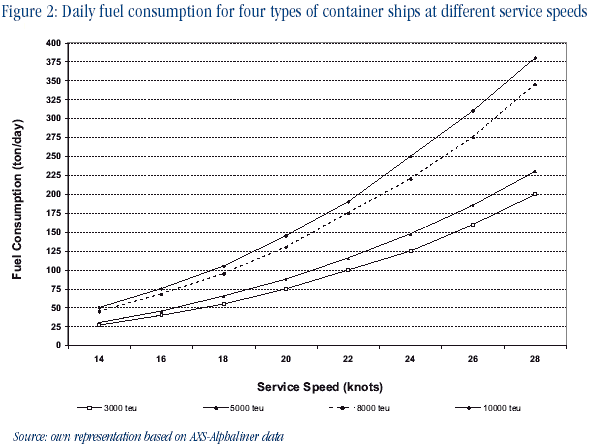
Table 22 gives an indication of the daily fuel costs at sea (at mid-2006 bunker prices) for three types of container ships and seven different service speeds, as estimated by leading containership classification society Germanischer Lloyd.
Table 22: Fuel costs at sea for three types of container vessels and different
service speeds (USD per day) at end-July 2006 bunker prices
|
Speed (kt) |
5000 teu |
8000 teu |
12,000 teu |
|
14 |
12,200 |
16,000 |
20,700 |
|
16 |
16,800 |
21,600 |
27,500 |
|
18 |
23,100 |
29,000 |
36,500 |
|
20 |
31,800 |
39,400 |
48,700 |
|
22 |
43,700 |
52,200 |
64,400 |
|
24 |
59,300 |
69,400 |
83,600 |
|
26 |
82,800 |
96,100 |
114,700 |
Source: Germanischer Lloyd
As a matter of fact, bunker prices have nowadays reached such a level that, at least for certain trade routes, it might be justified to add an extra vessel to an existing loop in order to slow down the sailing speed of all vessels plying it, while still maintaining the service frequency (usually weekly). Indeed, if the addition of an extra 8000 teu vessel to an existing loop would reduce the required service speed for all vessels plying it from 22 to 20 knots, this would result in fuel savings of some 45 tons per day for each of the vessels deployed. At a USD 280 per ton bunker price, this translates into a daily saving of some USD 12,800 per vessel. In this respect, it comes as no surprise that both the Grand Alliance and CMA CGM each decided to add a ninth vessel to one of their respective Far East-Europe loops during the Summer of 2006. The resulting fuel cost savings generated by each of the existing eight vessels more than compensated for the cost of hiring and operating the ninth vessel.
Secondly, rising port congestion levels might incite shipping lines to reshuffle the order of ports of call on a certain loop (possibly resulting in peak volumes in the 'new' first port of call) or, in extreme cases, leave them with no other option than to omit certain port calls altogether to get vessels back on schedule (cf. the diversions of container ships from Rotterdam to Antwerp and Amsterdam following IT-problems at the ECT Delta terminal on the Maasvlakte in May 2006). As discussed by Notteboom (2006), yet another option to keep deteriorating schedule reliability under control is the so-called "cut and run" principle, implying that crane operations on a vessel are abruptly stopped even if there are still some containers on the stack waiting to be loaded.
Thirdly, liner carriers could relax buffer time in their service schedules for contingencies such as bad weather and port delays. But increasing buffer time comes at a high cost, even an additional vessel on a loop.
Finally, as noted by Dynamar (2005), the prospect of ever-decreasing schedule reliability constitutes an important reason why shipping lines increasingly seek control of container terminals in strategic locations. Indeed, by investing in (semi-)dedicated facilities, shipping lines can reduce waiting times (cf. berthing on arrival) and are guaranteed of high vessel productivity. Moreover, terminal agreements typically lead to lower handling rates, enabling shipping lines to operate below the normal THC levels. As discussed previously, the trend towards more carrier involvement in terminals has not escaped the European port scene, quite to the contrary (see Table 14 above).
(2) Terminal operators , especially in those ports which are non-first port of call, are confronted with rising uncertainty with respect to estimated times of arrival (ETA) of container vessels. A container ship missing its contractually negotiated berthing window affects both berth planning and yard planning at seaport terminals. Moreover, as stated above, unexpected delays might force shipping lines to make last-minute changes to their shipping schedules (e.g. an inversion of port calls or the omission of a certain port call altogether). As a result, terminal operators can face sudden and unplanned peaks in volumes (forcing them to hire extra manpower), possibly leading to domino effects for ships berthing at the same terminal, aggravating problems even more. By way of illustration, average reliability of vessel arrivals for the container terminals operated by PSA HNN in the port of Antwerp was around 30% in 2005 (based on the monitoring of 30 loops, with somewhat higher reliability levels for deepsea vessels than for feeder vessels). This figure is well-below the schedule reliability needed for efficient terminal planning, which can be estimated at 90% (Notteboom, 2006), although this should be considered a theoretical figure.
(3) Inland transport operators are confronted with increasing unreliability of sailing schedules. Inland barge operators, for example, have to take into account the fact that most terminal operators treat deepsea traffic with priority over barge traffic. As a result, securing berthing space becomes ever-more difficult for inland barge operators when the reliability of deepsea services decreases. As an example, in the 2004 peak season, barge and feeder operators experienced delays of up to 60 hours at deepsea terminals in Rotterdam and Antwerp, causing havoc in their sailing schedules and forcing them to impose congestion surcharges on their clients to recover costs. In general, inland transport operators (be it truck, rail or barge operators) being faced with increasing delays can see their productivity levels significantly reduced. Since nowadays competition is no longer a question of "port versus port" but rather "supply chain versus supply chain", this can obviously have a profound impact on the competitive position of a seaport vis-à-vis its nearest rivals. In this respect, it comes as no surprise to see that terminal operators are showing an increasing interest to cooperate on a strategic basis with other players in the supply chain in order to safeguard the integrity of goods flows.
(4) Shippers/consignees , finally, are confronted with an increase in logistical costs because (1) they are faced with decreasing reliability of lead times, obliging them to invest in higher inventory levels in order to avoid disruptions to their production processes and meet service level agreements, and (2) they are faced with so-called 'congestion surcharges' imposed by deepsea shipping lines or inland transport operators aiming to recover costs associated with rising congestion levels (for a detailed overview of rate and surcharge developments imposed by deepsea shipping lines during 2004-2006, see Drewry Shipping Consultants, 2006 or Dynamar, 2006). It has to be noted, however, that congestion surcharges have only very rarely been imposed in European seaports in recent years. For a detailed case study on the impact of liner schedule unreliability on shippers/consignees the reader is referred to Vernimmen et al. (2006)
Overview of main developments in the European container market during 2006
|
Development of the world cellular fleet in 2006
According to AXS-Alphaliner, 357 cellular ships were added to the world fleet in 2006 (i.e. on average about one ship every day), representing 1.36 million teu and 16.76 million dwt. The same year hardly 19 cellular ships, totaling 28,576 teu (489,000 dwt), were deleted. As a result, at 01/01/2007 the world cellular fleet reached 3,949 ships for a total capacity of 9.57 million teu. This implies an increase of more than 16% of the teu-capacity during 2006.
Also during 2006, 401 cellular ships totaling 1.60 million teu (19.3 million dwt) were ordered, for a total contract value estimated at USD 24.2 billion (which boils down to roughly USD 15,000 per teu-slot). This followed already hefty ordering in 2005, when 522 vessels were ordered for a total capacity of 1.62 million teu and a total contract value of around USD 27.2 billion.
The cellular fleet is expected to continue growing strongly in 2007. No less than 503 cellular ships with a total capacity of 1.50 million teu should be added to the fleet, representing nearly 16% of the cellular fleet capacity at 01/01/2007. The net effect, however, will obviously be lower: given the age profile of the current cellular fleet (a lot of ships were built prior to 1975, including many ships in the 1000-3000 teu segment) it can be expected that (many) ships will be scrapped in the course of 2007.
Port/terminal development in Europe (non-exhaustive)
Although container volumes in European seaports increased rapidly during the last few years, 2006 did not witness the commissioning of many new container terminals. The only new terminals that were opened during the year included APM Terminals Zeebrugge (Belgium), Terminal de France (Port 2000, Le Havre), Astakos port (Greece), Gdynia Container Terminal (HPH-operated) (Poland), Gävle Container Terminal (Sweden), a second terminal in Klaipeda (Lithuania) and the first berth of CT-IV in Bremerhaven. However, apart from these new projects, a substantial amount of existing container terminals throughout Europe were either upgraded or expanded during 2006 in order to cope with the expected increase in cargo volumes. Examples (non-exhaustive) include ECT's Delta Terminal in Rotterdam, the MSC Home Terminal in Antwerp, Eurogate's Container Terminal Hamburg, Darsena Levante (Naples), Klaipeda Container Terminal, Baltic Container Terminal (Gdynia), East/Chita Docks (Valencia), Bristol Container Terminal and Southampton Container Terminal.
In February 2006 the Port of Felixstowe obtained government approval for its 'Felixstowe South Reconfiguration' project. This comprises the conversion of existing facilities into a 350m quay length container terminal with a capacity of some 1.5m teu per year. Some months before, Hutchison Port Holdings had also obtained approval for its Bathside Bay project in the port of Harwich. These two expansion projects are a much-needed development for the UK East Coast, where existing terminals are characterized by high utilization levels.
In August 2006 the Port of Thessaloniki signed a deal with the European Investment Bank for the financing of the expansion plans for its container terminal. The expansion, taking a start in 2007, comprises the construction of 500m quay length and corresponding superstructure.
In October 2006, the Port of Rotterdam received the go-ahead from the Dutch government for its massive Maasvlakte-2 expansion project. Maasvlakte-2 encompasses some 1000 hectares (net) of industrial sites, located directly on deep water. It will mainly be reserved for the container, chemical and distribution industry. Construction works are expected to start in 2008, with the first terminals being operational by 2012-2014. In June 2006 the Port of Rotterdam Authority and APM Terminals concluded an agreement, under certain conditions to be satisfied, for the lease of a container terminal on Maasvlakte 2. The terminal will cover about 167 hectares with a potential handling capacity of 4.5 million TEU per year. The first part of the terminal should be operational in 2014 at the latest. Next, the granting of another container terminal at Maasvlakte 2 (to be taken into operation in 2012-2013), for which a number of candidates were still in the running at the beginning of 2007, is expected to take place in the Summer of 2007.
In the port of Algeciras (south Spain) construction works started on the 'Isla Verda Exterior' expansion project in 2006. The first two phases of the project have meanwhile been finalized and comprise a container terminal with 1265m quay length and 50ha stacking yard. The third phase comprises an additional 995m quay length and 55ha stacking yard.
- In late 2006 the Port of Southampton commissioned a new berth for feeder vessels up to 150m in length. The berth is used to handle extra feeder volumes following the Grand Alliance's decision in June 2006 to consolidate calls at Southampton (implying traffic shifts from Thamesport). The feeder berth will also be used in a bid to attract more intra-European business.
- In the port of Barcelona construction works started on the new Prat Terminal (Muelle Prat). When finished, the terminal boasts a 1500m quay length and 93ha stacking yard, sufficient to handle 2.5m teu per year. The Prat Terminal will be operated by Hutchison Port Holdings together with Spanish partner Grupo Mestre (TerCat). The terminal should be taken into operation in 2008.
- In March 2007 formal planning approval was granted for the deepsea JadeWeserPort container terminal at Wilhelmshaven in North Germany. JadeWeserPort comprises a 120ha container terminal (capacity: some 3 million teu per year) and an adjacent 170ha zone for logistics activities. Construction of the terminal should take a start in the Summer of 2007. JadeWeserPort will be operated by Eurogate (70%) in joint venture with APM Terminals (30%) and its first phase should be operational by 2010, providing Northern Germany with much-needed extra handling space for the world's largest container vessels.
- In Gdansk the construction works on the DCT-Gdansk container terminal progressed well during 2006. The first operations should take a start in mid-2007, with the total terminal being finished around October.
Other significant developments (non-exhaustive)
In August 2006, the Odense Steel Shipyard delivered the long-awaited EMMA MAERSK to Maersk Line. With an LOA of 397m, a width of 56.4m (22 rows across) and an estimated nominal capacity of 14,000+ teu when carrying 9 tiers above deck, the EMMA MAERSK is the largest container vessel in the world. In fact, as at March 2007 she was about 50% bigger than the second-largest container vessels afloat (CSCL's 350m long and 18-wide XIN LOS ANGELES of 9580 teu). Hence, just as was the case with the 7000 teu REGINA MAERSK in 1996, Maersk Line again took a very important lead over its nearest competitors as far as the deployment of large vessels is concerned. Together with seven identical sister ships (of which the ESTELLE MAERSK, ELEONORA MAERSK and EVELYN MAERSK have already been delivered) the EMMA MAERSK will be deployed on the Far East-Europe trade. In fact, as from April 2007, these giant ships will only call at a handful of ports, namely Rotterdam, Bremerhaven, Algeciras, Tanjung Pelepas, Yantian (Shenzhen), Hong Kong, Ningbo, Xiamen, Hong Kong, Yantian (Shenzhen), Tanjung Pelepas, Algeciras, and back to Rotterdam. Given their 28,000+ teu nominal two-way capacity, these ships should generate massive import/export call sizes for the ports involved.
In October 2006, Panamanians have answered an overwhelming (almost 80% of the 43% of Panamanians that showed up) "Yes" to the plans for the construction of a third set of Panama Canal locks. If all goes as planned, this new set of locks will be operational in 2015 and will boost the "panamax" gauge to ships able to carry 12,000 teu. The total cost is estimated at some USD 5.25 billion, including a safety margin to face unplanned expenses. The new locks, which will measure 427 x 55 x 18.3m, imply that ports on the US East Coast as well as some US Gulf Coast ports and Caribbean ports will have to prepare the arrival of giant containerships in about 10 years from now (AXS-Alphaliner, 2006).
During 2006 a total of 17 new container services were launched on the East-West trades, involving 105 ships with an average capacity of 4500 teu. Similarly, the North-South trades welcomed no less than 38 new container services involving 187 ships with an average capacity of 2200 teu. In addition, 9 new container services were introduced in the intra-Europe container trade and the intra-Mediterranean container trade in 2006 (Dynamar, 2007). Apart from these new services, many existing services on the East-West, North-South and regional trades witnessed a (significant) capacity of the vessels deployed. It is beyond the scope of the present Report to discuss this in detail.
- The year 2006 saw the birth of "Emirates Shipping Line FZE", formed by former Norasia Line executive Vikas Khan. Emirates Shipping Line is registered in Dubai Maritime City (United Arab Emirates) and is owned by private interests. The company is commercially headquartered in both Dubai and Hong Kong. Between May and November 2006, Emirates Shipping Line launched no less than 6 services, of which three as vessel provider and three as slot buyer.
- The port of Amsterdam initiated AMSbarge, a 200 teu box barge fitted with a 35-ton gear including the required spreaders. The AMSbarge has been developed to collect containers at companies with an inland water connection, hence avoiding road transport. It will serve all container-handling facilities in Amsterdam, including NYK's Ceres Terminal. The AMSbarge can also serve as a floating container terminal, consolidating boxes from various barge operators.
- During the first half of 2006 the price for 380 CST bunker fuel climbed to a very high level. In Rotterdam, for example, bunker prices steadily increased from USD 273 per ton at the beginning of January to reach their peak level of USD 338 per ton in early May. Afterwards, prices fell to USD 287 per ton at the end of June, only to climb back to USD 326 per ton in Mid-August. The second half of 2006 saw a significant decrease of the price level to USD 254 per ton at the end of December. On average, bunker prices in Rotterdam attained USD 292 per ton in 2006, some 25% higher than the average USD 234 per ton during 2005. A similar picture applied to bunker prices in Singapore (from an average USD 264 per ton in 2005 to an average USD 314 per ton in 2006), Houston (from USD 250 per ton to USD 302 per ton), Fujairah (from USD 259 per ton to USD 311 per ton), Tokyo (from USD 296 per ton to USD 345 per ton) and Long Beach (from USD 267 per ton to USD 319 per ton). This obviously had an enormous impact on the bottom line of many container shipping lines.
Source: Dynamar (2006, 2007), AXS-Alphaliner and various trade press articles |
BACK TO INDEX
| |






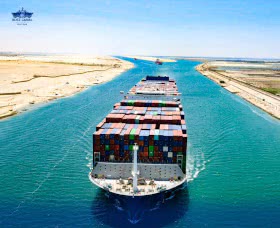
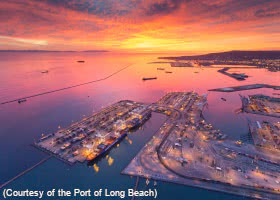








 - Via Raffaele Paolucci 17r/19r - 16129 Genova - ITALIA


