|
A future maritime policy for the European Union
Initial views on the forthcoming Green Paper of the European Commission
6 October 2005
1. Introduction
The European Sea Ports Organisation (ESPO) represents the port authorities, port administrations and port associations of the seaports of the European Union. The organisation acts as the representative body of all EU seaports and has observer members in Bulgaria, Croatia, Iceland and Norway.
ESPO welcomes the European Commission's initiative to produce a Green Paper on maritime policy and appreciates that seaports are being given a central role in the drafting process of the Green Paper. ESPO sees this as an opportunity to discuss the development of a more coherent European policy framework for seaports. ESPO however hopes that the Green Paper will not lead to an interventionist approach nor bring forward significant new legislation for seaports. Furthermore, ESPO believes that EU maritime policy should be closely coordinated with EU transport policy and therefore argues that the Green Paper should be tuned in with the forthcoming revision of the White Paper on Transport Policy.
This paper first of all highlights the importance of seaports for the EU as well as the main challenges the sector is currently facing. Secondly, it outlines ESPO's expectations from the Green Paper. These are largely based on the document "European seaport policy ' a practical guide for EU policy makers" which ESPO published in November 2004, outlining the basic common policy needs of European seaports.1 Finally, this paper also indicates in which areas ESPO would find a coordinated European approach superfluous and even counterproductive.
2. The importance of seaports for the EU
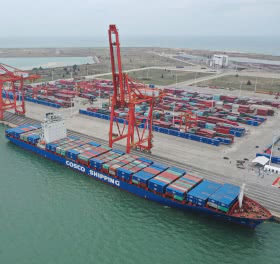
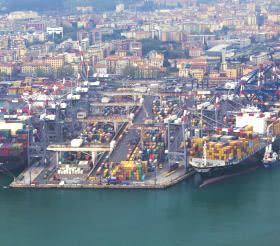
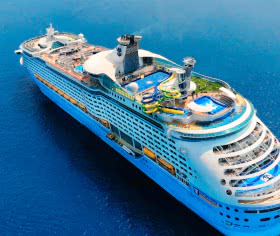
The European Union simply cannot function without its seaports. Almost all of the Community's external trade and almost half of it internal trades enters or leaves through the more than 1000 seaports that exist in the 20 maritime Member States of the European Union. On average 3,5 billion tonnes of cargo per year. In addition, every year 350 million passengers pass through European seaports ' the equivalent of 70 % of the European population.
Seaports enable a modal shift of transport from Europe's highly congested roads to more environmental friendly (short sea) shipping. Although shipping remains by far the most energy efficient and least polluting transport mode, seaports actively fight climate change by further eco-innovation and technological development.
Pollution in ports is being reduced by continuously improving facilities such as waste reception for oil and chemical residues, garbage, sewage, ballast water. Strict monitoring of the collected waste provides incentives for ships not to dispose any waste at sea. Seaports further actively cooperate with the European Maritime Safety Agency in creating an adequate legal framework for safe places of refuge for ships in distress and implementing SafeSeaNet to further develop a sustainable maritime environment.
As Commissioner Joe Borg highlighted in his keynote addressed to the ESPO Annual Conference held in Malta in April this year2, seaports have always been a means to serve the prosperity of Europe. Since the dawn of civilization, seaports were furthermore at the forefront in bringing new ideas and practices to Europe. Today, seaports are still indispensable not only to Europe's positioning in world trade but also to Europe's single market and its trans-European transport network. Approximately 350.000 people work in ports and directly related services which together generate an added value of about ' 20 billion.
3. The principal challenges of European seaports
Ports have developed tremendously over the last 10-20 years. The following illustrates that the challenges of the sector are numerous and complex3:
- traffic in European seaports is growing at a fast pace, on average 4 % per year and for container traffic between 7 and 15 % per year ' new investments are necessary in port infrastructure as well as maritime access and hinterland infrastructure to avoid congestion;
- restrained government budgets mean private capital is vital for the financing of such investments and requires long-term commitments from private investors in ports;
- potential port expansion areas are as scarce as nature conservation areas. EU nature conservation legislation, and in particular its local or national interpretation, puts an increased strain on vital port development plans;
- many European seaports have to deal with international groups who possess strong bargaining power and are often organised in strategic alliances, allowing them to be less loyal to one particular port;
- the traditional division of tasks within the logistics chain has become blurred by vertical integration strategies which make that European ports increasingly compete within supply chains;
- as intermodal connecting points, the efficiency of seaports relies very much on the efficiency of services provided both in the hinterland and the maritime foreland ' seaports need all modes of transport to function optimally;
- this efficiency is furthermore influenced by the fact that seaports are favoured locations for the provision of frontier controls and inspections, including safety of ships, security, customs, public health and environmental quality of which many are unique to the maritime sector;
- the added value of ports for the economy and society is often taken for granted by the wider community which tends to focus only on the environmental, safety and security impact despite numerous efforts which have already been made by seaports in this field.
4. Expectations from the forthcoming Green Paper
ESPO shares the Commission's aim to stimulate competitiveness and growth in Europe through the so-called "Lisbon agenda". In particular, it supports the priorities of ensuring free and fair trade, improving the business environment through better and less regulation, enhancing infrastructure, fostering of innovation and investing in an adaptable and skilled workforce.
ESPO hopes the Green Paper will acknowledge the efforts seaports have already made in this field and will not impose interventionist or disproportionate policy measures.
European seaports would like to see the development of a coherent EU policy framework which should focus on three key areas:
a) Facilitating development of adequate port capacity, maritime access and hinterland connections to allow ports to fulfil their role as gateways for Europe's external and internal trade ' through:
- clarifying State aid rules for public funding of port infrastructure, services of general interest in ports, as well as of maritime access and hinterland infrastructure, including nodal points;
- focusing support under TEN-T to missing or inadequate infrastructure links, especially those connecting seaports to their fore- and hinterlands;
- guaranteeing full autonomy to the managing body of the port, allowing new and existing investors normal returns on investment and fully respecting property rights;
- stimulating an open debate about the impact of nature conservation rules on vital port and port-related development projects.
b) Fostering the provision of competitive and efficient services in ports and within the transport chain ' through:
- guaranteeing that port charges are a matter of commercial and/or financial autonomy of each individual port;
- studying existing good practice in relation to the provision of services in ports before proceeding to any common framework;
- ensuring that services in the transport chain are equally competitive, market-oriented, efficient, safe, secure and environmentally-sustainable as those provided in seaports;
- ensuring that controls and inspections in ports are necessary, coordinated and efficient and that government responsibilities are not transferred to ports.
c) Stimulation of the wider community responsibilities of ports ' through:
- supporting the individual efforts of ports to achieve high environmental, safety and security standards through self-regulation;
- stimulating co-operation and exchange of best practice between ports by supporting pragmatic industry-driven projects;
- maintaining a proper balance between incentives to competing alternate transport modes;
- focusing short sea policy on efficient customs and administrative procedures.
5. What the Green Paper should not try to achieve
There have been several attempts in the past to develop policy measures or frameworks for European seaports which have either failed or fell into oblivion. This is due to a number of errors which have systematically been repeated, i.e.;
- policy makers ignored or underestimated the fact that European seaports are naturally diverse and complex;
- policy-makers have not anticipated or fostered market developments, but responded ex post facto by wanting to regulate, co-ordinate and intervene;
- a lack of overall vision on the actual needs of seaports which has lead to contradicting policy initiatives (e.g. EU transport vs. environment policy);
- seaports were mostly approached in a negative way, by focusing on negative externalities and unjustified claims of inefficiency, rather than looking at the positive contribution of seaports to Europe's welfare.
|
4 Draft own-initiative opinion of the Committee of the Regions on EU maritime policy ' a question of sustainable development for local and regional authorities ' Rapporteur Uwe D'ring ' 12 August 2005 ' DEVE-037
|
|
ESPO believes that large, medium-sized and small ports all have their role to play within the logistics network. Artificial intervention goes against the main regulating force of the market, which would only work counterproductive.
ESPO therefore strongly urges the Commission not to embark on such a route but to make sure that the forthcoming maritime policy of the European Union stimulates and facilitates the sound market-based and sustainable development of ports along the principles outlined above.
We further do not agree with the implication of the Committee of the Regions that the Green Paper should lead to new legislative proposals. On the contrary, ESPO believes that the Commission should shift its current emphasis on producing new ' and fragmented - legislation to a better coordination and application of existing legislation that affects seaports, introducing modifications where necessary. Non-legislative policy tools, such as interpretative communications and codes of practice should be more commonly used. This would also be in line with the Commission's own objective of producing better and less regulation.
6. Conclusion
ESPO welcomes the opportunity of the Maritime Policy Green Paper to discuss the development of a more coherent policy framework for seaports.
Such a framework should focus on three key areas:
- facilitation of development of adequate port capacity, maritime access and hinterland connections to allow ports to fulfill their role as gateways for Europe's external and internal trade;
- fostering provision of competitive and efficient services in ports and within the transport chain;
- stimulation of the wider community responsibilities of ports.
The forthcoming maritime policy framework should facilitate the sound market-based and sustainable development of ports along these principles but refrain from interventionist measures.
Also, the maritime policy framework should not lead to new legislation, but to a better coordination of existing policies, notably between transport and environment policies, as well as on enforcement of existing legislation. Being intermodal connecting points, for ports it is finally important that the maritime policy of the European Union dovetails with the land-based transport policies.
|





 European Sea Ports Organisation (ESPO) ha presentato oggi l'esito del proprio esame iniziale del prossimo Libro Verde della Commissione Europea sulla futura politica marittima dell'UE che si prevede venga pubblicato nel corso del primo semestre del prossimo anno.








 - Via Raffaele Paolucci 17r/19r - 16129 Genova - ITALIA


