|

THE IMPACT OF THE OCEAN
SHIPPING
REFORM
ACT OF
1998
FEDERAL
MARITIME COMMISSION
SEPTEMBER 2001
|
CONTENTS
INTRODUCTION
EXECUTIVE
SUMMARY
REGULATORY AND ECONOMIC
OVERVIEW
Regulatory Overview
Service Contracts
Agreements/Voluntary Service
Contract Guidelines
Tariffs
Restrictive Foreign
Practices
OTI Licensing and
Bonding
Economic Overview of US
Trades
Competitive
Conditions
Transpacific -
Inbound
Transpacific - Outbound
Transatlantic Trade
Mediterranean/Middle East
Trade
South American
Trade
Central American and Caribbean
Trades
Concentration
CHANGES IN SERVICE
CONTRACTING
Statutory Changes
The NOI and the Random Sample
of Service Contracts
SERVICE CONTRACT
CONFIDENTIALITY
OSRA's Changes
Industry
Experiences
AGREEMENT
ACTIVITY/VOLUNTARY
SERVICE CONTRACT GUIDELINES
Industry Structure
Overview
Discussion
Agreements
Operational
Agreements
Internet Portal
Agreements
Voluntary Service Contract
Guidelines
Guideline Content
Adherence to Service Contract
Guidelines
Agreement Issues Noted in
NOI Comments
Discussion
Agreements
Agreement Filings
Agreement Monitoring
Reports
OTI LICENSING AND
BONDING
The OTI Industry at a
Glance
Licensing/Bonding and Tariff
Publication
Competitive
Activity
TARIFF
PUBLICATION
Tariff Publishing Under
OSRA
The NOI and Tariff Use Under
OSRA
OTHER ISSUES (CONTROLLED
CARRIERS,
FOREIGN SHIPPING PRACTICES,
TRUCKING, AND E-COMMERCE)
Controlled Carrier
Oversight
Unfair Foreign Shipping
Practices
Port Trucking
Issues
E-Commerce
CLOSING
OBSERVATIONS
Snapshot of
Findings
Ongoing Evolution of the
Industry
Continuing Regulatory
Issues
Suggestions for Further
Legislative Consideration
Freight Forwarder
Compensation
Tariffs
Level of Civil Penalties and
Monetary Sanctions
Definition of "Ocean Common
Carrier" as it Affects the Scope of Agreements and Service
Contracts
Service Contract/Bill of Lading
Inconsistency
Controlled Carrier Issues
(Section 9)
Service contracts
Taking cost into
account
Definition of controlled carrier
to include NVOCCs
Remedies to address violations
of section 9
APPENDIX I
NOI REVIEWS BY QUESTION
APPENDIX II
SERVICE CONTRACT RANDOM
SAMPLE AND SURVEY
APPENDIX III
OCEAN TRANSPORTATION INTERMEDIARY STATISTICS
INTRODUCTION
It now has been two years since the
implementation of the Ocean Shipping Reform Act of 1998 ("OSRA") -- a sufficient
period of time for those in the industry to begin to adjust to the new regulatory
environment and for the Federal Maritime Commission("FMC"
or "Commission") to make an initial candidassessment of
how the impact of the legislation appears to be unfolding. While there may
be divergent views ripe for intriguing debate on various issues, the focus
of the following pages is to provide objective, impartial findings on the
regulatory and commercial impact of OSRA to date. We have relied on a broad
range of sources in collecting information on how the legislation has played
out across the industry. Representatives of all sectors of the industry have
provided the Commission with their views and comments throughout this two-year
period. The responses to the Commission's Notice of Inquiry ("NOI") on OSRA's
impact were voluminous. An in-house review of hundreds of service contracts
provided a rich source of information, as has our continued monitoring of
carrier activity exercising statutory antitrust immunity. We also have drawn
on the Commission's numerous and varied experiences in dealing with all aspects
of this new law over the past two years. Taken together, this information
provides a wealth of insight on the state of US ocean shipping under
OSRA.
It is important to emphasize that
this report concentrates on the impact of OSRA -- we have not undertaken
to present a general trade study on everything that has occurred in US liner
shipping since May 1, 1999. Our focus is the manner in which OSRA has shaped
or affected operations and developments in that time frame. As indicated
throughout the report, OSRA does appear to be achieving its primary policy
objectives. However, several areas do present significant issues that the
Commission must continually assess to determine if responsive action becomes
warranted.
This study is divided into five
topics: service contracts, agreements, ocean transportation
intermediary ("OTI") licensing and bonding, tariffs, and a grouping of other
relevant issues. The views of the various sectors of the industry, as well
as an assessment of OSRA's impact on these groups, are reflected throughout
each section. We have focused on what we believe to be more significant points
or developments so as to offer a streamlined report. Nonetheless, we have
cited some particular details or nuances to clearly convey OSRA's impact
on those who participate in US liner
shipping.
EXECUTIVE
SUMMARY
General
-
The
major regulatory changes made by OSRA were aimed at promoting a more
market-driven, efficient liner shipping industry. After two years of operations
under this statute, indications are that it generally is achieving this
objective.
-
The liner shipping industry has been experiencing dynamic structural changes
over the past several years. OSRA was enacted in full recognition of these
changes, and has helped to foster their continuing
evolution.
-
Developments in US liner shipping in the past two years, while occurring
in large measure due to the interplay of market forces, were impacted by
the changed business environment brought about by
OSRA.
-
While there is no industry-wide consensus on most specific issues involving
the impact of OSRA, this disparity of views has not had a major negative
effect on business relationships or ongoing arrangements among industry
participants.
-
The FMC developed comprehensive regulations to implement OSRA, and has altered
its approach to industry oversight to facilitate the attainment of OSRA's
basic policy direction.
Service
Contracting
-
Numerous pro-competitive reforms enacted under OSRA to increase industry
market responsiveness focused on service contracting. The ability to deal
with individual carriers, the elimination of the "me-too" requirement for
similarly situated shippers, and the confidentiality of certain commercially
sensitive service contract terms have fostered a shift to contract carriage
-- carriers generally report that 80 percent or more of their liner cargo
currently moves under service
contracts.
-
The 200 percent increase in the number
of service contracts and amendments filed since May 1999, as well as the
increase in the volume of cargo moving under service contracts is due, in
part, to the flexibility and confidentiality of individual service contracting.
-
Most shippers presently are negotiating one-on-one with individual carriers
for confidential service contracts, instead of negotiating with rate-setting
conferences or groups of
carriers.
-
Many service contracts continue to be linked to tariffs for accessorial charges,
surcharges, and certain rules.
-
Responses to the Commission's NOI contained no allegations that shippers
could not secure service
contracts.
-
Non-vessel-operating common carriers
("NVOCCs") would like to have the authority to engage in service contracting
with shipper customers, so as to put them on equal footing with vessel-operating
common carriers ("VOCCs").
Agreements
-
The emergence of global markets, the improved service of non-conference carriers,
and the deregulatory nature of OSRA are catalysts that have contributed to
the restructuring of the liner shipping industry. This has led to a de-emphasis
of traditional conferences and a dramatic increase in efficiency-enhancing
operational types of agreements, such as vessel-sharing and space charters.
-
While there were 35 conference agreements on file with the Commission in
1998, there were only 19 as of June 1, 2001. Operational agreements made
up 58 percent of all effective agreements as of June 1, 2001. Internet portal
agreements, basically "one-stop shopping" Internet sites, are innovative
agreements that promise to further improve operational efficiencies.
-
Carriers continue to use supply-side operational agreements, including global
strategic alliances, to expand service and geographic coverage, while limiting
individual risk and capital. Industry reports indicate that in the main east-west
trades, alliances now account for between 60 to 65 percent of all capacity
deployed, and have, along with the use of new technologies, enabled ocean
carriers to reduce their average cost by more than $260/TEU over the past
four years.
-
Broad-based discussion agreements with non-binding rate authority have become
the primary forum for carriers to exercise their antitrust immunity with
regard to rate levels. Attention has focused on agreement members' adoption
of and adherence to voluntary service contract guidelines affecting individual
service contracts. These guidelines must be strictly voluntary and are
non-enforceable by the agreement.
-
At present, the Commission receives confidential guideline submissions from
19 agreements. The guidelines establish objectives for general rate increases
("GRIs"), minimum rate levels, or rate increases for specific major-moving
commodities, surcharges, or accessorials. A Commission audit of 2000 and
2001 service contracts indicated that carrier success in gaining guideline
adherence generally depended upon overall market conditions.
OTI
Licensing and
Bonding
-
Since OSRA's implementation, the number of individual NVOCCs and ocean freight
forwarders has declined slightly, whereas the number of OTIs that are both
NVOCCs and freight forwarders more than doubled.
-
Consolidation
among OTIs, similar to that occurring elsewhere in the liner industry, and
the merging of NVOCC and freight forwarding functions into one firm, help
explain the decrease in the number of NVOCCs and freight
forwarders.
-
OSRA
requires that NVOCCs in the US now be licensed. Additionally, the Commission's
rules implementing OSRA subjected all NVOCCs and ocean freight forwarders
to a higher bonding level than pre-OSRA. OTIs generally have not objected
to these additional licensing and bonding requirements, nor is there any
evidence that these new requirements have had a significant effect on OTI
operations.
-
OTIs
voiced concern over what they perceive to be a closer FMC scrutiny of their
activities vis-a-vis those of VOCCs. Similarly, NVOCCs in the US pointed
to the significant and unfair advantage enjoyed by unlawfully-operated NVOCCs
who do not establish or adhere to published tariffs.
Tariffs
-
The
Commission's proposed tariff publication rules sought to implement OSRA's
requirements and enable the industry to take advantage of existing technology.
Based on comments received, the Commission significantly altered its proposal
so as to reduce compliance burdens further, and to provide carriers with
additional flexibility in publishing their tariff systems.
-
The
Commission continues to monitor accessibility of tariffs, and works with
tariff publishers to ensure an effective and efficient tariff publication
system. Systems that do not achieve statutory compliance are subject to
appropriate enforcement action as circumstances
warrant.
-
NVOCCs are of the opinion that they
are at a competitive disadvantage in relation to VOCCs because they must
make all of their rate information publicly available, while VOCCs are free
to enter into confidential service contracts with their shipper customers.
Other
Issues
Unfair Foreign Shipping
Practices
-
OSRA amended section 19 of the
Merchant Marine Act, 1920, and the Foreign Shipping Practices Act of 1988
("FSPA") to clarify that pricing practices are among the types of activities
that create unfavorable conditions to shipping in the US foreign
trades.
-
Most
commenters to the Commission's NOI believe that OSRA did not materially impact
this area. The Commission remains active in monitoring and addressing unfair
shipping practices as they arise. Periodic reports from carriers in specified
trade areas are used when appropriate to monitor
developments.
-
The
Commission has established a permanent Task Force that meets regularly to
exchange information about new and continuing areas of concern, and to formulate
recommended approaches to restrictive foreign shipping practices that may
require Commission action.
Controlled
Carriers
-
OSRA expanded the definition of a
controlled carrier by deleting the previous limitation that an entity can
be a controlled carrier only when it operates vessels registered under the
government that controls the carrier. This change removed a potential loophole
that may have enabled a controlled carrier to "flag-out" or register its
vessels under the laws and regulations of another country, and thereby avoid
the controlled carrier
provisions.
-
The
Commission's OSRA rules require an ocean common carrier controlled by a
government in any manner to provide the Commission with immediate written
notification to that effect. The recent addition of China Shipping Container
Lines Ltd. ("CSCL") to our controlled carrier list was accomplished after
that carrier advised us of its controlled
status.
-
OSRA
also removed three conditions that previously qualified as exceptions from
controlled carrier provisions: agreement membership, operations
in a controlled carrier's bilateral trade with the US, and signatory status
to the Organization for Economic Competition and Development ("OECD") shipping
policy.
-
The
Commission actively monitors controlled carrier practices to ensure continuing
statutory compliance. The Commission intends to intensify its efforts in
order to preserve fair competition and promote international
trade.
Port
Trucking
Issues
-
The International Brotherhood of
Teamsters, Port Division ("Teamsters") raised several issues not addressed
by others. The Teamsters believe that OSRA permits ocean common carriers,
through their agreements' voluntary guidelines, to establish harmfully low,
"anti-competitive ceiling rates" for through and inland transportation. They
contend that port driver wages have declined, driver bankruptcies and truck
repossessions have increased, and working conditions for port drivers are
generally "abusive."
-
A
comprehensive examination of voluntary guidelines on file with the Commission
did not reveal any indication that inland carriers are unable to negotiate
inland rates with ocean carriers, as alleged by the Teamsters. Further, the
Commission reviewed the confidential minutes of meetings of conferences and
discussion agreements on file and found no indication of discussions among
the respective agreement members concerning the negotiation of US inland
divisions with motor carriers. Additionally, agreement representatives confirm
that no arrangements involving motor carriers have been implemented pursuant
to agreements that authorize joint negotiation of inland divisions with motor
carriers.
E-Commerce
-
Although the emergence of e-commerce
in the ocean shipping industry is not a direct result of OSRA, the new law
did create a more competitive, market-oriented environment in which "dot-com"
businesses have grown in importance. Since an explosion in the number of
transportation-related e-commerce companies in 1999, many such sites have
been bought or gone out of business due to a lack of shipper interest and
carrier cooperation.
-
Track-and-trace
technologies, as well as cargo-based e-commerce portals, are the current
trend and are receiving much support from the major carrier companies. The
concept of "supply-chain collaboration" also has been gaining attention in
the industry and promises to streamline the logistics process
significantly.
-
The Commission will continue to address
the question of how these entities fit within the Shipping Act of 1984 ("1984
Act"), as well as the appropriate extent of Commission oversight they warrant.
Continuing Regulatory
Issues
-
The FMC recognizes the dramatic changes
taking place in international trade against the backdrop of OSRA. The Commission
is committed to fulfilling its statutory responsibilities in a manner that
gives deference to market processes while defending against market-distorting
abuses.
-
Notwithstanding the apparent widespread general satisfaction with the current
US regulatory framework for ocean shipping, the Commission will be focusing
on several major aspects of US shipping laws that cause concern for those
less than fully satisfied with OSRA's changes.
-
The
Commission will continue to evaluate the impact of discussion agreements
on rates. It is incumbent on those who participate in the ongoing debate
to address the effects of discussion agreements within the context of the
current regulatory environment.
-
While
the Commission's analyses and the comments of parties suggest that discussion
agreements are not utilizing service contract voluntary guidelines to
unreasonably increase rates, the issue merits ongoing close attention as
the industry evolves in the post-OSRA environment.
-
The
Commission's requirements for electronic tariff systems imposed a minimum
of restrictions and requirements, so as to maximize carriers' flexibility
in meeting their obligation to maintain accurate and accessible tariffs.
Although the regulations themselves have generated few complaints, the adequacy
of compliance remains a concern, which necessitates continuing review of
carrier systems.
-
Given that service contracts have become the overwhelmingly predominant
rate-setting vehicle, the Commission will continue to employ techniques such
as random sampling to evaluate trends and activities in this area and to
identify any market-distorting practices that
arise.
-
While
the Commission intends to encourage the advantages and efficiencies obtained
via e-commerce innovations, it will continue to evaluate this area to ensure
that any regulatory issues of concern are addressed as appropriate.
-
Experience
in administering the 1984 Act as revised by OSRA, leads the Commission to
suggest that several provisions could be revised for greater clarity or to
eliminate ambiguities. These provisions include those dealing with controlled
carriers, freight forwarder compensation, new or initial tariff rates, civil
penalties, and the definition of an ocean common carrier for certain
purposes.
REGULATORY AND ECONOMIC
OVERVIEW
 Regulatory
Overview
Regulatory
Overview
Service
Contracts
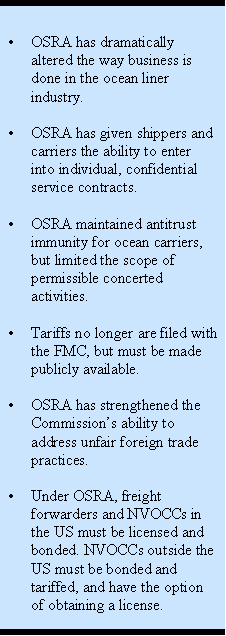
OSRA's amendments to the Shipping
Act of 1984 ("1984 Act") are dramatically altering the way business is conducted
in the ocean liner industry. Nowhere is this more evident than in the material
changes made to the service contracting process. The opportunity for shippers
and carriers to enter into individual, confidential service contracts, and
the inability of carrier agreements to prohibit or directly interfere in
that process, are the cornerstones of the new statute. Under OSRA, fewer
service contract essential terms and no rates are made public. Shippers no
longer have "me-too" rights to obtain the same essential terms as similarly
situated shippers, but for the first time, unrelated shippers have the option
to collectively enter into service contracts. OSRA also extended the authority
to offer joint service contracts to any agreement among ocean common carriers,
not just conferences.
Agreements/Voluntary
Service Contract
Guidelines
OSRA has greatly affected the functions
of traditional liner conferences. While OSRA maintained antitrust immunity
for concerted carrier activities, agreements no longer may prohibit service
contracting by their members, or require members to disclose the details
of their service contract negotiations. An agreement may establish voluntary
service contract guidelines applicable to members' individual service contracting
practices, but they are non-enforceable by the agreement. Additionally, notice
of independent action on tariff rates or charges was reduced from 10 to 5
days.
OSRA did not alter the 45-day period
for Commission review of agreements -- they continue to become effective
in that time absent Commission action to reject, request additional information,
or seek to enjoin an agreement. And, while OSRA made no changes to the general
standard for opposing substantially anti-competitive agreements, a Senate
Commerce Committee Report accompanying OSRA urged the Commission to take
a more active and vigilant role in administering
it.
Tariffs
OSRA eliminated the requirement that
tariffs be filed with the Commission, requiring instead that carriers develop
individual electronic tariff systems available to the public for a reasonable
access charge. The Commission is mandated to prescribe conditions for the
accessibility and accuracy of these systems, and to review them periodically.
Restrictive Foreign
Practices
OSRA gave the Commission greater
ability to guard against predatory pricing by clarifying that pricing activities
are among the practices that may constitute a condition unfavorable to shipping.
OSRA also made the suspension of service contracts available as a remedy
to address unfair foreign practices.
OTI
Licensing and
Bonding
OSRA has grouped both ocean freight
forwarders and NVOCCs under the heading of OTI. NVOCCs in the US now join
ocean freight forwarders in being required to obtain a license -- the
Commission's implementing regulations also permit NVOCCs outside the US to
apply for a license if they so choose. OSRA also requires that every OTI
have a bond or other financial security on file with the Commission. The
bond amounts are $50,000 for freight forwarders, $75,000 for NVOCCs in the
US, and $150,000 for non-licensed foreign
NVOCCs.
Economic
Overview of US
Trades
Competitive
Conditions
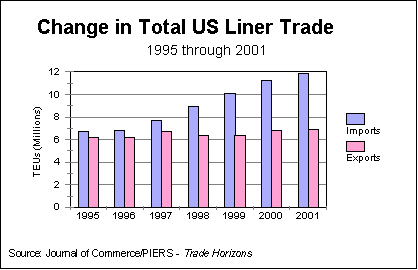
The US liner trades continue to reflect
the ebbs and flows of the world's economy which distinctively play out in
specific trade areas. US international trade volumes continue to grow, with
predictions that cargo volume will double over the next ten years. In the
near term, US containerized imports and exports for 2001 are forecasted to
grow at a slower rate of approximately 5.7 and 1.4 percent, respectively,
over last year's totals.
 Transpacific
-
Inbound: The
Transpacific Stabilization Agreement ("TSA") is the prime example of a discussion
and policy-setting agreement with voluntary pricing authority. The members
exchange information and discuss proposed GRIs, standardized surcharges,
and other pricing-related issues in the US inbound Far East
trade.
Transpacific
-
Inbound: The
Transpacific Stabilization Agreement ("TSA") is the prime example of a discussion
and policy-setting agreement with voluntary pricing authority. The members
exchange information and discuss proposed GRIs, standardized surcharges,
and other pricing-related issues in the US inbound Far East
trade.
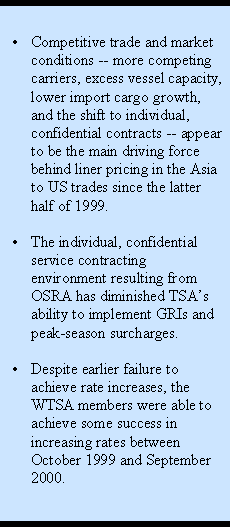
TSA members were largely successful
in implementing proposed GRIs and peak-season surcharges during 1998 and
1999, a period during which demand consistently outstripped the supply of
vessel capacity. More recently, members of TSA have been less effective in
implementing proposed pricing objectives. The cohesiveness of TSA and its
ability to implement rate increases have been reduced by several changes
in underlying competitive trade and market conditions: an increase
in the number of carriers serving the trade; an increase in vessel capacity
deployed; a reduction in import cargo growth; and a shift to individual,
confidential service contracting. Nonetheless, the group still enjoys a high
market share, i.e., approximately 80 percent at the end of the first
half of 2001. During the latter half of 2000 and into early 2001, carriers
and shippers reported declining rates and vessel oversupply following declines
in retailers' orders from Asia and rising unemployment rates in the
US.
TSA has adopted and filed with the
Commission voluntary service contract guidelines that the members may use
in their contract negotiations. A review of TSA members' individual service
contracts shows that, in general, TSA's ability to effectively implement
GRIs and peak-season surcharges appears to have diminished considerably due
to enhanced competition between members in a new individual, confidential
service contracting environment ushered in by OSRA. Negotiations for annual
contracts in May 2000 often resulted in lower rates and, generally, proposed
increases were not achieved. In light of increases in vessel capacity (10
percent) and soft economic trade growth (4-5 percent) during the first half
of 2001, it was no surprise that carriers were unable to obtain the May
2001-announced
GRI.(1)
Transpacific
-
Outbound:
The Westbound Transpacific Stabilization Agreement ("WTSA") is the outbound
counterpart to TSA and, likewise, provides a forum for the exchange of
information (including pricing) among its members. WTSA became the primary
pricing forum in the westbound transpacific trade following the demise of
the outbound conference, the Transpacific Westbound Rate Agreement, on May
1, 1999.
Despite the growing post-OSRA prominence
of discussion agreements in the transpacific, WTSA, for the most part, was
unable to implement relatively minor rate increases as market conditions
prevented members from becoming a cohesive group on pricing. The dramatic
trade imbalance (with vessels reportedly operating at approximately 50 percent
of capacity) significantly contributed to the failure of WTSA members to
achieve proposed rate increases. However, between October 1999 and September
2000, the members of WTSA began to experience higher vessel capacity utilization
as demand increased. Even though the inbound and outbound trades remained
imbalanced, WTSA members were able to achieve some measure of success in
increasing rates.
WTSA has adopted and filed voluntary
service contract guidelines that the members may use in their contract
negotiations. A review of a sample of WTSA members' individual 2000 and 2001
service contracts reveals that, in general, WTSA's relative success in 2000
appears to have been temporary. Declining trade growth, coupled with expanding
capacity, precluded achievement of rate increases during the first half of
2001. Carriers, however, were more successful in implementing a chassis usage
charge during the first half of
2001.
 Transatlantic
Trade: From
the early 1990s to the present, rate-related agreement activity in the
transatlantic trade primarily focused on the major conference between the
US and North Europe. At present, the Trans-Atlantic Conference Agreement
("TACA") faces a much higher degree of rate competition from independent
carriers than in the past. In addition, the authority the conference once
exercised over its members' service contracts has eroded. A combination of
regulatory actions both in the US and Europe dramatically altered the structure
and influence of the conference. The conference declined both in market share
and membership. From its initial formation in 1992, the collective market
share of the conference dropped from close to 80 percent to roughly 50 percent
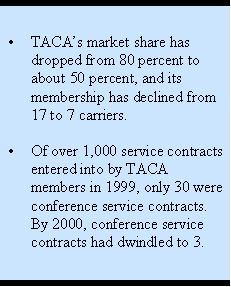
at present. In terms of conference participants, TACA's membership has fallen
from a high of 17 carriers to a low of 7
carriers.
Transatlantic
Trade: From
the early 1990s to the present, rate-related agreement activity in the
transatlantic trade primarily focused on the major conference between the
US and North Europe. At present, the Trans-Atlantic Conference Agreement
("TACA") faces a much higher degree of rate competition from independent
carriers than in the past. In addition, the authority the conference once
exercised over its members' service contracts has eroded. A combination of
regulatory actions both in the US and Europe dramatically altered the structure
and influence of the conference. The conference declined both in market share
and membership. From its initial formation in 1992, the collective market
share of the conference dropped from close to 80 percent to roughly 50 percent
at present. In terms of conference participants, TACA's membership has fallen
from a high of 17 carriers to a low of 7
carriers.
Starting in 1999, TACA amended its
service contract provisions to comply with OSRA, and to resolve legal issues
before the European Commission ("EC"). As such, TACA revised its authority
to permit TACA members to enter into non-conference service
contracts.(2) By the EC's directive, TACA
members are prohibited from adopting voluntary service contract guidelines
that affect their non-conference service contracts. Further, the EC restricts
TACA members from discussing their non-conference service contracts, and
no data or information on such contracts may be submitted to, or collected
by, the conference. TACA, however, may establish a model conference service
contract and rate matrices, provided such information is publicly available.
TACA members are permitted to refer to and adopt such information in their
non-conference service contract negotiations, if they so
choose.
Prior to the foregoing changes, a
major portion of the trade's cargo moved under TACA's conference service
contracts. For instance, TACA reported in its NOI response that nearly 600
conference service contracts were entered into in 1998. In 1999, however,
with OSRA becoming effective and competition accelerating in the trade, TACA
members actively entered into non-conference service contracts. By the end
of 1999, TACA members reported that upwards of 80 percent of their cargo
moved under non-conference service contracts. Of over 1,000 service contracts
entered into by TACA members in 1999, only 30 were conference service contracts.
In 2000, TACA entered into only 3 conference service contracts. Thus, the
decline in TACA's direct authority over its members' service contracts, and
hence pricing, was precipitated by OSRA and the directives of the
EC.
In general, freight rates have reflected
market conditions in the transatlantic trade. Over the past several years,
a trade imbalance has resulted from higher cargo growth in the inbound direction
from North Europe to the US. Consequently, freight rates for inbound cargo
have increased steadily in response to higher demand, while outbound freight
rates have remained unchanged or fallen due to weaker European demand for
US exports. In 2001, TACA implemented moderate tariff GRIs in both trade
directions, and plans to introduce further tariff GRIs toward the end of
the year. The direct impact of TACA's tariff GRIs is limited, however, since
the amount of cargo moved under the conference's rates has diminished. Recently,
TACA reported that only about 10 percent of the cargo carried by TACA members
moved under conference rates. To further gauge the prevailing trends in freight
rates, the Commission examined a limited number of 2000 and 2001 non-conference
service contracts for TACA members. The Commission found that contract rates
in the inbound direction increased moderately from the 2000 contract period
to the 2001 contract period. In the outbound direction, however, the majority
of contract rates remained unchanged and, in some cases, declined in 2001.
These results tended to correspond to the overall market trends in the trade.
Mediterranean/Middle East
Trade: The
Mediterranean is a logical collection point for in-transit cargo. This area
attracts a number of carriers outside the direct US/Mediterranean and Middle
East trade, which contributes to available cargo space. It also has seen
numerous types of arrangements focused on bringing stability to a heavily
imbalanced trade, with imports into the US far exceeding US
exports.
Like the trade between the US and
North Europe, rate-related agreement activity in the US/Mediterranean trade
is focused primarily on the major conference serving the trade. The United
States South Europe Conference ("USSEC") covers the trade between ports and
interior destinations in the US, and South European countries on the
Mediterranean. USSEC has three carrier members with a collective market share
of less than 50 percent as of the first half of 2001. As is the case in the
transatlantic trade, the EC prohibits USSEC members from adopting voluntary
service contract guidelines that affect their non-conference service contracts,
discussing their non-conference service contracts, and sharing information
or data on such non-conference service contracts through the conference
secretariat. USSEC members advise that they have increased their use of
individual service contracts substantially since the enactment of OSRA. The
convenience of one-on-one negotiations with shippers is specifically noted
as a driving factor for this increase. The intense competitive economic
environment in the US/Mediterranean trade has kept freight rates low, especially
in the outbound trade from the US. However, conference members are attempting
to implement rate increases in the relatively stronger inbound trade - announcing
a tariff GRI in January 2001 and a subsequent tariff GRI in May
2001.
The Eastern Mediterranean Discussion
Agreement (formerly the Israel Discussion Agreement), which covers the trade
between the US and Israel, Egypt and Turkey, has adopted and filed voluntary
service contract guidelines. However, given the current overall competitive
trade conditions, adherence appears to be
limited.
South
American
Trade: Changing
competitive trade conditions in South America, along with regulatory changes
under OSRA, have resulted in the demise of the major conferences that once
dominated the South American trades. Joint carrier activity now is accomplished
pursuant to two rate discussion agreements: the East Coast of
South America Discussion Agreement ("ECSADA") and the West Coast of South
America Discussion Agreement ("WCSADA"). The members of both discussion
agreements have commanded a high market share of at least 90 percent in each
trade direction from 1999 through the first half of 2001. Whereas the predecessor
conferences had hundreds of conference service contracts, the only collective
contracting taking place under either discussion agreement at present involves
a number of members contracting jointly without the involvement of the others.
Virtually all service contracts in both agreement trades now are negotiated
by the member lines on an individual basis. ECSADA and WCSADA have adopted
and filed voluntary service contract guidelines that the members may use
in their individual contracts. It appears that members are more likely to
follow the voluntary service guidelines when the market is tight,
i.e., when demand is high and capacity tight, than during slack-demand
periods with overcapacity. For example, during 2000 and the first half of
2001, ECSADA members appear to have adhered closely to their respective
commodity-specific service contract guidelines most of the
time.
Central American and Caribbean
Trades: The Central
America and Caribbean trades have undergone significant changes since the
passage of OSRA. Beginning in 1999, the economies of the region slowed, with
a concomitant decline in cargo, causing excess capacity and falling rates.
These depressed trade conditions were further compounded by the entry of
five new carriers in the trade during
1999.(3) Rate instability forced as many as
six carriers to either scale back services or leave the trade, contributing
to the demise of three conference agreements. Although there remain two
conferences serving the Central America and Caribbean trades, as in other
trade areas, discussion agreements are now the main forum for rate and policy
discussions. Both trades also have witnessed a growth in operational agreements
-- mostly two-party vessel-sharing
arrangements.
The Central America Discussion Agreement
("CADA") and the Hispaniola Discussion Agreement are the predominant agreements
now operating in the trades. Over the past several years, CADA's membership
and market share have fallen. As of the first half of 2001, CADA's membership
stood at five, down from nine in 1999. However, while CADA's outbound market
share to the US remained relatively flat from 1999 through the first half
of 2001, its outbound market share from the US fell from 73.5 percent in
1999 to 62 percent as of the first quarter of 2001. Individual service
contracting by the members of these two agreements since OSRA became effective
appears to have increased, although many of the service contracts are for
small volumes, often as little as one twenty-foot equivalent unit ("TEU").
While CADA has adopted and filed voluntary service contract guidelines, a
review of its members' service contracts shows that they rarely follow
them.
Concentration
 Like other transportation industries, international liner shipping has been
undergoing major structural changes for several years. Liner companies are
being driven by the same fundamental forces: the ongoing globalization
of manufacturing, technological innovations (especially those that support
vertical integration of transportation services, e.g., electronic
communications, automated data systems, larger/faster vessels,
etc.), intense competition and relatively low profit margins,
development of global service networks, deregulation, and privatization.
Carriers have responded to these pressures in several ways, including engaging
in a rash of mergers and acquisitions and forming global strategic alliances.
Like other transportation industries, international liner shipping has been
undergoing major structural changes for several years. Liner companies are
being driven by the same fundamental forces: the ongoing globalization
of manufacturing, technological innovations (especially those that support
vertical integration of transportation services, e.g., electronic
communications, automated data systems, larger/faster vessels,
etc.), intense competition and relatively low profit margins,
development of global service networks, deregulation, and privatization.
Carriers have responded to these pressures in several ways, including engaging
in a rash of mergers and acquisitions and forming global strategic alliances.
Since 1994, nearly all principal
global containership operators have grouped themselves into alliances. Through
operational cooperation, carriers have the opportunity to reduce costs and
business risks, while offering a broader range of improved customer service
options. The formation of global strategic alliances arguably has slowed
the pace of concentration in liner shipping because they offer a number of
the benefits associated with mergers (i.e., economies of scale,
expansion and improvement of services, etc.) while limiting members'
exposure to investment risk. Some carriers have chosen to venture beyond
alliances and have engaged in mergers or acquisitions that increase their
size and expand their scope of operations. Since 1995, seven principal mergers
and more than 30 acquisitions have taken place.
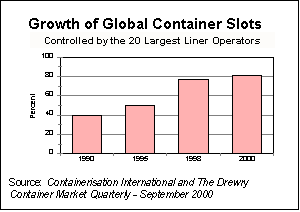 As a result of this increased merger and acquisition activity, the liner
shipping industry has become more concentrated over the last decade. In 1990,
the 20 largest liner operators controlled approximately 40 percent of the
global container slots. In 1995, their share grew to 50 percent; three years
later it jumped to 77 percent. By 2000, the top 20 operators controlled 81
percent of the worldwide fleet.(4) While the
industry is still highly fragmented -- with several hundred companies (including
feeder operators) offering regular liner services -- the largest operators
clearly dominate current container
supply.
As a result of this increased merger and acquisition activity, the liner
shipping industry has become more concentrated over the last decade. In 1990,
the 20 largest liner operators controlled approximately 40 percent of the
global container slots. In 1995, their share grew to 50 percent; three years
later it jumped to 77 percent. By 2000, the top 20 operators controlled 81
percent of the worldwide fleet.(4) While the
industry is still highly fragmented -- with several hundred companies (including
feeder operators) offering regular liner services -- the largest operators
clearly dominate current container
supply.
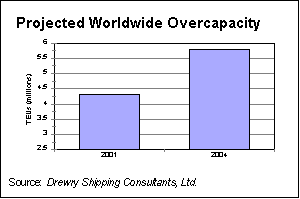
Industry reports suggest that over
the next three years, more than 1.5 million additional TEUs will be deployed,
representing an increase over current worldwide fleet capacity of nearly
35 percent, or an annualized growth rate of more than 12
percent.(5) In contrast, worldwide trade growth
is expected to increase by less than 9 percent. While the long-term effect
of continued industry consolidation remains uncertain, some industry
representatives believe that under these pressures, renewed merger/acquisition
activity can be expected.
CHANGES IN SERVICE
CONTRACTING
 Statutory
Changes
Statutory
Changes
Before the OSRA amendments, the 1984
Act permitted only individual carriers and conferences to enter into service
contracts. Conferences had the authority to regulate or prohibit their members'
use of service contracts. Except for brief periods, conferences rarely permitted
their members to engage in any form of independent service
contracting.(6) The statute required service
contracts to be confidentially filed with the Commission, and rates and other
essential terms to be made available to the public in tariff format. To
discourage any undue discrimination, carriers and conferences were required
to make the same essential terms available to similarly situated shippers
for a period of 30 days. This requirement was known as the "me-too" provision.
In 1993, the publication of tariffs and essential terms was computerized
with the introduction of the Commission's Automated Tariff Filing and Information
("ATFI") System.
Numerous pro-competitive reforms
enacted under OSRA to increase the market responsiveness of the industry
were aimed at service contracting. Under OSRA, only certain essential terms
now are required to be published; significantly, freight rates are among
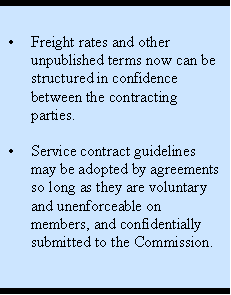
the non-published terms. Consequently, freight rates and other unpublished
terms now can be structured in confidence between the contracting parties.
In addition, the "me-too" requirement for similarly situated shippers was
eliminated.
Significant reforms relating to service
contracts were directed at reducing the collective control of conferences.
For one, all agreements now are permitted to enter into service contracts,
not just conferences, as was the case under the 1984 Act before amendment.
With this change, however, strict statutory prohibitions were placed on the
contracting authority of agreements. OSRA prohibits agreements from restricting
the right of their members to independently negotiate and enter into individual
service contracts. Moreover, agreements cannot require members to disclose
their individual service contract negotiations or unpublished terms, nor
adopt mandatory rules affecting such contracts. Voluntary service contract
guidelines, however, may be adopted by agreements so long as they are
unenforceable and confidentially submitted to the
Commission.
Individual carriers and agreements
still are required to file their service contracts confidentially with the
Commission under OSRA. For ease of filing, the Commission replaced its former
paper-format filing system with the electronic Service Contract Filing System
("SERVCON"). The Commission placed SERVCON into operation when OSRA became
effective on May 1, 1999.
The NOI and the Random Sample
of Service
Contracts
In order to identify pertinent
developments concerning service contracting under OSRA, the Commission's
NOI solicited comments from carriers and shippers on specific issues. In
addition, the Commission conducted a comprehensive service contract survey.
As discussed in Appendix II, the Commission's survey was based on two
computer-generated random samples of original service contracts on file in
SERVCON. Each random sample contained 500 contracts, so that a total of 1,000
separate contracts were reviewed. Relevant information from each contract
was entered into a unique database for each sample. This approach allowed
the Commission to analyze and compare the survey results of the two separate
random samples. A high degree of consistency existed between the two samples
on most of the issues examined, which added confidence to the survey results.
(See Appendix II.)
 Overall, the use of service contracts has increased significantly under OSRA.
According to NOI comments, this increase in contracting was due primarily
to the change from conference control of service contract availability to
easily obtainable and flexible individual service contracts. The 200 percent
increase in the number of service contracts and amendments filed with the
Commission since May 1999 bears witness to the fact that service contracting
is now overwhelmingly the primary rate-setting vehicle. As noted below, however,
most service contracts are linked to tariffs for accessorial charges, surcharges,
and certain rules. To effect changes across numerous contracts, it is more
expedient for carriers to make a single tariff change than amend multiple
service contracts. Carriers also use tariffs to publish the required service
contract essential terms.
Overall, the use of service contracts has increased significantly under OSRA.
According to NOI comments, this increase in contracting was due primarily
to the change from conference control of service contract availability to
easily obtainable and flexible individual service contracts. The 200 percent
increase in the number of service contracts and amendments filed with the
Commission since May 1999 bears witness to the fact that service contracting
is now overwhelmingly the primary rate-setting vehicle. As noted below, however,
most service contracts are linked to tariffs for accessorial charges, surcharges,
and certain rules. To effect changes across numerous contracts, it is more
expedient for carriers to make a single tariff change than amend multiple
service contracts. Carriers also use tariffs to publish the required service
contract essential terms.
 The increase in individual contracting also has altered the structure of
the industry. In their NOI comments, carriers related that the high demand
for individual contracts led to the termination or suspension of major conference
agreements in such trade areas as the transpacific and South America. In
their place, carriers have structured their collective associations more
loosely under discussion agreements with voluntary rate authority and service
provisions. In trades where conferences remain, agreement contracts among
conference members have fallen significantly. In comparing calendar years
1998 and 2000, conference service contracts fell from 596 to 3 for TACA,
and from 125 to 7 for the US Australasia Agreement. Former and present conference
carriers in these trades now are entering into a greater number of service
contracts on an individual basis with shippers outside the direct control
of their respective agreements.
The increase in individual contracting also has altered the structure of
the industry. In their NOI comments, carriers related that the high demand
for individual contracts led to the termination or suspension of major conference
agreements in such trade areas as the transpacific and South America. In
their place, carriers have structured their collective associations more
loosely under discussion agreements with voluntary rate authority and service
provisions. In trades where conferences remain, agreement contracts among
conference members have fallen significantly. In comparing calendar years
1998 and 2000, conference service contracts fell from 596 to 3 for TACA,
and from 125 to 7 for the US Australasia Agreement. Former and present conference
carriers in these trades now are entering into a greater number of service
contracts on an individual basis with shippers outside the direct control
of their respective agreements.
Service contracts also are being
used to ship a greater volume of cargo as a result of OSRA. NOI commenters
revealed that substantial portions of cargo shipped under tariffs prior to
OSRA shifted to individual contracts. In certain of the major trade lanes,
some shippers now are moving nearly 100 percent of their cargo under service
contracts. This shift is due primarily to the confidentiality and flexibility
achieved through individual contracts. In several trades where the volume
of service contract cargo had been 50 to 60 percent, some carriers indicated
that the volume jumped to 80 percent and greater under
OSRA.
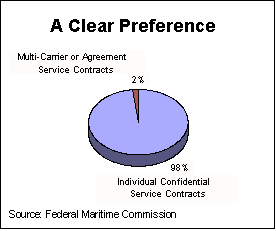
The preference for individual contracting
clearly was discernible from the Commission's random sample survey. Of the
1,000 separate contracts surveyed, 98 percent were individual contracts.
In their responses to the NOI, carriers and shippers reported numerous advantages
of contracting on an individual basis, but acknowledged an increased
administrative burden in managing the contracts. The main advantage was the
ability to engage in one-on-one negotiations with greater flexibility to
structure contracts as needed. Overall, shippers have found carriers more
responsive in meeting their specific contract requirements under OSRA. The
process of obtaining and amending individual contracts also was reported
to be easier and more efficient than in the past when dealing with conference
contracts. No longer are extended delays incurred in seeking the approval
of contracts and amendments through the conference's voting procedures.
Consequently, individual contracts are amended more frequently to reflect
changing market conditions.
Specific changes in contracting included
a trend toward smaller minimum volume commitments. The Commission's survey
showed that roughly 60 percent of the contracts sampled had minimum volume
commitments of 100 TEUs or less -- commitments ranged from one TEU to 68,000
TEUs. The willingness of carriers to allow smaller minimum volume commitments
was recognized in the NOI comments as a new development attributable to OSRA.
Contract duration, however, has remained predominantly within a one-year
period as before OSRA. The survey revealed that 90 percent of the contracts
had durations of 11 months or less, with a range from a few days to upwards
of two years. So far, contracts with smaller cargo commitments and limited
durations seem to be the market preference. Several commenters noted, however,
that such terms frequently are expanded through amendments beyond those initially
agreed to in the original contract.
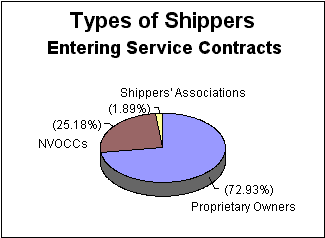 The Commission's
survey found no significant changes from the results of past studies on the
division of contracts between proprietary owners, NVOCCs, and shippers'
associations. Of the contracts sampled, over 70 percent were with proprietary
owners, roughly 25 percent were with NVOCCs, and 2 percent were with shippers'
associations. No shippers complained of an inability to obtain contracts.
However, some shippers' associations noted that since OSRA, carriers have
tried more aggressively to solicit independently their individual members.
To prevent this, some associations have included specific clauses addressing
such solicitation in their
contracts.
The Commission's
survey found no significant changes from the results of past studies on the
division of contracts between proprietary owners, NVOCCs, and shippers'
associations. Of the contracts sampled, over 70 percent were with proprietary
owners, roughly 25 percent were with NVOCCs, and 2 percent were with shippers'
associations. No shippers complained of an inability to obtain contracts.
However, some shippers' associations noted that since OSRA, carriers have
tried more aggressively to solicit independently their individual members.
To prevent this, some associations have included specific clauses addressing
such solicitation in their
contracts.
OSRA also increased the ability of
carriers and shippers to expand contract scopes by including multiple US
trades and adding foreign-to-foreign trades. Combining more trades and cargo
within a single contract gives shippers greater leverage in their negotiations
with carriers. While most NOI respondents reported some expansion of contract
scopes, the Commission's survey results revealed that the majority of contracts
had scopes confined to one US trade or geographic area, particularly in the
US/Asia trade. Ten percent of the total contracts sampled had scopes with
multiple US trade lanes, and 8 percent had global scopes -- i.e.,
scopes which included foreign-to-foreign trades. Shippers that conduct a
broader and more varied range of business worldwide may take advantage of
contracts with expanded scopes. Such shippers include large multi-national
companies, NVOCCs, and shippers' associations. Some NOI commenters related
problems with the regional dispersion of operations among both shippers and
carriers, which complicated structuring multi-trade and global contracts.
Carriers further noted a reluctance among some shippers to include their
foreign-to-foreign arrangements in US trade
contracts.
 Changes to the content of contracts have been moderate thus far under OSRA.
Carriers commented that the approach to adding contract clauses has been
gradual and cautious, with shippers preferring as much contract simplification
as possible. Recent developments show a compromise between contracting parties,
with some clauses favoring shippers and others benefiting carriers. The most
common changes include the addition of confidentiality clauses, specific
vessel space guarantees, advance booking notices, slack-season volume guarantees,
and certain standard or model contract terms. An increase in the use of vessel
space guarantees in contracting occurred post-OSRA, particularly in the inbound
transpacific as a result of tight demand during 1998 and 1999. Carriers also
mentioned more service guarantees for equipment and set transit times. On
the other hand, some shippers expressed concern over the use of service
commitment disclaimers to cover cases where the carrier uses chartered vessel
space. Shippers also mentioned their interest in increasing carrier liability
for cargo loss and damage beyond that provided in the standard bill of lading.
The Commission's survey examined contracts specifically for such provisions
as equipment guarantees, transit times, and increased carrier liability.
Less than 10 percent of the contracts sampled contained any of these provisions.
While such provisions are not widespread as yet, both carriers and shippers
foresee many of these issues as areas of future contract development over
the next five years.
Changes to the content of contracts have been moderate thus far under OSRA.
Carriers commented that the approach to adding contract clauses has been
gradual and cautious, with shippers preferring as much contract simplification
as possible. Recent developments show a compromise between contracting parties,
with some clauses favoring shippers and others benefiting carriers. The most
common changes include the addition of confidentiality clauses, specific
vessel space guarantees, advance booking notices, slack-season volume guarantees,
and certain standard or model contract terms. An increase in the use of vessel
space guarantees in contracting occurred post-OSRA, particularly in the inbound
transpacific as a result of tight demand during 1998 and 1999. Carriers also
mentioned more service guarantees for equipment and set transit times. On
the other hand, some shippers expressed concern over the use of service
commitment disclaimers to cover cases where the carrier uses chartered vessel
space. Shippers also mentioned their interest in increasing carrier liability
for cargo loss and damage beyond that provided in the standard bill of lading.
The Commission's survey examined contracts specifically for such provisions
as equipment guarantees, transit times, and increased carrier liability.
Less than 10 percent of the contracts sampled contained any of these provisions.
While such provisions are not widespread as yet, both carriers and shippers
foresee many of these issues as areas of future contract development over
the next five years.
Under OSRA, the prevailing rates
no longer are transparent and contracting has become more customized. In
their NOI responses, carriers consistently maintained that rate levels are
determined by market forces, and contended that individual contracting has
created more rate competition. NVOCCs complained that their inability to
contract as carriers places them at a rate disadvantage under OSRA. At the
same time, NVOCCs acknowledged that carriers are more agreeable to establish
"bullet rates"(7) in contracts, enabling them
to amend their contract rate levels with carriers more easily and frequently.
Some shippers commented that GRI clauses and other such tariff links in contracts
which allow for the pass-through of rate increases and surcharges that are
difficult to anticipate or ascertain are antithetical to the purpose of
contracting for a specified rate. Carriers maintained that such tariff references
and links make drafting and managing contracts
easier.
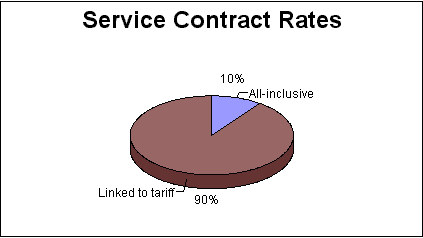 The Commission's
survey revealed that roughly 10 percent of the contract rates were completely
all-inclusive, while approximately 90 percent were linked or referenced to
a tariff. The survey defined completely all-inclusive as single rates inclusive
of freight and all other applicable charges for a fixed duration. Many contracts
contained rates inclusive of specific surcharges for fixed durations, with
the proviso that any other charges in the governing tariff would apply. Such
contracts, however, did not meet the survey's definition of completely
all-inclusive. In addition, the survey found that 36 percent of the contracts
contained GRI clauses or other such provisions for the general increase of
freight rates connected to tariff rate increases. Some GRI clauses directly
passed through the tariff rate increases, while others gave the shipper the
option to terminate the contract. While tariff references in contracts are
not new, their use under OSRA has created some controversy regarding the
carriers' ability to influence contract rate levels and terms collectively.
The Commission's
survey revealed that roughly 10 percent of the contract rates were completely
all-inclusive, while approximately 90 percent were linked or referenced to
a tariff. The survey defined completely all-inclusive as single rates inclusive
of freight and all other applicable charges for a fixed duration. Many contracts
contained rates inclusive of specific surcharges for fixed durations, with
the proviso that any other charges in the governing tariff would apply. Such
contracts, however, did not meet the survey's definition of completely
all-inclusive. In addition, the survey found that 36 percent of the contracts
contained GRI clauses or other such provisions for the general increase of
freight rates connected to tariff rate increases. Some GRI clauses directly
passed through the tariff rate increases, while others gave the shipper the
option to terminate the contract. While tariff references in contracts are
not new, their use under OSRA has created some controversy regarding the
carriers' ability to influence contract rate levels and terms collectively.
Thus far, OSRA's reforms have increased
the use of contracting both in terms of the number of service contracts and
cargo volume. New options in contracting are available, and business
relationships are evolving as contemplated. OSRA has reduced the direct control
of conferences, with greater freedom and flexibility of contracting on an
individual basis, while preserving the option for agreement contracts. With
contract rates and certain service terms no longer published, parties are
free to privately structure their contracts in accordance with their individual
business requirements. Service contracts are easier to obtain and amend.
For the most part, OSRA has enabled contracts to be fashioned and consummated
in a more market-responsive environment as intended.
SERVICE CONTRACT
CONFIDENTIALITY
OSRA's
Changes
 As previously discussed, OSRA's changes regarding the confidentiality of
service contracts have had a significant impact on the way service contracts
are developed and negotiated. OSRA discontinued the publication of rates
and certain other terms -- published essential terms now are limited to the
origin/destination port ranges, commodities, minimum commitments, and durations
of service contracts. All other essential terms now can be kept confidential
between the contracting parties. In this new environment, added measures
to preserve confidentiality in contracting have evolved. Specific clauses
and provisions have been included in contracts to restrict the disclosure
of unpublished terms to third parties. In some cases, contracting parties
have entered into agreements to ensure confidentiality prior to negotiations,
or added penalty provisions for breach of confidentiality. The Commission
specifically explored the effects and use of contract confidentiality in
both its NOI and its survey of service contracts randomly selected from
SERVCON.
As previously discussed, OSRA's changes regarding the confidentiality of
service contracts have had a significant impact on the way service contracts
are developed and negotiated. OSRA discontinued the publication of rates
and certain other terms -- published essential terms now are limited to the
origin/destination port ranges, commodities, minimum commitments, and durations
of service contracts. All other essential terms now can be kept confidential
between the contracting parties. In this new environment, added measures
to preserve confidentiality in contracting have evolved. Specific clauses
and provisions have been included in contracts to restrict the disclosure
of unpublished terms to third parties. In some cases, contracting parties
have entered into agreements to ensure confidentiality prior to negotiations,
or added penalty provisions for breach of confidentiality. The Commission
specifically explored the effects and use of contract confidentiality in
both its NOI and its survey of service contracts randomly selected from
SERVCON.
Prior to OSRA, carriers and shippers
could access the contract rates and terms of their competitors directly,
and relied heavily on the published essential terms of service contracts
as benchmarks in their own negotiations. Contract terms achieved by a particular
shipper were published and made available to any similarly situated shipper
through the "me-too" provision. Accordingly, carriers were more reluctant
to grant specific contract concessions for a particular shipper since their
other customers could request equal treatment. The transparency of information
constrained the commercial benefits of contract specialization for both carriers
and shippers.
Industry
Experiences
The confidentiality of information
under OSRA has altered the process of negotiating contracts considerably.
Comments in response to the Commission's NOI indicate that contract negotiations
are less focused on meeting a market-rate benchmark, or matching the terms
of competitors, and more attention is given to internal cost factors and
individual service requirements in contracts. Shippers and carriers advise
that they can discuss and address commercially sensitive issues more freely,
and privately structure their contracts accordingly. Respondents note that
greater emphasis is placed on the skill of conducting negotiations to achieve
business objectives. In their comments, shippers and carriers reported that
confidentiality has created a more favorable contracting process in which
it is easier to accommodate specific rate discounts and terms. NVOCCs concurred
with the general view that confidentiality has improved the contracting process,
but commented that tariff publication puts them at a competitive disadvantage
relative to VOCCs.
Since OSRA, more attention must be
devoted to evaluating market conditions through other sources of information.
Carriers commented that internal contract accounts and rate bids from shippers
constitute their main sources of market information. They contended that
some shippers use rate quotes from competing carriers as leverage for better
rate offers. Carriers noted, however, that such rate information is hard
to validate, and added that tariffs generally are not reflective of market
rates. Shippers commented that a wide range of published information and
data including tariffs is used in their market evaluations. They disclosed
that carrier sales representatives also provide a certain amount of market
information. Shippers' associations support their shipper members by collecting
and distributing market
information.
Shippers claimed to be at a disadvantage
relative to carriers in terms of market knowledge, noting that carriers can
make broader observations due to their greater access to information about
the overall market. Further, shippers complained that voluntary service contract
guidelines adopted by agreements allow carriers to share contract rate
information at agreement meetings. Carriers and agreements acknowledged that
some contract rate information is shared at agreement meetings, but stressed
that carriers must honor the confidentiality provisions of their individual
contracts. Carriers pointed out that much less specific contract information
is made available to agreement secretariats as a result of OSRA. They also
questioned the accuracy of contract rate information shared by competing
carriers at agreement meetings. Clearly, reliable rate information now is
more valuable and increasingly sought throughout the industry.
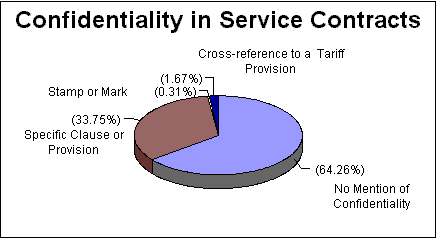
However, confidentiality clauses
and provisions increasingly are being added to contracts to restrict the
disclosure of unpublished contract terms. The Commission's survey specifically
reviewed the texts of the contracts for any of the following forms of
confidentiality between the parties: (1) a specific confidentiality
clause or provision, (2) a cross-reference to a tariff provision that describes
the parties' obligations with respect to confidentiality, or (3) a stamp
or mark of confidentiality within the contract. The survey revealed that
just over 35 percent of the contracts sampled contained one of the aforementioned
forms of confidentiality stated within their
texts.(8) For the most part, the confidentiality
clauses found in the survey stipulated that neither the carrier party nor
the shipper party could disclose unpublished contract information to third
parties. In some cases, clauses were less restrictive and allowed the carrier
party to share unpublished information with an agreement secretariat or other
carrier members of an agreement without identifying the shipper party.
 Certain carriers
disclosed in their NOI comments that internal controls and new procedures
were developed to limit the exposure of confidential contract information
within their companies. On the use of confidentiality in contracting, roughly
half of the carrier respondents indicated that standard confidentiality clauses
automatically are included in 100 percent of their contracts. Those carriers
also reported that shippers requested specifically crafted confidentiality
clauses or language in about 5 percent of the carriers' contracts. Such requests
were acceptable to the carriers so long as the confidentiality terms were
reciprocal. Other carriers stated that as a matter of policy, confidentiality
clauses are added to contracts only at the shipper's request. Further comments
disclosed that some of the larger shippers sought confidentiality agreements
prior to conducting contract negotiations. Such agreements usually were initiated
by shippers, and here again, carriers found them acceptable as long as the
terms were reciprocal.
Certain carriers
disclosed in their NOI comments that internal controls and new procedures
were developed to limit the exposure of confidential contract information
within their companies. On the use of confidentiality in contracting, roughly
half of the carrier respondents indicated that standard confidentiality clauses
automatically are included in 100 percent of their contracts. Those carriers
also reported that shippers requested specifically crafted confidentiality
clauses or language in about 5 percent of the carriers' contracts. Such requests
were acceptable to the carriers so long as the confidentiality terms were
reciprocal. Other carriers stated that as a matter of policy, confidentiality
clauses are added to contracts only at the shipper's request. Further comments
disclosed that some of the larger shippers sought confidentiality agreements
prior to conducting contract negotiations. Such agreements usually were initiated
by shippers, and here again, carriers found them acceptable as long as the
terms were reciprocal.
On a related issue, the Commission's
survey showed that only 2 percent of the contracts sampled contained penalty
provisions for breach of confidentiality. The breach penalties predominantly
focused on the recourse of legal action with court remedies. Most NOI comments
voiced no significant concern with respect to breach of confidential information.
Carriers stated that cases of suspected breach usually were treated by limiting
the number of participants in future negotiations. Certain carriers recognized
that sales representatives and shippers exchanged market information in the
course of making contract proposals, but did not characterize breach of
confidential information as a problem. Another shippers' association expressed
concern over the possible breach of confidentiality given non-contract parties'
broad access to rate information on bills of
lading.
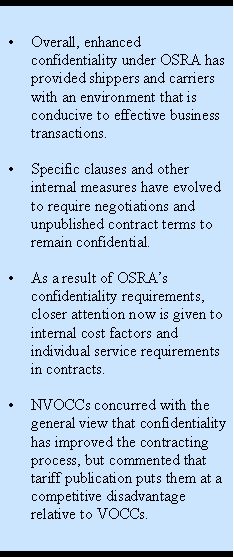
Overall, the responses reflect that
confidentiality under OSRA has provided shippers and carriers with the privacy
they deem necessary to freely transact business. With the ability to shield
such information, the contracting process is not constrained by the previous
standards of meeting benchmarks and matching terms identically. Commercially
sensitive issues and business requirements can be discussed more freely and
accommodated more easily with specific contract terms. Carriers and shippers
are more focused on achieving their individual rate and business objectives
through contract negotiations. Specific clauses and other internal measures
have evolved to ensure that negotiations and unpublished contract terms remain
confidential.
AGREEMENT
ACTIVITY/VOLUNTARY
SERVICE CONTRACT
GUIDELINES
Industry
Structure Overview
 While liner operators have enjoyed antitrust immunity since 1916, the last
decade has seen dramatic changes in their exercise of this privilege. No
longer can the structure of liner shipping be viewed as fifty or so major
carriers operating autonomously. It is more appropriate to view the industry
as blocs of operational partnerships with crisscross ties via space charters
between and among different members of different partnership blocs. Such
arrangements are important to understand when reviewing the use of antitrust
authority. The Commission is acutely aware of the growing mosaic of
vessel-sharing, alliance, and space-chartering configurations that can form
a web, often with a discussion agreement bringing all involved carriers together.
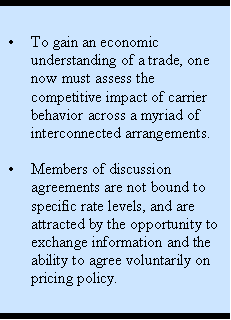
An economic understanding of a trade no longer can be garnered merely by
focusing on a single agreement -- the competitive impact of carrier behavior
across a myriad of interconnected relationships must be
assessed.
While liner operators have enjoyed antitrust immunity since 1916, the last
decade has seen dramatic changes in their exercise of this privilege. No
longer can the structure of liner shipping be viewed as fifty or so major
carriers operating autonomously. It is more appropriate to view the industry
as blocs of operational partnerships with crisscross ties via space charters
between and among different members of different partnership blocs. Such
arrangements are important to understand when reviewing the use of antitrust
authority. The Commission is acutely aware of the growing mosaic of
vessel-sharing, alliance, and space-chartering configurations that can form
a web, often with a discussion agreement bringing all involved carriers together.
An economic understanding of a trade no longer can be garnered merely by
focusing on a single agreement -- the competitive impact of carrier behavior
across a myriad of interconnected relationships must be
assessed.
The emergence of global markets and
anticipated deregulation under OSRA were the twin catalysts that triggered
de-emphasis on traditional conferences and the continual migration to operational
agreements. In 1996, one observer opined that "[a]ny history of the industry
will have to distinguish between 'Before Global Alliance' and 'After Global
Alliance,' so radical are the changes which the new structure
promises."(9) The story of the use of antitrust
immunity under OSRA is the progressive shifting from a demand-side focus
to a realization of the considerable possibilities to be gained from a
supply-side focus.
Discussion
Agreements
During the 1980s, the traditional
demand-side preoccupation was with rate stability, and the vehicle to address
this single concern was the stereotypical, binding-ratemaking conference.
The emergence of strong non-conference carriers, bringing a homogeneity of
services across most liner operators, fractured the existing industry structure
of strong conferences and weak non-conference carriers. The conference system
was unable to deal with outsiders that provide a similar level of service,
traditionally the exclusive domain of conference carriers. Given continued
price-spread tensions between conference and committed non-conference carriers,
in the face of endemic overtonnaging, there was pressure for some forum to
mitigate rate competition between these two groups. The Eurocorde Discussion
Agreement in the transatlantic and TSA in the US inbound Far East trade emerged
in response to these forces. While the conference carriers were unable to
entice the committed independents to become conference members and engage
in binding ratemaking, they were able to bring them under the discussion
agreement umbrella of voluntary ratemaking. Furthermore, during the late
1980s, carriers realized that supply-side control could be extremely powerful
in curtailing destructive rate competition and consequently turned to capacity
management in discussion
agreements.
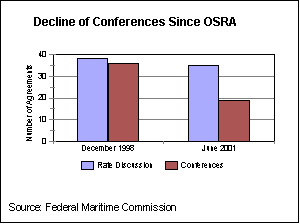 With the demise of the conference system, the discussion agreement, by default,
became the sole forum for collective carrier pricing activity in most US
liner trades. In the major trades, it is able to attract key players by being
less bureaucratic and autocratic than the traditional conference. Members
are not bound to specific rate levels, and among the variety of their features
found attractive, the opportunity to exchange information and the ability
to agree voluntarily on pricing policy are paramount. Although a discussion
agreement's ratemaking may not be on the rigid, enforceable scale of the
traditional conference, the ability of the members to share commercial
information and formulate pricing policy can have a considerable demand-side
influence under certain economic conditions.
With the demise of the conference system, the discussion agreement, by default,
became the sole forum for collective carrier pricing activity in most US
liner trades. In the major trades, it is able to attract key players by being
less bureaucratic and autocratic than the traditional conference. Members
are not bound to specific rate levels, and among the variety of their features
found attractive, the opportunity to exchange information and the ability
to agree voluntarily on pricing policy are paramount. Although a discussion
agreement's ratemaking may not be on the rigid, enforceable scale of the
traditional conference, the ability of the members to share commercial
information and formulate pricing policy can have a considerable demand-side
influence under certain economic conditions.
Unlike conferences, which saw a marked
decline in their numbers (almost one-third either disbanded or were suspended
about the time OSRA became effective in May 1999), the number of rate discussion
agreements has remained somewhat stable during the first two years of OSRA.
As of June 1, 2001, there were 19 conferences and 36 discussion agreements
in effect. Further, consistent with the decline in the number of conferences,
the number of discussion agreements that include a conference as a member
has likewise fallen. The Commission's June 2000 Interim Status Report noted
that there were 18 such agreements at that time. Currently, there are only
four such agreements.
Operational
Agreements
The demand-side demise of the traditional
conference system and the emergence of discussion agreements undoubtedly
are major hallmarks of the OSRA era. But the bigger headline is on the supply
side, where carriers have turned to operational agreements to achieve significant
efficiencies and global service
expansion.
Globalization requires carriers to
expand into new markets, and deregulation made it unlikely that strong
conferences would be the vehicle for such expansion. The global strategic
alliance soon emerged as the key vehicle for a carrier's entry into new markets
by offering the ability to expand service and geographic coverage, while
limiting individual risk and
capital.
Alliances, like globalization and
deregulation, developed gradually. Upon recognizing the advantages of operational
cooperation, carriers initially ventured into space-chartering, joint services,
and vessel-sharing arrangements that were typically confined to a single
trade lane. Positive experiences in deployment and vessel-sharing cost savings
led to more involved cooperation, and ultimately to the global strategic
alliance as we know it. Alliances essentially strove to maximize the advantages
of operational cooperation while maintaining individual marketing. Alliance
partners worked to capture efficiencies across the entire gamut of shared
operational assets such as vessels, containers, marine terminals, equipment,
and inland facilities.
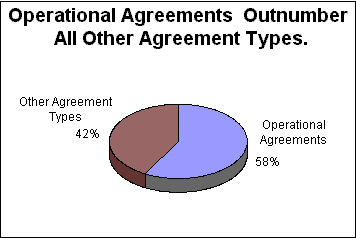 Operational
agreements comprised 58 percent of all effective agreements on file with
the Commission as of June 1, 2001. They range in scope and complexity from
simple space-sharing arrangements (for example, one carrier selling to another
25 TEUs of space on one vessel operating in a single trade), to the highly
integrated multi-carrier, multi-trade lane, global strategic alliances
(typically, 3-5 carriers coordinating the services of numerous -- often as
many as 80 -- vessels calling at ports worldwide). Although global alliance
agreements are not numerous,(10) reports
indicate that in the main east-west trades, alliances now account for between
60 to 65 percent of all slots deployed. Moreover, alliances and the use of
new technologies have enabled ocean carriers to reduce their average cost
by more than $260/TEU over the past four
years.(11)
Operational
agreements comprised 58 percent of all effective agreements on file with
the Commission as of June 1, 2001. They range in scope and complexity from
simple space-sharing arrangements (for example, one carrier selling to another
25 TEUs of space on one vessel operating in a single trade), to the highly
integrated multi-carrier, multi-trade lane, global strategic alliances
(typically, 3-5 carriers coordinating the services of numerous -- often as
many as 80 -- vessels calling at ports worldwide). Although global alliance
agreements are not numerous,(10) reports
indicate that in the main east-west trades, alliances now account for between
60 to 65 percent of all slots deployed. Moreover, alliances and the use of
new technologies have enabled ocean carriers to reduce their average cost
by more than $260/TEU over the past four
years.(11)
While operational agreements such
as global alliances and basic space-chartering/vessel-sharing arrangements
have the potential to reduce costs and expand the service network of each
participant, there may be down sides to such supply-side forms of cooperation.
Some shippers pointed out in their NOI responses that, in certain cases,
carriers that are party to these integrated operational arrangements no longer
have complete control over assets and, therefore, are unable to guarantee
vessel space.(12) There also may be instances
in which service levels (i.e., capacity and number of vessel calls)
are reduced as a result of carrier cooperation because the service is "shared"
among carriers.
On the other hand, operational agreements
offer an alternative to consolidation through mergers and acquisitions. These
operational agreements arguably provide shippers with more service choices
and the possible preservation of competition with respect to price and ancillary
or related services, as compared with the results of mergers and
acquisitions.
Internet Portal
Agreements
Like most other industries, ocean
shipping is adapting to the age of the Internet. A new carrier innovation
that improves operational efficiencies and financial results is the formation
of Internet portal agreements. Two portal agreements have been filed with
the Commission that provide "one-stop shopping" Internet sites. Under these
agreements, the participating carriers have established a common Internet
portal and platform through which the carriers and other transportation service
providers interact with shippers through a common set of transactions covering
tracking and tracing, booking, and the like. The portals also contain links
to the individual carriers' own
web-sites.
Voluntary Service Contract
Guidelines
With the proliferation of individual
service contracts since OSRA, greater scrutiny has shifted toward determining
the degree of influence agreements are able to exert on the contracting practices
of their agreement members. As broad-based discussion agreements evolved
in many trades, attention has focused on the agreement members' adoption
of and adherence to voluntary service contract guidelines affecting individual
service contracts. The extent to which agreement members adhere to voluntary
service contract guidelines, especially on rate matters, gives an indication
of the agreement's collective influence or market power in its respective
trade. Under OSRA, agreements that adopt guidelines are required to submit
them confidentially to the Commission. Because of the confidential nature
of the guidelines and the service contracts actually filed, the results of
our review of the nature of and adherence to voluntary service contract
guidelines may be reported only in general terms. At present, the Commission
receives guideline submissions from 19 agreements.
Guideline
Content
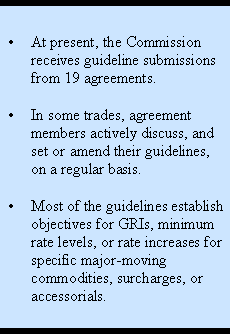 The guidelines adopted by the respective agreements vary considerably. It
is evident in some trades that agreement members actively discuss, and set
or amend their guidelines, on a regular basis. Activity often centers on
very specific rules or charges for particular countries within the geographic
scopes of the agreements. Conversely, in other trades, agreement members
set very basic guidelines on an infrequent or sporadic basis. Most of the
guidelines establish objectives for GRIs, minimum rate levels, or rate increases
for specific major-moving commodities, surcharges, or accessorials. One
particular set of guidelines recommended that agreement members use time-volume
rates rather than service contracts. Many guidelines encouraged open
communication between members on information relating to proposed or effective
individual service contracts, provided that no confidentiality agreements
are breached. Other guidelines discouraged rate discount mechanisms in their
contracts, and instead recommended including automatic GRI clauses. Some
guidelines further recommended using prescribed confidentiality clauses,
as well as establishing specific dollar limitations for cargo loss or damage
in line with the Carriage of Goods by Sea Act.
The guidelines adopted by the respective agreements vary considerably. It
is evident in some trades that agreement members actively discuss, and set
or amend their guidelines, on a regular basis. Activity often centers on
very specific rules or charges for particular countries within the geographic
scopes of the agreements. Conversely, in other trades, agreement members
set very basic guidelines on an infrequent or sporadic basis. Most of the
guidelines establish objectives for GRIs, minimum rate levels, or rate increases
for specific major-moving commodities, surcharges, or accessorials. One
particular set of guidelines recommended that agreement members use time-volume
rates rather than service contracts. Many guidelines encouraged open
communication between members on information relating to proposed or effective
individual service contracts, provided that no confidentiality agreements
are breached. Other guidelines discouraged rate discount mechanisms in their
contracts, and instead recommended including automatic GRI clauses. Some
guidelines further recommended using prescribed confidentiality clauses,
as well as establishing specific dollar limitations for cargo loss or damage
in line with the Carriage of Goods by Sea Act.
Adherence to Service Contract
Guidelines
To measure guideline adherence, the
Commission undertook an audit of service contracts for the 2000 and 2001
contract periods. While all guidelines are reviewed, the audit focused on
major agreements in various US liner trades including: the
transpacific, transatlantic,(13) Australia/New
Zealand, and South and Central America. The Commission selected a range of
service contracts on file with the Commission for major commodities moved
by a variety of agreement carriers in each trade. Rate levels in each contract
were examined to determine whether agreement members
 were
able to implement and/or sustain the rate objectives specified in each
agreement's guidelines. In the case of GRIs, contracts and amendments for
2000 were matched with the corresponding 2001 contracts for each identical
shipper and carrier to gauge the level of rate change. The rates were evaluated
from 2000 through the start of the 2001 contract renewal period to determine
whether carriers were able to implement increased rates by the full or partial
GRI amount, or not at all. Where guidelines set commodity rates at specific
levels, contracts for the same commodities were retrieved for 2000 and 2001
to determine whether the rates adhered to the guideline criteria. Adherence
to the commodity rate guidelines was considered to be affirmed if the contract
rates were at or above the specified levels. Other common guidelines regarding
additional charges also were evaluated. If applicable, contracts were reviewed
to determine whether carriers adhered to the guidelines by assessing a
peak-season or equipment imbalance surcharge, and/or a chassis usage
charge.
were
able to implement and/or sustain the rate objectives specified in each
agreement's guidelines. In the case of GRIs, contracts and amendments for
2000 were matched with the corresponding 2001 contracts for each identical
shipper and carrier to gauge the level of rate change. The rates were evaluated
from 2000 through the start of the 2001 contract renewal period to determine
whether carriers were able to implement increased rates by the full or partial
GRI amount, or not at all. Where guidelines set commodity rates at specific
levels, contracts for the same commodities were retrieved for 2000 and 2001
to determine whether the rates adhered to the guideline criteria. Adherence
to the commodity rate guidelines was considered to be affirmed if the contract
rates were at or above the specified levels. Other common guidelines regarding
additional charges also were evaluated. If applicable, contracts were reviewed
to determine whether carriers adhered to the guidelines by assessing a
peak-season or equipment imbalance surcharge, and/or a chassis usage
charge.
The results of the Commission's review
of over 600 individual service contracts and rate observations confirm that
carriers' success in gaining guideline adherence generally depended upon
overall market conditions. For example, it appears that guideline adherence
in 1999, when high demand kept inbound Far East vessels relatively full,
was greater compared to 2000 and 2001. The current weaker US trade conditions,
with anticipated additions in capacity, resulted in actual rate erosion in
the inbound Far East trades in the face of guidelines calling for rate increases.
However, the audit found that carriers in the inbound Far East trades were
more successful with adherence to surcharge guidelines than those pertaining
to GRIs. This result was similar across the other trades audited.
The degree of adherence to voluntary
service contract guidelines is routinely reviewed by the Commission. In sum,
our findings were consistent with the preliminary findings made in the
Commission's June 2000 Interim Status Report on
OSRA: ". . . overall carrier compliance with [the
guidelines] has been limited, depending on the trade in question . . . .
The most important factor [to adherence] is the general economic conditions
in the trade." While these findings remain true, the results of this audit
yielded additional information with respect to adherence. Overall, the percentage
of contracts adhering to guideline recommendations on surcharges and/or
accessorials was mixed, ranging from 34 to 100 percent depending on the trade.
Given the extensive impact of surcharges on a shipper's bottom-line costs,
a high degree of adherence on such items merits the continued close attention
of the Commission in evaluating the anticompetitive effects of an agreement
under the section 6(g) standard. Adherence to guideline-recommended GRIs
and commodity-specific rate increases was less successful, ranging from none
to upwards of 60 percent.
Agreement Issues Noted in NOI
Comments
A number of commenters raised issues concerning
agreements, with a particular focus on discussion agreements, agreement filings,
and monitoring
reports.
Discussion
Agreements
There were numerous comments and
suggestions for future Commission action regarding agreement structure and
activities. Carriers emphasized the necessity for discussion agreements and
the benefits of exchanging information, i.e., a more stable environment
which benefits shippers and provides carriers with the security to make
additional financial investments. Shippers suggested that the anti-competitive
effects of discussion agreements should be examined by the Commission. Many
believed that voluntary service contract guidelines are not voluntary and
that carriers use them, as well as their exchange of information on capacity
and surcharges, to increase freight rates. A number of shippers contended
that discussion agreements contravene the pro-market thrust of OSRA. (See
Appendix I: questions
14-17.)
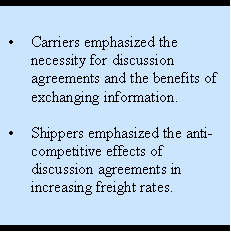 As noted above, the Commission thoroughly reviews
all agreements, with a particular emphasis on discussion agreements. Under
the Commission's monitoring program, the activities of discussion agreements
and the web of agreements that make up the structure of agreement activity
are evaluated through examination of confidentially-filed monitoring reports,
agreement minutes, service contracts and other trade sources. The information
contained in the Commission's service contract database is evaluated
continuously, along with voluntary service contract guidelines, to determine
whether there is abuse of antitrust immunity. This information is analyzed
in conjunction with other pertinent data, including agreement monitoring
reports and minutes of meetings.
As noted above, the Commission thoroughly reviews
all agreements, with a particular emphasis on discussion agreements. Under
the Commission's monitoring program, the activities of discussion agreements
and the web of agreements that make up the structure of agreement activity
are evaluated through examination of confidentially-filed monitoring reports,
agreement minutes, service contracts and other trade sources. The information
contained in the Commission's service contract database is evaluated
continuously, along with voluntary service contract guidelines, to determine
whether there is abuse of antitrust immunity. This information is analyzed
in conjunction with other pertinent data, including agreement monitoring
reports and minutes of meetings.
Agreement
Filings
Several commenters suggested that
the Commission consider exempting certain carrier agreements from filing
and waiting requirements. For example, commenters variously proposed that
agreements regarding specific aspects of space-charter arrangements
(i.e., operational matters), changes to space allocations, and the
expansion of the geographic scope of agreements, be allowed to become effective
on filing or effective on less than 45-days' notice (e.g., effective
after five business days). These agreement-related issues, as well as others,
currently are being reviewed by the Commission's staff, and proposals are
being developed in connection with a Notice of Inquiry - Docket No. 99-13
- The Content of Ocean Carrier and Marine Terminal Operator Agreements
Subject to the Shipping Act of 1984, August 3, 1999, 64 FR
42057.
Agreement
Monitoring
Reports
A number of carrier
commenters raised a variety of concerns regarding the Commission's monitoring
report program. They suggested that the Commission review, revise, or reduce
its monitoring report requirements in light of the changes brought about
by OSRA. The commenters acknowledged that some reporting is necessary in
order for the Commission to fulfill its regulatory responsibilities. However,
they noted that the present reporting requirements "pre-date" OSRA and argue
that they are not well suited to a regulatory system in which a majority
of cargo moves under the confidential terms of individual service contracts.
Several carriers questioned the necessity of having any monitoring report
requirements on various types of agreements such as operational agreements
which are entered into for efficiency purposes and to meet the specific needs
of customers. Carriers made a number of other suggestions for streamlining
the reporting process which many found burdensome and costly.
Based on the Commission's experiences
with monitoring reports over the last several years, and in light of the
reforms introduced under OSRA, the Commission has begun to consider possible
changes to the agreement information form and monitoring report requirements.
Any proposed changes to these requirements would be addressed at some future
date in a proposed rulemaking.
OTI LICENSING AND
BONDING
The OTI Industry at a
Glance
OSRA, together with the continuing
logistics and supply-chain evolution, is bringing about significant change
in the structure of the OTI industry. Since OSRA became effective, the number
of NVOCCs has decreased by almost 15 percent and ocean freight forwarders
by 21 percent; however, the number of OTIs that are both NVOCCs and ocean
freight forwarders has more than doubled. Overall, the total number of OTIs
has fallen by about 6 percent, but the number of foreign NVOCCs keeps
rising.
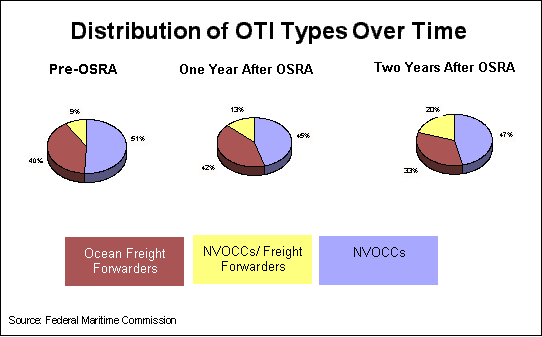
There are several possible explanations
for the decrease in the total number of OTIs. One is the increasing consolidation
among OTI firms, similar to that occurring elsewhere in the liner industry.
Second, as just cited, is the increase in the number of OTIs adding freight
forwarding or NVOCC activities to their existing functions. This increase
in the number of OTIs that are both NVOCCs and ocean freight forwarders was
explained by some commenters to the Commission's NOI as an effort to remain
competitive by offering a wide variety and level of services. These intermediary
respondents noted that ocean carriers also are diversifying operations by
developing and offering their own value-added services and performing traditional
OTI activities. With the increased awareness of efficiencies from, and customer
demand for, supply-chain management, carriers are developing and selling
services traditionally offered by OTIs and logistics providers. Confidential
contracting between shippers and carriers has fostered the rapid growth in
carriers providing logistics and value-added services. Through the confidential
contracting process, carriers and shippers jointly can customize service
packages that include both ocean transportation and logistics
services.
Licensing/Bonding
and Tariff
Publication
OSRA requires that NVOCCs in the
US now be licensed by the Commission. Additionally, the Commission's rules
implementing OSRA increased the bond amount required from all NVOCCs. Ocean
freight forwarders, while already licensed and bonded, also are subject to
a higher bonding level under the Commission's implementing regulations. The
vehicle for insuring financial responsibility to date has been surety bonds
exclusively. (See Appendix III.) OTIs generally have not objected to these
additional licensing and bonding requirements, nor have there been indications
that these new requirements have had a significant impact on OTI operations.
However, OTIs have raised various concerns since OSRA became effective. They
are troubled that their regulatory burden increased, and consistently have
questioned the regulatory need for NVOCC tariff publication. They also believe
that they are subjected to more FMC oversight -- tariff publication, adherence
to tariffs, and common carriage provisions of the 1984 Act -- than vessel
operators. Similarly, OTIs in the US contend that they have a significant
and unfair competitive disadvantage since they face closer FMC scrutiny regarding
statutory compliance. Some commenters suggested a relaxation, simplification,
or elimination of applicable requirements and/or a reduction of enforcement
activities directed at NVOCC compliance with tariff and common carriage
provisions of the 1984
Act.
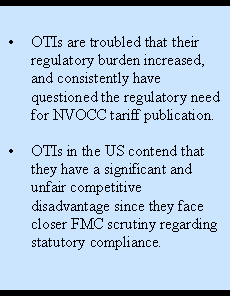 Competitive
Activity
Competitive
Activity
As mentioned, many shippers' associations
and OTIs expressed concern with the greater level of regulation of OTIs relative
to VOCCs. They point to the fact that NVOCCs still must make their rates
publicly available, while VOCCs are free to sign confidential service contracts.
In their opinion, this gives ocean common carriers a commercially competitive
advantage over NVOCCs, who cannot protect their customers' rates and terms
of service from public scrutiny via confidential service contracts. They
submit that ocean carriers are using all the competitive tools at their disposal,
including confidential contracting and antitrust immunity, to compete
head-to-head with transportation intermediaries, both on the ocean side and
in market sectors such as logistics and supply-chain management. Several
intermediary commenters indicated that VOCCs are able to provide a bundling
of services from warehousing, to customs brokerage, to ocean shipping all
in one confidential package, and therefore have a substantial advantage over
OTIs who are legally prohibited from offering confidential "one-stop"
transportation packages to shipper-clients. Some commenters believe the
Commission should examine more closely carriers' concerted activities and
allegedly unfair shipping practices.
While the Commission does not have
evidence of specific harm to OTIs vis-a-vis ocean carriers due to OSRA's
changes, OTIs as a group have voiced their concerns at the highest national
levels. And as previously mentioned, the doubling in the number of OTIs that
are both NVOCCs and ocean freight forwarders can be attributed to a perceived
need to offer more service to customers in an effort to strengthen competitive
position under what is seen as a more difficult operating environment under
OSRA. The FMC recognizes the importance of the interplay between the VOCC
and OTI sectors, and will monitor future activities
closely.
TARIFF
PUBLICATION
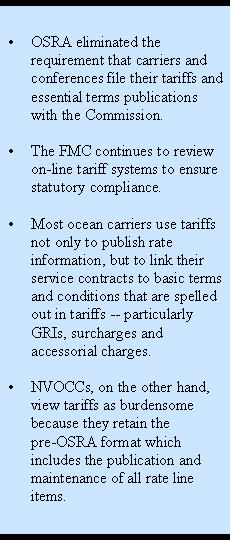 Tariff
Publishing Under OSRA
Tariff
Publishing Under OSRA
Tariff publication was the area affected
the most by OSRA's regulatory approach. Effective May 1, 1999, OSRA eliminated
the requirement that carriers and conferences file their tariffs and essential
terms publications with the Commission. OSRA requires carriers and conferences
to publish their tariff rates and services in automated systems to be made
available to any person, without time, quantity, or other limitation, through
appropriate access from remote locations. OSRA also authorizes assessment
of a "reasonable charge" for tariff access. Additionally, with respect to
service contracts, OSRA removed rates and charges, service commitments, and
any liquidated damages from the essential terms required to be made public.
Instead, public essential terms of service contracts now are: the
origin and destination port ranges; commodity or commodities; minimum volume
or portion; and the duration of the contract. OSRA also provides that marine
terminal operators ("MTOs") may publish schedules of their rates, regulations,
and practices, if they so
choose.
OSRA mandates the Commission to prescribe
the requirements for the accessibility and accuracy of carrier automated
tariff systems ("CATS") and, after periodic review, to prohibit the use of
any automated tariff system that fails to meet these requirements. The Commission
issued a proposed rule to implement OSRA that covered all relevant aspects
of tariff publication. Based on public comments received from affected parties,
the Commission significantly altered its proposal to reduce further the burdens
of compliance, and to provide carriers with more flexibility and options
in publishing their CATS. All conferences, VOCCs and NVOCCs are required
to publish the services they offer.
Following the implementation of OSRA,
the Commission reviewed a number of tariff systems and found that many appeared
to limit the public's access to tariff information. The Commission contacted
carriers and publishers in an attempt to rectify significant problems. The
Commission consistently concentrated on compliance with OSRA's requirements
that tariffs be accessible to the public and accurate -- a number of questions
were asked and clarifications
sought.
After several failed attempts to
obtain overall industry statutory compliance, the Commission issued
Circular Letter No. 00-1, Public Access to Tariffs and Tariff
Systems Under the Ocean Shipping Reform Act of 1998, on April 6, 2000.
The circular letter, addressed to carriers, conferences, and tariff publishers,
indicated that a number of tariff systems failed to provide adequate user
instructions, had no commodity index or failed to provide a commodity search
feature, had no historical data search capability, required a considerable
time to download or move from one function to another, and had access fees
and/or monthly minimum requirements that appeared to discourage public use.
The Commission urged publishers to correct access deficiencies and advised
public users to notify the Commission of any problems that might be experienced
in accessing tariff systems. The circular letter also expressed the Commission's
desire to work with the industry to address any problems that limit public
access to tariff systems. The letter concluded with the admonition that,
if the problems were not remedied voluntarily, the Commission would consider
other remedial actions to ensure public access to tariffs in accordance with
the Congressional mandate contained in
OSRA.
The Commission also issued an Advance
Notice of Proposed Rulemaking addressing the issues of access fees and monthly
minimum charges, seeking input from all interested parties on the reasonableness
of such fees and charges. Based on a review of the comments, the Commission
determined not to proceed with a rulemaking and instead issued Circular
Letter No. 00-2, Charges Assessed for Access to Tariffs and Tariff
Systems, on October 6, 2000. The Commission stated that while it was
not promulgating regulations governing tariff access charges, it was providing
guidance with respect to access fees and monthly minimum charges assessed
by carriers, conferences, and tariff publishers, as well as certain costs
and expenses that should not be recovered when establishing charges for tariff
access. The Commission indicated that voluntary adherence to the guidelines
mentioned in the circular letter would obviate the need for further Commission
action.
No written complaints have been received
by the Commission concerning the issues addressed in the two circular letters.
The Commission's staff, however, has received informal inquiries from members
of the public requesting assistance in retrieving tariff information. During
the course of these communications, allegations have been made that some
carriers' tariff access fees are too high, hence the request for staff
assistance. Such inquiries generally involve only a minor amount of tariff
research.
The Commission will continue its
monitoring efforts so as to ensure equitable, uniform compliance with OSRA's
requirements. Given the various uses of tariffs, particularly their applicability
to service contracts, fair and effective administration of this responsibility
is important. Additionally, since OSRA, and the Commission's implementing
regulations, greatly reduce the burden of publishing tariff information,
compliance should not be difficult to achieve. Naturally, our efforts will
continue to seek voluntary compliance. However, more formal action may need
to be instituted for those who refuse to comply or are involved in particularly
egregious activity.
The
NOI and Tariff Use Under
OSRA
Comments received in response to
the Commission's NOI expressed varying opinions concerning the accessibility
and accuracy of tariffs. (See Appendix I, summary of responses to questions
24 through 29.) Most ocean carriers use tariffs not only to publish freight
rate information, but to link their service contracts to basic terms and
conditions that are spelled out in tariffs -- particularly GRIs, surcharges
and accessorial charges. The carriers indicated that the linkage between
tariffs and service contracts relieves them of the burden of repeating these
common service contract provisions separately in each contract. It would
also appear that linking service contracts to these tariff terms and conditions
makes it easier for carriers to take such items out of the negotiation process.
Consequently, most ocean carriers are satisfied with present-day tariff
publication requirements.
NVOCCs, on the other hand, view tariffs
as burdensome because they retain the pre-OSRA format, which includes the
publication and maintenance of all rate line items. NVOCCs also are of the
opinion that they are disadvantaged because most of the active VOCC rates
are contained in confidential service contracts, and therefore NVOCCs are
precluded from reviewing them. They point to the fact that VOCCs individually
have access to specific commercial information, and depending on specific
agreement authority, may collectively exchange this information as members
of discussion or other types of agreements (within the restrictions of any
service contract confidentiality requirements). In addition, many NVOCCs
want the tariff requirement removed entirely. They believe this would put
them on equal footing with
VOCCs.
Ocean freight forwarders generally
stated that they had no real difficulty in accessing tariff systems, although
one forwarder group advised that the lack of appropriate standards made access
difficult for its members. Many OTIs viewed tariffs as very useful for inland
rate information, which they said can be incorporated in their rate quotes.
Other OTIs contended that tariff information was not relevant in the current
trading environment.
Shippers varied in their views on
the ease of access to, and overall usefulness of, tariffs. Some stated that
they had no difficulty in accessing carrier systems and found the published
data informative. Others indicated that they had no occasion to refer to
tariffs. And still others referred to them as too cumbersome, or complained
that they did not have adequate guidance on how to access linked tariffs
which are issued by different publishers. Certain shippers advised that they
contacted carriers directly for rate and rate-related information. Shippers'
associations reported that they referred to tariffs regularly since their
contracts so often were linked to them. They accessed tariffs to verify charges,
obtain rates for service contract movements, or for general market information.
One association emphasized that the publication of a commodity index and
bottom-line rates would increase tariffs' utility.
Maintaining public tariffs and adherence
to specific publication requirements continue to be a contentious issue.
Despite OSRA's deregulatory changes in this area, debate still persists on
the usefulness of tariffs, the burden of applicable statutory and regulatory
requirements, and tariffs' overall impact on industry operations. Not only
do the different sectors of the industry disagree, but there is far from
unanimity within sectors. Often, a company's views on tariffs are dictated
as much by its internal circumstances and general approach to business, as
they are by the competitive consequences of pricing services. Clearly this
issue is far from resolved, and indications are that it may be presented
in some form for Commission consideration in the future. The Commission will
continue to fulfill its oversight role with the aim of assisting the industry
in achieving compliance as efficiently as possible, while helping to create
the trade environment envisioned by
OSRA.
OTHER ISSUES
(CONTROLLED
CARRIERS,
FOREIGN SHIPPING
PRACTICES,
TRUCKING, AND
E-COMMERCE)
 Controlled Carrier
Oversight
Controlled Carrier
Oversight
The 1984 Act defines a controlled
carrier as an ocean common carrier whose operating assets are, directly or
indirectly, owned or controlled by a government. Due to a controlled carrier's
close national ties, profit cannot always be assumed to be the chief motivation
for its operations. To address this concern, Congress enacted the Controlled
Carrier Act (section 9 of the 1984 Act), to prevent controlled carriers,
whose marketplace decision-making can be influenced by governmental priorities
or by their access to non-market sources of capital, from engaging in
unreasonable below-market pricing practices that could disrupt trade or harm
privately-owned shipping companies.
A number of changes instituted under
OSRA strengthened the controlled carrier provisions. OSRA expanded the definition
of a controlled carrier by deleting the previous limitation that an entity
can be a controlled carrier only when it operates vessels registered under
the government that controls the carrier. This change removed a potential
loophole that may have enabled a controlled carrier to "flag-out" or register
its vessels under the laws and regulations of another country, thereby avoiding
the controlled carrier provisions.(14) In
addition, OSRA removed three exceptions from the controlled carrier
provisions: agreement membership, operations in a controlled carrier's
bilateral trade with the US, and OECD signatory status. Prior to OSRA, the
rates, charges, classifications, rules, etc., of a controlled carrier
were exempt from the controlled carrier provisions when they were pursuant
to a conference tariff. The removal of the second exception now brings cargo
in a controlled carrier's bilateral trade under the controlled carrier provisions
of OSRA. The last change regarding OECD signatory status appears to have
had minimal impact.
Over the past several years, carriers
of the People's Republic of China ("PRC") have been the largest group of
controlled carriers.(15) Currently there
are five PRC-controlled carriers. COSCO North America, Inc. ("COSCO"), the
largest of the group, has grown from a very modest beginning to become one
of the largest carriers in the world -- during 2000 it ranked as one of the
top five carriers serving the US
trades.(16) COSCO's fleet consists of more
than 500 ships which call at ports in approximately 180 countries. It also
is a very diversified company, offering non-shipping services such as real
estate, finance, and insurance. CSCL, one of the newest controlled carriers,
has grown considerably. It currently has more than 100 ships and has embarked
on a building program to further expand its fleet. CSCL's market share in
the trade between the US and the rest of the world increased from .02 percent
(2,707 TEUs) in 1999 to 1.1 percent (205,616 TEUs) in 2000. During the same
period, it increased its market share in the trade between the US and the
PRC from 0.1 percent (1,328 TEUs) to 3.9 percent (139,947
TEUs).(17)
In response to the Commission's NOI,
COSCO reiterated some of its earlier comments made in a petition for regulatory
relief before the Commission.(18) In its
latest petition, COSCO requested the Commission to expand its current exemption
from the Controlled Carrier Act (as amended by OSRA) to permit COSCO to publish
tariff rate decreases in the US foreign commerce that would be effective
upon publication, without regard to competing carrier
rates.(19) In both the petition and in its
response to the Commission's NOI, COSCO contends that it lost its short-term
flexibility to price tariff cargo freely in the trade between the US and
the PRC due to the repeal of the bilateral trade exception to the Controlled
Carrier Act; therefore, it contends its burden of regulation has increased
under OSRA. COSCO has found this burden especially difficult with regard
to oversized project and forwarder-controlled cargoes that need quick (often
one-day) tariff publication. COSCO would like to see the 30-day notice
requirements for its tariff publications dropped. The merits of the specific
regulatory relief sought by COSCO will be evaluated by the Commission in
the proceeding that considers Petition P3-99. The Commission also will increase
its focus on controlled carrier activities to ensure that the Controlled
Carrier Act objectives of preserving equitable competition and promoting
international trade are being met.
Unfair
Foreign Shipping
Practices
OSRA amended section 11a of the 1984
Act (FSPA), and section 19 of the Merchant Marine Act, 1920, to add the
suspension of service contracts to the remedies available to the Commission
to address unfavorable conditions, and to clarify the types of foreign activities
that create unfavorable conditions to shipping in the US foreign trades,
enumerating pricing practices as among those activities that may create
unfavorable conditions.
The majority of those commenting
on this issue in response to the NOI believed that OSRA had no impact on
potentially unfair shipping practices. Several commenters stated that it
was beneficial for the FMC to have authority to take action against foreign
restrictive practices and noted their concern regarding such practices in
particular US foreign trades. (See Appendix I, question 30.)
The Commission continues to address
unfair shipping practices as they arise. The Commission requires periodic
reports from carriers in specified trade areas, when appropriate, to monitor
developments. Further, the Commission has established a permanent Task Force
on Restrictive Foreign Practices, chaired by the General Counsel, with
representatives from a number of bureaus and offices. The Task Force meets
regularly to exchange information about new and continuing areas of concern,
and to formulate recommended approaches to restrictive foreign shipping practices
which may require action under the Commission's statutory authorities. Since
the implementation of OSRA, the Commission has continued to address unfair
shipping practices under existing proceedings and continuously monitors new
developments in this
area.
Port
Trucking
Issues
Question 23 of the Commission's NOI
asked: "What impact, if any, has the implementation of OSRA had
on the port trucking industry?" In responding to this question, the International
Brotherhood of Teamsters complained that port driver wages have declined,
driver bankruptcies and truck repossessions have increased, and working
conditions for port drivers are generally "abusive." The Teamsters believe
that OSRA permits ocean common carriers, through their rate agreements' voluntary
guidelines, to keep inland rates harmfully low by setting anti-competitive
and unreasonable "ceiling" rates for both through and inland transportation.
Further, they claim that the inland transportation rates "dictated by ocean
common carriers and shippers" to trucking companies are non-negotiable rates
and prohibit trucking companies from providing a living wage to port drivers.
The Teamsters provide several examples of poor working conditions in the
container hauling industry, including port congestion, unpaid waiting time
at ports, unroadworthy chassis, overweight containers, and improperly labeled
hazardous materials.
 Because the purpose of the Commission's NOI proceeding was to examine the
impact of OSRA, the Commission is not treating the Teamsters' comment as
a petition for formal action, nor is the Commission addressing whether the
Teamsters' concerns would be remediable by the Commission were a complaint
or petition filed. It does not appear, however, that the Teamsters' concerns
are occasioned by the passage of OSRA. Rather, its comments reflect longstanding
difficulties faced by the port trucking industry in its relationship to the
ports and ocean carrier industry. One apparent change in the law related
to the Teamsters' concerns is found in section 10(c)(4). Prior to OSRA, section
10(c)(4) prohibited concerted action in negotiating with non-ocean carriers
on "rates or services provided to ocean common carriers within the US by
those non-ocean carriers." OSRA amended the prohibition to allow for such
concerted action if "negotiations and any resulting agreements are not in
violation of the antitrust laws and are consistent with the purposes of this
Act." The Teamsters do not cite specifically to this change in the law and
do not provide specific facts alleging unlawful concerted action in negotiating
with inland providers. Furthermore, the Commission has no information to
indicate that this particular change in the law has had a detrimental effect
on the port trucking
industry.
Because the purpose of the Commission's NOI proceeding was to examine the
impact of OSRA, the Commission is not treating the Teamsters' comment as
a petition for formal action, nor is the Commission addressing whether the
Teamsters' concerns would be remediable by the Commission were a complaint
or petition filed. It does not appear, however, that the Teamsters' concerns
are occasioned by the passage of OSRA. Rather, its comments reflect longstanding
difficulties faced by the port trucking industry in its relationship to the
ports and ocean carrier industry. One apparent change in the law related
to the Teamsters' concerns is found in section 10(c)(4). Prior to OSRA, section
10(c)(4) prohibited concerted action in negotiating with non-ocean carriers
on "rates or services provided to ocean common carriers within the US by
those non-ocean carriers." OSRA amended the prohibition to allow for such
concerted action if "negotiations and any resulting agreements are not in
violation of the antitrust laws and are consistent with the purposes of this
Act." The Teamsters do not cite specifically to this change in the law and
do not provide specific facts alleging unlawful concerted action in negotiating
with inland providers. Furthermore, the Commission has no information to
indicate that this particular change in the law has had a detrimental effect
on the port trucking
industry.
Voluntary guidelines for service
contracting are filed confidentially with the Commission pursuant to 46 C.F.R.
§ 535.802(e). These were examined carefully to determine which guidelines
could affect port trucking. Some guideline provisions were found that could
theoretically impact inland truckers and port drivers. Certain of the voluntary
guideline provisions would appear to aim at relieving port congestion, one
of the Teamsters' significant concerns, and thereby would benefit port truck
drivers. Nothing in the voluntary guidelines, however, substantiates the
Teamsters' apparent claim that they allow carriers to jointly negotiate inland
divisions, defined in section 3 (11) as "the amount paid by a common carrier
to an inland carrier for the inland portion of through transportation offered
to the public by the common carrier." Section 7(b)(2) establishes that antitrust
immunity is not extended to discussion agreements or conferences for the
purpose of discussion or negotiation regarding the "inland divisions." The
inland division is specifically distinguished in section 7(b)(2) from the
inland portion, or the amount charged by the common carrier to its customer
for inland services. Nor do the voluntary guidelines indicate that carrier
practices with regard to agreements affecting the inland portion of through
rates have changed as a result of OSRA: carrier antitrust immunity
for such activities by conferences and rate agreements existed under the
1984 Act prior to the passage of OSRA. Its extension by OSRA to voluntary
rate discussion agreements does not appear to have any connection to the
Teamsters' concerns as they were presented; no specific allegations or evidence
was provided to suggest such a connection. Further, the voluntary guidelines
do not provide any indication that inland carriers are unable to negotiate
inland rates with individual ocean carriers, as alleged by the Teamsters.
In sum, the Commission is unaware of any agreements which, through their
voluntary guidelines, permit concerted activity with regard to inland trucking
in contravention of the 1984 Act.
 In addition to the examination of voluntary service contract guidelines,
the Commission also identified several agreements that contain language
authorizing the respective members to jointly negotiate inland divisions
with motor carriers. Agreement representatives, however, confirm that no
arrangements involving motor carriage have been implemented. The Commission
also reviewed the confidential minutes of meetings of conferences and discussion
agreements on file with the Commission and found no indication of discussions
among the respective agreement members concerning the negotiation of US inland
divisions with motor carriers. The Commission will continue to review guidelines,
minutes, and agreement provisions to ascertain whether agreement authority
is occasioning any adverse effects on port and trucking
operations.
In addition to the examination of voluntary service contract guidelines,
the Commission also identified several agreements that contain language
authorizing the respective members to jointly negotiate inland divisions
with motor carriers. Agreement representatives, however, confirm that no
arrangements involving motor carriage have been implemented. The Commission
also reviewed the confidential minutes of meetings of conferences and discussion
agreements on file with the Commission and found no indication of discussions
among the respective agreement members concerning the negotiation of US inland
divisions with motor carriers. The Commission will continue to review guidelines,
minutes, and agreement provisions to ascertain whether agreement authority
is occasioning any adverse effects on port and trucking
operations.
E-Commerce
Prior to the passage of OSRA,
transportation-related, e-commerce businesses had already started appearing
on the liner shipping scene. Many of the original Internet-based companies
focused specifically on developing automated services (including e-commerce
auction sites) tailored to the business of liner shipping. Many of these
start-ups were founded by carrier and shipper executives displaced as a result
of industry down-sizing that occurred during the 1990s. These former carrier
and shipper executives have combined their extensive industry expertise with
today's high-tech capabilities to advance industry automation. Traditional
information management companies, either independently or in cooperation
with liner shipping firms, also have entered the liner shipping arena, offering
an array of automated, value-added service
packages.
While OSRA is not directly responsible
for the emergence of these dot-com businesses, it arguably has created a
more competitive, market-oriented environment in which these companies have
grown in importance. For example, 1999 saw an explosion in the number of
dot-com companies focused on the design and promotion of automated services
customized for liner shipping. Since then, however, liner shipping dot-com
firms have generally followed the same consolidation trends of those in other
industries -- by January 2001, many firms that partially were labeled as
"Internet auction" companies had been bought or gone out of business. The
surviving companies have changed their emphasis drastically from auction
sites to focus on more fundamental, practical
applications.
For example, track-and-trace
technologies, which provide visibility, are gaining in popularity. Cargo-based,
e-commerce portals are the current trend and are receiving much support from
major liner companies. These Internet portals provide a centralized location
for "one-stop shopping" for various participating carrier services and obviate
the need for shippers to refer to numerous individual carrier web-sites.
INTTRA and Global Transportation Network, two ocean carrier-backed Internet
portals, focus on track-and-trace systems as a core capability. Extensive
carrier collaboration is expected to continue in this area. In addition,
one carrier recently unveiled six products that it will provide shippers,
along with a track-and-trace feature. These products include: vessel
schedule information, on-line booking capability and shipping instructions,
ability to print remote bills of lading, automated shipment tracking, and
a complete on-line invoicing and payments
system.
E-commerce for value-added services
was seen by the NOI commenters as something that was likely to prove more
useful than e-auctions, both in allowing carriers and shippers to reduce
costs, and improving carrier-shipper relationships. E-auctions, however,
received very little support from vessel operators because the auctions are
meant to fill unused capacity by auctioning-off unused slots at reduced rates.
Carriers generally believed that participation in e-auctions only hurts their
operations by further lowering rates. It is no surprise that those companies
who concentrated on this type of service largely were unsuccessful. Shippers
additionally noted that they are looking for applications that go beyond
ocean carriage to include middleman functions as well. Some also contended
that because many lines offer their own systems, the complexity of dealing
with multiple systems makes the current offerings less useful than otherwise
might be the case. The new portals look to ease this
complexity.
A relatively new development in the
area of logistics and e-commerce also may address the problem of multiple,
complex systems. The concept of "supply-chain collaboration" has been gaining
attention in liner shipping and promises to streamline the process significantly.
True collaboration involves two or more companies working jointly to develop
shared information, design and execute a logistics supply-chain plan, measure
performance, and share equally in the rewards. In essence, collaboration
involves the supply-chain partners sharing commercially sensitive,
customer-demand forecast information, and using it throughout the supply
chain, to ensure the correct and timely delivery of products. Collaboration
is considered so critical in today's highly competitive environment that
many of the largest US-based shippers (including Wal-Mart, K-Mart, Eastman
Kodak, etc.) formed a group known as VICS -- Voluntary Interindustry
Commerce Standards -- to develop uniform documentation and standards for
supply-chain collaboration.
The advent of auction dot-coms,
transportation exchanges, Internet portals, and similar e-commerce entities
has increasingly blurred the distinction between forwarding (OTI) and other
value-added services. Some commenters to the Commission's NOI believe these
new entities should be reviewed to determine how they fit within the 1984
Act, as amended. The Commission recognizes the important role that these
entities play in the efficient movement of goods in the US-foreign commerce,
as well as in reducing operational costs. The question of the rights and
responsibilities of these entities under OSRA and the role, if any, of the
Commission in regulating their activities is an issue that the Commission
will continue to evaluate. In the meantime, it is likely that transportation
exchanges and similar e-commerce firms will continue to evolve and provide
cost-saving solutions to the industry.
CLOSING
OBSERVATIONS
Snapshot of
Findings
The changes in the liner shipping
industry, and OSRA's impact over the past two years, can be characterized
as significant, but are not totally unexpected. Certainly the dissolution
of the traditional conference system in most major trades, and the ascendency
of discussion agreements, was anticipated. The wholesale reshaping of carrier
supply-side operations, replete with various types of partnering and
vessel-sharing arrangements, continued a trend that had begun several years
ago. And the across-the-board surge in service contracting (as reflected
in the number of contracts, the cargo volume, and the percentage of cargo
moved under such contracts), while greater and more sudden than most expected,
was consistent with the anticipated decline in tariff movements as a result
of individual confidential contracting and the removal of conference oversight
authority.
 But these changes over the past two years nonetheless have been noteworthy.
The high percentage of service contracts entered into by individual carriers
(98 percent of all contracts in the Commission's 1,000 contract random sample)
is remarkable. The confidentiality, flexibility, and lack of conference control
over these instruments have made them attractive to carriers and shippers
alike, who share the desire to find cost savings and efficiencies through
individualized arrangements. The portal for tariff information has migrated
from the FMC's ATFI System to the Internet. And while the preponderance of
service contracts refer to the respective carrier tariff for accessorial
and GRI information, tariffs are far different from those of a mere two years
ago. They no longer are the center stage for rate information, but more the
coordinating link across most service contracts. Of course, NVOCC rate
information still is contained in published tariffs. Consolidation is also
taking place in the OTI sector as more traditional freight forwarders and
NVOCCs seek to wear both hats; this is consistent with attempts to respond
to customer demand for more integrated logistic
services.
But these changes over the past two years nonetheless have been noteworthy.
The high percentage of service contracts entered into by individual carriers
(98 percent of all contracts in the Commission's 1,000 contract random sample)
is remarkable. The confidentiality, flexibility, and lack of conference control
over these instruments have made them attractive to carriers and shippers
alike, who share the desire to find cost savings and efficiencies through
individualized arrangements. The portal for tariff information has migrated
from the FMC's ATFI System to the Internet. And while the preponderance of
service contracts refer to the respective carrier tariff for accessorial
and GRI information, tariffs are far different from those of a mere two years
ago. They no longer are the center stage for rate information, but more the
coordinating link across most service contracts. Of course, NVOCC rate
information still is contained in published tariffs. Consolidation is also
taking place in the OTI sector as more traditional freight forwarders and
NVOCCs seek to wear both hats; this is consistent with attempts to respond
to customer demand for more integrated logistic
services.
OSRA specifically amended the 1984
Act to encourage the growth of US exports through ". . . a
greater reliance on the marketplace." The changes in service contracting
and the rise in carrier efficiency-enhancing agreements suggest that OSRA
has achieved this objective. Many see the replacement of the conference system
with discussion agreements as resulting in a less rigid form of carrier control
over the liner trades. Others, however, remain concerned with the degree
to which such agreements are able to achieve adherence to voluntary service
contract guidelines. As indicated earlier, the Commission's confidential
review of carrier service contracts found limited adherence to contract
guidelines, although carrier actions in this regard appear to be dictated
by prevailing market conditions.
Ongoing Evolution of the
Industry
 OSRA is but one factor in the ongoing reshaping of worldwide distribution
(in which liner shipping is one component). This evolution is driven by the
powerful and recent economic forces of technology, partnering, globalization
and process integration. The fundamental concept behind these forces is as
old and unchanging as the market itself: buyers looking for the
most advantageous deals and sellers striving to provide a service that attracts
and retains customers.
OSRA is but one factor in the ongoing reshaping of worldwide distribution
(in which liner shipping is one component). This evolution is driven by the
powerful and recent economic forces of technology, partnering, globalization
and process integration. The fundamental concept behind these forces is as
old and unchanging as the market itself: buyers looking for the
most advantageous deals and sellers striving to provide a service that attracts
and retains customers.
Limits on the speed and accuracy
of information exchange historically have constrained efficient market processes.
The rapid availability of electronic information has radically eased such
limits and helped to promote globalization. No longer do companies confine
themselves to their service segment, when it has become clear that significant
efficiencies are to be captured from integration across all segments.
Supply-chain management, which integrates traditionally independent processes,
has led to efficiencies in each link of the chain, from product inception
to delivery. Sellers of goods must partner with their customers and work
with others in the supply chain to realize and share available economic benefits.
Hence, liner operators, middlemen, third-party logistics providers,
consolidators, and others all now seek to redefine themselves beyond their
traditional transportation sector. More than one liner operator's mission
statement, for example, has been revised to indicate a broader distribution
and logistics focus than just liner
movements.
When viewed from the broad perspective
of worldwide distribution, OSRA was a clear response to calls for an
institutional scheme that was more adaptive to the emerging economic order
of integrated, information-intense, supply-chain processes. This is nowhere
more evident than in the rush of carriers and shippers to enter into one-on-one
service contracts that accommodate broader and more customized distribution
arrangements. As shown, there has been a surge in individualized contracting,
a transformation in the manner by which ocean carriers in any given trade
collectively address pricing and service matters, and a proliferation in
efficiency-enhancing operational carrier arrangements.
One issue worth noting is the apparent
impact of OSRA on limitations of carrier liability for cargo loss or damage.
As our report reflects, both shippers and carriers reported to us that some
shippers are seeking service contract provisions which would raise carriers'
liability, and that certain carriers are seeking to address the issue
collectively through discussion agreement service contract guidelines. While
the issue of carrier limitations of liability for cargo loss or damage is
not addressed in the 1984 Act, the availability of confidential, individual
carrier service contracts pursuant to OSRA appears to be providing a new
medium in which shippers and carriers will address such matters. To date
the FMC has not received formal complaints or requests for action under the
statutes it administers to address this issue. We intend to monitor ongoing
developments in this important area.
By any standard, OSRA is still in
its infancy. Clearly, its impact on liner shipping and worldwide distribution
will continue to unfold. As this occurs, and those in US ocean shipping further
adapt to a new trade environment, its direct effects should be even more
discernable.
Continuing Regulatory
Issues
 The dramatic changes taking place in international trade against the backdrop
of OSRA, and the issues they raise, are focal points for the Commission.
The FMC is committed to fulfilling its statutory responsibilities in a manner
that gives deference to the market process while defending against
market-distorting abuses. Its mission statement and strategic goals are based
on this underlying
premise.
The dramatic changes taking place in international trade against the backdrop
of OSRA, and the issues they raise, are focal points for the Commission.
The FMC is committed to fulfilling its statutory responsibilities in a manner
that gives deference to the market process while defending against
market-distorting abuses. Its mission statement and strategic goals are based
on this underlying
premise.
Despite what appears to be widespread
general satisfaction with most aspects of the current US regulatory framework
for ocean shipping, a number of issues remain as points of contention. Some
of these issues stem from changes made by OSRA; others include policies which
preceded OSRA but which OSRA left unchanged, or policies which OSRA did not
amend as radically as some proponents had advocated during the legislative
process. There appear to be several major aspects of the US shipping laws
which are generating the most expressions of concern among those less than
wholly satisfied with the 1984 Act as amended by
OSRA.
The first of the issues is the
aforementioned concern with the rise of discussion agreements and the relative
merits of antitrust immunity for rate-setting forums. While the 1984 Act's
section 6 provisions for FMC action on agreements remained unchanged, the
OSRA amendments included refinements to the section 4 provisions describing
the agreements within the scope of the 1984 Act, as well as the section 5
provisions prescribing independent action and the rights of agreements in
addressing service contract matters. Thus, Congress reaffirmed the general
principle of limited antitrust immunity for rate-setting arrangements, while
amending the scope and conditions of that immunity. Therefore, the validity
and appropriateness of continued limited antitrust immunity must be evaluated
in the context of the changes effected by OSRA. Among the factors relevant
to such an assessment are the decline in conference power and influence,
the proliferation of individual carrier contracts, the freight rate levels
predominating in the trades, the impact of discussion agreement rate discussions
and information sharing as well as voluntary guideline authority, and the
other services, charges, innovations and developments, for better or worse,
brought about via concerted carrier activity under the post-OSRA regulatory
scheme. Moreover, the effects of immunity under a variety of economic and
trade conditions would provide the best means of fully evaluating its impact.
The overall low freight rates prevailing in most US trades may appear to
suggest that agreement and conference authority has limited impact at the
present time, but under trade conditions more favorable to the carrier sector,
the newly amended authorities may prove less benign from the shipper perspective.
Thus, it is incumbent on the Commission to continue to assess and evaluate
the impact of discussion agreements on rates, in order to assess more accurately
the OSRA amendments' influence on the role and effects of immunity for
ratemaking. Similarly, as the debate continues, it is of paramount importance
that the participants address the alleged benefits and harm resulting from
immunity for ratemaking under the current revised regulatory scheme, rather
than to reiterate the arguments pro and con expressed over the last decade.
Of particular relevance is OSRA's
authorization of voluntary guidelines for discussion agreements and the degree
of adherence to such guidelines among agreement members. Critics argue that
such authority has vested in discussion agreements effectively the same
authorities that the now weakened or defunct conferences had once wielded.
This is another issue of continued spirited debate, and the subject demands
ongoing attention on the part of this agency. As noted supra, an
agreement's cohesiveness on service contract matters varies with the trade
and particular market influences. The fact that guidelines are "voluntary"
and unenforceable does not render those guidelines and the discussion agreements
ineffectual; on the other hand, the fact that the carriers are occasionally,
frequently or regularly cohesive does not suggest that they are abusing that
authority or that the guidelines are violative of the 1984 Act merely because
they are having the intended consequences. When the Commission promulgated
its regulations implementing OSRA, one of the more challenging undertakings
was in fact the regulations corresponding to the voluntary guidelines language
of OSRA's addition to section 5(c)(3) of the statute. The Commission retreated
from its earlier, more restrictive reading of those provisions enunciated
in its proposed rule, and instead adopted in its final rule a more permissive
approach toward voluntary guidelines that was, the Commission majority concluded,
consistent with the new language of the statute. The Commission's own analyses
and the comments in response to our NOI suggest that the dire predictions
that discussion agreements would abuse this authority to effect unreasonable
rate hikes have not, to date, been realized. However, as noted above, the
issue merits continuing close attention as trade conditions change and as
the industry evolves in the post-OSRA
environment.
Tariff publication is another matter
generating some controversy within the industry. OSRA eliminated the
responsibility to file tariffs with the Commission, substituting a responsibility
merely to publish tariffs electronically. OSRA clearly reflected a compromise
between the competing interests in transparency on the one hand (a seemingly
necessary component of common carriage), and flexibility and competition
on the other. In promulgating implementing regulations, the Commission imposed
a minimum of restrictions and requirements, opting instead, as an initial
approach, to maximize the carriers' flexibility in meeting their obligation
to have accurate and accessible tariff publications. The regulations themselves
have generated few complaints, although the Commission has some concerns
about the adequacy of compliance, particularly as to accessibility. However,
the underlying statutory mandate for some form of public rate information
continues to be challenged by some as unnecessary in light of the overwhelming
predominance of shipments which are now rated under service contracts in
lieu of tariffs.
The question of the usefulness of
tariff publication requirements takes on additional nuances in that those
challenging tariff publication tend primarily not to be ocean common carriers,
but rather the NVOCC-OTIs. The OTI complaint generally is that the NVOCCs
bear the burden of being treated as a common carrier when it comes to tariff
publication, but that NVOCCs do not enjoy the privilege afforded to ocean
common carriers of offering service contracts to their shipper customers.
Thus, a common grievance expressed in the course of this Inquiry was that
even under the OSRA amendments, the 1984 Act continues to provide NVOCCs
all the obligations of being a common carrier but few of the advantages (some
citing as well the new requirement for NVOCCs to be licensed as well as bonded,
neither of which requirements applies to ocean common carriers). Whether
to confer upon NVOCCs the right to enter into service contracts in their
carrier capacities is peculiarly a legislative prerogative and is not a matter
subject to administrative discretion. The Commission is aware that some in
the NVOCC community have proposed petitioning the Commission for an exemption
from the statutory tariff publication requirement under the Commission's
section 16 exemption standards. It would be premature, therefore, for the
Commission to address this issue further in advance of an anticipated petition,
and without the input of other interested persons who have the right to offer
comment on any petition that is
filed.
The foregoing represent what appear
to be the major contentious issues arising from or continuing beyond the
passage of the OSRA amendments to the 1984 Act. They are by no means the
only regulatory issues which may be debated. Other topics of increasing interest
may include the proliferation of e-commerce companies and how they fit into
the current regulatory scheme. Technological advances are thriving in the
OSRA environment and are creating new and evolving efficiencies. While the
Commission wants to encourage the advantages and efficiencies gained through
these innovations, it must further evaluate this area to address any regulatory
issues of concern.
Additionally, service contracts have
become the overwhelmingly predominant rate-setting vehicle, and as
carrier/shipper cooperation increases, they no doubt will become even more
important. With confidentiality and streamlined contracting, it is all the
more critical that smaller-volume shippers receive fair treatment. The Commission
will continue to employ techniques such as analysis of random samples of
service contracts to evaluate trends and activities in this area.
While the Commission's experience
under OSRA to date, and the industry's account of its own experiences since
May 1999, have not demonstrated an obvious or compelling need for revisions
in the foregoing areas at this time, they remain the matters on which the
Commission intends to focus its attention and resources in the immediate
future.
In sum, OSRA thus far has accommodated
the ongoing process of industry transformation. As liner operators vie with
other participants in the distribution industry to serve as supply-chain
managers/collaborators, only time will tell how successful they will be and
how much further OSRA can accommodate such directions. Clearly, the industry
as we know it today will not look the same in the future. It is within this
context that the Commission will continue to encourage a free-market environment
which enhances the ability of the shipping industry to operate as efficiently
and effectively as
possible.
Suggestions for
Further Legislative
Consideration
In the course of administering the
OSRA-amended 1984 Act over the past two years, the Commission has identified
several provisions in the statute which are either ambiguous or could be
revised in order better to effect the intentions of Congress. To this end,
the Commission suggests that Congress might wish to consider certain amendments
and clarifications, addressing the following matters.
Freight Forwarder
Compensation
Section 8(a)(1)(C) of the 1984 Act, 46 U.S.C.
app. § 1707(a)(1)(C), requires that a tariff state the level, if any,
of freight forwarder compensation to be paid by a carrier or conference.
Section 19(e)(4), 46 U.S.C. app. § 1718(e)(1), provides that no conference
or group of two or more carriers authorized to agree on the level of
compensation, may either deny any member or group the right to take independent
action on the level of compensation to be paid, or agree to limit that
compensation to less than 1.25 percent of the aggregate of the applicable
rates and charges. The level of freight forwarder compensation is now being
included as a negotiable term in many service contracts, independent of the
level set forth in the applicable tariff.
Congress may wish to clarify whether, under
sections 8(a)(1)(C) and 19(e)(4), the level of freight forwarder compensation
paid for shipments moving under a service contract may be different from
the level of compensation paid for shipments rated according to a tariff
rate. That is, did Congress intend that parties to a service contract be
permitted to negotiate the level of freight forwarder compensation to be
paid on shipments moving under the service contract?
Tariffs
Section 8(d) provides that
No new or initial rate or change in an existing
rate that results in an increased cost to the shipper may become effective
earlier than 30 calendar days after publication. The Commission, for good
cause, may allow such a new or initial rate or change to become effective
in less than 30 calendar days. A change in an existing rate that results
in a decreased cost to the shipper may become effective upon
publication.
46 U.S.C. app. § 1707(d). Prior to OSRA,
carriers and conferences were required to obtain "Special Permission," granted
upon the showing of good cause, to file new or initial rates on less than
30 days' notice. However, since OSRA, the Commission has, in practice, allowed
such rates to become effective immediately, rather than on 30 days notice,
and without the filing of a special permission request, to better serve the
shipping community.
We suggest that section 8(d) be amended to reflect
this policy. Changes in rates or charges that result in an increased cost
to the shipper would still require a 30-day publication period before becoming
effective.
Level
of Civil Penalties and Monetary
Sanctions
We suggest that the following sections be annotated
to indicate that the amount of the civil penalty set forth therein has been
adjusted for inflation by the Federal Civil Penalties Inflation Adjustment
Act of 1990, 46 U.S.C. 2461, as amended by the Debt Collection Improvement
Act of 1996, Pub. L. 104-134, and further, that such adjustment will continue
to be made every four years.
| United States Code
Citation |
Civil Monetary Penalty
description |
| 46 U.S.C. app. sec. 817d |
Failure to establish financial responsibility
for death or injury |
| 46 U.S.C. app. sec. 817e |
Failure to establish financial responsibility
for non-performance of transportation |
| 46 U.S.C. app. sec. 876 |
Failure to provide required reports, etc.
-- Merchant Marine Act of 1920 |
| 46 U.S.C. app. sec. 876 |
Adverse shipping conditions/Merchant Marine
Act of 1920 |
| 46 U.S.C. app. sec. 876 |
Operating after tariff or service contract
suspension/Merchant Marine Act of 1920 |
| 46 U.S.C. app. sec. 1710a |
Adverse impact on US carriers by foreign
shipping practices |
| 46 U.S.C. app. sec. 1712 |
Operating in foreign commerce after tariff
suspension |
| 46 U.S.C. app. sec. 1712 |
Knowing and willful violation/ Shipping
Act of 1984 or Commission regulation or order |
| 46 U.S.C. app. sec. 1712 |
Violation of Shipping Act of 1984, Commission
regulation or order, not knowing or willful |
| 31 U.S.C. sec. 3802(a)(1) |
Program Fraud Civil Remedies Act/giving
false statement |
| 31 U.S.C. sec. 3802(a)(2) |
Program Fraud Civil Remedies Act/giving
false statement |
Definition of
"Ocean Common Carrier" as it Affects the Scope of Agreements and Service
Contracts
Another matter which has arisen in connection
with the Commission's implementation of the OSRA amendments relates to the
1984 Act's definition of an "ocean common carrier." Section 3(16). That
term, by incorporating the more general definition of common carrier at section
3(6)(B), provides that an ocean common carrier is "a person holding itself
out . . . to provide transportation for passengers or cargo between the United
States and a foreign country [utilizing] . . . a vessel operating on the
high seas or the Great Lakes between a port in the United States and a port
in a foreign country." In applying that definition in the context of agreements
within the scope of section 4 of the 1984 Act, which are exempt from the
antitrust laws once filed and effective, the Commission ruled that a conference
could not include in its filed agreement any provision authorizing rate setting
for calls between foreign ports. In Transpacific Westbound Rate Agreement
v. FMC, 951 F.2d 950 (9th Cir. 1991) ("TWRA"), the
Ninth Circuit Court of Appeals upheld the Commission's ruling declining
jurisdiction over foreign-to-foreign portions of mixed foreign and US-trade
agreements and found the Commission's regulatory power over common carriers
is limited to the US trades. The Commission's and the Court's interpretation
turned on the 1984 Act's definition of the term "common carrier by water."
The agreement at issue in TWRA was
a rate-setting agreement. However, industry developments in the intervening
years, including the proliferation of new forms of operational and cooperative
working arrangements among carriers, such as the VSAs and global alliances
discussed in this study, as well as the new authority under OSRA for ocean
common carriers to enter into individual service contracts pursuant to
collectively established voluntary guidelines, have led to the filing of
agreements and service contracts which are of global scope or whose terms
are applicable, in part, to service between foreign ports. In many such
agreements, sanitization of the parties' actual agreement or contract to
omit or delete portions affecting non-US service is impracticable or would
result in less than a full reflection of the parties' arrangements affecting
the US trades. As a practical matter, the Commission has permitted the filing
of agreements whose reach extends beyond the US trades when the agreement
parties recognize and acknowledge that no antitrust immunity or Commission
jurisdiction attaches to foreign-to-foreign provisions or activities by virtue
of the filing and effectiveness of the agreement. Nevertheless, we recognize
that carrier agreements and service contracts may have terms which affect
US trades by including trade-offs of services and prices in one trade for
another. While we might view such agreements as falling within the scope
of section 4 in their entirety by virtue of their inclusion of terms affecting
the US trades, the status of such agreement terms under the antitrust laws
might be called into question in light of the 1984 Act's ocean common carrier
definition and the TWRA decision. Moreover, in view of the increasing
frequency with which carrier agreements include supply-side arrangements
of multi-trade or global scope, as well as the authorization of multi-trade
and global service contracts pursuant to OSRA, it might be useful for Congress
to re-examine these issues.
Service
Contract/Bill of Lading
Inconsistency
Section 8(a)(1)(E) of the 1984 Act requires
that carrier tariffs "include sample copies of any loyalty contract, bill
of lading, contract of affreightment, or other document evidencing the
transportation agreement." As indicated in our study, many carrier tariffs
now serve as the source of common elements affecting or incorporated by reference
in service contracts. The 1984 Act does not specifically address the relationship
between tariffs or boilerplate bills of lading issued by ocean common carriers
and their service contracts. Many carrier service contracts provide that,
where service contract terms conflict with bill of lading terms, the bill
of lading will prevail. However, absent such provisions, there may be instances
in which carrier bills of lading issued for shipments of cargo booked pursuant
to a service contract include terms which are not consistent with particular
service contract terms, such as those relating to carrier liability for loss
or damage. In such instances, it may be unclear which document would govern.
This may be an issue appropriately addressed through legislation.
Controlled
Carrier Issues (Section
9)
When the Controlled Carrier Act (now section
9 of the 1984 Act) originally was adopted by Congress in 1978, it was done
in the context of an industry which operated much differently than it does
today.
Service
contracts: Although section 9 was amended by OSRA to recognize
that service contract rates provide another vehicle by which controlled carriers
may unreasonably underprice their competition, Congress may again wish to
consider section 9 in light of the fact that service contracts have become
the primary measure for, as well as method to implement, changes to pricing.
Congress may wish to give the Commission greater authority to address unjust
and unreasonable rates contained in service contracts filed by controlled
carriers by:
-
Providing explicit authority for the Commission to impose further form and
manner requirements for the filing of service contracts of controlled carriers
to facilitate review of their rates; and
-
Revising section 9(c) to include a thirty-day
delay for the imposition of service contract rates which result in lower
rates (section 9(c) currently applies only to reductions in tariff
rates).
Taking
cost into
account: OSRA made the Commission's examination of costs an
issue which the Commission must, rather than may, take into account in an
assessment of a controlled carrier's rate. Prior to OSRA, below-cost pricing
was just one of several factors the Commission could consider when it examined
controlled carriers' rates. As revised, section 9(b) requires the Commission
to
-
take into account whether the rates or charges
which have been published or assessed or which would result from the pertinent
classifications, rules or regulations are below a level which is fully
compensatory to the controlled carrier based upon that carrier's actual costs
or upon constructive costs.
In prior proceedings, the Commission had found
it necessary to examine costs only when a controlled carrier's "overall rate
structure" was at issue; when the examination concerned an individual commodity
rate, the Commission's analysis focused on the extent to which the rate caused
disruptive effects on the trade. OSRA's revision to section 9(c) appears
to invalidate this distinction, and may have been intended to create a
presumption that a controlled carrier's use of a particular commodity as
a "loss leader" makes that rate unjust and unreasonable. However, the revision
also appears to impose the extraordinary, perhaps unintended burden on the
Commission of undertaking a cost analysis when it seeks to address individual
commodity rates of controlled carriers even though there may be other sufficient
bases to establish whether particular rates are not just and reasonable.
Congress may wish to clarify this matter.
Some may also contend that the Commission must
take such costs into account in any case before it requests a statement
of justification from the controlled carrier under section 9(c). Congress
may wish to clarify that the Commission need not make an initial finding
(akin to a probable cause showing), that the rates in question are below
cost and therefore unreasonable before the Commission may require
the controlled carrier to justify those rates. Conversely, Congress may wish
to direct the Commission that the initial assessment may be based on factors
other than a price/cost comparison.
Definition
of controlled carrier to include
NVOCCs: Controlled carriers are currently defined by section
3(8) of the 1984 Act as ocean common carriers owned or controlled
by a government. Congress may wish to consider expanding the application
of the prohibitions and limitations on controlled carriers to all common
carriers, whether they be ocean (and therefore vessel-operating) or
non-vessel-operating common carriers, owned or controlled by a
government.
Remedies
to address violations of section
9: It appears that the only applicable remedies to address
unjust or unreasonable rates under section 9 are prospective: suspension
or prohibition of the use of those rates. Because of the time-consuming nature
of determining if the controlled carrier is engaged in predatory pricing,
the remedies may be moot as the rates may no longer be in effect by the time
such findings are made (when, for example, the service contracts containing
those rates have expired or will soon expire). It appears that no retroactive
penalties, i.e., the assessment of fees, are presently available
under the statute. Thus, Congress may wish to consider giving the Commission
the authority to impose retrospective penalties. Congress may also wish to
clarify whether any person may bring a complaint under section 11 alleging
violations of section 9, and if so, what penalties or damages would be available
to a successful complainant.
APPENDIX I
NOI REVIEWS BY
QUESTION
NOI General
Description
The FMC's NOI was issued on January 22, 2001,
with comments to be returned to the Commission by March 12, 2001. On
March 7, 2001, a Notice of Extension of Time was issued which extended
the comment date through March 22, 2001. The Commission asked thirty-five
questions concerning the impact of OSRA on all sectors of the international
ocean liner transportation industry. Several key areas are addressed in the
NOI, including service contracting, the activities of carrier agreements,
the impact of OSRA on OTIs, shippers' associations and other affected parties,
and tariff accessibility and accuracy. Of the sixty-one responses that the
Commission received, twenty-one came from individual carriers, eleven from
freight forwarders and NVOCCs, ten from shippers and shippers' associations,
eight from various industry groups, seven from discussion agreements, and
four from carrier conferences. These comments have assisted the Commission's
analysis and evaluation of the new Act's effects during its first two years
in force, and have been incorporated in the present study. The following
is a list of the commenters:
A.N. Deringer, Inc.
American International Freight Association &
Transportation Intermediaries Association
American President Lines, Ltd.
Americana Carriers (Lykes Lines Limited, LLC
and Mexican Line Limited, LLC)
Atlantic Container Line
Australia-New Zealand Direct Line
Australian Peak Shippers Association
Central America Discussion Agreement
Contship Containerlines Limited
COSCO North America, Inc.
Crowley Liner Services, Inc.
Dryvit Systems, Inc.
DuPont Co. (USA)
East Coast of South America Agreement/West Coast
of South
America Discussion Agreement
Evergreen Marine Corp. (Taiwan) Ltd.
Gemini Shippers' Association, Inc.
Globe.Com Lines, LLC.
Hamburg Süd Group (Columbus Line, Inc.,
Crowley American
Transport, and Alianca Lines, Inc.)
Hanjin Shipping
Hapag-Lloyd Container Line
Hayleys Export Shipping Department
Hispaniola Discussion Agreement
Hyundai Merchant Marine Co., Ltd.
Importers Association of Australia
International Transportation Group of ATOFINA
Chemicals, Inc.
International Brotherhood of Teamsters
Israel Trade Conference
Judy July
"K" Line America
LTD Shippers Association
M. G. Maher & Company, Inc.
Maersk Sealand
Mediterranean-North Pacific Coast Freight
Conference
Middle East Indian Subcontinent Discussion
Agreement
Mitsui OSK Lines (America), Inc.
National Customs Brokers & Forwarders
Association of America, Inc.
National Industrial Transportation League
National Unaffiliated Shippers' Association
New York/New Jersey Foreign Freight Forwarders
and Brokers Association, Inc.
Nippon Yusen Kaisha Line
North Atlantic Alliance Association, Inc.
Orient Overseas Containerline Limited
Orion Marine Corp.
P&O Nedlloyd, Limited
Roadway Express, Inc.
Samuel Shapiro & Company, Inc.
South Florida NVOCC - NAOCC Association,
Inc.
Toy Shippers Association, Inc.
Trans Service Line, NVOCC
Trans-Atlantic Conference Agreement
Transpacific Stabilization Agreement
Tucker Company
US Shippers Association
United States South Europe Conference
United States Australasia Agreement and
US/Australasia Interconference
and Carrier Discussion Agreement
Wallenius Wilhelmsen Lines AS
Westbound Transpacific Stabilization
Agreement
Westwind International Inc., Westwind Maritime
International Inc. and
Westwind NVOCC Inc.
World Shipping Council
Yang Ming Line
Zim-American Israeli Shipping Co., Inc.
The following are summaries of the responses
to the NOI. Unless specifically noted, comments attributed to "shippers"
include comments of shippers' associations. The variation in detail provided
in the summaries reflects in large measure the various degrees of explanation,
illustration and argument provided in the comments themselves. Anyone interested
in reviewing a particular respondent's actual submission should contact the
Commission's Office of the Secretary. In several instances our questions
called for differentiation and specificity in responses. When our summaries
do not reflect such differentiation and specificity, it is because it was
not provided by the respondents. It should also be noted that in a number
of instances our summaries reflect inconsistencies in responses, for example,
where a single respondent or group of respondents pointed to favorable impacts
of certain types of agreements in one question and detrimental impacts of
the same type of agreements in other questions.
Service
Contracting
1. Has your company's use
of service contracts expanded under OSRA? Why or why not? If so, please include
the approximate increase (by volume of cargo shipped) of such use, by relevant
trade lane.
Most carriers commented that OSRA has significantly
expanded both the use of service contracts and the volume of cargo moving
under service contracts. Common reasons given for the increase in service
contracts were customer demand and preference for a contractual relationship
that preserves the confidentiality of the terms of the contract without fear
of competition undercutting contract deals, as well as the opportunity for
shippers and carriers to build a working relationship or partnership. Carriers
that were previously members of conferences reported the largest increase
in usage of service contracts, as the number of conference service contracts
drastically diminished or have been completely eliminated. All or most contracts
are now executed by individual lines. However, independent, non-conference
carriers reported that their use of service contracts had not significantly
expanded, as they were using service contracts to meet their objectives prior
to OSRA. Hamburg Süd Group ("Hamburg Süd"), while reporting an
increase in service contracts, noted that overall volume had not changed
significantly due to more small-volume contracts with minimum commitments
of 25 TEUs or less.
Most shippers and shippers' associations reported
that the number of contracts increased following OSRA. DuPont Co. (USA)
("DuPont") pointed out that OSRA has allowed for more freedom and flexibility
in contracting. However, some shippers reported that OSRA's impact has been
mixed regarding the overall volume of cargo moving under service contracts;
e.g., Gemini Shippers' Association ("Gemini") believes that cargo
volumes have expanded dramatically, while the Toy Shippers Association, Inc.
("Toysa") advised that overall volumes have not increased.
The majority of OTIs/NVOCCs/freight forwarders
and their associations reported an increase in the use of service contracts.
The National Customs Brokers & Forwarders Association of America ("NCBFAA")
and the New York/New Jersey Foreign Freight Forwarders and Brokers Association,
Inc. ("NY/NJ Forwarder Group") pointed out that this increase is due to the
dissolution of conferences and the rise of one-on-one contracting with individual
carriers. Orion Marine Corp. ("Orion") explained that its use of service
contracts has not expanded because it can obtain "ad hoc" terms of carriage
under tariff rates that are more favorable than fixed contract provisions.
Trans Service Line, an NVOCC, contended that the use of service contracts
has increased due to market conditions rather than a result of OSRA. M. G.
Maher & Company, Inc. ("Maher"), a licensed OTI and customs broker, stated
that OSRA has not detracted from nor enhanced its business opportunities,
but that it is "handicapped" without the ability to sign service contracts
as a carrier.
2. Has OSRA changed the way
you negotiate contracts? If so, in what ways (for example, shifting from
conference contracts to individual contracts, or changes in the negotiating
process itself)? If no, why not? Are your contracts being amended more frequently
under OSRA? If so, why?
With the exception of two independent carriers,
carriers and carrier agreements opined that OSRA has changed the way contracts
are negotiated, noting that prior to OSRA many contracts were negotiated
through a conference structure. They pointed out that now contracts are,
for the most part, negotiated directly between a shipper and a carrier, allowing
for "tailor-made solutions" to meet shipper requirements. Moreover, carriers
and conferences noted that this flexibility and efficiency extends to rate
and non-rate parts of the service contract. APL advised that there is now
an increased customer demand for multi-trade and global service contracts.
Further, many carriers reported a sizable increase in the number of contract
amendments, while a few noted minimal or no changes to amendment volumes
or changes only in certain trades. Hapag-Lloyd Container Line ("Hapag-Lloyd")
added that through amendments the parties can address changing business
requirements without fear of competitors finding out.
Shippers noted that they now are able to work
more closely with individual carriers as opposed to conference members. Shippers
also pointed out that, due to the confidentiality aspects of OSRA, carriers
are more willing to customize contracts to suit individual shipper needs,
allowing shippers to better meet their requirements. Most shippers stated
that negotiations have become faster with carriers being more responsive.
Toysa thought the negotiation process had become more complicated and
time-consuming.
Most OTIs responded that OSRA has changed the
way contracts are negotiated. As a result of the one-on-one negotiation process,
contracting is more rapid and flexible. Samuel Shapiro & Company, Inc.
("Shapiro") also points out that carriers now are willing to sign contracts
for smaller volume commitments.
3. Have the types of contracts
your company signs (single trade, multi-trade, global, multi-shipper,
multi-carrier) changed under OSRA? [Note: A multi-trade contract
is one that covers multiple US trade lanes in one contract, but no
foreign-to-foreign trades. A global contract is one that covers
multiple trades, including foreign-to-foreign
trades.]
Most carriers reported increases in the number
of global and multi-trade contracts. While many reported only modest increases,
APL indicated that global and multi-trade contracts together now represent
48 percent of its total service contract volume. A reason given for the increase
was shippers' apparent preference to deal with selected global carriers to
meet all of their requirements, which is seen as improving the bargaining
power of the shipper while simplifying the negotiation process. Still other
carriers advised that there has been no (or at least no significant) increase
in these types of contracts. "K" Line America ("K Line") indicated that
multi-carrier contracts are not popular because they are more cumbersome
than individual contracts. K Line also stated that multi-shipper contracts,
though increasing somewhat, still are not widely used. Other carriers also
reported very few multi-carrier contracts.
Many shippers noted
that global contracts are more accessible when negotiating with an individual
carrier as opposed to negotiating with a conference. OTIs pointed out that
carriers are offering various incentives to be flexible in their contracts,
allowing OTIs to expand their opportunities under OSRA. Also, NVOCCs believed
that various types of contracting and negotiating options now are available
to them since they no longer are restricted to dealing through the conference
secretariat.
4. Has the content of your
service contracts changed (for example, the inclusion of new types of clauses)
under OSRA? If so, what are those changes? Why have they occurred?
Carriers agreed that under OSRA the content
of service contracts has changed to fit the needs of both shippers and carriers.
Carrier and carrier agreements commented that there has been an increase
in unique and customized service contracts. The most significant changes
include an increased demand for special clauses. For example, many service
contracts now include confidentiality clauses, service commitment clauses,
performance guarantees (which include penalty and liability clauses, space
and equipment guarantee clauses), GRI clauses, and transit time guarantees.
K Line stated that "[t]hese changes have occurred because shippers are seeking
to protect their legal interests [by shifting liability to the carrier and/or
increasing the limits of the carrier's liability]."
Most shippers agreed that rates were the primary
focus of contracts prior to OSRA, and that service issues now have become
more important. Shippers also noted that one of the developments in service
contracts was the increase in carrier liability.
5. Have OSRA's service
contracting provisions (for example, the end of public filing of rates and
certain terms, the removal of conference authority to regulate members'
contracts, allowing explicit confidentiality agreements in contracts) had
any impact on your contract rates? Please explain, and include relevant
illustrative examples where possible.
Most carriers agreed that market conditions
of supply and demand continue to be the most critical factor in determining
rates. Although most felt that OSRA has had little to do with rates, some
carriers added that identifying market-rate levels has become increasingly
more difficult, which has given the shipper an edge in obtaining lower rates.
Several carriers noted that OSRA's service contract provisions have made
rates more competitive, with a clear downward pressure on rate levels. Yang
Ming Line ("Yang Ming") added that ending the public filing of contract rates
has made its pricing policy more flexible and more attractive to its
customers.
All shippers commented that OSRA's service
contracting provisions have had an impact on contract rates. Some believed
OSRA's service contracting provisions have created a more competitive and
more market-based environment with lower rates. They emphasized that one-on-one
relationships between a carrier and a shipper have improved, particularly
in previously conference-dominated trades. Others voiced the view that OSRA
has not removed the carrier-collusive nature of the business, since carriers
have antitrust immunity and engage in discussion agreements.
OTIs generally believed that OSRA has resulted
in lower rates, creating competition among the carriers. However, Westwind
International Inc., Westwind Maritime International Inc., and Westwind NVOCC
Inc. ("Westwind International") pointed out that individual shippers often
receive rates from carriers much lower than what NVOCCs can negotiate, even
when the latter guarantee significantly more TEUs per annum. NCBFAA contended
that although OSRA initially had an impact on rates, it is too soon to determine
the true extent of the effects.
6. Are there any service
contract issues that you believe are likely to become of increasing importance
in the next 5 years? For example, issues concerning space guarantees, service
commitments, standardization of contract formats, or liability clauses. Please
explain.
Most carriers reported that contracts are now
fairly uniform, with clauses added as necessary to meet specific needs of
the shipper or the carrier. The contract issues that carriers believe to
be increasingly important include: space guarantees; electronic
information (e-business) requirements and resulting protective clauses; liability
clauses; service commitments; further globalization of service contracts;
rate structures, i.e., "all-in rates" versus port-to-port rates
plus surcharges; and contract clauses dealing with the application of GRIs.
Carriers most frequently cited liability clauses, with one carrier noting
that increasing carrier liability can have negative effects on carriers that
lack adequate insurance coverage. Carrier comments also mentioned the increasing
importance of "tailor-made" contracts. Crowley Liner Services, Inc. ("Crowley"),
noted the importance of incorporating ocean shipping services into supply-chain
logistics packages.
The most common issues reported by shippers
were: more flexibility in contracts in regard to pricing and service;
contract volume commitments (with shortfall penalties being cited as
counter-productive to contract flexibility); and penalties for service incidents
along with rewards for good service. OTIs recognized the increasing importance
of commitment to service.
7. For shippers, shippers'
associations, and
NVOCCs: For
the following categories of contract terms, please indicate the type of change,
if any, that has occurred in the contracts you have signed since the
implementation of OSRA (May 1, 1999).
Respondents were asked to indicate their degree
of satisfaction with the following contract terms: space guarantees,
service commitments, liquidated damages, breach of contract, range of commodities
included, and level of rates and charges. Each term was to be characterized
as "less satisfactory," "unchanged," or "more satisfactory" since OSRA. The
following chart reflects the percentage of respondents selecting the degree
of satisfaction for each contract term listed -- 13 parties responded to
this question.
| Contract
Term |
Less
Satisfactory |
Unchanged |
More
Satisfactory |
| Space guarantees |
23% |
54% |
23% |
| Service commitments |
8% |
62% |
31% |
| Liquidated damage terms |
0% |
54% |
46% |
| Breach of contract terms |
0% |
67% |
33% |
| Range of commodities included |
0% |
54% |
46% |
| Level of Rates and Charges |
23% |
54% |
23% |
For each of the identified contract terms, a
majority of respondents stated no change since the implementation of OSRA.
Nevertheless, 46 percent of respondents indicated that they were more satisfied
with the changes they have experienced in liquidated damage terms and the
range of commodities included in service contracts, while approximately one-third
indicated more satisfaction with contract terms relating to service commitments
and breach of contract. Responses pertaining to space guarantees and level
of rates and charges were split, with 54 percent citing no change, 23 percent
less satisfied, and the remaining 23 percent more satisfied.
8. For VOCCs
and
NVOCCs: In
their role as shippers, have NVOCCs been able to use (a) the initial
contract negotiation process, and/or (b) the ability to subsequently amend
contract rates(e.g., use "bullet" rates), to benefit
from OSRA's contracting reforms? Please explain your response (referring
to specific trade lanes where relevant).
A number of VOCCs reported that NVOCCs have
benefitted from OSRA's contracting reforms as evidenced by the increase in
the number of service contracts signed with NVOCCs and subsequent contract
amendments. Reasons given for the increase in NVOCC contracts and amendments
include the ability to deal with selected global carriers to meet all their
transportation requirements, and the freedom to avoid contacting individual
conferences covering different trade lanes. K Line reasoned that NVOCCs,
more than beneficial cargo owners, need to frequently adjust their contracts
to meet market conditions. Several carriers reported that NVOCCs are treated
the same as beneficial cargo owners, with an identical contracting process
for each. Wallenius Wilhelmsen Lines AS ("Wallenius") added that NVOCCs benefit
because they are able to re-market carrier rates and services without significant
capital investments.
Most VOCCs also noted the substantial use of
"bullet" rates by NVOCCs. Bullet rates are specific commodity rates that
are added to a service contract after its original effective date, thereby
effectively providing the flexibility of tariff rates and the confidentiality
of service contracts. NVOCCs acknowledged that they have benefitted from
the ability to obtain "bullet" rates by amending contracts to accommodate
specific needs.
Contract
Confidentiality
9. What significant effects,
if any has OSRA's elimination of public filing of contract rates and services
had on the way your company does business? Please explain.
Many carrier comments cited improved carrier/shipper
relationships and freedom to negotiate as a positive OSRA effect. Further,
without "me-too" clauses, carriers advised that they are now negotiating
more individualized and efficiency-oriented contracts. Instead of monitoring
filed rates, carriers advised that they now use more market-based approaches
for rates. Carriers reported that they now are better able to accommodate
niche shippers, and rates can be tailored to the best interests of the carrier
and shipper alike. Several carriers mentioned that improved one-on-one
relationships between the carrier and shipper encourage long-term partnerships.
Carriers also reported that they now dedicate more resources to statistical
information and to analyzing market conditions. One carrier added that it
now pays closer attention to fixed and variable costs.
Most shippers noted that OSRA has made contracting
easier because they can negotiate individual contracts. Shippers added that
OSRA has placed greater reliance on the marketplace, which in turn has forced
them to improve their market intelligence skills to remain competitive. Most
NVOCCs noted that OSRA's elimination of public filing of contract rates and
services facilitated negotiation of contracts with increased volumes. NCBFAA
pointed out that the confidentiality that the parties to a contract desire
may not be achievable because of the reporting requirements of Customs and
Census ". . . as well as the reporting obligations that the carriers may
'voluntarily' take on pursuant to their 'voluntary guidelines'."
10. In the absence of public
filing of service contract rates and terms, has your company been able to
adequately identify the range of ocean shipping rates relevant to your business
from alternative information sources? If so, what sources? If not, what has
been the effect on your business?
Many carriers pointed out that the absence of
public filing has made identifying the range of ocean shipping rates much
more difficult and uncertain. Several carriers also acknowledged that in
speaking to a variety of customers and monitoring market conditions, they
are able to adequately identify ranges of rates. They also noted that with
the lack of public filing, and the resultant uncertainty of rates, the focus
in contracting has shifted from rates to service issues, requiring greater
emphasis on the contract negotiation process. A few carriers stated that
the lack of public filing contributed to the deterioration of rates in some
trades. MOL noted that it can benchmark requested rates against already existing
rates of similar moves within its organization. P&O Nedlloyd's view was
that the inability to benchmark rates has not resulted in any significant
advantage or disadvantage for carriers or shippers.
Shippers noted that they use a combination of
resources in negotiating their rates: NVOCCs, transshipment carriers,
direct carriers, trade journals, shipper publications, and Internet sites.
NVOCCs' responses varied, with some reporting no problem identifying rates,
and others noting the need to make more phone calls. Several other NVOCCs
reported that they are unable to identify rates.
11. Has your company sought
to negotiate specific confidentiality measures in the contracts you have
signed since OSRA took effect? If so, were you able to negotiate what you
consider adequate confidentiality measures (including pre-negotiation
confidentiality agreements, if sought)? Please explain.
Most of the responding carriers indicated that
they include a standard confidentiality clause in their service contracts.
Of the carrier respondents that do not, the vast majority stated that they
have successfully negotiated confidentiality measures that were agreeable
to both the shipper and carrier. Some carriers noted that often the
confidentiality measures in their contracts are initiated and encouraged
by their customers. COSCO explained that early on in the life of OSRA,
shipper-proposed confidentiality clauses were one-sided, but that it had
been able to negotiate reciprocal confidentiality commitments in all those
cases.
Shippers generally reported that confidentiality
agreements are adequate. Some stated that the standard confidentiality agreement
is sufficient, thereby making the pre-negotiation confidentiality agreement
unnecessary. Others have made it a standard practice to have all contracts
covered by a pre-negotiation confidentiality agreement(s). NVOCCs generally
reported that they have not sought to negotiate specific confidentiality
measures in their contracts since OSRA took effect.
12. Please estimate the
percentage of the service contracts that your company signs that
(a) include a confidentiality clause or (b) are covered by a pre-negotiation
confidentiality agreement.Was the inclusion of such clauses
or pre-negotiation agreement, if any, generally made at your company's request
or by the other party?
Carrier use of service contract confidentiality
clauses was on opposite sides of the spectrum, with eleven carriers indicating
that most or all of their contracts contained confidentiality clauses, while
seven carriers indicated very little usage of such clauses (less than 13
percent of contracts). A final carrier indicated that 20-25 percent of its
contracts contained confidentiality clauses.
While most carriers said that their contracts
were not subject to a pre-negotiation confidentiality agreement, other carriers
noted: (1) that they do use such agreements in all or a portion
of their contracts; (2) that such agreements were not practical and they
had received few requests for them; (3) that the use of such agreements is
diminishing; and (4) that they enter into a number of pre-negotiation
agreements with larger shippers.
Shipper responses to this question were received
from US Shippers Association ("USSA"), Toysa, Gemini, DuPont, and International
Transportation Group of ATOFINA Chemicals, Inc. ("ATOFINA Chemicals"). Both
USSA and ATOFINA Chemicals reported that while all of their contracts include
confidentiality clauses, neither used pre-negotiation agreements. Although
Toysa, Gemini, and DuPont did not (in their respective responses) provide
a separate percentage for (a) the degree to which their contracts contain
confidentiality clauses and (b) the degree to which their contracts are covered
by a pre-negotiation agreement, they each reported that such clauses and
agreements were used "100%" of the time.
13. In your company's experience
to date, has breach of service contract confidentiality been a problem? If
so, please explain how you dealt with such breaches.
Breach of service contract confidentiality has
not been a problem for the vast majority of all respondents. K Line suspected
that breaches of confidentiality do occur from time to time, but opined that
it is very difficult to verify those instances. APL noted that it takes steps,
as a preventative measure in some situations, to reduce the number of
participants in negotiations. Two carriers emphasized that by using one carrier's
offer as leverage in rate "shopping," customers may undermine contract
confidentiality.
Agreement Activity/Voluntary
Guidelines
14. In your company's experience,
have the rate and/or surcharge activities of discussion agreements (or
conferences), under OSRA, generated either significant problems or benefits
for your business? Please explain your response and indicate the trade lane(s)
to which it applies.
Carriers largely agreed that discussion agreements
have provided benefits including: the exchange of information,
a common or unified approach on commercial and regulatory issues, and a forum
for discussion of rates and trade conditions. Carrier comments maintained
that discussion agreements tend to stabilize the commercial trade environment,
while noting that supply and demand for cargo still control the market. They
further indicated that voluntary service contract guidelines help make the
negotiation of rates easier, and provide benchmark rates that can be tailored
in order to accommodate their customer relationships. The World Shipping
Council ("WSC") submitted that discussion agreements reduce commercial
uncertainty and promote further capital investment. It stated that the ultimate
benefits to the shipping public are increased rate and service stability,
along with continued adequate levels of investment in vessels, equipment,
facilities, and communication systems to meet the rapidly growing demand
for ocean carriage and related logistics services. P&O Nedlloyd and other
carriers noted that there is a greater willingness for carriers to participate
in discussion agreements because they are voluntary and non-binding. K Line
stated that discussion agreements have had little impact on its business,
while Wallenius noted that these arrangements provide a useful buffer against
destructive rate competition.
A number of shippers and OTIs voiced concerns
that discussion agreements have presented problems to their businesses.
Representative comments claimed that discussion agreements:
-
Undermine the development of one-on-one
relationships between carriers and shippers.
-
Obstruct the free market principle of supply
and demand and have become very hostile to exporters.
-
Limit or eliminate competition on price and
capacity by combining conference members and independent operators in any
particular trade.
-
Are used only to increase freight rates, limit
capacity, and create obstacles to multi-year contracts.
-
Stifle free-market pricing and contract
negotiations, contrary to the spirit of OSRA and confidential contracting.
Many shippers and OTIs were particularly concerned
over the actions of the TSA. LTD Shippers Association ("LTD Shippers") stated
that the level of price and surcharge increases in the transpacific eastbound
trade was due to TSA, which used strong shipping volumes to obscure real
price and contract initiatives by all contracting parties.
15. In your experience, has
liner shipping consolidation via acquisition, merger, or the formation of
operational alliances affected prices and/or service? If so, in what ways
and resulting in what benefits or problems?
Carriers generally commented that these
consolidations provide increased and improved services at lower costs and
better asset management. Some carriers noted that consolidations have resulted
in an escalation in global contracting, and allow carriers to achieve a global
presence with limited service through alliances. Many shippers, NVOCCs, freight
forwarders, and related groups were concerned that consolidation has, in
fact, resulted in overall reduced service levels.
Contrary to WSC's assertion that vessel-sharing
agreements and space charters improve service to shippers, several commenters
reported service failures due to the inability of carriers to guarantee and
control space under space-chartering/vessel-sharing arrangements. In fact,
NCBFAA, in response to question 4 concerning changes to the content of service
contracts, noted that they have seen clauses in contracts that remove carrier
space guarantees when space is chartered on a vessel under the control of
another carrier. Orion commented that service levels are at their lowest
due to the concentration of carriers.
Less clear, however, is the commenters' assessment
of the overall effect of consolidations on rates. While Zim-American Israeli
Shipping Co., Inc. ("Zim") noted that the improved services and lower operating
costs afforded by consolidations appear to result in lower prices to shippers,
other carriers believed that rates and prices have not been affected. P&O
Nedlloyd noted that consolidations, mergers, and alliances are more beneficial
from an expense standpoint than a revenue generation standpoint. The WSC
contended that carrier consolidation has not generated the high industry
concentration ratios that could lead to negative effects on rates and service,
and that global alliances appear to have offset some of the pressure to
consolidate. Orion claimed that "mega carriers are most abusive, insensitive
and generally inaccessible to small clients." Shapiro, on the other hand,
noted that consolidation has brought prices down so low in many cases that
carriers cannot afford to provide the service that the marketplace demands.
Toysa offered yet another view, stating that consolidation has had no effect
on prices. ATOFINA Chemicals observed that initially with carrier consolidations,
freight rates go down in an effort to gain market share, but once established,
move back up.
DuPont commented that "[g]enerally alliances
and mergers result in problems early on as they try to merge different
organizations, but long term we believe we will see stronger carriers.
Operational alliances generally result in quicker improved services. The
big question is whether long term these will lead to monopolistic
behaviour."
16. (A) For
VOCCs: Have
(a) discussion agreements, (b) global alliances, and (c) space/sharing
agreements led to more efficient use of carrier assets? Produced other benefits?
Any problems? Please explain for each
category.
Carriers agreed that discussion agreements are
beneficial to their operations. WSC commented that the information exchange
from discussion agreements "is an important agreement activity that helps
member lines improve business planning, encourage better capacity utilization,
and develop rational pricing policies as well as strengthening business
confidence." Wallenius pointed out that such agreements can assist carriers
in making decisions about commercial policy and investment in trade
infrastructure. Hamburg Süd noted that "discussion agreements have led
to a better understanding of pricing and surcharge ranges, market conditions
and port regulations at non-U.S. ports."
There was also a consensus among carriers of
the operational efficiencies associated with alliances and space/sharing
agreements. P&O Nedlloyd believed that alliances and space chartering
are extremely beneficial because they promote efficient use of assets and
offer shippers better service from more carriers who are competing with one
another. P&O Nedlloyd stated that it can offer 20 sailings per week to
North America because of its participation in carrier alliances. Wallenius
commented that global alliances can be an effective way to share costs of
providing efficient and competitive service, while minimizing the investment
risk of trade imbalances or downturns. It also noted that
space-chartering/vessel-sharing agreements enable carriers to expand service
without added vessel deployment, which also results in environmental benefits.
16. (B)
For shippers, shippers' associations, freight forwarders, and
NVOCCs: In
your company's experience to date, what benefits or problems, if any, have
(a) discussion agreements, (b) global alliances (c) space sharing/chartering
agreements produced? Please explain your response for each category with
as much specificity as
possible.
Several shippers commented that discussion
agreements are detrimental to service contract negotiations because carriers
thereby exchange information, and diminish the confidentiality their service
contracts call for. NCBFAA commented that it is difficult to see how shippers
and OTIs could benefit from discussion agreements, and cited as an example
the establishment of a $100 fee for handling paper Shipper Export Declarations
that it believed would never have occurred if such arrangements did not exist.
DuPont reported that discussion agreements have had no impact on its company,
while Australian Peak Shippers Association commented that such discussion
agreements are only used to increase freight rates and limit capacity. The
National Industrial Transportation League ("NIT League") stated that shippers
remain cautious over the operation of discussion agreements, and urged the
Commission to continually monitor them.
Several shipper groups noted that global alliances
and space-chartering/vessel-sharing agreements have improved services, created
efficiencies, and lowered costs.
Shapiro added that VOCCs often have difficulty
in preventing cargo from being "rolled" to subsequent vessel sailings because
they are not the vessel operator or their space allocation has been
met.
17. How has the use of OSRA's
authority for VOCCs to agree upon voluntary service contract guidelines affected
your company's business, if at all? Please explain.
Carriers generally submitted that voluntary
guidelines were not restrictive to individual carriers and that they help
promote market stability and avoid destructive rate competition. Rather than
being used as a rate-setting mechanism, APL asserted that voluntary guidelines
are more relevant to market structure because they may serve to dampen market
volatility. Many carriers reported that the guidelines have been useful in
establishing benchmark rates and other terms that the parties may use in
contract negotiations. MOL remarked that negotiations within a framework
created by voluntary guidelines make it less likely that either a carrier
or shipper will insist upon or agree to service contract terms that are seriously
out of line with market conditions. TSA added that its discussion agreement
cannot and does not alter the basic supply and demand factors prevailing
in the market, noting that benchmarks reflect the conditions of the market.
Conferences and discussion agreements generally reported that there appears
to be significant deviation from guidelines and that they are unaware of
shipper complaints involving voluntary service contract guidelines. Australia-New
Zealand Direct Line ("ANZDL") believed that allowing lines to enter into
independent confidential contracts that may vary considerably from the voluntary
guidelines has put increased bargaining power into the hands of their customers,
and enables each carrier to make decisions based on its own business requirements
as opposed to a conference requirement. ANZDL stated that OSRA's provision
for "voluntary guidelines" has resulted in a significant decline in its revenues
since May 1999. Crowley stated that, ". . . the ability of
carriers to adopt voluntary service contract guidelines has helped somewhat
in avoiding disruptive and destabilizing rate and service offerings. Because
they are voluntary and compliance cannot be monitored, however, their impact
on any particular service contract is doubtful."
While NIT League submitted that it has not received
any complaints from its members that a discussion agreement member has refused
to negotiate on service contract terms, some shippers are very concerned
that voluntary guidelines are not truly voluntary and may interfere with
individual carriers' pricing and negotiating behavior. The South Florida
NVOCC - NAOCC Association, Inc. ("South Florida Association") noted that
its members do not believe that voluntary guidelines have been significantly
better than the prior system because carriers traditionally have either "cheated"
on their conference obligations or abided by them, whichever was in their
interest. NY/NJ Forwarder Group claimed that its membership has been subject
to discriminatory actions by discussion agreements before and after OSRA,
citing specific examples involving
guidelines.(20)
Shippers' Associations,
Intermediaries and Port Trucking
Issues
18. How has OSRA affected
shippers' associations (if at all) with respect to membership growth,
consolidation among associations, and the development of new activities or
membership services?
LTD Shippers, USSA, Gemini, the National
Unaffiliated Shippers' Association, and the North Atlantic Alliance Association,
Inc. ("NAAA") said OSRA stimulated interest or growth in membership. Toysa,
however, indicated that OSRA slowed membership growth of shippers' associations
due to carriers' soliciting individual association members to sign their
own service contracts.
All three OTI respondents to this question believed
that OSRA encouraged the development of shippers' associations. They claimed
generally that to remain competitive with larger shippers, small and medium-sized
companies must pool cargo to increase their negotiating power.
Contship Containerlines Limited ("Contship")
and the Americana Carriers (Lykes Lines Limited, LLC and Mexican Line Limited,
LLC) noticed an increased growth in the number of shippers' associations
as well as increased membership within existing associations. Nippon Yusen
Kaisha Line ("NYK") and Crowley indicated a growth in membership in shippers'
associations. These carriers believe shippers' associations allow members
to have greater bargaining power and thereby obtain better deals. Hamburg
Süd, Hanjin Shipping ("Hanjin") and K Line believe OSRA did not affect
or had only a minimal effect on shippers' associations. Conference respondents
also indicated that OSRA had minimal or no adverse impact on shippers'
associations. Many carriers noted that OSRA did not change the manner in
which they deal with shippers' associations.
19. For shippers'
associations and
NVOCCs: In
the period since OSRA took effect (since May 1, 1999) has your business grown,
declined, or remained largely unchanged? If it has grown or declined, please
indicate the percentage change in volumes shipped. Has OSRA contributed to
that change? Please
explain.
Gemini reported that membership and member business
grew and diversified "since the enactment of OSRA." LTD Shippers credited
growth to an increase in contracts with individual lines rather than contracts
with a conference. Shapiro and NCBFAA did credit OSRA with fostering a
competitive environment which contributed to their firms' growth, brought
about by activities such as one-on-one contract negotiations. Dryvit Systems,
Inc. ("Dryvit"), USSA and NAAA mentioned no overall change in their level
of business.
Trans-Service Line, Orion, and Maher responded
that their business grew, though not as a result of OSRA. Rather, in their
view, market conditions, currency valuation, and internal company policies
such as the focus on developing value-added services were the major factors
of this growth.
On the other hand, Globe.Com Lines, LLC
("Globe.Com") and Westwind International indicated that their NVOCC business
under-performed, while their firms' other business sectors, such as brokerage
and air freight forwarding, grew.
20. For
NVOCCs: What
effects, if any, have the statutory provisions of OSRA, and the commercial
environment in which they apply, had on your operations as an NVOCC (including
your offering of any value-added services) and/or your clients? Please support
your response with as much detail as possible and explain which provisions
(or factors) have had the most significant impact on your
operations.
Westwind International and Roadway Express,
Inc., found more negative impact than positive with the implementation of
OSRA. NCBFAA, NAAA, South Florida Association, and NY/NJ Forwarder Group
stated that the negative impact is due primarily to two statutory provisions:
the licensing requirement for NVOCCs and the continuation of a public tariff
requirement. In addition, NAAA, NCBFAA, and South Florida Association saw
OSRA as increasing the regulatory burden of NVOCCs since NVOCCs in the US
now are required to be licensed in addition to being bonded. They also believe
NVOCCs are disadvantaged in competition with VOCCs because they cannot sign
confidential service contracts with their shipper customers, while VOCCs
can conduct virtually all of their business under confidential service contracts.
Orion, A.N. Deringer, Inc. ("Deringer"), Maher, and the American International
Freight Association & Transportation Intermediaries Association ("TIA")
viewed the requirement for publicly available tariffs as unnecessary, and
the cost to maintain tariff systems as burdensome and without benefit to
the shipping public. NAAA and NY/NJ Forwarder Group asked the Commission
to examine the implementation of the Interstate Commerce Commission Termination
Act of 1995 and to determine whether flexibility in tariff enforcement and
an exemption for NVOCCs could be employed under OSRA.
NY/NJ Forwarder Group, TIA, NCBFAA, and the
South Florida Association noted that the tariff publication and licensing
requirements appear to have resulted in an increased level of enforcement
activity directed at NVOCCs by the Commission. They were concerned that more
significant market-distorting practices, such as carrier behavior as a result
of antitrust immunity, are not being investigated more by the Commission.
Furthermore, TIA, NY/NJ Forwarder Group and NAAA stated that the air freight
industry does not have a tariff filing/publication requirement, which
consequently offers more flexibility in meeting customer needs.
21. For
VOCCs: For
the last calendar year, approximately what percentage (by TEUs carried) of
your total cargo carried in the US trades (total import and export) was NVOCC
cargo? Approximately what percentage of that NVOCC cargo was full-container-load
cargo (offered but not consolidated by an NVOCC), and what percentage was
less-than-container-load cargo that the NVOCC had consolidated? To the extent
that the answers may vary significantly by trade lane, please
explain.
The percentages varied by trade lane for many
carriers. Fourteen of the 16 carrier respondents provided specific percentages
for either certain trades or overall movements. The overall movement percentages
with two exceptions were at or below 35 percent. Most of the percentages
were in the 15-35 percent range; while one major carrier was as low as 7
percent, two other operators were well over 50 percent. For those carriers
who responded, the overwhelming majority of NVOCC cargo was full-container-load
cargo rather than less-than-container-load cargo.
22. For
VOCCs: Has
there been a change (increase or decrease) in the percentage of NVOCC cargo
carried by your line since OSRA took effect, as compared with pre-OSRA NVOCC
carriage? If so, what was the change and was it a result of OSRA's implementation
or other factors? Please
explain.
Most carrier respondents reported an increase
in NVOCC cargo carried since OSRA became effective. Zim and Wallenius attributed
the increase to the ability of NVOCCs to negotiate one-to-one confidential
service contracts, including multi-trade and global contracts. APL, Zim and
Hanjin believed that their entry or expansion into new markets or internal
marketing changes, rather than OSRA, explained the increases.
Yang Ming stated that it lost NVOCC cargo to
previous conference members because of service contract confidentiality,
i.e., because agreement members now tend to offer confidential, individual
service contracts (subject to confidentiality provisions) rather than conference
service contracts, there is less opportunity to collectively share shipper
account information and/or participate in joint/conference service contracts.
Evergreen, Hamburg Süd, Orient Overseas Container Line Limited ("OOCL"),
Contship, and Crowley noted that there was no significant change in their
NVOCC cargo after OSRA came into effect.
23. What impact, if any, has the
implementation of OSRA had on the port trucking industry?
The vast majority of respondents did not answer
this question. Of those who did, several respondents believe that there was
no impact, while others voiced their uncertainty on the matter. The Teamsters
contended that OSRA negatively affected the port trucking industry. Specifically,
the Teamsters alleged that discussion agreements and voluntary guidelines
have had a negative impact on truckers' salaries. A major concern raised
by the Teamsters is port drivers' lack of leverage in dealing with carriers
who have antitrust immunity. The Teamsters asked the Commission to conduct
a comprehensive investigation into carrier rate-setting practices under the
discussion agreement umbrella, with the goal of leveling the playing field
for port drivers and the inland transport sector of the industry.
Tariff Use, Access, and
Accuracy
24. In the last 6 months, has your company
tried to access carrier (VOCC and/or NVOCC) tariffs, or MTO schedules? If
so, which kind (VOCC, NVOCC, or MTO), for what purposes, and what was your
experience? If not, why not?Almost all carriers reported accessing
carrier tariffs in the last six months to check rates, rules, and accessorial
charges. Access to VOCC tariffs was more frequent than access to NVOCC tariffs.
APL and Hamburg Süd noted the limited need to access other carriers'
tariffs because of the amount of cargo moving under service contracts.
Hapag-Lloyd reported that it had not accessed carrier tariffs in the last
six months because tariffs are not relevant to its decision-making. Crowley,
Evergreen, MOL, OOCL, Zim and NYK stated that access to tariffs was considered
generally satisfactory. Crowley and NYK reported that access to NVOCC tariffs
was somewhat less satisfactory. P&O Nedlloyd and Maersk Sealand stated
that successful rate inquiries often require research by a relatively
knowledgeable staff member.
ATOFINA Chemicals and DuPont reported that they
had not accessed carrier tariffs, but had instead requested rates and
rate-related tariff information directly from the carrier. ATOFINA Chemicals,
however, noted that carriers have not provided requested assistance on
rate-related information "that may be hidden in their tariffs." LTD Shippers
reported that it was able to readily and easily access VOCC web-site tariffs,
and that those sites are more informative than information available in
"pre-OSRA" and "pre-Internet days." NAAA reported that it, as well as its
NVOCC members, accessed carrier tariffs on an almost daily basis to obtain
surcharges, accessorial charges, and other provisions pertaining to the rates
in the service contracts. It reported that typically the required information
was published where expected in the tariff. USSA reported accessing both
VOCC and NVOCC tariffs and MTO schedules to look for general market information
and to gain an understanding of the tariffs, but acknowledged spending little
time on the published tariff data. Dryvit indicated that Internet access
to carrier tariffs is complicated and cumbersome for the casual user and
rules are difficult to find.
OTIs had varied responses to this question.
Several OTIs reported accessing tariffs to obtain inland rates. Shapiro noted
that its ability to access inland rates increased its efficiency and
competitiveness, allowing it to quote rates more quickly and more effectively.
NCBFAA reported some of their members accessed VOCC tariffs without any
particular difficulty. Deringer believes that the tariff publication requirement
should be eliminated. It further advised that anyone requiring a rate quote
can call a carrier directly to get a rate without going through access to
a published tariff. Maher & Globe.Com found both the carrier and NVOCC
tariffs of other carriers difficult to navigate, or had difficulty finding
the bottom line because of all of the accessorial charges. The South Florida
Association reported that their members found no utility in accessing tariffs
because OSRA encouraged widespread use of service contracts, making tariffs
meaningless. NY/NJ Forwarder Group commented that it had little-to-moderate
difficulty in accessing either VOCC or NVOCC tariffs, but added that enforcement
of carrier tariffs under OSRA was inconsistent with OSRA's stated purpose
of encouraging a more market-driven approach to international liner shipping.
This association would like the FMC to modify substantially its publication
requirements for common carrier tariffs and its enforcement actions targeted
at the NVOCC community.
25. Are the VOCC and NVOCC tariffs in
which you are interested, if any, currently accessible to you at what you
consider a reasonable cost? Please explain and support with specific examples
if possible.
The majority of carriers found that the tariffs
in which they were interested were available either at a reasonable cost
or for no access fee at all. Additionally, arrangements often were available
with the tariff vendor to access other carriers' tariffs at a competitive
market price. COSCO wished to see the wide range of access costs more
standardized; Crowley generally found NVOCC tariffs more difficult to access
than VOCC tariffs, and sometimes subject to excessive fees; Hanjin thought
more carriers should charge for access to improve the technical problems
in their tariff database management systems; and P&O Nedlloyd has limited
interest in accessing tariff information in general, and especially avoids
accessing tariffs where a fee is required. Israel Trade Conference commented
that the cost of accessing some carrier tariffs was prohibitive. The Middle
East Discussion Agreement said that its members had generally been able to
access one another's tariffs as well as the rate levels in NVOCC tariffs
at little or no cost. Crowley and Wallenius specifically commented that some
NVOCC access fees were excessive, and NYK and P&O Nedlloyd stated that
some companies assessed access charges that they were unwilling to pay.
ATOFINA Chemicals checked prices for certain
tariffs and, based on three hours of access time per month, cited costs ranging
from a low of $50 to a high of $164 per month. The shipper noted that the
$50-per-month cost would have provided access only to a bill-of-lading tariff,
and that one tariff service gave no indication of how to sign up for tariff
access or what the costs would be. NAAA did not encounter any access fees
for tariffs published by any of the carriers with which the association had
service contracts. USSA found that many VOCC and NVOCC tariffs seemed to
be accessible at no cost, but also found that some tariff sites charged
prohibitively high rates for access to tariff data.
Globe.Com found that costs varied widely, from
free to an initialization fee as high as $2,000 plus additional annual fees.
Orion found carrier tariffs to be accessible with little or no cost, but
generally of little value. Shapiro noted that certain carrier tariffs only
required access to the Internet and that those costs were already counted
as a cost of doing business. NY/NJ Forwarder Group commented that, despite
the general accessibility of tariffs, some carrier and conference tariffs
were not readily accessible even when the required access payment had been
made. NCBFAA also said that a number of its members found the process very
difficult and confusing, particularly in ascertaining bottom-line rates.
However, according to NCBFAA, the cost and difficulty does not appear to
be a significant issue; its members do not have a need to access tariffs.
26. Do VOCC and NVOCC tariffs that you
have accessed in the last 6 months, if any, provide accurate and useful
information? Please explain and support with specific examples if
possible.
Many carriers stated that tariffs provided or
appeared to provide accurate information. However, several carriers reported
that tariffs were of limited use because the meaningful rate details were
in confidential service contracts. Maersk Sealand found accuracy to be a
function of the user-friendliness of the tariff site's retrieval system.
Some carriers deemed tariff information useful, particularly for trade
accessorial charges, surcharges, and the terms and conditions of carriage.
Hanjin noted that the time and effort required to retrieve the information
from an individual tariff limited the usefulness of that information, and
Maersk Sealand noted that the more specific a tariff site's retrieval system
was to the particular requirements of a particular carrier, the less
user-friendly and useful the tariff information would be. The WSC commented
that tariffs remained an important pricing tool for niche trades, reefer
and seasonal commodities, benchmark rates, and spot market rates.
NAAA found that tariff information was generally
accurate and at times useful, but frequently found that changes/additions
made to the rules section of a tariff became effective on less than the required
30 days statutory notice and believed such non-compliance was typical under
OSRA. USSA, acknowledging limited experience to judge the accuracy and usefulness
of the tariffs it had accessed, found it difficult to be sure that certain
movements were covered under the searched items. USSA also believed that
a commodity index providing a list of products shipped would be helpful,
and added that it also would be helpful if the tariff data showed the
"bottom-line" rate first in the summary tables without requiring calculations
on each value.
Orion stated it had no occasion to access tariff
information. Deringer found tariffs to be too cumbersome to provide accurate
and useful information in a service contract-driven market. Several OTIs
found carrier tariffs to be extremely useful for determining inland rates
and incorporating those rates in their quotes. Several other OTIs believed
that they had been able to obtain reasonably accurate tariff information
even though they did not believe tariff information to be relevant in the
current environment.
27. Are the service contracts that your
company has signed, if any, linked to tariffs? If so, please describe the
nature of such links and explain briefly their purpose.
Carriers indicated that they linked all or most
of their service contracts to their tariffs to simplify the contracts and
shorten the contracting process by applying rules of general applicability
from a single, readily accessible location where the standard terms and
conditions can be specified in full detail. Carriers also indicated that
they have linked their service contracts to their tariffs for trade accessorial
charges so that the charges for volatile cost items, such as bunker fuel,
can float with the market.
ATOFINA Chemicals said that its contracts were
linked to carrier tariffs by the contract provision that subjected the contract
to the "rules, terms, conditions, charges and surcharges set forth in carriers'
governing tariffs and in effect at time of shipment." Several shippers'
associations said that their contracts were linked to carrier tariffs for
the governing rules; LTD Shippers indicated that this link resulted in more
flexible contract delivery terms and a greater range of prices for the individual
members of the association. DuPont noted that, as an exception to general
practice, a few of its time-volume rate arrangements were linked to carrier
tariffs. USSA advised that it tried to minimize any linkage from its service
contracts to the carrier tariffs because it viewed such links as a unilateral
opportunity for the carrier to increase rates. The desire for bottom-line
service contract freight charges was a major issue of this association, citing
its members' need for quick, accurate rates in advance to quote competitively
for their export sales. This association believed that links to tariffs
complicated service contracts, caused documentation errors, increased the
difficulty of auditing and correcting invoices, and added to the time and
administrative burden on short-staffed shipper distribution departments.
28. For shippers,
shippers' associations, and
NVOCCs: If
your service contracts are linked to VOCC tariffs, do you have adequate access
to those tariffs? If not, please explain.
Shippers had a variety of comments on this question.
Several shippers reported that Internet access to tariffs varied from carrier
to carrier; some tariffs were complicated and cumbersome for the casual user
and rules were difficult to find. NCBFAA commented that its members had adequate
access but noted that it was difficult to tell in advance what effect any
tariff might have on a given contract. Additionally, several shippers commented
that they did not have adequate access to linked carrier tariffs because
each of their carriers employed a different tariff publisher, and none of
their carriers provided information or guidance about how to use the particular
tariff publisher's services. NAAA indicated that its members sometimes were
unable to easily verify references to the tariff item that provided for a
GRI or increase in accessorials, such as equipment imbalance, bunker, and
other surcharges. On the other hand, LTD Shippers reported having ready and
easy access to linked tariffs.
Several OTIs noted that access to carrier tariffs
linked to service contracts varied from carrier to carrier, but generally
was adequate. Orion saw little need to access the tariff unless a dispute
had arisen. Many OTIs reasoned that their service contracts were linked to
carrier tariffs because tariffs were the basis for a service contract; therefore,
they must incorporate the pertinent tariff and governing rules provisions.
OTIs added that generally this practice might be beneficial when service
contracts are linked to non-rate provisions, but consider it unfair and
inappropriate when they are linked to rate or rate increases without the
consent of the shipper. The South Florida Association thought that carriers
were abusing antitrust immunity because they would not negotiate the removal
of boilerplate language linking service contracts to tariffs. Orion observed
that carriers are free to include provisions in a contract that are unique
to the contract. Several OTIs reported that VOCCs can use their knowledge
of NVOCC tariff levels to raise their service contract rates. This enables
VOCCs to squeeze the profit margins of NVOCCs and unfairly raise the costs
of services to the NVOCCs' customers. Shapiro stated that the service contracts
it signed as a member of a national shippers' association were often linked
to the carrier tariffs for the determination of the inland freight rates,
both in the US and overseas. Several NVOCCs said that their service contracts
were not linked to tariffs.
29. In general, have you
found it (a) easier, (b) about the same, or (c) more difficult to access
carrier (NVOCC and VOCC) tariffs, and MTO schedules since OSRA, than prior
to OSRA? Please explain.
APL, Crowley and Hanjin responded that it was
easier to access carrier tariffs since OSRA, with APL stating that access
through the Internet was far superior to the historical use and expense of
tariff watching services. Crowley found it easier to access VOCC tariffs,
but more difficult to access NVOCC tariffs. Hanjin found access to tariffs
over the Internet easier, but retrieval of tariff information more difficult
due to the inadequacy of the database search tools at the web-sites.
Evergreen and Maersk Sealand found the ease
of access to carrier tariffs to be about the same as before OSRA, although
there was more variation from carrier to carrier. Four other carriers indicated
that it was more difficult to access carrier tariffs since OSRA. Reasons
mentioned for this difficulty were the need to consult more than one web-site
and database system, various site navigation rules, and access fees.
Several shippers found it more difficult to
access carrier tariffs since OSRA due to access fees and the need to be familiar
with the web-sites of several different tariff publishers. Dryvit said that
Internet access to carrier tariffs was very complicated and cumbersome for
the casual user, and that rules were difficult to find. Several other shippers,
however, reported finding it easier to access carrier tariffs since OSRA;
LTD Shippers attributed this to the combination of the Commission's regulations
implementing OSRA and the dynamics of the Internet. NAAA claimed that in
most cases carrier tariffs continued in the pre-OSRA format, thereby facilitating
the search for information in the tariff. However, this shipper also found
that the information in carrier tariffs was becoming more ambiguous in the
post-OSRA environment and that service contracts were less precise when
referencing the governing tariff. As an example, NAAA contended that service
contracts frequently referred to rules in the tariff that had been deleted
and to tariffs that had expired and been replaced; carriers often failed
to change the base ports in the respective tariff scope even months after
they had discontinued a vessel-sharing agreement for the particular trade
lane; and service contracts used new names for certain charges that were
in fact the same charges that already were included in the contract. As a
remedy, NAAA "believes that the Commission should recognize the congressional
intent of OSRA, which is to shift from a highly regulated environment to
a more market-driven shipping environment. Thus, the Association requests
that the Commission consider relaxing the current regulatory requirements
for common carrier tariff publication, especially as it applies to the NVOCC
community."
Several OTIs found access to carrier tariffs
to be about the same as before OSRA. Shapiro said that it was easier since
many carriers provided ready access through the Internet. On the other hand,
NY/NJ Forwarder Group indicated that its membership reported access to carrier
tariffs to be generally more difficult because of the failure of the FMC
to set any standard for accessibility. The association believed that the
present situation did not provide for meaningful use of tariffs by the NVOCC
community or the shipping public.
30. What impact, if any,
has the implementation of OSRA had on potentially unfair foreign shipping-related
practices (for example, pricing practices, business restrictions, foreign
laws)? Are there any identifiable areas of continuing concern?
A large majority of commenters reported that
OSRA has had no impact on potentially unfair shipping-related practices.
However, P&O Nedlloyd noted that the deregulatory aspects of OSRA provide
arguments against efforts by foreign governments (e.g., the Shanghai
Shipping Exchange) to increase regulatory activity. Wallenius added that
the Commission's authority under the 1984 Act and OSRA regarding unfair
shipping-related practices may deter foreign governments from adopting laws
or regulations that might be viewed as detrimental to US commerce. Zim believes
that it is beneficial for the FMC to have the authority to intervene when
certain foreign governments establish controls, taxes, or regulations that
are applied in a discriminatory manner against non-national carriers.
Crowley feared "that OSRA may foster unfair
pricing (dumping) by foreign carriers, which in some cases have involved
quoting through rates below their inland costs to secure service contracts."
Further, Crowley added that it is concerned with certain government restrictions
relating to US trade with Central America and Caribbean countries.
31. Has the growth of e-commerce
offerings (including, but not limited to, on-line space auctions) created
any regulatory concerns for your company? If so, please explain.
Most commenters reported no regulatory concerns
with the growth of e-commerce. Although there was concern in the initial
start-up stages of the e-commerce offerings regarding spot shipment pricing
and services advertised on ad-hoc auction forums, this concern apparently
has faded as the on-line space auctions have dwindled over the last year.
Maersk Sealand participates in a broad range of e-commerce activities and
Hyundai Merchant Marine Co., Ltd. ("Hyundai") performs Internet-based Electronic
Data Interchange and cargo tracing, but regulatory issues have not emerged.
Commenters indicated that several neutral and multi-carrier portals have
been developed. The LTD Shippers noted that e-commerce activities should
be reviewed to identify whether the FMC has authority over these transactions
before problems arise.
32. In your experience, has
the burden of regulation faced by your company been reduced, increased, or
been unaffected by the implementation of OSRA? Please explain and give relevant
examples where possible.
Most carriers reported that their regulatory
burden had been reduced because of the abolition of the formal requirements
associated with the ATFI System, notwithstanding that publishing tariff rates,
rules, terms, and essential terms electronically has costs associated with
it. Some carriers commented that the conference system used to negotiate
and handle the administrative costs of service contracting, and that individual
carriers now have taken over these functions with a resultant increase in
the costs of administering service contracts.
Shippers generally reported that the regulatory
burden that they now face has been relatively unaffected. USSA added, however,
that the disappearance of the old conferences has had a positive impact on
it.
Several NVOCCs indicated that they were dissatisfied
with the burden of regulation under OSRA, primarily citing the cumbersome
burden of tariff filing. These NVOCCs contended that the increased use of
service contracts has resulted in an increased burden for them since they
must file a myriad of rates and amendments in their tariffs relating to various
billing rates and other amendments that they have negotiated with the carriers.
Moreover, they noted that OSRA requires NVOCCs to become licensed, subjecting
them to increased scrutiny by the FMC's Bureau of Enforcement. Additionally,
NVOCCs believe that they are less competitive with ocean carriers because
VOCCs conduct virtually all of their business under confidential service
contracts, an option not available to NVOCCs under OSRA. However, NVOCCs
believe that being able to enter into confidential service contracts as shippers
with carriers has increased their bargaining flexibility.
33. Are there any
OSRA-related regulatory issues that you believe should be considered for
future Commission review?
The Commission received a wide range of responses
to this question, addressing a variety of subjects both OSRA-related and
not. Shippers predominantly reported that the anti-competitive effects of
discussion agreements should be examined, while a majority of carriers reported
that monitoring report guidelines should be streamlined. NVOCCs recommended
that the Commission eliminate their tariff publication requirement.
Carriers reported that several Commission
requirements should be reviewed and changed, the most important of which
are the reporting requirements for discussion agreements. Carriers believed
that these reporting requirements are time-consuming and arduous and that
the reports should be simplified. Several carriers agreed that the FMC should
streamline its procedures for the filing of operational type agreements,
as filing creates unnecessary burdens and delays service enhancements in
the trade. NYK commented that it would be beneficial to eliminate the requirement
to publish service contract essential terms because the FMC receives the
entire contract, and because the public does not appear to make use of this
information. Another carrier suggested discontinuing confidential service
contract filing altogether.
Many shippers contend that discussion agreements
are used to increase freight rates and limit capacity, and therefore should
be reviewed. ATOFINA Chemicals commented that flexibility, efficiency, and
reliance on market forces are difficult to attain when carriers are agreeing
on rate levels and service. Several other shippers commented that the Commission
should review voluntary service contract guidelines to examine whether they
are in fact "voluntary." A number of shippers commented that the FMC should
standardize the publishing of tariffs to make them more accessible, accurate,
and understandable. Additionally, some shippers believe that accessorials
and surcharges are used as revenue enhancers and that the FMC should limit
their use.
OTIs stressed that no useful purpose exists
for publishing tariffs and that the FMC should eliminate its tariff publishing
requirement. NCBFAA commented that the FMC should reconsider the issue of
whether a forwarder can act as a shipper, contending that if a forwarder
signs a service contract, it does so at the risk of prosecution. NCBFAA believes
that this is unreasonable and inappropriate.
Several other miscellaneous OSRA regulatory
issues were addressed in the NOI responses. In connection with these issues,
commenters suggested that the FMC investigate the following:
-
Foreign freight forwarders operating without
licenses;
-
Auction dot-coms and e-commerce to see how they
fit within OSRA;
-
Ocean freight forwarder compensation; and
-
The compatibility of OSRA and other US shipping
statutes with the laws of our trading partners.
34. Overall, has the net
impact of OSRA on your company been positive or negative? (Circle the
most accurate description.) Please explain
briefly.
Although responses to this question vary widely,
of the 38 responses received, the majority (22) believed that the effect
of OSRA had so far been somewhat to very positive.
Nine companies reported that, overall, the net
impact of OSRA has been very positive for their companies. Confidential service
contracting was viewed favorably by carriers and shippers. As one shipper
reported, it is much easier to work with an individual carrier as opposed
to a group of carriers. Further, commenters noted that OSRA has improved
the speed of the contract negotiation process, simplified the business process,
allowed for tailor-made service contracts, increased flexibility in doing
business, improved partnering between carriers and shippers, and allowed
meaningful commitments to shippers.
Thirteen companies reported that the net impact
of OSRA has been somewhat positive for them. These respondents generally
listed the same reasons as those cited in the very positive category,
e.g., the ease in working with an individual carrier as opposed
to a group of carriers, the ability to enter into long-term partnerships,
and the ability to tailor contracts. Hanjin commented that OSRA has allowed
unrelated shippers to get together and form an association that could potentially
reap benefits similar to what large shippers enjoy. Evergreen reported the
positive effects of the elimination of "me-too" clauses and the addition
of confidentiality clauses in service contracts. NCBFAA agreed that OSRA
has somewhat positive benefits for the industry, but added that the Commission
needs to do more to help assure that small shippers and OTIs realize the
benefits of the legislation.
Nine firms reported that the impact of OSRA
on their firms has been neutral. Hyundai commented that it was just too soon
to tell what, if any, impact OSRA has had on its firm. An NVOCC commented
that OSRA does little to help NVOCCs. Hamburg Süd reported that the
value of process streamlining has been offset by more elaborate contract
"clausing," and added that there is a lingering concern over OSRA's negative
impact on rates.
Three firms stated that the effects of OSRA
are somewhat negative for them. Orion commented that OSRA does not serve
the public interest, while another NVOCC reported that OSRA does not benefit
NVOCCs. ATOFINA Chemicals stated that it had anticipated developing long-term
relationships with carriers. It noted that carriers initially were receptive,
but this willingness decreased as the conferences it dealt with regained
their footing.
Three carriers and one shipper reported that
the net impact of OSRA has been very negative for their firms. The carriers
reported that freight rates have deteriorated between 30 to 35 percent over
the last 2 years, with profound negative effects on revenue. Moreover, they
contend that unreasonable market-rate erosion caused by excessive rate shopping
and leveraging has had a significant impact on bottom-line results and the
ability of carriers to invest in enhanced services. Toysa noted that the
impact has been very negative for its operations because during the first
year of OSRA, a $900 GRI and new surcharges were implemented by TSA. Toysa
added its belief that as long as carriers have antitrust immunity, OSRA will
not foster competition.
35. Are there any other ways
in which the implementation of OSRA has affected your business or industry
that have not been addressed in the preceding questions? If so, please
explain.
Several representative comments follow:
-
If less emphasis were placed on tariff publishing
in the US as is customary in Europe, the tendency of many OTIs and NVOCCs
to circumvent frivolous regulation would come to an end. (Shapiro)
-
OSRA has been a very positive success in moving
toward the September 2000 mission statement of the Federal Maritime Commission.
We are concerned, however, that discussion agreements may erode the stated
goal of the mission statement. In the global export arena, a competitive,
market-driven, customer-focused transportation system will ensure that exporter's
needs are addressed fairly and responsibly. (USSA)
-
OSRA allows carriers to negotiate inland agreements
with railroads and truckers and the benefits have not been realized.
(Hapag-Lloyd)
-
We believe that in evaluating the effect and
impact of OSRA, it is appropriate to evaluate the Commission's role in
implementing OSRA and in regulating the industry in the post OSRA environment.
This means that the Commission should be engaged in self evaluation and that
it should seek and obtain candid and meaningful reviews of its performance
from those whom it regulates. We also believe that the Commission has done
an admirable job in its implementation of OSRA and its attempts to examine
the impact of OSRA. (P&O Nedlloyd)
-
Discussion agreements and conferences have been
able to maintain price fixing practices. This is completely against the growth
and development of US exports through competitive and efficient ocean
transportation by placing greater reliance on the marketplace. (ATOFINA
Chemicals)
-
OSRA has given our company increased flexibility
in moving our ocean cargo. It has also enhanced the environment for
shipper-carrier relationships, and in many cases, has strengthened those
relationships. (DuPont)
APPENDIX
II
SERVICE CONTRACT
RANDOM
SAMPLE AND
SURVEY
With the new statute now in place for two years,
the Commission sought to examine pricing and service behavior by conducting
an independent survey of service contracts. Previously, the Commission surveyed
a selected sample of service contracts on a preliminary basis for its Interim
Status Report on OSRA in June 2000. For this study, the Commission conducted
a more comprehensive examination from random samples of service contracts
taken from its SERVCON electronic Service Contract Filing System.
Selection of
Contracts
To conduct its survey, the Commission ran two
computer-generated random samples of original service contracts on file in
SERVCON from January through November 2000. Each sample was randomly selected
and extracted from the overall sampling population. The Commission used only
original service contracts for its sampling population in order to obtain
complete contracts with all the necessary information. Each random sample
contained 500 service contracts, so that 1,000 separate contracts were reviewed.
The Commission surveyed unique or separate service contracts within each
sample, i.e., there was no duplication of service contracts between
the two samples.
The raw survey data from the first sample were
entered into a unique database for that sample and then analyzed. Survey
data from the second sample were collected in an identical manner and entered
into their own database for analysis. This approach allowed the Commission
to compare the survey results of the two separate random samples. The comparison
of survey results enables some inference as to how well the samples correspond
to the overall sampling population of original service contracts.
Contract Information
Evaluated
The questions or issues addressed in the survey
focused on the topic areas of: general contract information;
geographic scope; freight rates and surcharges; and special contract clauses.
Under each topic area, contract data and information were collected in response
to specific survey questions or issues. The data responses were analyzed
for each question or issue to discern and assess any noticeable trends in
service contracting since OSRA became effective.
General contract information included such data
as the contract number, the identity of the carrier party (or parties), the
contract duration, and the status of the shipper(s). The minimum quantity
or volume commitment of each contract also was collected. All minimum commitments
specified on a container basis were converted to TEUs as a standardized measure
for analysis. Further, the survey addressed whether each contract was negotiated
on an individual basis, or an agreement basis with multiple-carrier participants.
The shipper signatory also was examined to determine whether the contract
was entered into by a single-shipper entity, or by multiple non-affiliated
shipper parties outside of an association. The survey classified shippers'
associations and multiple affiliated shipper parties under one signatory
as a single-shipper entity.
The origin and destination port ranges and areas
within the geographic scope of each contract also were reviewed. The survey
sought to discern each contract's trade direction to and from the US. In
this regard, a determination was made whether cargo shipments were exclusively
in the inbound (import) direction to the US, exclusively in the outbound
(export) direction from the US, or in both the inbound and outbound directions.
Based on the trade scope of each contract, the survey also divided the contracts
into categories of either: (1) a single US trade or geographic
area; (2) multiple US trades or areas; or (3) global. Contracts in the single
trade category had scopes limited to one US trade or geographic area, such
as between the US and Germany, or the US and Asia. Contracts with multiple
scopes spanned two or more US trades or areas, such as between the US and
South America, North Europe, and Asia, or US worldwide. Contracts categorized
as global contained foreign-to-foreign trades within their scopes in addition
to one or more US foreign trades, such as from South America, Mexico, and
the US to North Europe. Further, the foreign origins and/or destinations
to and from the US were identified for each contract by general geographic
region, e.g., Asia, South America, North Europe, the Mediterranean,
etc.
A number of issues were examined relating to
the rate provisions and terms of each contract. The survey addressed whether
the contract rates were completely all-inclusive, defined as freight rates
that include the base freight rate and all other applicable accessorial charges
and surcharges. A related issue focused on whether the contract rate provisions
were linked or referenced to a separate carrier or conference tariff. The
contracts also were examined for the inclusion of a specific clause incorporating
any published GRI, or any other provision for the general increase of freight
rates connected to tariff rate increases.
Review of the last topic area, special service
contract clauses, focused on specific provisions of OSRA along with other
issues identified as important by shippers and carriers. Of particular
significance, the survey addressed the subject of confidentiality between
contracting parties, as established by OSRA. Confidentiality allows shippers
and carriers to restrict the disclosure of unpublished service contract terms
to third parties. The main focus of non-disclosure to third parties usually
relates to the freight rates stated in the contract.
In addressing confidentiality, the survey confined
its examination to the actual text of the contract and did not endeavor to
search cross-references to the governing tariffs of carriers or conferences.
While many contracts included generic tariff references, researching the
identity and purpose of these general tariff references was not conducted
in this particular survey. The textual content of the contract was reviewed
for any form of confidentiality between the parties as follows: (1)
a specific confidentiality clause; (2) a tariff reference in the service
contract specifically denoting confidentiality; or (3) a plainly discernable
designation of confidentiality (stamped or marked) within the contract. If
none of these were found, the survey concluded that the contract made no
mention of, or direct reference to, a confidentiality clause or provision.
On a related issue, the survey addressed whether the contract contained a
penalty provision for breach of confidentiality between the parties.
Special carrier performance standards or service
guarantees also were reviewed. The survey identified special provisions such
as those that specifically set delivery or transit times, which also may
include quantitative measurements or ratings of the carrier's service along
with penalties and/or rewards. Equipment guarantees also were noted in the
survey.
Another subject of special interest concerned
the carrier's liability for cargo loss or damage. Contracts were examined
to see whether the carrier party was assuming a greater degree of liability
for cargo loss or damage in addition to the standard bill-of-lading provisions.
Other special survey issues focused on whether contracts included such provisions
as an official rate rebate or volume incentive discount, and/or pledges by
the carrier to match a lower tariff rate.
Results of
Evaluations
Analysis of the data revealed a high degree
of consistency between the two samples on most of the issues examined in
the survey. The similarity between the two samples gives added confidence
to the survey results. Both samples included service contracts from over
60 different individual carriers and 4 agreements.
The survey showed that since OSRA was implemented,
individual service contracts negotiated on a one-on-one basis between carriers
and shippers were clearly preferred over agreement contracts with multiple
carrier participants. In both samples, individual service contracts between
a single carrier and shipper entity accounted for the vast majority, nearly
100 percent. In addition, neither sample contained contracts signed by multiple,
non-affiliated shippers outside of an association. On the issue of shipper
status, the division of contracts between the various types of shippers was
consistent between the two samples. Shippers identified as proprietary owners
of the cargo entered into slightly over 70 percent of the contracts, while
those identified as NVOCCs entered into roughly 25 percent. Shippers'
associations were the smallest group with 2 percent of the contracts. These
results generally are consistent with results previously reported in the
Commission's June 2000 Interim Status Report on OSRA.
On other general issues, 90 percent of the contracts
in both samples were for a duration of 11 months or less -- the overall range
in both was from a few days to upwards of 2 years. In assessing cargo volume
commitments, the survey showed that roughly 60 percent of the contracts in
both samples had minimum commitments set at 100 TEUs or less. Between the
two samples, the minimum commitments of contracts were set as low as 1 TEU,
and as high as 68,000 TEUs.
The data collected on geographic scope were
first analyzed in total, irrespective of geographic area. The survey revealed
that in both samples, over 50 percent of the contracts were exclusively for
the shipment of imports to the US, while upwards of 35 percent were exclusively
for exports, and less than 10 percent included the shipment of imports and
exports. In this regard, it should be noted that the survey only measured
the number of contracts in each direction and not the amount of cargo shipped.
Therefore, while the number of contracts favored a certain trade
direction over the other by a certain proportion, no specific conclusions
can be drawn regarding the volume of cargo moved in either trade
direction. On the issue of trade scope, the survey indicated in both samples
that the majority of total contracts was confined to a single US trade or
geographic area, while roughly 10 percent spanned multiple US trades or areas,
and about 8 percent were global.
Further analyses and observations were made
with respect to the various geographic areas. Contracts which included Asian
countries were the most common in both samples. Among these Asia contracts,
the majority were exclusively for the shipment of imports in the US inbound
direction. Additionally, the majority were strictly confined to the single
geographic area of Asia. The second most common geographic area in both samples
was North Europe. Contracts with North European countries in the scopes were
more evenly divided in terms of trade direction, and most were strictly confined
to the single geographic area of North Europe.
Other geographic areas showed different results.
Areas where the trade direction favored exclusive export contracts outbound
from the US included Central America/Caribbean, Australia/New Zealand, South
America, the Mediterranean, and the Middle East. Areas with a high proportion
of global and multi-trade contracts included the Indian Subcontinent, the
Middle East, and Australia/New Zealand.
With respect to freight rates and surcharges,
both samples showed that less than 10 percent of the contract rates were
completely all-inclusive, while over 90 percent of the contract rate provisions
were linked to or referenced a separate carrier or conference tariff. In
addition, upwards of 35 percent of contracts in both samples contained a
GRI clause or other provisions for the general increase of freight rates
connected to tariff rate increases.
On confidentiality, an examination of the text
of each contract in both samples revealed that about 35 percent contained
either a confidentiality clause, a tariff reference in the contract denoting
confidentiality, or a designation of confidentiality (stamped or marked).
This percentage may be understated in terms of the actual use of confidentiality
between contracting parties, because the review did not expand into a check
of cross-references to a specific carrier's or agreement's governing tariff
rules that might contain such confidentiality provisions. Additionally, any
informal agreements between the parties, or confidentiality agreed to outside
the terms of the actual contract, were not counted. On a related issue, both
samples showed that only an extremely small number of contracts, around 2
percent, included penalty provisions for breach of confidentiality. Further,
the survey results indicated that, in all cases, less than 10 percent of
the contracts contained any of the other special clauses examined
(e.g., special carrier performance standards, equipment guarantees,
volume incentive discounts, etc.).
APPENDIX
III
OCEAN TRANSPORTATION INTERMEDIARY
STATISTICS
This Appendix presents more detailed information
on the number of NVOCCs and ocean freight forwarders, their financial
responsibility amounts, and the nature of bonding coverage.
Number of
OTIs
Prior to the passage of OSRA there were 2,200
NVOCCs, both in and outside the US, 1,700 licensed ocean freight forwarders,
and 400 firms that were both NVOCCs and ocean freight forwarders. Altogether,
there were approximately 4,300 OTIs. A year after the effective date of OSRA,
there were 4,175 OTIs: 1,900 NVOCCs (1,300 in the US and 600 outside
the US); 1,750 licensed ocean freight forwarders; and 525 firms that were
both NVOCCs and ocean freight forwarders. As of June 30, 2001, there were
4,043 OTIs: 1,878 NVOCCs (1,250 in the US and 628 outside the
US); 1,347 ocean freight forwarders; and 818 firms that were both NVOCCs
and ocean freight forwarders (see table below).
| Ocean Transportation
Intermediaries |
|
Pre-OSRA |
One Year After OSRA |
Two Years After OSRA |
| NVOCCs |
2,200 |
1,900 |
1,878 |
| Ocean Freight Forwarders |
1,700 |
1,750 |
1,347 |
| NVOCC/Ocean Freight Forwarder |
400 |
525 |
818 |
| Total |
4,300 |
4,175 |
4,043 |
Amounts of Financial
Responsibility on File with the
Commission
Financial protection for the public for damages
arising from the transportation-related activities of NVOCCs has increased
since OSRA became effective. Before OSRA, each NVOCC was required to provide
proof of financial responsibility in the amount of $50,000, plus $10,000
for each unincorporated branch office in the US. The total amount of financial
responsibility in place was approximately $130 million collectively for the
2,600 NVOCCs. Because of the increased amount of financial responsibility
now required of NVOCCs (i.e., $75,000 for US-based NVOCCs and $150,000
for non-licensed foreign NVOCCs), along with the requirement that $10,000
be posted for each unincorporated NVOCC branch office in the US, proof of
financial responsibility for NVOCCs now collectively totals approximately
$264 million.
Before OSRA went into effect, each ocean freight
forwarder was required to provide proof of financial responsibility in the
amount of $30,000, plus $10,000 for each unincorporated branch office. The
total amount of surety bond financial responsibility for ocean freight forwarders
at that time was approximately $85 million. After OSRA became effective,
freight forwarders were required to provide $50,000, plus $10,000 for each
unincorporated branch office. The ocean freight forwarder proof of financial
responsibility now collectively totals approximately $129 million. In summary,
total consumer protection against losses caused by NVOCCs and ocean freight
forwarders is currently at $393 million.
Surety
Companies
Although Commission regulations permit OTIs
to use guaranties and insurance policies as proof of financial responsibility,
all coverage currently is provided by surety bonds. At this time, approximately
67 surety companies underwrite OTI surety bonds. The top two companies underwrite
approximately 49 percent of the total number of bonds; the top five approximately
72 percent; and the top 10 approximately 87 percent.
Currently, only one group surety bond is on
file with the Commission. The Federation Internationale des Associations
de Transitaires et Assimiles NVOCC bond covers approximately 160 members.
Notes
1. The Commission's
observations regarding guideline adherence discussed in this section are
based on research described in the Agreement Activity/Voluntary Service Contract
Guidelines section of this study.
2. The EC specifically considers
conference service contracts to be those contracts negotiated directly through
the conference secretariat on behalf of the TACA members. The EC considers
all other contracts negotiated outside of the conference secretariat by TACA
members to be non-conference service contracts. OSRA, however, distinguishes
between agreement service contracts and individual carrier service contracts.
Agreement service contracts under OSRA are those contracts negotiated pursuant
to the agreement's rate authority, which are not necessarily administered
through an agreement secretariat.
3. During 1999, American
President Lines, Ltd. ("APL"), Evergreen Marine Corp. (Taiwan) Ltd.
("Evergreen"), Maersk Line, P&O Nedlloyd, Limited ("P&O Nedlloyd"),
and Mitsui OSK Lines (America), Inc. ("MOL") entered the trade in an effort
to expand their separate global services.
4. Various issues of
Containerisation International, and Drewry Shipping Consultants
Ltd., The Drewry Container Market Quarterly, September 2000.
5. Ibid., Note 4: Drewry
Shipping Consultants Ltd., The Drewry Container Market Quarterly,
September 2000.
6. Exceptions to this occurred
just prior to the implementation of OSRA when a number of conferences, in
anticipation of OSRA's reforms, relinquished their control over individual
member service contracting.
7. Bullet rates are specific
commodity rates that are added to a service contract after its original effective
date. (This is a publication feature which is similar to adding specific
commodity rates to an existing tariff.) In effect, bullet rates provide the
flexibility of tariff rates and the confidentiality of service
contracts.
8. The actual use of
confidentiality provisions may be understated since the survey confined its
examination to the texts of the sampled contracts. Certain governing tariffs
of carriers and conferences contain general confidentiality provisions which
apply to service contracts and which may not be cross-referenced in the contract.
Further, some industry participants have indicated that confidentiality
agreements may be reached prior to the negotiation of the service contract.
9. Drewry Shipping Consultants
Ltd., Global Container Markets, July 1996.
10. Only four were on file
with the Commission as of June 1, 2001.
11. Containerisation
International, November 2000, p.14; "Drewry predicts better times ahead,"
The Drewry Shipping Consultants, The Drewry Annual Container Market Review
and Forecast 2000.
12. Other shippers stated
that, while there may be some service problems during the initial process
of merging or coordinating different services and organizations, financially
stronger and, therefore, more stable carriers with improved services are
the long-run result.
13. The transatlantic is
distinct from other US liner trades regarding guidelines. As previously
mentioned, the EC prohibits carrier agreements that include European Union
nations from setting voluntary service contract guidelines. Moreover, the
EC significantly restricts any discussion or collection of information on
service contracts negotiated outside of an agreement secretariat. Such
agreements, however, are permitted to establish a service contract rate matrix
that must be made publicly available. By the terms of their agreement, conference
members may refer to and adopt such rates in their individual contract
negotiations, if they so choose. Nonetheless, the transatlantic was included
in the audit because of its commercial significance.
14. To improve the process
of identifying controlled carriers operating in the US trades, the Commission's
rules implementing OSRA provided that an ocean common carrier that is owned
or controlled by a government, in any manner, must furnish the Commission
with immediate written notification as to its status as a controlled
carrier.
15. There are currently
13 carriers on the Commission's list of controlled carriers. Two of the most
recent additions include CSCL and China National Foreign Trade (Group)
Corporation ("SINOTRANS").
16. COSCO's volume in the
trade between the US and the rest of the world increased from 4.9 percent
(847,688 TEUs) in 1999 to 5 percent (962,995 TEUs) in 2000. During the same
period, while the volume of cargo carried by COSCO in the bilateral trade
between the US and the PRC increased, its market share decreased from 13.9
to 12.1 percent. Source: Journal of Commerce ("JOC") PIERS.
17. Source: JOC PIERS.
18. Petition of China
Ocean Shipping (Group) Company for a Partial Exemption from the Controlled
Carrier Act, Petition No. P3-99, March 31, 1999.
19. In October 2000, SINOTRANS
filed a petition (Petition of China National Foreign Trade Transportation
(Group) Corp. (SINOTRANS) for Exemption from Section 9(c) of the Shipping
Act of 1984, Petition No. P2-00) with the Commission requesting the
same relief granted to COSCO in an earlier proceeding. This was an exemption
from the requirements of section 9(c) to allow it to lower tariff rates to
exceed or meet competitors' rates, but not to undercut them. Both P3-99 and
P2-00 are pending before the Commission.
20. According to the NY/NJ
Forwarder Group, several discussion agreements in South America established
NVOCC benchmark rates in voluntary guidelines that were adhered to for most
of the shipping season. It reported that NVOCCs in the transpacific trades
were subject to TSA-agreed to voluntary price and service conditions and
that TSA indirectly implemented surcharges applicable to the whole shipping
community active in the transpacific inbound trades. With regard to the
transatlantic, it stated that an equipment repositioning surcharge that was
imposed by TACA and non-conference lines on or about the same day in October
1999, has been rolled into the base ocean freight rates offered to shippers.





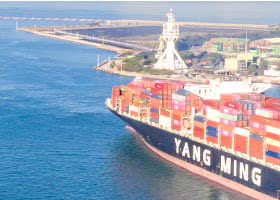

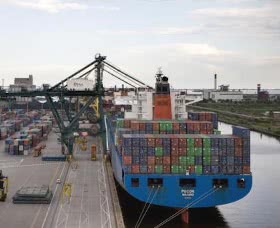











 - Via Raffaele Paolucci 17r/19r - 16129 Gênes - ITALIE


