
|
|
|
|
The Chemical Carrier Market in 2004
|
The freight market
The fleet
|
Having started in the second half of 2003, the improvement
in freight rates of chemical product carriers reached record
heights this year, which have not been seen since the
preceding periods of tensions in 1991 and 1995. This
revival, which lasts for more than a year, shows no signs of
losing pace at the start of 2005. It was however paradoxical
that the market was one of the few not to follow the general
rise in the movement earlier, which was set by the dry bulk
shipping market, oil tankers and containerships. Sooner or
later the chemical products should follow this upward spiral of the other shipping
sectors.
It was high time for all participants that the market
found its balance, for the last ten years the surplus
tonnage kept the level of freight rates often below running
costs, which resulted in owners ending up with their
balance sheets in the red. In order not to slip further down
or go under, the market has seen all over the year the
formation of pools or other partnership agreements.
This year again some changes have been carried out, with
the Vopak Essberger pool renamed Broere Essberger Chempool,
but with a single shareholder. Ahrenkiel has left the UCT
pool and with Odfjell they have formed a new pool for
inter-European movements: Odfjell Ahrenkiel Europe GmbH. In
response, Schoeller, the other partner in UCT, has
associated with Seatrans to form United Seatrans Chempool.
Too much out on a limb in this market, Naviera Quimica and
la Navale Francaise have been bought by Camillo Eitzen, who,
with his other ships coming out of Copenhagen Tankers, will
operate a fleet of 25 chemical carriers. |
|
Freight rates |
|
|
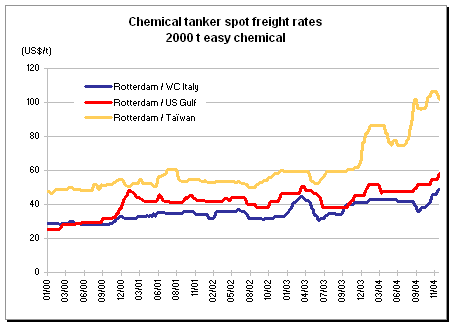
On all European routes,
spot freight rates have been continuously on the rise with an
even more significant increase between September and December.
The North European market has naturally profited from this
improvement, but very often the majority of owners did not have
the opportunity to take an interest in the spot market being largely
covered with contracts.
With few offers, and therefore less
competition, freight rates increased by 20 to 30 % on average
over the year. The rise in bunkers costs should be taken into
account in the operational results, but with virtually all transactions being in
the European currency, this has allowed owners to stay in line
with the currency of their fixed costs.
Mediterranean movements are always split in two,
with on one hand the older 'unapproved' ships and on the other
hand the modern ships. But contrary to previous years all ships
benefited from the improved freight rates. Demand for
'unapproved' ships, but with stainless steel tanks, was very
strong in Eastern Mediterranean and notably in the Black Sea for
acid movements. Nonetheless a large number of ships disappeared
from the fleet, with owners not hesitating between the high
maintenance costs and the very attractive rates being offered for
scrap, but renewal of these ships is not taking place in the
Mediterranean. There are openings in this market for owners in
search of new outlets, but rates should rise further, or at least
stabilise at current levels which have followed the same
hike in Northern Europe.
The strategy of owners for renewing
contracts has considerably evolved. Generally speaking, owners
who have
until now not been able to benefit from the rise in the spot
market (being too committed on their contracts) now ask for a
minimum and a maximum on the negotiated quantities, in order to
be able to participate in the spot market when it is attractive.
Open contracts are disappearing, as they allow charterers to play
on the spot market when it drops and to take up the 100 %
allowance with their contractual partner when it rises.
On
movements from the U.S. to Europe, |
already benefiting from a very
strong hike in rates at the end of 2003, the market continued to
firm through the first quarter and saw a minor slide until the
end of the summer. From the autumn, activity suddenly rebounded
to reach heights which had not been attained since the spring of
2002 and in 1997.
In
a market dominated by contracts, and apart from regular movements
of cumene and styrene, we have witnessed a more sustained export
of ethanol, MTBE and benzene out of South America and especially
Brazil.
On the eastbound leg, in a more contrasted manner than on the
westbound one, freight rates continued to rise right until
the end of the first quarter then sharply dropped before settling
out during the summer period and finally increasing by more than
30 % at the end of the year for lots of 2,000 tons. The firmness
in the market was much more evident in the size lots of 5,000
tons and more. As in previous years, the main movements seen
coming out of Europe were with cargoes of caustic soda, sulphuric
acid, base oils, benzene and pygas.
On average, freight rates increased from about $ 45 per ton up
to nearly $ 65 per ton for lots of 2,000 tons, and this rise of
40 % was also reflected in the renewal of contracts at the end of
the year.
Movements from Europe to Asia this year saw an explosion in
freight rates which has not been seen for 25 years. Starting from
an extremely firm market in 2003, Chinese demand for chemical
products contributed to a jump in rates of over 50 % on average,
with a spread of 100 % between the lowest and the highest levels
within the year 2004. Rates very quickly took off, in particular
for the small lots of 1,000 to 2,000 tons and the latter went
from $ 60 to more than $ 100 per ton.
The rise in bunker prices, the lack of modern tonnage available
and the optimisation of charterers' nominations within their
contracts, are part of the explanation towards such a movement in
the market. This evolution has on the reverse side incited some
exporters on the spot market to postpone their shipments, or else to
undertake 'swaps' with Asian producers and even to export small
lots of 500 to 1,000 tons with ISO containers. This revitalising
of the market should also give the four main parcel tanker owners
cause to reflect and to review their strategy in reducing the
proportion of their fleet dedicated to contract business to take
better advantage of the very firm spot market and offer more
space to European exporters.
|
|
|
The fleet |
|
|
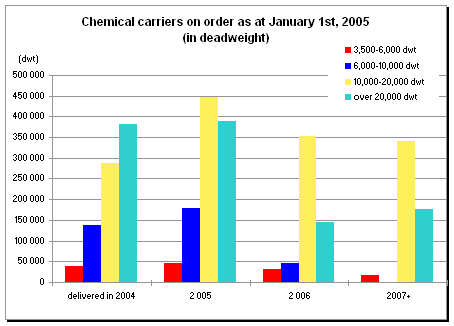
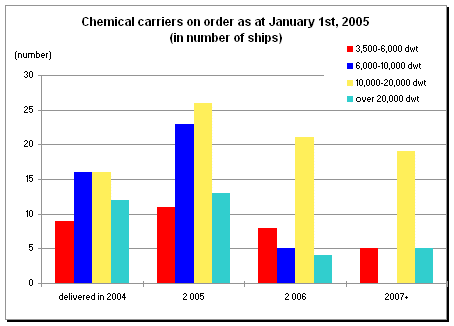
Deliveries of new chemical carriers with stainless steel
tanks reached a record level in 2004 with some fifty ships
for a total of 800,000 dwt, which brings the average age of
the combined fleet to 11.7 years. Sizes of ships are also
well distributed, with 16 ships between 5,000 and 10,000
dwt, 15 ships between 10,000 and 20,000 dwt and a dozen
above 20,000 dwt. The orderbook is also filled, with more
than 60 ships to be delivered in 2005 of which half between
15,000 and 20,000 dwt. More than 80 % of the ships delivered
this year were built in Japan and in 2005 we will witness
the first deliveries of newbuildings out of China (5 units).
Deliveries beyond 2005 are for the moment far fewer, with 30
ships expected in 2006 and 15 ships in 2007.
Demolition of chemical carriers has doubled this year
with 21 ships sold for scrap for 220,000 dwt. This trend
should continue as 138 ships of more than 20 years are still
in service, of which 70 are more than 25 years.
2004 has thus been a good year for owners, but it will
remain above all a year full of promises for the future ' or
at least the next two years. Starting from 2005, freight
contracts renegotiated at higher levels will begin to
generate a supplementary revenue to owners. Delivery of
newbuildings, although significant, should only serve to
replace the older ships leaving the fleet.
In effect, the quality measures imposed by charterers
combined with the new directives set out by the IMO
beginning in 2007 for the transport of vegoils (imposing IMO
III ships but with a double-hull) will mean that a number of
large units will disappear from the market. Modern ships
will thus be greatly solicited. It should be added that
shipyards are currently fully booked, plus the fact that the
price of steel is prohibitive for orders of chemical
carriers fitted with stainless steel tanks.
In the past we have experienced peaks in the market but
generally over fairly short periods. The current situation
is new and seems to be solid, without any major accidents or
a decline in economic activity, this should continue to last
quite some time.
|
|
|
Shipping and Shipbuilding Markets in 2004
I N D E X
|



















 - Via Raffaele Paolucci 17r/19r - 16129 Genua - ITALIEN


