testata inforMARE
Cerca
19 de agosto de 2026 - Año XXX
Periódico independiente sobre economía y política de transporte
20:39 GMT+2
LinnkedInTwitterFacebook
FORUM de lo shipping y
de la logística


Outlook

In our previous report, we anticipated that freight levels would hold for 2001 and 2002 before a probable dropping off in 2003 given the massive number of newbuildings then appearing.

With the world economic climate suddenly wavering between stagnation and depression, and an America unexpectedly facing the woes of unemployment, compounded by terrorist attacks putting at stake its supremacy, freight rates have got sucked into a downward spiral which is certainly overdone.

The question is to know whether this is a mechanical phenomenon which is justified and long lasting or, on the contrary, simply a strong reaction which will enable the market to recover a healthy balance quicker than expected. We think this second hypothesis to be more likely.

Many experts believe that the United-States will recover from the dramatic events of September 11th stronger than before, and that growth will pick up again after the second quarter of 2002. The role that the world's most important economic power plays in terms of energy consumption will be confirmed and it is likely in addition that we shall see a decline in the use of nuclear energy.

Despite efforts of producing countries to push up oil prices, the world producing capacity today is such that the oil price is unlikely to go over $25 per barrel. This is another factor in favour of a rapid economic recovery.

The high freight rates registered in 2000 and in the beginning of 2001 acted as a brake for any voluntary scrapping of the oldest vessels. However, faced with depressed rates such as we have currently, their employment should be increasingly dubious.

Given that today we have already witnessed a serious decline in the number of orders of newbuildings for the three main categories of tankers, we should see an increase in the number of vessels over 20 years heading for the scrapyard. The return of a better balance between supply and demand could therefore occur in a far shorter time than predicted by many.

The second-hand oil tanker market 

Last year's revue concluded by drawing the reader's attention to the trend towards a slowing down in world growth and the repercussions that this would have on the value of ships built in the 70's and 80's. This perception was revealed to be accurate, or more honestly partially so, as in fact all ages of ships suffered a drop in value even if older ships were the most affected.

The year 2001 saw an impressive number of transactions, at the end of the year we have listed about 140 second-hand sales of ships for navigation or transformation (and thus excluding demolition). In comparison, the total of ships transacted in 2000 was 126 and in 1999 only 98. This figure of 140 is however slightly misleading as a considerable number of transactions were done "en bloc" and it is primarily by this yardstick that one can measure the effects of mergers and regroupings within the shipowning world.

Values have declined due to a drop in ships' revenues for all sizes, the systematic compressing of construction costs offered by yards, and by charterers taking a control of the market at the expense of owners. Just as at the end of 1998 and during 1999, charterers can again pay themselves the luxury of deciding arbitrarily whether to reject older ships without risk of paying a heavy premium for a modern ship. It is for this reason that no matter what the size, ships of the 70's and 80's have seen their value drop by more than 45 % during the course of the year, whereas modern units and double-hulls have lost between 20 to 25 % of their value.

Prices remained firm at the beginning of the year but collapsed as the steady decline in daily revenues was being realised and slipped further after the events of September. We should like to point out certain tendencies which characterise this sector but which are also present in other types of tonnage:

  • The cyclical rise and fall of values are getting shorter not only because of the instability of our economies but also due to the shorter reaction time of the players be they owners, charterers, or builders.
  • If the concentration of tonnage in the various pools helps push the market on its way up, they do not seem capable of slowing it down on the falls.
  • Different types of owners exist and their varying time horizons contradict their objectives, which are equally different. Consequently, those who are under obligation to always produce profits in the short term, tend to amplify the movements of the market.
  • The sellers' ability to resist their counterparts when values are declining seems stronger than the resistance of buyers when values are rising.

The year 2002 appears to be starting out as difficult times for owners. The asset worth has fallen to levels of 1999 and a large number of ships are due to come into service for the Aframax and the Panamax fleets. The demolition of the oldest units is inevitable in the short-term, but the revenues of the old ships are often the means of financing the costs of their new ships.

Experience shows that the tonnage on offer has not and should not be the problem. The really essential factor is demand and it is this demand that we should try to determine as best as possible. Although we can not be categorical in our forecasts, we would nonetheless give some suggestions to potential investors:

  • with modern ships, to seriously look at the possibility of buying "resales" (with equivalent specification) rather than systematically ordering new ships,
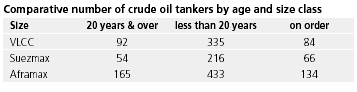
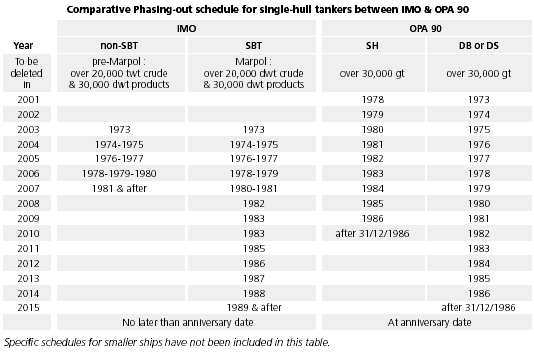
  • with older ships, to keep in mind the comparative table of phasing-out given above.
  • phasing-out
     
     The second-hand market for VLCCs

    This sector of the market saw 37 units change hands, namely five times more than last year. The main player in this was Frontline (directly or via the Tankers International pool), since it seems that 13 ships out of the 37 involved this owner. The fluctuating values allowed certain to realise brilliant operations in terms of timing. For example Bergesen was able to sell for nearly $78 million per unit, several of his ships which he had bought for less than $65 million a year before. As mentioned above, a number of sales were done "en bloc", 17 ships out of the total 37 transactions changed hands in this manner. The most noteworthy without doubt being the sale of four - m/t ‘Hellespont Burnside', m/t ‘Hellespont Elmere', m/t ‘Hellespont Holly', m/t ‘Hellespont Sheridan' of 305,000 dwt built by Samsung, for delivery in 2001 and 2002 to the National Shipping Company of Saudi Arabia for a price of $82.5 million per vessel.

    Out of 18 ships sold this year, built after 1990, all except four were double-hulled and were less than three years (newbuilding resales included). Among the four single-hulled, was the sale "en bloc" of the m/t ‘Front Tarim' and the ‘Front Tartar' of 306,902 dwt built in March 1993, for a combined price of $104 million with three years charter at $38,000 per day.

    Ten ships built between 1980 and 1989 changed hands and to illustrate the drop in prices, we can cite the sale of the single-hulls with the m/t ‘Isuzugawa Maru' of 247,392 dwt built in 1987 for $28.5 million in February, whilst the m/t ‘Cosmo Jupiter' of 248,965 dwt built in 1986 achieved $18.9 million in October. Owners of ships in good running order and built in the 70's have managed to survive with honours in the current skirmishing. Out of the nine ships sold from this decade, seven were converted into FSO or FPSO. Thus the t/t ‘Stena Companion' allowed her owners to obtain over twice the price of her scrap value, achieving nearly $15 million in September.

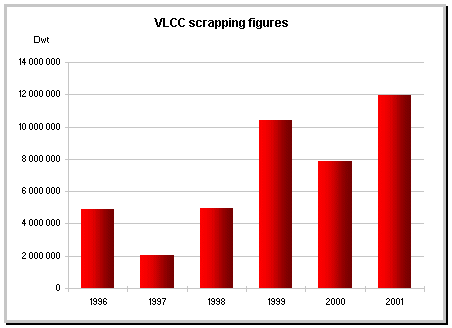
    Although a final reckoning still remains to be done, it seems that at time of press, around 30 ULCC/VLCC have been sold for demolition. It is worth pointing out however that the rhythm of scrapping has been increasing in pace over the past months and that in the last two months of this year the activity was hectic. This tendency should continue even to accelerate right throughout 2002, and in any case to last at least as long as rates are under pressure. The price per light ton has also diminished and while it was possible to obtain about $170 per light ton at the beginning of the year, it finished at the end of the year at somewhere near $135 per ton.

    Vlcc scrapping

     The Suezmax second-hand market

    The volume of activity during these last years has remained extremely stable for this type of ship. We noted 23 transactions per year for 1999 as well as 2000, and this year the number changing hands has been 24. In the same way as with VLCCs, the number of ships sold "en bloc" was also significant, since a third of the 24 ships (namely eight) were subject to two grouped sales. The more important of the two was that which consisted of five resales, the ‘Hyundai 1351', ‘Hyundai 1350', ‘Hyundai 1336', ‘Hyundai 1335', ‘Hyundai 1334', and ‘Hyundai 1333' for delivery in 2002 / 2003 and sold during the summer for $330 million en bloc.

    We have seen however that activity is essentially concentrated on very modern ships. Ten resales, added to five ships built between 2000 and 2001, then a single unit built in 1993, represented two-thirds of the sale and purchase deals in this sector. Several of these units have changed hands with charter back attached, such as the m/t Four Smile' 160,573 dwt built in 2001, which was sold for a price of about $60 million with a five year charter back at $27,500 per day. To our knowledge the only ship sold from the 90's was the m/t ‘Polysymphony' 150,038 dwt built in 1993, which went at the beginning of the year for $41 million.

    No ship built between 1980 and 1989 was sold and the remaining transactions were for units built in the 70's. As in the VLCC category, with freight rates collapsing during the year, buyers were especially active at the beginning of the year since five of the seven transactions were done in the first half of 2001. Thus the m/t ‘Enalios Thetis' of 149,992 dwt built in 1979 was able to achieve a price of $6.5 million in February whereas in mid- November the m/t ‘Elfwaihat' built in 1976 was sold at a level very close to its scrap value, of about $3.2 million.

    The demolition figures were impressive, as 28 ships were taken off to the Far East. This is a level comparable to that of 1999 in which 26 ships were withdrawn from the market. The attractive freight rates in 2000 only produced 16 demolitions. As with all size of tankers for this year, sales of Suezmax for scrapping became more numerous as the year progressed.

    The second-hand market for Aframax et Panamax

    In the Aframax market we have seen in 2001 a similar volume of activity to that of last year's, namely 34 sales as compared to 36, which pales against the figure of 50 achieved in 1999. This figure is relatively small if we take into account the total number of ships comprising the active fleet namely 540 units. As a matter of fact, the division by age which has been relatively stable and balanced since the 70's up till now, should allow greater movement and flexibility in this market, in contrast to the VLCC and Suezmax categories which suffer from a lack of tonnage built in the 80's.

    The sale of modern ships played a significant part as 16 of the 34 deals concerned ships under 10 years, all double-hulled bar one. Several sales "en bloc" were also achieved of which the m/t ‘Astro Saturn' and the m/t ‘Astro Maria' of 105,690 dwt, both built in 1999, went for a price of $45 million per ship in May. In comparison and to illustrate the progressive drop in the market all through the year, we can mention the sale of the ‘resale' ‘Samho S141' for delivery 2002, which changed hands in November for a price of $39.5 million.

    Fourteen units built between 1980 and 1991 were sold and once again those with SBT were able to extract a higher price. The value of these ships has nonetheless been badly hit. We have seen the sale of the m/t ‘Magnolia', 84,656 dwt built in 1983, for a price in the region of $11.7 million in January, whereas a seller had to accept in November a price of $7 million for each of the m/t ‘Winamac', m/t ‘Wapello' and m/t ‘Waneta', in addition to taking them back under charter for a three year period at a reported rate of $14,000 per day. Only five ships built between 1975 and 1979 changed hands to continue employment. The last to date as we write has been the m/t ‘Orapin Ocean' of 81,269 dwt built in 1976 who had her classification renewed in January of this year and which achieved a price of $3 million in December.

    We have counted 19 Aframax which have been sent to the scrapyard. Unlike the VLCC and Suezmax, demolition figures show no noticeable change over 2000, which saw 18 and 1999 with 20. This is hardly surprising as this category of ship has been able to weather the lowering of freight rates better than others and even the older units give respectable daily returns East of Suez.

    As to the Panamax sector there is renewed life and vitality, but above all it is the favourite of second-hand buyers. We wish that this trend will last, as the orderbook for newbuildings has seen on its side a substantial increase with 42 ships in 2001 against only 13 last year. The volume of sales reached 27 ships of 50,000 to 75,000 dwt this year, some 11 more than in 2000. It should be pointed out that five of these 27 Panamax had a width over 32.2 metres. The breakdown of sales by age bracket was relatively balanced. Thus seven of less than ten years were sold, and the most noteworthy sale without doubt was that of the m/t ‘Maya', m/t ‘Aztec', and the m/t ‘Inca' of 68,467 dwt built in 2001, for a price per ship of $42 million in July.

    Ten other units built between 1980 and 1989 changed hands. For example in May the m/t ‘Minerva' and the m/t ‘Andromeda' of 63,953 dwt built in 1984 were sold en bloc for a total price of $26 million. The other ten remaining sales related to ships built in the 70's, and the last to date was that of the m/t ‘Sealion I' of 59,250 dwt built in 1977, which obtained a price in the order of $3.7 million, having passed her special survey. There were only seven ships sold for demolition in this category in 2001, as compared to eight last year and this was a satisfactory figure given that only four new units entered the fleet in 2001. The challenge is of another order for next year.

     The second-hand market for OBOs

    With 11 ships sold during the course of the year, the volume of sales in this category has remained stable since 10 ships changed hands last year. No less than seven of these, the ‘SCF Spirit', ‘SCF Trust', ‘SCF Star', ‘SCF Champion', ‘SCF Endurance', ‘SCF Challenger', and ‘SCF Trader' of 95,000 dwt built between 1991 and 1992, were sold en bloc for a total sum of $210 million during the summer to the great satisfaction of the sellers (and that doubtless only possible) due to the thinness of the market. The four other ships sold, date all from 1981 or 1982, and we can give as example the sale of the ‘OBO Panoil' of 70,637 dwt built in 1981, in June at a price of $5.5 million.

    Elsewhere, 11 OBO ships were demolished this year, their sizes ranging from 72,000 dwt to 172,000 dwt, having been built between 1974 and 1978. Currently some 140 ships of this type whose tonnage exceeds 50,000 dwt remain in service, even if not all have the ability to carry oil products in their present state.


    Shipping and Shipbuilding Markets in 2001

    I N D E X

    ›››Archivo
    En el segundo trimestre, el tráfico de mercancías en el puerto de Taranto creció un +6,7%.
    Taranto
    En julio se registró un aumento del +104,9%.
    Viking Holdings Cruise Line registra ingresos trimestrales récord
    Los Ángeles
    Beneficio neto de 587,7 millones de dólares (+33,8%)
    El tráfico de contenedores en el puerto de Los Ángeles disminuyó un 5,8% el mes pasado.
    Los Ángeles
    En los primeros siete meses de 2026 se registró un crecimiento del +1,8%.
    El tráfico de contenedores en el puerto de Long Beach disminuyó un 1,7% en julio.
    Playa larga
    En los primeros siete meses de este año, el tráfico total fue de 5.758.086 TEU (+1,2%).
    En el segundo trimestre, RCL registró un aumento en los ingresos que se vio contrarrestado por el aumento en los costos operativos.
    Bangkok
    El beneficio neto disminuyó un 1,1%.
    Mejora el rendimiento financiero trimestral de la empresa danesa DFDS.
    Copenhague
    En el trimestre de abril a junio, el material rodante transportado por la flota aumentó un 1,1%. El número de pasajeros disminuyó un 8,9%.
    El tráfico de contenedores en las terminales de HHLA disminuyó un -8,0% en el segundo trimestre.
    Hamburgo
    Los ingresos aumentaron un 2,5%. Los costes operativos aumentaron un 5,7%.
    Costa Cruceros anuncia un cambio en la dirección de la región de las Américas.
    Génova
    Jorge Serrano Martín de Vidales reemplazará a Darío Rústico
    La Autoridad Portuaria de Livorno crea un grupo de trabajo interno para el proyecto Darsena Europa.
    Livorno
    El objetivo es garantizar una coordinación unificada con la estructura de comisionados que sigue el proyecto.
    MSC instala el sistema de limpieza proactiva del casco de Jotun en el MSC Daniela.
    Sandefjord
    Combina tecnología avanzada antiincrustante con inspección y limpieza robótica.
    Wan Hai Lines reporta un aumento del 965,6% en sus ganancias trimestrales.
    Taipéi
    La empresa encarga seis nuevos buques portacontenedores con capacidad para 11.000 TEU.
    En el segundo trimestre, el tráfico de carga en los puertos montenegrinos disminuyó un -5,8%.
    Podgorica
    El volumen de carga con origen y destino en Italia disminuyó un 40,6%.
    El Grupo Grimaldi ha recibido el Grande Pacifico.
    Nápoles
    El buque es el primero de cinco nuevos buques PCTC gemelos con una capacidad de 9.800 unidades de transporte marítimo de pasajeros (CEU).
    En 2025, los ingresos del grupo Fratelli Cosulich ascendieron a 1.900 millones de euros (-11,5%).
    Génova
    Beneficio neto de 20,0 millones de euros (-3,0%)
    Ha fallecido Maurizio Longo, secretario general de Trasportounito.
    Roma
    Falleció en Roma tras una larga enfermedad.
    Terminal Investment Limited abandona la adquisición de Tercat.
    Bruselas
    Preveía el control conjunto de la terminal de Barcelona con Hutchison Ports.
    Se han finalizado los trabajos para activar el suministro eléctrico en frío en la terminal de cruceros de Porto Corsini en Ravenna.
    Rávena
    Aceleración del proceso de reurbanización de la antigua zona CIVAM en el puerto de Vibo Valentia Marina.
    Vibo Valentia
    La zona se transformará en nuevos patios para logística comercial.
    Maersk Group vende Maersk Training y Maersk H2S Safety Services.
    Copenhague
    Serán vendidas a US Open Gate Capital, especializada en operaciones de escisión industrial.
    PROXIMAS SALIDAS
    Visual Sailing List
    Salida
    Destinación:
    - orden alfabético
    - nación
    - aréa geogràfica
    En el trimestre de abril a junio, el puerto de Venecia gestionó 6,3 millones de toneladas de mercancías (-1,2%).
    Venecia
    El número de pasajeros de cruceros disminuyó un -15,3%.
    En el segundo trimestre, el tráfico de mercancías en el puerto de Ravenna registró un fuerte aumento del +10,9%.
    Rávena
    En los primeros seis meses de 2026 el aumento fue del +5,9%.
    DP World adquiere seis centros logísticos de GXO en el Reino Unido.
    Dubái
    186.000 metros cuadrados y 2.000 empleados cambian de manos: esta es la transferencia impuesta por la Autoridad Antimonopolio británica por la adquisición de Wincanton.
    DHL se dispara en el segundo trimestre, pero no en todas partes.
    Bonn
    Ingresos y EBIT de dos dígitos. Express tuvo un buen desempeño, mientras que Supply Chain y Post & Parcel Germany no lo tuvieron tan bien.
    Global Ship Lease registra ingresos récord trimestrales y semestrales.
    Atenas
    El aumento de los costes repercute en los beneficios.
    DP World construirá un centro logístico con temperatura controlada en el puerto de Amberes.
    Dubái/Kallo
    GNV activará el sábado un tercer servicio marítimo a Argelia.
    Génova
    La línea Civitavecchia-Annaba complementará las rutas existentes desde Sète a Argel y Bejaia.
    Danaos Corporation registra un crecimiento trimestral de sus ingresos del 4,7%.
    Atenas
    El segmento de buques portacontenedores se mantiene estable. Los graneleros siguen contribuyendo.
    Un buque granelero alcanzado por un proyectil en el estrecho de Ormuz.
    Southampton/Londres
    Según los informes, un miembro de la tripulación está desaparecido.
    Este año se espera la llegada de 800.000 pasajeros de cruceros a Messina.
    Messina
    Los pasajeros generan un gasto directo de casi 16 millones de euros en la ciudad.
    El tráfico de contenedores en el puerto de Nueva York creció un 1,6% en el segundo trimestre.
    Nueva York
    En los primeros seis meses de 2026, se gestionaron 4,43 millones de TEU (+0,2%).
    HZ Cargo y Railtrans forman una empresa conjunta para el transporte intermodal.
    Zagreb
    El objetivo es activar un tráfico de más de 500 mil toneladas entre los puertos de Croacia y los mercados de Europa Central.
    ICTSI registra un beneficio neto récord de 363 millones de dólares (+24,2%) en el segundo trimestre.
    Manila
    Otro buque de GasLog sufrió un accidente al salir del Golfo Pérsico.
    El Pireo/Southampton
    Daños en la sala de máquinas
    Finnlines registra ingresos trimestrales récord.
    Helsinki
    En el periodo de abril a junio, el beneficio neto fue de 42,9 millones de euros (+64,7%).
    Spinelli Group aprueba su informe de sostenibilidad de 2025.
    Génova
    El valor de la producción creció un 5%. Las nuevas contrataciones aumentaron un 48%.
    Fabrizio Marilli será el nuevo secretario general de la Autoridad Portuaria del Mar Adriático Central.
    Ancona
    El Comité de Gestión ha aprobado el ajuste presupuestario de la institución.
    La Autoridad Portuaria del Mar de Liguria Occidental ha adoptado el Plan Portuario 2026-2028.
    Génova
    Las proyecciones para 2028 indican un aumento de aproximadamente 150 empleados en los puertos del sistema.
    La Autoridad Portuaria del Sur del Mar Tirreno y Jónico ha aprobado el ajuste presupuestario.
    Gioia Tauro
    Registra mayores ingresos y mayores gastos de 1,69 millones de euros.
    Un millón y medio de euros para formación en puertos toscanos.
    Livorno
    La Autoridad Portuaria del Tirreno Septentrional ha presentado su plan de formación para el periodo 2026-2028.
    Terminali Italia gestionará la terminal intermodal de Orte a partir del próximo año.
    Roma
    Tiene aproximadamente 96.000 metros cuadrados de patios y tres pistas.
    Italia y Túnez firman un acuerdo de colaboración en el sector del transporte y la logística.
    Roma
    Otro buque Bahri, propiedad de Arabia Saudí, fue atacado por los hutíes en el Mar Rojo.
    Southampton/Saná/Riad
    El portavoz de los militantes yemeníes reivindicó la autoría del ataque contra el buque cisterna de productos químicos "NCC Ghazal".
    Hoy se ha logrado completar la perforación de los dos túneles principales del Túnel de Base del Brenner.
    Bolzano
    Las dos zonas de construcción están conectadas aproximadamente a 1.400 metros por debajo del paso del Brenner.
    Los ingresos de UPS aumentaron un 7,6% en el segundo trimestre.
    Atlanta
    El beneficio neto ascendió a 604 millones de dólares (-52,9%).
    En 2025, los ingresos de la empresa de logística italiana Nord Ovest crecieron un +13,6%.
    Cuña
    El beneficio neto disminuyó un 8,3%.
    El tráfico de mercancías trimestral aumentó en los puertos de Algeciras y Barcelona. Valencia experimentó un descenso.
    Algeciras/Barcelona/
    Valencia
    Aumento de contenedores en el puerto catalán
    Fincantieri firma un acuerdo con los socios de reinversión de NextGeo.
    Trieste
    Esta operación forma parte de la estrategia de desarrollo en el segmento del buceo.
    Se ha adoptado la actualización del DPSS de los puertos de Cerdeña.
    Cagliari
    Resolución del Comité de Gestión de la Autoridad del Sistema Portuario
    ICTSI adquiere las terminales de carga a granel ATU12 y ATU18 en el puerto brasileño de Aratu.
    São Paulo/Manila
    Serán vendidos por SIMPAR por aproximadamente 355 millones de dólares.
    Konecranes informa de un descenso en su rendimiento financiero trimestral a medida que aumentan los pedidos.
    Helsinki
    El valor de los pedidos relacionados con equipos portuarios creció un 17%.
    Catorce regiones están a favor y cinco en contra del proyecto de ley de reforma de la gobernanza portuaria.
    Roma
    Rixi: Continuemos ahora con el proceso institucional con el objetivo de lograr una reforma equilibrada.
    Las ventas netas de Kuehne+Nagel aumentaron un 8% en el segundo trimestre.
    Schindellegi
    El rendimiento mejoró notablemente en el segmento de carga aérea.
    El equipo directivo de Assagent ha sido renovado.
    Génova
    La composición del comité ejecutivo y los presidentes de las comisiones
    DP World firma un acuerdo preliminar para construir dos terminales en el puerto de Fujairah.
    Dubái
    VIO - Renovación del Consejo de Administración del Interpuerto de Vado Ligure
    Génova
    Pierangelo Olivieri ha sido nombrado presidente
    La facturación de Kalmar aumentó un 14% en el segundo trimestre.
    Helsinki
    El valor de los nuevos pedidos se mantiene estable.
    Saipem gana un nuevo contrato de perforación en alta mar frente a las costas de Costa de Marfil.
    Milán
    Fue otorgado por Eni Costa de Marfil.
    El rendimiento trimestral de DSV continúa creciendo, impulsado por la adquisición de Schenker.
    Hedehusene
    En el periodo comprendido entre abril y junio de 2026 se registró un beneficio neto de 2.600 millones de coronas danesas (+11,5%).
    Falteri (Federlogistica) ha sido incorporada al Consejo de Administración de la Asociación Europea de Logística.
    Génova
    Protocolo de colaboración internacional sobre logística integrada con ACLI Terra
    PUERTOS
    Puertos italianos:
    Ancona Génova Rávena
    Augusta Gioia Tauro Salerno
    Bari La Spezia Savona
    Brindisi Liorna Taranto
    Cagliari Nápoli Trapani
    Carrara Palermo Trieste
    Civitavecchia Piombino Venecia
    Interpuertos Italianos: lista Puertos del mundo: Mapa
    BANCO DE DATOS
    Armadores Reparadores navales y astilleros
    Expedicionarios Abastecedores de bordo
    Agencias marítimas Transportistas
    MEETINGS
    La conferencia "Acuerdo UE-Mercosur: El papel de la economía marítima" se celebrará en Génova el 1 de julio.
    Génova
    Está organizado por la Fundación Casa América ETS y la Autoridad Portuaria de Liguria Occidental.
    La asamblea de los Federagentes se celebrará en Civitavecchia el 3 de julio.
    Roma
    Pessina: No hablaremos de regulaciones, relaciones comunitarias ni de la búsqueda de teorías y burocracia, sino de los desafíos de la infraestructura portuaria italiana.
    ››› Archivo
    RESEÑA DE LA PRENSA
    Empire buys back: After Tata, Adani can rewrite India's colonial past
    (The Economic Times)
    Govt does not interfere in port management appointments - Loke
    (Bernama)
    ››› Reseña de la Prensa Archivo
    FORUM de lo shipping y
    de la logística
    Intervento del presidente Tomaso Cognolato
    Roma, 19 giugno 2025
    ››› Archivo
    El Consejo de Cooperación del Golfo insta a la comunidad internacional a proteger el transporte marítimo contra las amenazas de los hutíes.
    Riad
    Reacciones al anuncio de un embargo marítimo contra Arabia Saudita.
    Fincantieri firma un acuerdo en Qatar para la gestión operativa del Centro de Entrenamiento y Simulación.
    Trieste
    El centro está destinado a la formación del personal naval de la Armada de Qatar.
    Más de 770 kilos de cocaína incautados en el puerto de Vado Ligure.
    Savona
    Una vez comercializada, la droga habría garantizado a las organizaciones criminales beneficios de 250 millones de euros.
    Wärtsilä registra un fuerte aumento en el valor de los nuevos pedidos en el segundo trimestre.
    Helsinki
    La facturación neta disminuyó un -2%.
    Yang Ming encarga a Hanwha Ocean la construcción de seis buques portacontenedores de doble combustible con capacidad para 13.000 TEU.
    Keelung
    Contrato valorado en más de 1.200 millones de dólares.
    El número de víctimas de los ataques a barcos en el Mar Negro se agrava.
    Odesa
    Diez muertos a bordo de un barco que salía del puerto de Odessa.
    Hoy se ha producido un nuevo ataque contra un barco en el estrecho de Ormuz.
    Southampton
    El buque cisterna Kavomaleas, de la empresa griega Dynacom Tankers Management, se incendió.
    Confitarma se muestra decepcionada por la propuesta de la Comisión de revisar el RCDE UE.
    Roma
    Zanetti: La ausencia más notable es la competitividad del sector naviero italiano y europeo.
    ALIS: Las propuestas de la Comisión sobre el RCDE UE son positivas, pero persisten problemas importantes.
    Roma
    El MIT adopta directrices para el planchado en frío.
    Roma
    El objetivo es garantizar criterios claros, uniformes y transparentes para todas las autoridades del sistema portuario.
    En el primer semestre del año, el tráfico de cruceros en las terminales portuarias de GPH creció un +10,1%.
    Estanbul
    Solo en el segundo trimestre el aumento fue del +2,8%.
    La Autoridad Portuaria de Liguria Occidental aprueba la actualización del presupuesto para 2026.
    Génova
    Assiterminal aclara sus dudas sobre las responsabilidades asignadas a Porti d'Italia Spa.
    Génova
    ABB compra British Rotork.
    Zúrich/Londres
    La empresa, con sede en Bath, está especializada en control de flujo y automatización industrial.
    La Autoridad Portuaria del Adriático Central refinancia 100 millones de euros procedentes del Decreto de Infraestructuras.
    Ancona
    Los fondos se destinan a siete intervenciones estratégicas del sistema portuario.
    El tráfico de contenedores en el puerto de Los Ángeles aumentó un 3,4% en el primer semestre de 2026.
    Los Ángeles
    En el segundo trimestre, el crecimiento fue del +11,5%.
    La OMI y la ITF piden que cesen los ataques contra los marineros y los trabajadores del transporte.
    Londres
    Resurgimiento de incidentes en la región del Mar Negro, el Mar de Azov y el Estrecho de Ormuz.
    El tráfico de contenedores en el puerto de Hong Kong creció un 0,2% en el segundo trimestre de 2026.
    Hong Kong
    En junio se registró un aumento del +6,5%.
    Uiltrasporti se opone firmemente a la creación de Porti d'Italia Spa.
    Roma
    Verzari y Gulli: los proveedores de servicios publicitarios deben estar coordinados por un organismo público que pueda proteger a los trabajadores portuarios.
    CMPort establece nuevos récords mensuales, trimestrales y semestrales de tráfico de contenedores.
    Hong Kong
    En el primer semestre de 2026, se trasladaron 78,3 millones (+4,6%).
    En el primer semestre de este año, el puerto de Singapur gestionó 22,7 millones de contenedores (+4,7%).
    Singapur
    Récord histórico en ventas de búnkeres durante el primer semestre
    El tráfico de contenedores en el puerto de Long Beach aumentó un 10,3% en el segundo trimestre.
    Playa larga
    En el primer semestre de 2026 se registró un crecimiento del +1,7%.
    Se ha nombrado al nuevo consejo de administración de Ferrovie dello Stato Italiane.
    Roma
    Tommaso Tanzilli confirmado como presidente. Gianpiero Strisciuglio es el nuevo director general.
    Puerto de Gioia Tauro: se lanza la licitación para la finalización de las actividades de dragado.
    Gioia Tauro
    La duración prevista del contrato es de 60 días.
    En el primer semestre de 2026, el tráfico de carga en los puertos turcos fue de 279,1 millones de toneladas (+1,5%).
    Ankara
    Los envíos con destino a Italia ascendieron a 23,4 millones de toneladas (-2,5%).
    El primer corte de acero del crucero Carnival Destiny .
    Monfalcone
    Fincantieri y Carnival celebran el trigésimo aniversario de su colaboración.
    - Via Raffaele Paolucci 17r/19r - 16129 Génova - ITALIA
    tel.: +39.010.2462122, fax: +39.010.2516768, e-mail
    Partita iva: 03532950106
    Registrazione Stampa 33/96 Tribunale di Genova
    Director: Bruno Bellio
    Prohibida la reproducción, total o parcial, sin el explicito consentimento del editor
    Búsqueda en inforMARE Presentación
    Feed RSS Espacios publicitarios

    inforMARE en Pdf
    Móvil