testata inforMARE
Cerca
22 de febrero de 2026 - Año XXX
Periódico independiente sobre economía y política de transporte
04:33 GMT+1
LinnkedInTwitterFacebook
FORUM de lo shipping y
de la logística


The Shipbuilding Market in 1998


Analysis by country

Japan

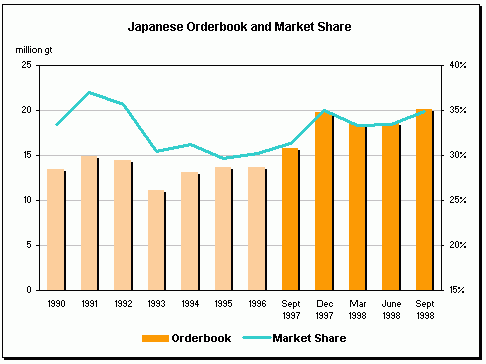
Kentaro Aikawa, President of the Shipbuilders Association, said in September 1998: "the Japanese shipyards have enough contracts to be fully occupied during the next two years, and they have no need to run all over the world looking for new orders". 

This statement sums up well enough the record figure of 20.1 million gt reached by the Japanese yards in the third quarter of 1998, maintaining their market share. It also shows their extraordinary reactivity in the face of their Korean rivals, which benefited from an unprecedented competitive devaluation. 

It is true that the financial crisis that forced Korea to seek help from the IMF in the fourth quarter of 1997 might initially have been of benefit to the Japanese yards. Shipowners naturally turned to them, given legitimate queries about the survival of the Korean yards and above all their temporary inability to conclude orders because of the failure of the banking system. 

The Japanese yards were also able to benefit from the gradual depreciation of the yen against the dollar, from 120-125 yen/$ at the beginning of the year to 140-145 yen/$ in September 1998. This devaluation also caused positioning by shipowners anticipating a still weaker yen. However, this trend stopped on 8 October, when the yen appreciated suddenly and unexpectedly from 140 to slightly above 111 yen/$. 

Of course the situation is not uniform, and affects small and medium-size yards differently. In April 1998 the Japanese government invited the large yards to help the small yards by sub-contracting jobs to them wherever possible. 

The output of many of them is acquired by domestic shipowners, whose investment capacity remains conditional on obtaining bank loans; the difficulties that the Japanese banks are encountering in turn is leading to credit restrictions and complicates loan syndication. 

Furthermore, many small Japanese shipowners customarily order against long-term charter parties, mainly from first-rank Japanese shipowners or from Western companies. The uncertainty, the reduction in growth and the contraction of international trade have reduced transport needs, leading to a fall in freight rates which again compromises investment options. Some orders have had to be cancelled. Confronted with this situation, the small yards have had to agree to further reductions. 

Orderbook Japan

Japan nevertheless has dynamic shipowners, and the share of domestic orders in the Japanese yards is still very high, at nearly 60% in 1998 compared to 40% for export. The Japanese trading companies play a predominant role. 

However, the yards must face up to another challenge. In order to continuously improve their competitiveness, most of them have considerably reduced their personnel wherever possible, and notably with regard to their engineering and project management resources. 

Some yards have focused their production on one or two types of ship, which they then build in series. This is the case of Oshima and Tsuneishi for bulk carriers and Onomichi for refined product carriers. 

Diversified and single-product Japanese yards
On order at

Kawasaki

Oshima

Onomichi

Bulkers

1

40

-

Tankers

8

-

8

Containerships

1

-

-

Roro

2

-

-

Gas carriers

6

-

-

These ships have excellent designs and, in the keen competition for dry bulk cargo transport, it can be affirmed that shipowners (hardly) make any attempt today to ask for changes in the specifications. In this sense the Japanese yards have won their wager to design an industrial product without major involvement by the customer, whose role during building is diminishing little by little. Some shipowners still want to build their own ships, incorporating the fruit of their experience, in order to maintain a competitive advantage through lower operating costs, reduced maintenance and a higher resale value. They do not always obtain a favorable response from these specialized yards. Price is perhaps not the only factor in the choice. 

It might be wondered what the more or less long-term impact of this policy on the market will be, in that the shipowners, losing an additional competitive advantage, will not have any other choice than to order and sell at the right times; a complex exercise in a deflationary period. 

But Kentaro Aikawa later declared in December 1998: "1999 will not be an easy year for the shipbuilders. I do not see any sign favoring a recovery in prices. The industry suffers from overcapacity and financing difficulties, while the yen has strengthened". 

This demonstrated the fragility of positions that were taken for granted; many economic parameters outside the direct control of the yards can influence the course of activities. 

1998 was a difficult year for the country, with a decrease in gross domestic product and increases in bankruptcies and unemployment. 

The banking difficulties and the decrease in the bulk carrier market should have a negative effect on the number of domestic orders. 

In addition, a stronger yen and the pressure from the Korean shipyards should reduce the number of export orders, unless of course the Japanese economy, the second in the world, picks up or the yen depreciates. 


Korea

1998 ended much better than it began. The Korean yards have again increased their orderbook in absolute value and maintained their market share. 

In November 1997 the country was literally in shock. Bankruptcies threw about 10,000 people a day onto the streets. The paralysis that blocked the Korean economy and doubt about the magnitude of the crisis at first rendered the yards incapable of taking new orders. No order was recorded in January 1998. 

This period of uncertainty did not last long, because the Koreans reacted very quickly under the impetus of their new president. Workers, managers and directors agreed to make enormous sacrifices in the form of overtime and large salary reductions. 

An equilibrium, still fragile, was achieved in the Spring. Whereas the exchange rate had increased from about 900 won/$ in November 1997 to almost 2,000 at the end of 1997, the won stabilized at the end of March and the beginning of April at about 1,400. 

With the notable exception of the Halla yards, the large Korean yards such as Hyundai HI, Daewoo and Samsung did not stop taking orders from that point on, with Hanjin following them a few months later. It is interesting to note in this context that the country's orderbook has increased. In 1998 Korea's nominal capacity was thus reduced for the first time, because of the absence of Halla, without diminishing or affecting the actual national production capacity, in fact just the contrary. 

While prices have already dropped by 15 to 30%, some are wondering about how important it is for the country to maintain this status quo, insofar as the reactivation of the Halla yards could contribute to a further fall in prices, to the detriment of the other yards and the national interest. Time will tell. 

The main difficulty has been in setting up down-payment refund guarantees acceptable to the shipowners and their banks. The bank guarantees issued by Kexim, the Korean import-export bank, have had to be counter-guaranteed by Western banks or insured by first-rank insurance companies. 

However, this has not always been the case, and some Middle East shipowners were satisfied with Kexim guarantees. Others found their own financing. 

The Korean yards got around the difficulty by, for the first time, applying payment terms shifted toward delivery, thus facilitating the setting-up of these counter-guarantees because of the smaller amounts, whereas previously the yards had always favored installment payments during construction, such as 5 x 20%. This resulted in additional costs for the yards, as interest rates in Korea were also higher (up to 17%). At the same time the face value expressed in dollars decreased. 

It appeared that a certain level of confidence had been restored in the Spring, and payments, cash or brought forward towards the signing of the contract, could be negotiated in order to give the shipowners additional discounts, calculated on the cash advances thus agreed at very high interest rates. This no doubt once again altered the market's perception of the prices obtained. Overseas Shipholding Group (OSG) concluded a contract with Hyundai HI for a VLCC at approximately $65 million on the basis of payments shifted towards delivery. 

The Korean yards thus recorded many more orders than they had initially estimated. 
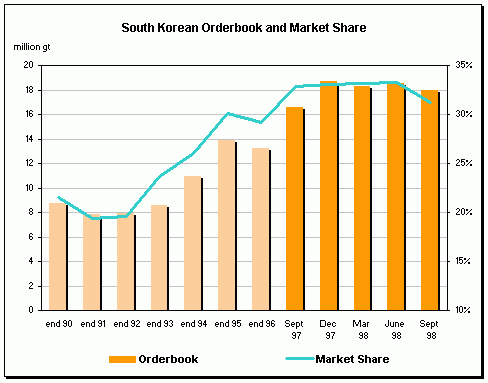
Orderbook Korea

However, in 1998 they had to face up to the disappearance of their domestic market. Shipowners such as Hanjin Shipping and Hyundai Merchant Marine, which in previous years had contributed about one third of the orders placed with the Hanjin and Hyundai HI yards, were no longer present and all the orders taken were for export. 

It is interesting to note that the Korean yards also contributed to their own success. They did so by deliberately and continuously improving their productivity. For example, the Daewoo yards announced productivity gains of 24% in 1997. However, as Daewoo did not set up new production capacity, its productivity gains can be estimated by the number of ships or the tonnage delivered in recent years: in 1990 Daewoo delivered 13 ships totaling 1 million gt, while in 1996 it delivered 30 ships totaling 2.25 million gt. Over the same period the number of employees decreased. 

The Korean shipbuilders also showed great flexibility in understanding and implementing shipowner demands, resulting in better quality and greater recognition by the international community. 

There has been much speculation about the future of the Halla and Daedong shipbuilding yards. Daedong continued to take orders. Two thirds of Halla's debt was cleared. But the situation of this yard is still blocked and will probably remain so until complete settlement of its debt. 

Despite the drop in prices, the main shipbuilders Hyundai HI, Daewoo, Samsung, Hanjin and Daedong will post profits for 1998. The South Korean government, under pressure from the IMF, is pushing the chaebols to reorganize themselves. This reorganization is already under way in the automotive and electronic industries, but no movement has yet been observed in shipbuilding. 

Although prospects for 1999 are still somber, 1998 finished better than it began: 

  • Korea was to repay part of its debt to the IMF in Dec 1998. The Yonhap agency recently quoted a government source stating that Korea was going to buy dollars because the won was at about 1,200, judged too high. 
  • The balance of payments turned around from a deficit of $8.2 billion at the end of 1997 to a surplus of $40 billion. 
  • The Seoul stock market rose by 50%. 

Moreover, according to the latest estimates, orders in 1998 should exceed 10 million gt, while the Korean orderbook broke the 20 million gt barrier at the end of the year. The Hyundai Economic Research Institute forecasts more than 10.5 million gt of orders for the Korean shipyards in 1999


China

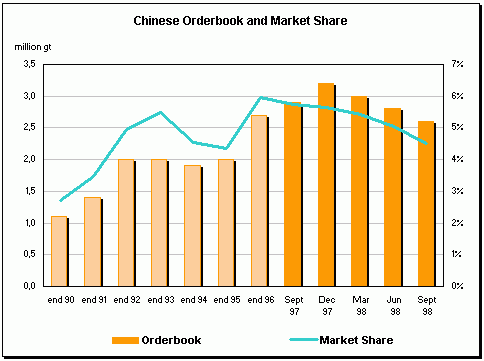
The big surprise in 1998 came from China. The shipyards were not able to maintain their orderbooks, which fell from 3.2 million gt at the end of 1997 (2.9 million gt in the third quarter 1997) to about 2.6 million gt in the third quarter of 1998. 

Their market share also decreased. This reduction is in clear contradiction with the objectives and development prospects of Chinese shipbuilding. 

Orderbook China

The main reason for this situation was the relative appreciation of the yuan against the other currencies of the region (Korea and Japan), leading to increased competi tion, mainly from Korea, on the export market, and lower reactivity of these yards to the crisis and to the fall in prices. 

It should not be forgotten, either, that the orderbook of the Chinese yards had benefited in 1994 from the 30% devaluation of the yuan and the increase in demand for newbuilding bulk carriers. 

The Chinese yards have always positioned themselves with respect to their closest competitors by quoting at very similar levels, which was more difficult this year in a very changeable market. 

Another explanation is that a tanker cycle has started and only the Japanese and Korean yards build VLCCs and Suezmax today. The only VLCC construction dock in China is at the Dalian New Shipyard, which up to now has never built tankers of this size. 

Furthermore, it should also be noted that many shipowners continue to prefer the Japanese and Korean yards, more experienced particularly in the building of ships demanding more know-how such as these tankers or very large containerships. 

The Chinese authorities have decided to react to improve the competitiveness of their yards and accelerate their reorganization. The commercial structure, China Shipbuilding Trading Co Ltd, which includes 25 yards, is to be split up into three regions around Dalian in the North, Shanghai in the center and Guangzhou in the South. VAT, levied on ships intended for the domestic market, is to be abandoned to promote the domestic market, in a context where the Chinese shipowners Cosco, China Shipping and Sinotrans placed major orders for Capesize and Panamax bulk carriers with Korean and Japanese yards in 1998. 

China still wants to occupy a first-rank position in the near future, as shown by the projects to build VLCC construction docks. At present there are seven such projects. Some have slowed down because of financing difficulties, but all these docks will probably be completed soon. The fact that these construction docks will be operational at the end of the tanker cycle does not bode well for the shipbuilding market. 

Finally, the stock exchange listing of the Guangzhou yard should be highlighted, illustrating as it does a very capitalist manner for the state to divest itself of its most profitable enterprises. 


Shipping and Shipbuilding Markets 1999

I N D E X

›››Archivo
DB Cargo planea recortar alrededor de 6.000 empleos
Berlina
Las negociaciones con los representantes de los trabajadores comenzarán pronto
En 2025, los contenedores transportados por la flota de RCL aumentaron un +8,8%
Bangkok
Los ingresos por esta actividad crecieron un +5,2%
Respecto al nombramiento de Tardini como presidente de la Autoridad Portuaria de Sicilia Occidental, Salvini y Schifani (por ahora) han enterrado el hacha de guerra.
Palermo
El tráfico anual de contenedores crece un 5,4% en las terminales portuarias de HHLA
Hamburgo
Se esperan ingresos récord de 1.760 millones de euros (+9,9%)
Se espera que el tráfico de contenedores en el puerto de Nueva York crezca un 2,3% en 2025.
Nueva York
Aumento significativo de contenedores llenos para exportación
Política y Assiterminal celebran la ampliación del bono portuario
Roma/Génova
Ferrari: entendió el valor de la planificación detrás de la reformulación de la ley
El tráfico de contenedores en el puerto de Hong Kong disminuyó un -3,2% en enero
Hong Kong
Se manejaron 1,13 millones de TEU
Costamare obtiene 940 millones de dólares en ingresos por el fletamento de 12 buques portacontenedores
Monje
CMA CGM ha encargado seis portacontenedores de GNL de 1.700 TEU al Astillero Cochin.
Marsella
A finales de año, el número de marineros indios a bordo de los barcos del grupo francés aumentará a 1.500.
El tráfico de carga en el puerto de Singapur creció un 13,0% el mes pasado.
Singapur
Los contenedores sumaron 3.892.370 TEUs (+11,3%)
Filt Cgil, reunión sobre la importancia del artículo 17 de la Ley 84/94
Roma
Se celebrará mañana en Roma en el Centro de Congresos Frentani.
Britta Weber ha sido nombrada nueva directora ejecutiva del Grupo Hupac.
Ruido
Es el actual vicepresidente de UPS Healthcare para Europa y Asia.
Saipem adquirirá una unidad móvil de perforación offshore por 272,5 millones de dólares
Milán
Acuerdo con Norwegian Deep Value Driller
El 20 de febrero se celebrará en Génova la 59ª edición del Premio San Giorgio.
Génova
La Targa San Giorgio será otorgada a Gian Enzo Duci
Filt Cgil apela la autorización de Cartour para realizar operaciones de amarre y desamarre.
Medlog inaugura un parque logístico en el puerto Rey Abdul Aziz de Dammam
Ginebra
Ocupa una superficie de más de 100 mil metros cuadrados.
Manageritalia y Assologistica firman la renovación de los gerentes Ccnl de la logística
Roma
Aumento mensual de los ingresos brutos a 750 euros en tres tramos
Suscribió un acuerdo vinculante para la adquisición de Qube por Macquarie Asset Management
Sydney
Fue aprobado por unanimidad por el grupo logístico australiano Cda
Meyer Turku completó el diseño de un crucero a cero emisiones netas
Turku
El principal combustible es el biometanol
El año pasado la facturación de Kalmar creció un +1%
Helsinki
Ingresos operativos, ganancias netas y nuevas órdenes en aumento respectivamente de +26%, +28% y +8%
Terminal Investment Limitada pone manos en el puerto peruano de Pisco
Lima
Adquirió la Terminal Portuario de Paracas
Assagenti insta a una información más constante y oportuna sobre el progreso del trabajo de la nueva presa de Génova
Grimaldi ha recibido el Grande Michigan
Nápoles
Es el octavo Pure Car and Truck Carrier amoniaco listo del grupo napolitano
Reunión entre los presidentes de la Federación Marítima y Assoporti
Roma
Mario Mattioli y Roberto Petri abordaron los principales temas del clúster marítimo
Marsa Maroc participa en el desarrollo del puerto de Monrovia
Casablanca
Contrato para la gestión de dos muelles y la construcción de una terminal multipropósito
La surcoreana Pan Ocean compra diez superpetroleros (VLCC) a su compatriota SK Shipping
Seúl
Transacción valorada en aproximadamente 668 millones de dólares
Roberto Mantovanelli ha sido nombrado Secretario General de la Autoridad Portuaria del Adriático Norte.
Venecia
Aprobado el Plan Operativo Trienal 2026-2028 de los Puertos de Venecia y Chioggia.
Stefano Messina ha sido confirmado como presidente de Assarmatori
Roma
También presidirá la asociación de armadores en el cuatrienio 2026-2030.
En 2025, los puertos albaneses gestionaron un tráfico récord de 8,2 millones de toneladas de mercancías (+6,2%)
Tirana
Un nuevo pico de pasajeros también ascendió a 1,7 millones de unidades (+6,4%)
WASS (Fincantieri) ha obtenido un contrato de Arabia Saudita para el suministro de torpedos ligeros.
Trieste
El pedido vale más de 200 millones de euros
Oxin (Somec) recibió un importante pedido para la construcción de áreas de cocina, despensa, catering y bar para dos cruceros.
San Vendemiano
El valor del pedido es de 53 millones de euros.
Sogedim lanza un servicio diario entre Carpi y Campogalliano/Inglaterra
Carpos
Servicio de transporte diario desde los centros logísticos de Campogalliano, Carpi y Prato.
Danaos Corporation informa ingresos trimestrales y anuales récord.
Atenas
Las ganancias están cayendo
CPPIB y OMERS están considerando vender su participación del 67% en Associated British Ports.
Londres
Maersk encarga ocho portacontenedores de doble combustible de 18.600 TEU
Copenhague
Construidos por New Times Shipbuilding Co., serán entregados entre 2029 y 2030.
PaxOcean abre un nuevo astillero en Singapur
Singapur
Ocupa una superficie de 17,3 hectáreas.
El mayor buque portacontenedores jamás llegado al puerto de Trieste
Trieste
Puerto de escala del "MSC Diana" que tiene una capacidad de aproximadamente 19.000 TEUs
Antin Infrastructure Partners adquiere el constructor naval estadounidense Vigor Marine Group
Nueva York
Tiene astilleros en Seattle, Portland, Vancouver, San Diego y Norfolk.
PROXIMAS SALIDAS
Visual Sailing List
Salida
Destinación:
- orden alfabético
- nación
- aréa geogràfica
En 2025, los puertos marroquíes gestionaron un tráfico récord de 262,6 millones de toneladas de mercancías (+8,9%)
Rabat
Transbordo equivalente al 50,5% del total
Yang Ming despliega el primero de cinco buques de GNL de doble combustible de 15.500 TEU en la ruta Asia-Mediterráneo
Keelung
Se utilizará en el servicio MD2.
Un estudio destaca los desafíos que enfrentan los buques portacontenedores de GNL para cumplir con los futuros requisitos de conexión de planchado en frío
Berlín/Hamburgo
Fincantieri y Wsense llegan a un acuerdo para ofrecer sistemas submarinos de última generación
Trieste
Se planea el desarrollo conjunto de soluciones de tecnología inalámbrica avanzada
Un estudio encuentra altos niveles de contaminantes orgánicos persistentes causados por las actividades de desguace de buques
Bruselas
Puerto de Livorno: comienza la licitación para la gestión de los residuos generados por los buques
Livorno
El valor esperado del contrato supera los 40 millones de euros
Los ingresos y las ganancias de DSV se ven afectados por la adquisición de Schenker
Copenhague
En 2025, la facturación creció un +48,0%
Wärtsilä reporta un crecimiento significativo en los resultados trimestrales y anuales del segmento Marino
Helsinki
Los nuevos pedidos adquiridos por el grupo finlandés hasta 2025 se mantienen estables.
La empresa holandesa Portwise ha sido comprada por su compatriota Haskoning
Rijswijk
La empresa ofrece soluciones para optimizar las operaciones de las terminales mediante la automatización y la electrificación.
Ha comenzado en China la construcción del primero de seis buques portacontenedores para Italia Marittima.
Trieste
Los buques, que podrán utilizar combustible tradicional y metanol, tendrán una capacidad de 2.400 TEUs.
En el estrecho de Ormuz, buques armados ordenaron a un petrolero estadounidense detenerse
Southampton/Londres
GTS anuncia nuevos servicios ferroviarios entre el puerto de Génova y el centro y sur de Italia.
Bari
Conexiones a través de la terminal Segrate de Milán
Kuehne+Nagel amplía CargoCity South en el aeropuerto de Frankfurt
Schindellegi
Las nuevas instalaciones se completarán y se pondrán en funcionamiento a finales de 2028.
Se prevé que el número de buques de doble combustible empleados por las líneas navieras de línea se duplique para 2025
Washington
Actualmente, el 74% de la cartera de pedidos está compuesta por unidades de este tipo.
AD Ports firma un acuerdo para construir y operar una terminal multipropósito en el puerto de Matadi
Abu Dabi/Kinshasa
Relanzamiento del Proyecto de Construcción del Puerto de Aguas Profundas de Banana
Confitarma: la posición de la Agencia Tributaria corre el riesgo de tener graves repercusiones sobre el empleo de los marinos italianos.
Roma
Bucchioni nombrado presidente pro tempore de la Asociación de Transitarios del Puerto de La Spezia
La Spezia
Se ha iniciado la licitación para el desarrollo del polo de construcción naval en el puerto de Ancona.
Ancona
El Comité de Gestión de AdSP ha aprobado la convocatoria de licitación
El desempeño financiero trimestral de ONE continúa decayendo
Singapur
El volumen de carga contenerizada transportada por la flota se mantiene estable
Se ha firmado la nominación de Laura DiBella para la presidencia de FMC.
Washington
Su mandato expirará el 30 de junio de 2028.
El puerto de Singapur registró un récord de entregas de búnker en 2025
Singapur
La empresa conjunta PSA-MOL gestionará una nueva terminal ro-ro
El puerto de Taranto recibió la visita de una delegación de la empresa japonesa FLOWRA
Taranto
La asociación reúne a 21 de los principales actores energéticos japoneses
Los nuevos pedidos de ABB en un trimestre superan los 10.000 millones de dólares por primera vez.
Zúrich
Creciente demanda en los sectores marítimo, portuario y ferroviario
En Estados Unidos, MSC fue multada con un total de 22,67 millones de dólares.
Washington
La Comisión Federal Marítima ha publicado los resultados de una investigación
CSC Vespucci y Livorno Reefer formarán una única plataforma dedicada a las frutas, verduras y productos exóticos en el puerto de Livorno
Signal Ocean ha adquirido AXSMarine
París/Londres
La empresa ofrece plataformas web para apoyar al sector de alquiler de buques
Stena RoRo ha realizado un pedido de dos buques ro-ro en China con opciones para cuatro más.
Gotemburgo
Fueron diseñados en cooperación con la italiana Naos.
Shanghai Zhonggu Logistics Co. encargará cuatro nuevos portacontenedores de 6.000 TEU
Llevar a la fuerza
El pedido incluirá opciones para dos buques adicionales
Los ingresos de UPS disminuyeron un 2,6% en 2025
Sólo en el último trimestre se registró un descenso del -3,2%.
La ICS ha publicado su análisis periódico del desempeño del Estado del pabellón
Londres
Michail Stahlhut dejará el cargo de director ejecutivo de Hupac en mayo
Ruido
Bertschi: Bajo su liderazgo se ha fortalecido la posición de la empresa como proveedor líder de transporte combinado carretera/ferrocarril en Europa.
Se han nombrado los miembros del Organismo de Asociación de Recursos Marinos de Rávena.
Rávena
Se reunirá por primera vez el 4 de febrero y permanecerá en funciones durante cuatro años.
Messina (Assarmatori): El decreto del MIT sobre el planchado en frío es algo bueno.
Roma
Se trata de un paso fundamental -subrayó- para garantizar que la electrificación de las plataformas sea realmente utilizable.
Contship se ha unido al programa DCSA+ de la Asociación de Envío de Contenedores Digitales.
Melzo
Entre los objetivos se encuentran mejorar la eficiencia de las operaciones de la terminal, la precisión de la planificación y la colaboración con las compañías navieras.
La Federación Obrera Portuaria Argentina amenaza con un paro en los puertos nacionales.
La Plata
Acción en apoyo a los trabajadores del puerto de Concepción del Uruguay
En 2025, el tráfico de mercancías en el puerto de Taranto creció un +0,8%
Taranto
Sólo en el último trimestre se registró un descenso del -22,6%.
El tráfico de contenedores en el puerto de Valencia creció el año pasado un +3,4%
Valencia
Se manejaron 5.662.661 TEU
Fincantieri gana un contrato de la Armada italiana para mejorar la resiliencia cibernética de los buques de guerra
Nueva instalación en Charleston para la producción y prueba de sistemas de propulsión y energía marina
Arlington
Fue inaugurado por Leonardo DRS, filial de la italiana Leonardo
Proyecto para fortalecer la ciberseguridad marítima y portuaria
Brest/Bruselas/Roma
Los socios son France Cyber Maritime, FEPORT y la Federación del Mar
El tráfico de contenedores en el Puerto de Los Ángeles cayó un 10,6% en el último trimestre de 2025.
Los Ángeles
Se registró una disminución del -0,6% para todo el año.
En los primeros seis meses de funcionamiento, InnoWay Trieste produjo 170 vagones de ferrocarril
Trieste
Está prevista la construcción de 600 unidades en Bagnoli della Rosandra en 2026
Ferretti rechaza la oferta pública de adquisición voluntaria parcial y condicional de KKCG Maritime.
Milán
Se reafirma la fuerte confianza en la estrategia a largo plazo de la empresa
El puerto de Haropa establece un nuevo récord de tráfico de contenedores
El Havre
El año pasado, el tráfico total de mercancías aumentó un +2%
Falleció Decio Lucano, el decano del periodismo marítimo.
Génova
Sus aventuras en papel son innumerables, entre ellas "Vita e Mare" y "TMM", pero también digitales con "DL News".
Marsa Maroc encarga 106 tractores de terminal eléctricos a Terberg
Benschop
Serán empleados en el puerto de Nador West Med
Contargo adquiere el 50% de Cargo-Center-Graz Logistik
Mannheim
La compañía alemana amplía su red intermodal a los puertos adriáticos de Koper y Rijeka.
Una única oferta vinculante de Dubai para la compra del puerto marítimo Ro-Port de Venecia
Venecia
La empresa gestiona la terminal de las autopistas del mar y de los cruceros en Fusina
El puerto de Long Beach manejó un tráfico récord de contenedores en 2025
Playa larga
En el último trimestre se registró un descenso del -8,8%.
HMM introducirá soluciones de navegación autónoma basadas en IA en 40 buques
Seúl
Contrato con Avikus y acuerdo con KSOE
Dos nuevas conexiones ferroviarias con Alemania desde el Interpuerto de Padua
Padua
Son operados por InRail y LTE Italia
Intersea se ha convertido en el agente general en Italia de la portuguesa GS Lines
Génova
La naviera forma parte del Grupo Sousa
MSC y la empresa qatarí Maha desarrollarán y gestionarán el puerto libio de Misurata
París/Misurata
Se espera una inversión de 1.500 millones de dólares
F2i se adjudica la concesión del puerto turístico de Lavagna
Milán
El contrato de concesión tendrá una duración de 50 años
Eni bota el casco del buque Coral North FLNG
Geoje/San Donato Milanese
Se utilizará en las aguas costeras de Cabo Delgado, al norte de Mozambique.
Laghezza ha adquirido un almacén logístico en Sarzana
La Spezia
El objetivo es establecer un centro local para actividades de producción local.
Se ha inaugurado la terminal de contenedores del Mar Rojo en el puerto egipcio de Sokhna.
Sokhna
Es operado por una empresa conjunta de Hutchison Ports, COSCO y CMA Terminals.
El ferry GNV Altair se ha unido a la flota de GNV
Génova
Tiene una capacidad de 2.700 pasajeros y 915 metros lineales de material rodante.
Maersk confirma la reanudación de los tránsitos del MECL por el Canal de Suez
Copenhague
La línea conecta India y Oriente Medio con la costa este de Estados Unidos.
Ignazio Messina & C. ha adquirido el control total de Thermocar
Génova
La empresa genovesa opera en el sector de la logística de contenedores refrigerados a temperatura controlada.
La junta directiva de Genco rechazó la propuesta de adquisición de Diana Shipping.
Nueva York/Atenas
La compañía estadounidense, sin embargo, deja un rayo de esperanza al admitir la validez de la fusión.
MSC incluirá el puerto de Trieste en la ruta Dragon Italia-EE.UU.
Ginebra
Se llegará al puerto juliano a partir de la segunda quincena de febrero
De Wave Group ha adquirido la empresa francesa DL Services.
Génova
La empresa está especializada en el diseño de cocinas industriales y el suministro de componentes técnicos y repuestos a bordo.
El servicio transatlántico TUX de CMA CGM hará escala en el puerto de Salerno
Marsella
La línea conecta Turquía con la costa este de EE.UU.
El tráfico de cruceros en el puerto de El Pireo aumentó un 9% el año pasado
El Pireo
Se movilizaron aproximadamente 1,85 millones de pasajeros
Nuevas conexiones intermodales entre el norte de Italia y Bélgica por GTS Rail y CargoBeamer
Bari/Leipzig
Activado en las líneas Padua-Zeebrugge y Lieja-Domodossola
En 2025, el tráfico de cruceros en el puerto de Génova creció un +6,5%
Génova
Los pasajeros del ferry bajan un 3,6%
Grimaldi recibió el PCTC Grande Manila
Nápoles
El buque tiene una capacidad total de 9.241 CEU.
PUERTOS
Puertos italianos:
Ancona Génova Rávena
Augusta Gioia Tauro Salerno
Bari La Spezia Savona
Brindisi Liorna Taranto
Cagliari Nápoli Trapani
Carrara Palermo Trieste
Civitavecchia Piombino Venecia
Interpuertos Italianos: lista Puertos del mundo: Mapa
BANCO DE DATOS
Armadores Reparadores navales y astilleros
Expedicionarios Abastecedores de bordo
Agencias marítimas Transportistas
MEETINGS
Filt Cgil, reunión sobre la importancia del artículo 17 de la Ley 84/94
Roma
Se celebrará mañana en Roma en el Centro de Congresos Frentani.
El 19 de enero se celebrará en Génova una conferencia sobre la congestión en el sistema logístico del noroeste.
Génova
Se celebrará en el Salón de la Transparencia de la Región de Liguria.
››› Archivo
RESEÑA DE LA PRENSA
Auction of megaterminal in Santos may be postponed due to deadlock within the Federal Government
(A Tribuna)
East Port Said Port faces a new challenge with Europe's carbon rules for shipping
(EnterpriseAM)
››› Reseña de la Prensa Archivo
FORUM de lo shipping y
de la logística
Intervento del presidente Tomaso Cognolato
Roma, 19 giugno 2025
››› Archivo
El crucero de expedición Exploris One será subastado
Nantes
Tiene una capacidad de 144 pasajeros y 102 tripulantes.
SeaCube Container Leasing ha adquirido Martin Container.
Montvale
La empresa se especializa en el segmento de contenedores refrigerados.
Pisano: La Zona Logística Simplificada tiene una gran importancia estratégica para el puerto de La Spezia.
La Spezia
RINA y HPC lanzan un proyecto para promover puertos verdes en la región del Caspio
Génova
Contrato de cinco años con la OSCE
- Via Raffaele Paolucci 17r/19r - 16129 Génova - ITALIA
tel.: +39.010.2462122, fax: +39.010.2516768, e-mail
Partita iva: 03532950106
Registrazione Stampa 33/96 Tribunale di Genova
Director: Bruno Bellio
Prohibida la reproducción, total o parcial, sin el explicito consentimento del editor
Búsqueda en inforMARE Presentación
Feed RSS Espacios publicitarios

inforMARE en Pdf
Móvil