Independent journal on economy and transport policy
10:49 GMT+1
SHIPPING
Four bottlenecks, one problem: maritime transport can no longer take its routes for granted
For decades, shipping has chased the lowest cost and just-in-time delivery. Today, that model faces a world where routes can close
Ginevra
November 26, 2026
For decades, maritime transport has lived on a promise
implicit: the major routes would remain open. On this
premise, a model based on the most
low, on the shortest route, on incoming goods
exactly when they are needed. In 2026, that premise has stopped
to be reliable. This is the thesis of the new edition of the
"Review of Maritime Transport" of UNCTAD, the
United Nations Conference on Trade and Development,
aptly titled "Shipping at a crossroads", the
navigation at a fork.
The most striking figure is simultaneity
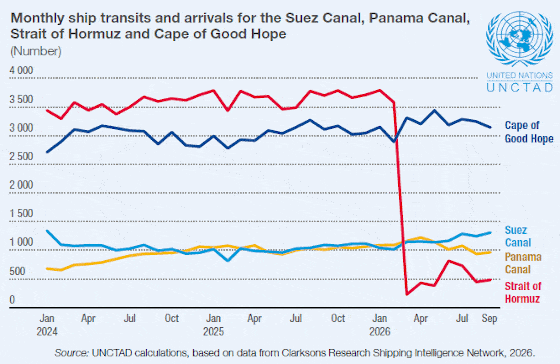
of the crises that occurred in 2026. In the Strait of Hormuz, from which
about one fifth of the world's oil transits, the traffic is
collapsed by about 95% at the beginning of March, after the explosion of the
Middle East conflict on February 28. Before the crisis
about 120 ships crossed the strait a day. About 3,200
units, equal to 4% of the world tonnage, remain
trapped in the Persian Gulf along with more than 20,000
Marines: thousands of them, recalls the report published today
from UNCTAD, had not yet managed to leave the area to
July.
It didn't go any better elsewhere. In the Red Sea
instability continues to push many ships to circumnavigate
Africa, with longer distances, costs, and times. In September
Some scheduled airlines have started returning to the route of
Suez, but the threats, especially against oil tankers, are not
cease.
In the Black Sea, since June, the escalation of risks for
security has interrupted the grain trade. Finally, in Panama, more
traffic, higher U.S. energy exports, and new
draft restrictions related to weather changes and
fears about the El Niño climate phenomenon have prolonged
queue and increased auction prices for channel transits
Panamanian.
There was an attempt at détente: at
In June, the Islamabad memorandum opened a negotiating window
of 60 days with measures to restore traffic in Hormuz. The
ship traffic resumed to rise, but in July the conflict was
resumed and the situation has reversed. For UNCTAD, also
The end of hostilities would not be enough to guarantee a recovery
rapid: credible guarantees of safe transit would be needed,
protection of seafarers and freedom of navigation.
The report of the United Nations Conference on Trade and
Development notes that the maritime transport system has
absorbed the shock, but slowing down. Maritime trade in 2025
reached 12.3 billion tons, with year-on-year growth on
year of +1.9%, compared to +3.9% in 2024. For 2026, UNCTAD
forecasts zero growth, followed by a recovery to +3.2% in 2027. The
Containerized transport performs better, with +3.3% expected this year.
Meanwhile, goods transported by sea travel more
far away. The UNCTAD report explains that between 2015 and 2025 the
ton-miles grew by +2.8% year-on-year, compared to +1.6%
of transported volumes, and the gap widened after the
2020, especially for containers and smaller bulk cargo. Maritime routes
between Asia and Europe, after the Red Sea crisis, they are on average more
30% long. Extending voyages supports the demand for ships, but
increases costs and delivery times. Geography also changes: in
In 2025, containerized South-South traffic grew by +12.1%,
ensuring almost a third of the total increase, with countries such as
Indonesia, Mexico, and Vietnam increasingly central in the chains
of value.
Meanwhile, freight rates have followed the ups and downs of events.
The Shanghai Containerized Freight Index (SCFI) of containers,
which in January 2026 was around 1,500 points, in August it
reached an average of about 3,400. Oil tanker freight rates have
set records on some routes and insurance against the risks of
wars have increased, in just a few days, from about 0.2% to 1% of
hull value. Crude oil jumped above 100 dollars
per barrel.
The UNCTAD document explains that the weight of the increase in
costs and fees are not distributed evenly. I
Small island developing states and least developed countries
often import food and fuel through long routes and
indirect, with transshipments and multiple maritime routes, and have
few alternatives if a passage closes. A simulation based
only on the marine fuel cost channel - excluding
broader effects of rising oil prices - estimates that a price increase
sustained by +70-80% until the end of 2027 would raise
Consumer prices by +0.19% globally, +0.27% in
small island states and +0.35% in the least developed countries, almost
double the world average. Real income would fall
respectively by -0.20%, -0.33%, and -0.30%.
Yet the report also points out a progress to defend: in twenty years the
Less developed countries have improved connectivity
maritime line about three times faster than the rest
worldwide, with an increase of +47% since 2006, even starting from a
a gap still wide and with more volatility.
The document also focuses on the state of the naval fleet
commercial, which grows and ages. As of January 1, 2026, the fleet
worldwide counted 115,655 ships for 2.53 billion tons of
gross throughput, growing by +3.5%, faster than load
transported, for an estimated value of 1.74 trillion dollars. But
ships over twenty years old make up about 42% in number and the
17.4% in capacity, a share rising to 18.3% in the fleets of
Developing countries versus 11.5% of those of the countries
developed. The report notes that, with more environmental rules
strict, renewal becomes a necessity and recycling
of ships, concentrated in a few South Asian countries,
It should accelerate, also thanks to its entry into force in 2025
of the Hong Kong Convention.
As for the decarbonization of maritime transport, the
The report confirms that it is proceeding, albeit in a scattered order:
emission intensity improves thanks to efficiency and
slow navigation, while overall emissions remain
high. Regulatory fragmentation and uncertainty about which
fuels will prevail - the document notes - complicate
investment decisions, and the share of alternative fuels in the new
orders, after the trend of recent years, showed a slight decline.
The report then emphasizes that the effects of tensions
geopolitical policies on maritime transport end up being dumped on
ports, where the average waiting times for ships are almost
doubled between 2019 and the first six months of 2026, with 31%
the increase in total time for a container ship that depends
from waiting to be able to access the mooring in port.
On the regulatory front, the report includes several new developments:
from November 2027, the HNS Convention will come into force, which
regulates liability and compensation for damages
caused by the maritime transport of hazardous and harmful substances and
which will guarantee up to 250 million special rights of
Accident withdrawal in case of damage from hazardous substances
transported by sea. Furthermore, the IMO guidelines have arrived
against fraudulent ship registrations, the code does not
mandatory for autonomous ships (operational from July 1, 2026,
with a binding code set for 2030), the agreement on
High Seas Biodiversity (BBNJ), the Beijing Convention
on judicial sales of ships and the new convention on
negotiable transport documents. Each of these instruments -
however, warns UNCTAD – it only works if States adhere to it
and they apply them.
In the preface to the report, the acting secretary-general
of UNCTAD, Pedro Manuel Moreno, notes that the lesson that is learned
It is necessary to prepare for crises before
that arrive, with: continuity plans for the corridors
commercial agreements agreed with neighboring countries and tested with simulations;
shared food and fuel stocks for the most
small; monitoring dependency on suppliers and steps
obliged. However, UNCTAD is realistic about the limits of this
approach: bottlenecks are difficult to replace, and the
Circumnavigating Africa adds distance, costs, and time, while ports
alternatives become congested. "Ultimately"it's the
Moreno's laconic conclusion - ships must pass where the
geography brings them." Hence the final call to a trade
rules-based maritime: freedom and rights of navigation
and transit provided for by the UN Convention on the Law of the Sea and
seafarers' safety, which today, after months of deadlock in the plan
evacuation of the International Maritime Organization for those
stuck in the Persian Gulf, remain the first human emergency of
this crisis.
- Via Raffaele Paolucci 17r/19r - 16129 Genoa - ITALY
phone: +39.010.2462122, fax: +39.010.2516768, e-mail
VAT number: 03532950106
Press Reg.: nr 33/96 Genoa Court
Editor in chief: Bruno Bellio No part may be reproduced without the express permission of the publisher






 For decades, maritime transport has lived on a promise
implicit: the major routes would remain open. On this
premise, a model based on the most
low, on the shortest route, on incoming goods
exactly when they are needed. In 2026, that premise has stopped
to be reliable. This is the thesis of the new edition of the
"Review of Maritime Transport" of UNCTAD, the
United Nations Conference on Trade and Development,
aptly titled "Shipping at a crossroads", the
navigation at a fork.








 - Via Raffaele Paolucci 17r/19r - 16129 Genoa - ITALY


