Independent journal on economy and transport policy
19:21 GMT+1
SHIPPING
Greek shipowners against Brussels: EU rigidity puts IMO negotiations on the decarbonisation of shipping at risk
On the eve of the London meetings, the UGS denounces the stalemate and asks for flexibility
Il Pireo
November 16, 2026
Greek shipowners accuse the European Union of obstructing, with
its own rigidity of negotiations, the achievement of a
global agreement at the International Maritime Organization (IMO)
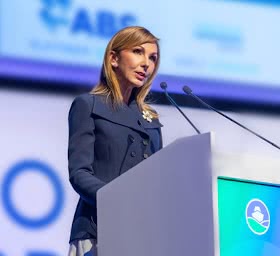
on the decarbonisation of maritime transport. The President
of the Union of Greek Shipowners (UGS), Melina Travlos,
denounced the lack of substantial progress towards the
The next round of discussions, scheduled to take place in London at the end of
November and the beginning of next month, on the Net-Zero Framework
of the IMO.
Negotiations will resume after the postponement of the
decision on the adoption of the new global regulatory framework,
established in October 2025 by Marine Environment Protection
Committee (MEPC) of the IMO
(
of 17
October 2025). The preparatory phase continued with the
meeting of the Intersessional Working Group on Reduction of GHG
Emissions from Ships of last September
(
of 4
September 2026).
"Two months after the last round of negotiations at the IMO,
ended without result, and on the eve of a new and crucial phase
of discussions, no substantial progress is in sight",
denounced Travlos, recalling the difficulties that
continue to characterize international comparison.
At the heart of the divergences between the shipping industry and
Brussels there is also the relationship between European legislation and the
future global IMO system. In particular, European Shipowners
(ECSA), which represents national shipowners' associations
and the UGS complain that the European Commission has not
made an explicit commitment to withdraw the EU ETS for transport
once the regulatory framework has entered into force
international. The proposal for the revision of the European system,
presented last July
(
of 17
July 2026), in fact, provides for measures to avoid double payments
in the presence of a global agreement, but does not guarantee the withdrawal of the
Community rules. According to the shipowners, the maintenance of two
overlapping regulatory systems would risk imposing
shipping companies, additional economic and administrative burdens.
The IMO Greenhouse Gas Strategy, revised in 2023
(
of 7
July 2023), aims at climate neutrality of the
international maritime transport "by or around 2050",
with indicative milestones of reducing emissions by at least 20%
(aiming for 30%) by 2030 and at least 70% (aiming for
80%) by 2040 compared to 2008, and at least 5% (aiming for
10%) energy from zero-emission fuels and technologies, or
by 2030. To translate it into binding rules, the IMO has
approved in April 2025 the Net-Zero Framework
(
of the 11th
April 2025), a global standard on gas intensity
greenhouse fuels, combined with a price mechanism, with a
fund fed by payments from ships that exceed the threshold.
It should concern ships of at least 5,000 tons
gross. However, in October 2025, Member States postponed by
one year adoption with 57 votes in favor of postponement, 49 against, 21
abstentions (Greece and Cyprus among the abstentions).
In the meantime, the EU has already extended its system of
Emissions Trading (ETS) for maritime transport: from 2026
covers 100% of relevant emissions, including methane and nitrous oxide
for intra-EU journeys and port stops, and 50% of
those between an EU port and a non-EU port. From 2025, the
European FuelEU Maritime requires a gradual reduction in the intensity of the
of greenhouse gases from the energy used on board (2% in 2025, 6% in 2030,
up to 80% in 2050). In addition, last July the Commission
has proposed to revise the ETS and to include it from 2031 also
general and offshore cargo ships between 400 and 5,000 tons.
On the Greek side, the president of the UGS recalled that "in the
debates in the European context, Greece, together with other
three EU Member States (Cyprus, Italy and Malta, ed.) which,
Overall, they control 70% of the European fleet
constantly stressed the need for Europe to
present at the IMO with a real willingness to negotiate.
Unfortunately, these appeals have gone unheeded. È
- Travlos underlined - to observe such a
clear policy inconsistency on the part of the European Union on a
of this magnitude. The EU's rigid attitude is
pushing the process within the IMO towards a further stalemate,
undermining negotiations from the outset and precluding that
flexibility that is instead essential to achieve
a positive outcome".
"This - continued the president of the shipowners
GRECI - raises a broader question: the real priority
is perhaps the safeguarding of its own measures to
and related revenues, rather than the
Reaching a comprehensive and balanced agreement? In fact, the EU
is letting other interests prevail over a solution
shared at international level for the decarbonisation of the
maritime sector, thus imposing an additional burden on the
European citizens, already struggling with a cost of living in
constant increase".
"Despite this context
- Travlos invited - we urge the Member States
IMO to listen, this time, to the voice of the industry
and to recognise that, in order for legislation to be
must be realistic, proportionate and feasible, taking into account
actual commercial and operational conditions, and
practical constraints of the sector. To achieve this, it is
it is necessary to align long-term ambitions with actual
market capacity and degree of maturity
technology. This requires taking into account the
availability, scalability, and cost of
alternative fuels, technologies and related
supporting infrastructure, as well as competing demand
from other sectors. The regulatory framework must also
recognise all the options available to the maritime sector,
rather than relying solely on fuels
alternative pathways. It should support all effective pathways to
reducing emissions, including efficiency measures
energy of a technical and operational nature'.
The president of the UGS noted that "the strategy
for the reduction of greenhouse gas emissions allows, for example,
its nature, a certain flexibility as to how
objectives of achieving their objectives. Consequently, measures to
should be considered as part of a framework
regulatory development, rather than as an isolated tool in
able to autonomously drive the energy transition.
An overly restrictive interpretation of the strategy -
observed - exacerbates disagreements, once again leading to the
negotiations to a stalemate. For this reason, it is
It is essential that Member States explore all solutions
in a spirit of cooperation, including, in any case,
those that respond to market dynamics. In addition, they
should enhance the most effective elements of these
options for establishing a comprehensive, balanced,
sustainable in the long term, aimed at reducing the efficiency of
greenhouse gas emissions, without compromising the
international trade, food security or development
economic crisis. In this context, we once again call on all
IMO Member States to rise to the occasion,
to support the institutional role and mission of the Organization, and
to exercise the leadership necessary to overcome differences,
with the aim of reaching a mutually acceptable agreement
and sustainable".
- Via Raffaele Paolucci 17r/19r - 16129 Genoa - ITALY
phone: +39.010.2462122, fax: +39.010.2516768, e-mail
VAT number: 03532950106
Press Reg.: nr 33/96 Genoa Court
Editor in chief: Bruno Bellio No part may be reproduced without the express permission of the publisher






 Greek shipowners accuse the European Union of obstructing, with
its own rigidity of negotiations, the achievement of a
global agreement at the International Maritime Organization (IMO)
on the decarbonisation of maritime transport. The President
of the Union of Greek Shipowners (UGS), Melina Travlos,
denounced the lack of substantial progress towards the
The next round of discussions, scheduled to take place in London at the end of
November and the beginning of next month, on the Net-Zero Framework
of the IMO.
 (







 - Via Raffaele Paolucci 17r/19r - 16129 Genoa - ITALY


