Independent journal on economy and transport policy
18:44 GMT+1
PORTS
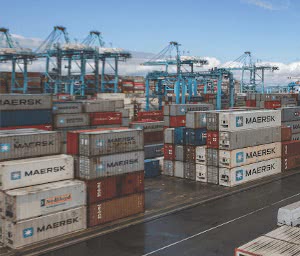
From Egypt to Morocco, passing through Gioia Tauro: does the ETS move containers to non-EU ports?
A study promoted by Assarmatori sees signs of relocation already underway and calls for corrections
Bruxelles
November 4, 2026
While the European Parliament and the Council are debating the
revision of the maritime ETS proposed in July by the European Commission
(
of 17
July 2026), today in Brussels, during the workshop "EU
ETS Maritime: Safeguarding European Transhipment" hosted
by MEP Letizia Moratti, the
main findings of the EU ETS and Southern
Europe's container hubs: concrete results of transshipment
relocation" created by Giovanni Satta, associate professor
of the Department of Economics of the University of Genoa,
developed by T.I.M. 10 Srl and promoted by Assarmatori.
The work, which confirms many trends already recorded
by the EU-ETS Observatory of Spain's Puertos del Estado
(
of 16
December 2025, 23
February and 31
July 2026, detects signs of a possible relocation
transhipment traffic to non-EU ports and identifies some
changes to scheduled services that could be traced back to
introduction of the ETS. However, it does not demonstrate that all the
observed changes were caused by the new system.
The Spanish Observatory comes to similar conclusions from a street
with an analysis based on AIS data and tracking of
containers until March 2026.
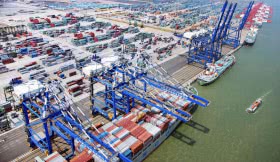
The Italian study analyzes the scheduled services connected to
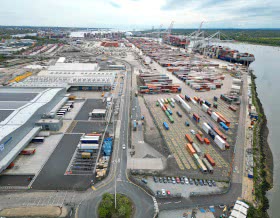
four port hubs: Gioia Tauro, Marsaxlokk, Sines and Taranto. The
document explains that the four ports have been selected in a way that
to represent different geographical areas, transhipment profiles and
competitive positions within maritime transport networks
of containers in southern Europe. However, it is necessary to
note that the Apulian port has been for a long time now,
excluded from the main intercontinental traffic routes
and which, as the study points out, in 2024 has
handled only 16,114 TEUs with an incidence of transhipment of
49%. The study, evidently, has sample limitations, as
four ports, one of which is marginal, do not represent the whole of the
Mediterranean.
Study finds greater instability of services
liner shipping in the post-ETS scenario, i.e. since the
EU ETS emissions trading system is
which has gradually entered into force for the maritime sector in
from 1 January 2024. In particular, it notes that the
total number of changes in services has gone from 211
in the pre-ETS scenario to 305 in the post-ETS scenario and that the
potentially attributable to the ETS are not negligible,
with 77 variations identified as potentially determined
ETS and covering 41 of the 86 services analysed by the study.
In addition, the study points out that the number of changes
potentially determined by the ETS has increased significantly
between the two scenarios: in the pre-ETS scenario,
26 changes potentially attributable to the ETS have been identified,
while in the ETS scenario this number has risen to 51. Among the
services that - according to the analysis - show at least one change
potentially determined by the ETS, the interregional ones
They constitute the largest group, with 22 services
affected (out of 43), followed by 18 global services (out of 31). Only one
regional service (out of 12) has recorded a change
potentially attributable to the ETS. The average number of changes
monthly income has gone from 7.0 in the pre-ETS scenario, ranging from
14 July 2021 when the "Fit
for 55" as at 31 December 2023, at 10.9 in the post-ETS scenario,
which runs from January 1, 2024 to April 2026. In addition, it should be noted that
whereas, compared to the pre-ETS scenario, the average number of changes
per single service is increased for global services,
going from 3.2 to 4.6 (+44%), and for interregional services,
going from 2.4 to 3.7 (+54%), while on the contrary services
decreased from 0.8 to 0.3
variations by service.
With regard to the possible transfer of traffic to
transhipment from the four ports examined to competing ports
North African countries, the study specifies that among the 20 historical services that
no longer call at the ports of Gioia Tauro, Marsaxlokk,
Sines and Taranto, eight have recorded at least one change
potentially attributable to the EU ETS, for a total of ten
variations. In most cases, these were
services with global coverage (six out of eight).
The study therefore presents two cases considered emblematic of the
Process of transferring transhipment traffic out
by the EU, noting that in the Ocean Alliance's MED5 service, the
Maltese port of Marsaxlokk has been replaced by the
Egyptian of Alexandria, while in the Levante Express service of the
MSC port of Gioia Tauro has been replaced by the
Egyptian of Abu Qir.
The study then examines the potential economic and
on employment for Europe, including Northern European ports, in the
case of a transfer of 7.5%-15% of containerized traffic
transhipment outside the EU, and highlights that, on a traffic
total European level of 38-42 million TEUs per year, this
means the loss of a volume of 2.85-6.3 million TEUs,
annual revenues of €403-892 million, estimated on the basis of
average Italian parameters, of a need for port investments
€1.4-3.6 billion lower than needed
to handle these volumes in the European hubs and 2,005-4,431 seats
of related work. The loss of revenues is estimated on the
Italian average parameters of 141.65 euros per TEU and that of
employees of about 0.0007 workers per TEU.
The study also considers the original rule of the
300 nautical miles away from EU ports to exclude
in non-EU ports within this radius by the definition of
'stopover' for the purposes of calculating journeys subject to the ETS,
which has been strengthened by the Commission's proposal
European with two new criteria: ports within 150 miles with requirements
or ports within 300 miles with transhipment
more than 50%. The analysis notes that this contrasts the stopovers
elusive intermediate ports, but not the shift of transhipment
to non-EU hubs, and also risks generating side effects
negative unforeseen carbon leakage within the
container transshipment market.
It should be remembered that, to date, the European Union's surveys on the
possible shift of the transhipment activity of
containers in non-EU ports were presented in March 2025 in the
Report on the monitoring of the implementation of Directive No. 87 of 2003
(
of 19
March 2025). The Commission's report, which is now in its third
quarter 2024 when only 40% of ETS allowances applied,
concluded that there was no evidence of a relocation
Transhipment and the changes observed in the network
of sea routes were attributed mainly to the crisis in the
Red. The ports of Piraeus and Marsaxlokk were losing traffic, but in
parallel to the loss of ports of large ships throughout the basin
oriental position. However, even the Commission's report does not
excluded the risk of subtraction of transhipment volumes and
reported the cases of the ports of Damietta and Nador to be monitored and a
increase from 30% to 34% of intermediate stopovers in the United Kingdom in the
US-EU routes.
A more up-to-date picture is also contained in the
economic study commissioned by the Directorate-General for Mobility
of the European Commission and published on 17
July, dedicated to the risk of carbon leakage in the sectors
aviation and maritime transport. The analysis does not detect evidence
a generalised relocation of activities or a
systemic loss of competitiveness attributable to the ETS, but
identifies future risks concentrated in certain areas of the Mediterranean,
indicating precisely in the transfer of transhipment to the hub
one of the most plausible scenarios.
On the occasion of today's presentation of the study
the Assarmatori shipowners' association has highlighted that the
Transfer of transhipment activities outside
of Europe is already visible in the shipping market
and it is a trend destined, without correctives, to
consolidation, with an economic stake that could
reach 892 million euros in annual revenues and 3.6 billion euros in
equivalent port investments, but above all it would deprive
Europe of strategic control over its supply chains
supply, moreover at an extremely
complicated geopolitically.
"Supply chain shocks related to
ongoing conflicts - said the Secretary General of
Assarmatori, Alberto Rossi - showed what happens when a
strategic step, over which we do not exercise direct control,
is interrupted. The "transfer" of the
transshipment in Africa carries the real risk of transforming the
continent in a new nerve center from a logistical point of view
and geopolitical. Rather than a nerve center of scope
geographical area, such as Suez or Bab el-Mandeb, Africa is
becoming a center of congestion and significant dependency
strategic for global supply chains. These are
A question of logistical dependency and rivalry
geopolitics, and which is of great importance not only because of the
of the European Union's inability to control the
security of port hubs outside their borders, but
Also because port investments are often made
by external powers: global private operators and foreign governments,
in particular China, are pouring large sums of money
in African port concessions to ensure control over the
trade flows. Entrusting critical transhipment nodes to hubs
controlled by rival geopolitical actors exposes economies
to forced interruptions and retaliation in the event of tensions
in other words, to a real risk of control
asymmetrical".
If it is true - as Rossi pointed out - that China is
investing heavily in Africa, including in port infrastructure,
The study presented today, however, listing the operators who
have invested in North African ports, confirms that currently
port terminals on the southern shore of the Mediterranean, including those
competitors of European transhipment ports, are owned and
operated mainly by European or Western carriers and operators,
including Hapag-Lloyd, Eurogate, Contship, CMA CGM, MSC and APM
Terminals/Maersk, with China's Hutchison and COSCO among others.
"The issue - observed Cesare Crocini, head of
of the Brussels Office of Assarmatori - is not only linked to
the loss of competitiveness of our ports, the
relocation of trafficking or jobs at risk. Here it is
the logistical security of Italy and Europe is at stake. Who
opposes a correction to the ETS mechanism that incentivises the
transhipment betrays the spirit of union."
In order to avoid the risk of transferring volumes of
transhipment traffic to non-EU ports, among the proposals
presented to the European Parliament and the Council
has accepted the compromise as the most promising
promoted by MEP Peter Liese last week: the last
version combines an incentive linked to the share of goods subjected to
to transhipment in EU ports with a distance-based correction
traveled. The mechanism - Assarmatori noted - thus integrates
volume-based and distance-based approaches, consider travel
and reduces the threshold from 10,000 to 5,000 TEUs
size of eligible vessels. For the association, the
changes would make it possible to better represent the services in
and strengthen the incentive to maintain Europe's
operations of long-haul hubs.
- Via Raffaele Paolucci 17r/19r - 16129 Genoa - ITALY
phone: +39.010.2462122, fax: +39.010.2516768, e-mail
VAT number: 03532950106
Press Reg.: nr 33/96 Genoa Court
Editor in chief: Bruno Bellio No part may be reproduced without the express permission of the publisher






 While the European Parliament and the Council are debating the
revision of the maritime ETS proposed in July by the European Commission
 (












 - Via Raffaele Paolucci 17r/19r - 16129 Genoa - ITALY


