Independent journal on economy and transport policy
15:39 GMT+1
TRANSPORTATION
T&E, the ETS becomes the engine of investments for e-fuels for aircraft and ships
The organization's requests for the revision of the emissions trading system: more European resources, a dedicated fund and double-sided auctions
Bruxelles
November 2, 2026
Transport & Environment (T&E) reiterates that the review
ETS proposal, the Emissions Trading System
is not enough to support investments in fuels
for the aviation and maritime transport sectors,
two sectors that also contribute significantly to revenue
ETS. The European non-governmental organisation, active in the field of
sustainable transport and the decarbonisation of the transport sector
transport, specifies that, however, the extension of the application
of the Emissions Trading System to multiple flights outside Europe and to
smaller ships proposed last July by the
The European Commission is a step in the right direction, even if it is
if insufficient
(
of 17
July 2026).
In a new briefing published today, Transport &
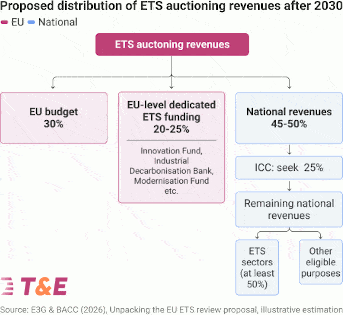
Environment recalls that the Commission proposes to tie up 50%
of national ETS revenues to decarbonisation measures in the
priority areas. Welcoming the inclusion of transport
air and sea between them, T&E nevertheless calls for
stricter enforcement of the obligation to spend the
remainder for climate and energy purposes, with requirements of
reporting. Today - underlines the
Briefing - Many Member States pay revenues into budgets
without a specific destination, making it difficult to track
use.
In addition to being a price tool for polluters -
says the organisation - the ETS can become a lever of
industrial policy, provided that the principle of "those who
polluter pays". To achieve the objectives of the regulations
ReFuelEU Aviation and FuelEU Maritime of the climate package
Fit for 55 with truly green and scalable fuels - notes T&E
- in the next decade we need rapid growth in production and
use of e-fuels (RFNBOs, renewable source fuels
non-biological). The organization believes that financial support
is also crucial for the domestic supply chain, the autonomy
strategic strategy and industrial competitiveness in the
clean technologies.
Transport & Environment explains that there is
also a problem of size, given that after 2030 the threshold of
50% will apply to a much smaller pool of
as the starting figures suggest. 30% of the proceeds
would feed into the long-term EU budget from 2028, a
an additional 20-25% would finance ETS funds at European level, and the
compensation of indirect costs for energy-intensive industries (CCIs)
may absorb 25% or more of national quotas,
while 50% only applies to what remains.
At the European level - T&E recalls again - the proposal to
The revision of the ETS strengthens the architecture of the funds by extending the
Innovation Fund and the Modernisation Fund beyond
2030 and introducing two new instruments, the Investment Booster (30
billion euros between 2027 and 2030) and Industrial
Decarbonisation Bank (IDB) from 2031. Air and sea transport not
however, they are included in these tools and remain dependent
by the Innovation Fund alone, which after 2030 would fall from the
about 530 million allowances to 200 million, while covering a
wider range of sectors. In addition, the
Briefing - The proposal removes the current dedicated contribution of the
air transport to the Fund (five million allowances).
T&E therefore calls for e-fuels for aviation and shipping
are explicitly included in the Investment Booster perimeter, and
IDB, and that the Modernisation Fund can support them in their
Member States with lower incomes.
He then emphasized that the volumes of financing alone are not enough
to launch sustainable fuels projects, T&E
notes that the nascent e-fuel market is blocked by a
classic problem of the chicken and the egg: producers, often
small developers with limited capital, they need
ten-year purchase agreements to obtain financing, while
buyers (airlines, shipowners, fuel suppliers)
they think about cycles of 1-3 years, they fear the disadvantage of the "first
arrived" and are also held back by uncertainty about possible
regulatory backwards, as in the planned revision of ReFuelEU
by January 1, 2027. The result is that many
final investment decisions remain at a standstill, while competitors
as China and the United States gain ground.
To resolve this stalemate, T&E proposes the
creation of a market intermediary that buys fuel from
manufacturers with long-term contracts and resell it with contracts
users by managing double-sided rods:
manufacturers offer the minimum selling price, buyers the
maximum purchase, and the intermediary covers the difference with the
budget. According to T&E, this would create pressure
competitiveness on both sides, reducing the need for subsidies and
producing transparent price signals. The briefing recalls that in the
Sustainable Transport Investment Plan, the European Commission has
committed to "working for" the creation of a similar
intermediary for the sustainable fuels market. T&E
specifies that, although the feasibility assessment is to be concluded
by 2027, design and financing remain undefined. The
support - underlines the briefing - should focus on RFNBOs
produced in the EU, the only fuels that are sustainable at the same time,
scalable and sovereign.
To finance the intermediary, T&E
proposes an E-fuels Funding Pool to be established in the ETS Directive,
powered by Investment Booster, IDB and national revenues, and open
also contributions from the Innovation and Modernisation Funds,
national sanctions under ReFuelEU Aviation and FuelEU
Maritime and voluntary contributions from Member States. Designed as
Autonomous mechanism for T&E outside the EU budget in the long term
It could be created right away and managed by a dedicated entity
or hosted by the IDB, becoming fully operational in 2028 with
windows for air freight, sea freight and level
and EIB trade guarantees.
T&E also recalls that the proposal for the revision of the ETS of the
EU Commission strengthens fuel quota mechanism
sustainable aviation (SAF) and introduces a similar one for the
shipping, the SMAP (Sustainable Maritime Alternative Propulsion). For
aviation, to the current 20 million allowances until 2030
would add 110 million. For maritime transport, the SMAP
would be worth up to 110 million allowances between 2028 and 2040, including for
technologies such as electric or wind-assisted propulsion. T&E
asks to improve the design by tying up 80% of the 110 million
of the additional SAF allowances (approximately 90 million) to e-SAF and approximately
70% of the SMAP (76 million) to RFNBOs, of which 30.5 million
products in the EU, as well as introducing or expanding mechanisms for
Advance booking to support long-term purchase contracts
term.
Specifying that these tools, however, act as
decentralized subsidy that supports demand and only
indirectly the offer, while double-sided auctions are a
top-down intervention that reduces risk on both fronts, T&E
considers that for this reason quotas should not be at the expense of
auctions, while complementarity should be assessed,
weighing the benefits of cumulation against the risk of overcompensation,
and ensuring that the total support does not exceed 100% of the costs
eligible.
- Via Raffaele Paolucci 17r/19r - 16129 Genoa - ITALY
phone: +39.010.2462122, fax: +39.010.2516768, e-mail
VAT number: 03532950106
Press Reg.: nr 33/96 Genoa Court
Editor in chief: Bruno Bellio No part may be reproduced without the express permission of the publisher






 Transport & Environment (T&E) reiterates that the review
ETS proposal, the Emissions Trading System
is not enough to support investments in fuels
for the aviation and maritime transport sectors,
two sectors that also contribute significantly to revenue
ETS. The European non-governmental organisation, active in the field of
sustainable transport and the decarbonisation of the transport sector
transport, specifies that, however, the extension of the application
of the Emissions Trading System to multiple flights outside Europe and to
smaller ships proposed last July by the
The European Commission is a step in the right direction, even if it is
if insufficient
 (








 - Via Raffaele Paolucci 17r/19r - 16129 Genoa - ITALY


