Independent journal on economy and transport policy
19:28 GMT+2
This page has been automatically translated by Original news
ECONOMY
In Italy, the blue economy is worth 225 billion and boating alone exceeds 10 billion in exports
SACE's Focus On presented at the Genoa Boat Show
Roma
September 28, 2026
In Italy, the maritime economy has over 250 thousand companies and 1.13
millions of employees, and generates 80 billion euros of added value
which rise to 225 billion considering relations with the
the rest of the economy, equal to 11.4% of national value added,
up by +3.8% against +2.1% for the entire economy. The
highlights the "Focus On Blue Economy and Boating" developed
by the research office of SACE, the Italian Export Credit Agency
owned by the Ministry of Economy and Finance, which is
presented at the Boat Show to be held
from 1 to 6 October in Genoa. The document specifies that behind
These results There are structural factors that are reporting
The sea at the heart of European strategies: the reorganisation of
global supply chains, the energy transition, security
critical infrastructure and the growing role of the Mediterranean
in geopolitical balances.
The report explains that the territorial dimension is one of the most important
of the distinctive elements of the Italian blue economy. The
Southern Italy contributes about 34% to the added value
and almost 40% to employment. The sea
thus confirms a lever of economic and social development for the
coastal areas. Liguria, Sardinia, Friuli-Venezia Giulia, Campania,
Sicily and Lazio show a particularly high concentration
of blue activity.
The document of the SACE research office confirms that the strength of the
of the blue economy lies in the ability to activate other
supply chains, as every euro produced by the maritime sectors generates
another 1.8 in the rest of the national economy. In addition, the network
it involves activities often far from the sea in the strict sense
but indispensable to its functioning: manufacturing, energy,
construction, digital services, training, research, finance and
consultancy. The highest multipliers are those of the
handling of goods and passengers (2.7) and shipbuilding
(2.4). In both cases, the dense network of suppliers weighs heavily,
technologies, logistics services and infrastructures involved. Tourism
sports and recreational activities and the fish supply chain
Instead, they activate complementary supply chains, from the agri-food sector
to hospitality, from furniture to specialized manufacturing.
The report notes that the challenge for the growth of the blue
economy is not only about maritime traffic, but about the capacity
to integrate port, rail, road and hinterland into
efficient and sustainable logistics. According to SACE, the competitiveness of the
will depend on acting on three lines: simplifying,
innovate and train. The interventions indicated as essential
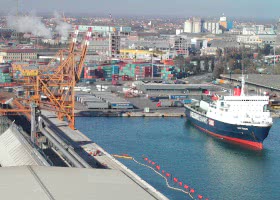
are: the development and modernization of infrastructures
ports, including by reinvesting ETS revenues in the green transition;
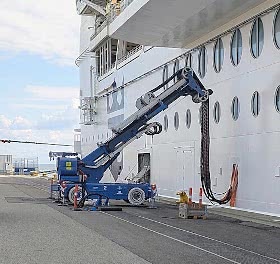
the electrification of the docks; the digitalisation and
automation of logistics; strengthening of skills
technical skills.
The document then points out that at the heart of the blue economy
Italian boating industry, a productive reality
heterogeneous and innovative, one of the main drivers of growth
national law, which involves almost a thousand companies and over 168 thousand
employees, with an added value of more than 13 billion euros.
It is directly worth 1.6% of Italian exports of goods and over 25%
of European nautical exports, with peaks of almost 30% for the
yachting. For Italian boating, 2025 was a year of
record and for the first time boat exports exceeded
10 billion euros, with a growth of +40% over 2024 which has
all segments.
- Via Raffaele Paolucci 17r/19r - 16129 Genoa - ITALY
phone: +39.010.2462122, fax: +39.010.2516768, e-mail
VAT number: 03532950106
Press Reg.: nr 33/96 Genoa Court
Editor in chief: Bruno Bellio No part may be reproduced without the express permission of the publisher







 In Italy, the maritime economy has over 250 thousand companies and 1.13
millions of employees, and generates 80 billion euros of added value
which rise to 225 billion considering relations with the
the rest of the economy, equal to 11.4% of national value added,
up by +3.8% against +2.1% for the entire economy. The
highlights the "Focus On Blue Economy and Boating" developed
by the research office of SACE, the Italian Export Credit Agency
owned by the Ministry of Economy and Finance, which is
presented at the Boat Show to be held
from 1 to 6 October in Genoa. The document specifies that behind
These results There are structural factors that are reporting
The sea at the heart of European strategies: the reorganisation of
global supply chains, the energy transition, security
critical infrastructure and the growing role of the Mediterranean
in geopolitical balances.
In Italy, the maritime economy has over 250 thousand companies and 1.13
millions of employees, and generates 80 billion euros of added value
which rise to 225 billion considering relations with the
the rest of the economy, equal to 11.4% of national value added,
up by +3.8% against +2.1% for the entire economy. The
highlights the "Focus On Blue Economy and Boating" developed
by the research office of SACE, the Italian Export Credit Agency
owned by the Ministry of Economy and Finance, which is
presented at the Boat Show to be held
from 1 to 6 October in Genoa. The document specifies that behind
These results There are structural factors that are reporting
The sea at the heart of European strategies: the reorganisation of
global supply chains, the energy transition, security
critical infrastructure and the growing role of the Mediterranean
in geopolitical balances.










 - Via Raffaele Paolucci 17r/19r - 16129 Genoa - ITALY


