Independent journal on economy and transport policy
04:21 GMT+2
This page has been automatically translated by Original news
SHIPPING
Shipping faces its triple challenge: decarbonisation, geopolitics and the new geography of the automotive industry
At the Euromed Convention in Grimaldi, the sector has to deal with new environmental rules, increasingly exposed routes and the shift of automotive production to Southeast Asia
Pula
September 25, 2026
If a thread binds the three panels of the XXVII Euromed Convention "From
Land to Sea" promoted by the Grimaldi group, staged
today at the Forte Village in Pula (Cagliari) in front of over 700
protagonists of world shipping, is the feeling
shared that the sector is going through three
transformations that until a few years ago did not exist or proceeded
on separate tracks: the decarbonisation imposed by the International
Maritime Organization (IMO) by 2050, the redefinition
geopolitics of trade routes triggered by the Suez crises and
Hormuz and the shift in the automotive production center of gravity
towards Southeast Asia. Three thrusts that add up and
condition each other, and which they found in the intervention of
Opening by the CEO of the shipping group
Emanuele Grimaldi, who recalled the initiatives in
course of the group between new ammonia-ready ships, an investment by
$1.5 billion in methanol units and reconfirmation
of connections with Sardinia, a concrete example of how
The shipping industry is already trying to respond.
Grimaldi, in fact, recalled that in the last 24 months the
Group took delivery of 14 Pure Car and Truck Carriers
"ammonia-ready", i.e. prepared for use
future of ammonia as an alternative fuel, and by April
2027 the fleet will have 17, including the most
of the capacity of 9,800 CEU combining high
Low-consumption load capacity per unit
transported. This is accompanied by an investment plan of 1.5
billion dollars for the construction of nine new ro-pax ships,
destined to enter the fleet between 2028 and 2030: thank you
to the use of methanol as an alternative fuel, these units
aim to reduce CO2 emissions per unit load
by 50% compared to the ships in service today, up to reaching
the goal of net zero emissions. The CEO of the
Grimaldi also announced that the Research and
The Group's development is already working on two new
Projects at an advanced stage of study: new generations of ships
con-ro and multipurpose, with the aim of making them "the most
Flexible and technologically advanced from an environmental point of view
in the world in their respective segments".
On the connection front, the Grimaldi group has strengthened its
presence in Asia, where it now employs 30 ships in services
that connect it with the other continents, while
with regard to connections with Sardinia, the venue of the edition
2026 of the Convention, the group was reentrusted with
another five years, under the territorial continuity regime, the
Naples-Cagliari-Palermo and Civitavecchia-Arbatax-Cagliari routes.
The first panel, "Shipping in Transition: Innovation,
Regulation and Sustainability", addressed the challenge of
decarbonisation in light of the IMO's strategy to
achieve net-zero greenhouse gas emissions from maritime transport by
2050, with binding intermediate targets already in 2030 and 2050.
2040. The debate identified three interdependent factors on which
The transition is at stake: technological innovation, necessary for
the development of fuels such as hydrogen, ammonia and methanol and for
the electrification of the docks; the human factor, which calls for
due to both the personnel on board and the opportunities offered
from artificial intelligence in onshore and offshore connections;
and regulatory clarity, made more urgent by the
that have transformed sustainability from
ethical choice as a requirement of compliance and competitiveness.
The second panel, "Geoeconomic & Geopolitical Challenges for
Maritime Transport in the Med Area", focused on the
Mediterranean as a historical hub of global traffic and a bridge
between Europe, Asia and Africa, but today it is exposed to
geopolitical crises and geoeconomic rearrangements that are reshaping
the world's maritime routes. The security criticalities related to
at choke points - in particular the Suez Canal and the Strait of
Hormuz - are already reflected in the numbers: according to what emerged
from the debate, there is a -10% contraction in exports and
a -4% reduction in crude oil imports from the Middle
East. Three aspects are indicated as decisive for the future of the
maritime transport in the Mediterranean: the vulnerability of
trade routes, which affects supply chains, costs and
freight and safety of navigation; the role of the ports of the
northern shore of the Mediterranean, called upon to reorganize themselves on the
logistics and infrastructure to respond to changes of course
transoceanic operations; and the overall economic balances, with
particular attention to Europe's role in terms of security
Energy, industrial autonomy and logistical centrality
of the Mediterranean area. From the comparison also emerged a
Indication of method: decarbonisation, as far as desired,
must not result in a loss of competitiveness for the
sector.
The third panel, "Automotive Seaborne Trade: A
Challenging World", focused on the car sector
Carrier and Ro-Ro that is undergoing a phase of profound reorganization
in parallel with the transformations of the automotive industry and
of the entire global logistics chain. Three strategic elements
emerged from the debate: the reconfiguration of flows and
hold capacity, linked to the rise of new markets
producers and exporters - in particular from Southeast Asia -
that is changing traditional routes; safety and new
propulsion technologies, with the operational challenges posed by the
transport of electric vehicles, from battery management to
and the regulations on the decarbonisation of fleets; and the
resilience of the logistics chain, which aims to integrate transport
port terminals and land connections to ensure
on-time deliveries in a global market and increasingly
interconnected.
- Via Raffaele Paolucci 17r/19r - 16129 Genoa - ITALY
phone: +39.010.2462122, fax: +39.010.2516768, e-mail
VAT number: 03532950106
Press Reg.: nr 33/96 Genoa Court
Editor in chief: Bruno Bellio No part may be reproduced without the express permission of the publisher







 If a thread binds the three panels of the XXVII Euromed Convention "From
Land to Sea" promoted by the Grimaldi group, staged
today at the Forte Village in Pula (Cagliari) in front of over 700
protagonists of world shipping, is the feeling
shared that the sector is going through three
transformations that until a few years ago did not exist or proceeded
on separate tracks: the decarbonisation imposed by the International
Maritime Organization (IMO) by 2050, the redefinition
geopolitics of trade routes triggered by the Suez crises and
Hormuz and the shift in the automotive production center of gravity
towards Southeast Asia. Three thrusts that add up and
condition each other, and which they found in the intervention of
Opening by the CEO of the shipping group
Emanuele Grimaldi, who recalled the initiatives in
course of the group between new ammonia-ready ships, an investment by
$1.5 billion in methanol units and reconfirmation
of connections with Sardinia, a concrete example of how
The shipping industry is already trying to respond.
If a thread binds the three panels of the XXVII Euromed Convention "From
Land to Sea" promoted by the Grimaldi group, staged
today at the Forte Village in Pula (Cagliari) in front of over 700
protagonists of world shipping, is the feeling
shared that the sector is going through three
transformations that until a few years ago did not exist or proceeded
on separate tracks: the decarbonisation imposed by the International
Maritime Organization (IMO) by 2050, the redefinition
geopolitics of trade routes triggered by the Suez crises and
Hormuz and the shift in the automotive production center of gravity
towards Southeast Asia. Three thrusts that add up and
condition each other, and which they found in the intervention of
Opening by the CEO of the shipping group
Emanuele Grimaldi, who recalled the initiatives in
course of the group between new ammonia-ready ships, an investment by
$1.5 billion in methanol units and reconfirmation
of connections with Sardinia, a concrete example of how
The shipping industry is already trying to respond.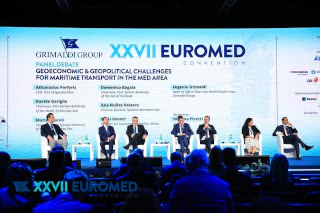








 - Via Raffaele Paolucci 17r/19r - 16129 Genoa - ITALY


