Independent journal on economy and transport policy
13:16 GMT+2
This page has been automatically translated by Original news
EDITORIAL
From Puertos del Estado to Porti d'Italia: the same inspiration, an opposite outcome
For the harbour reform the government refers to the Spanish model, but builds the exact opposite: a new door that the Italian corporate spirit can invent so well
Genova
September 25, 2026
Ten years ago, commenting on the legislative decree promoted by the then minister of Infrastructures and the Transports, Graziano Delrio, in the within of the government Renzi that rewrites the law 84/1994 replacing the Harbour Authorities with the Authorities of Harbour System, we wrote that the Italian government was opening "a third way bisecante the traditional regimes in vigor in Europe": neither the North-European management management, where the ports are controlled by local authorities that are also the first economic beneficiaries, nor the South-European collegial one, where Harbour Committees give voice to Regions, Municipalities, marine authorities, enterprises and unions, but a management to marked state footprint, with Committees of management of the Harbour System Authorities presided over by government appointments and a reduced weight of the economic categories of the territory(of 25 January 2016).
Ten years later, that third street is getting even closer. The draft law C. 2925, approved by the Council of Ministers on 22 December 2025 and currently under examination by the Chamber of Deputies(of 22 December 2025), does not limit itself to reform the governance of the Italian port authorities: creates a new subject, Ports of Italy Spa, destined to become the "operative arm" of the State for the realization of the strategic infrastructures of the national harbour system. It is a leap of institutional quality, being the first time that a significant part of the harbour infrastructural function is concentrated in a national corporate subject, distinct from the Authorities of Harbour System, and as every qualitative leap brings with it a bundle of questions that beyond one hundred parliamentary auditions and the more than 600 deposited amendments, most to sign of the Democratic Party, followed by Brothers of Italy, have made away more sharp.
The government proposal allocates to the Ports of Italy the concession for 99 years of the realization of the strategic investments of national and international relevance and the extraordinary maintenance of the ports included in the "Italian Network of the portualità", activity classified as service of general economic interest, therefore subtracted to the free market. At the same time, the proposal assigns freedom of enterprise to the new company, which can operate both nationally and abroad in competition, designing and carrying out works also for third parties. Functions that the measure provides are transparently separate from a separate accounting between the two activities. To the Authorities of Harbour System remain the territorial management of the ports of call, the state concessions and the ordinary maintenance. The economic and organic resources assigned to the Ports of Italy would prove from two state funds fed by a quota between 15% and 25% of the proceeds that the Authorities of Harbour System collect from anchorage taxes, port taxes and authorization rights, plus the transfer of a share of staff of the AdSP not exceeding 25%.
The starting point, before every judgement on the chosen instrument, is the problem that the harbour reform of the government says it wants to face: that to improve the competitiveness of the harbour system and logistic national, to facilitate the increase of the traffics of the goods and the people, as well as to promote the intermodality in the traffic goods.
In fact, the total tonnage of the goods enlivened from the Italian ports is still, in a long period reading: the record of 2007, 537 million tons, has never been equaled, and in 2024 Italy fell to 480,7 million tons and then rise to 510,8 million tons in 2025. But these data, alone, say less than it seems on the quality of harbour governance. The aggregated port traffic follows to a large extent the trend of the economy that serves, and the Italian economy grows from a quarter of a century to a rhythm among the lowest in Europe: a real annual average around +0,4-0,7% from 2000 to today, against, for example, the +1,7-2,1% of Spain, that in the same period has also benefited of a robust demographic increase (almost three million inhabitants in more from 2016, in large consumption alone). The comparison between the Spanish tonnage, climbed from 445 to more than 558 million tons between 2013 and 2024, to descend one million tons in 2025, and the Italian one, substantially flat in the same period, thus significantly reflects this macroeconomic gap, not necessarily a deficit of infrastructure or coordination.
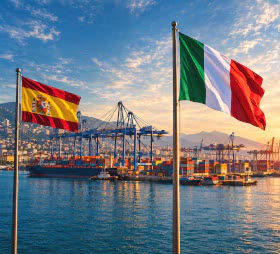
The comparison with Spain is not random since the Italian government in presenting the reform, had explicitly admitted to look at the Spanish harbour model. But the model he cited and the model he built seems to be two different things. Puertos del Estado, the public body that since 1992 coordinates the Spanish harbour system, never enters the yard: defines strategic objectives, approves the plans, coordinates the budgets, exercises supervision on the Portuarias Autoridades, but leaves to them the realization of the works. It is a public body of public law, not a company of shares: it does not need separate accounts not to distort competition, because it simply does not operate on the market or competes with the enterprises that operate there.
Between 2022 and 2023 the vice-minister of Infrastructures and Transports, Edoardo Rixi, announced the intention to reform the harbour governance inspired by the Spanish model. That announcement deserves to be read today, because it contained a warning that the current bill, in fact, did not listen. Rixi then approached Puertos del Estado to ENAV, the Italian agency that manages air traffic control. A comparison that generated perplexity, since it risked to overlay the new skills to those already exercised by the Corps of the Harbour offices on the control of the marine traffic. Our fear, then, was not that the Spanish model was wrong in itself, but that Italy would end up building a version watered by its "corporative spirit": a new body added to those already existing, without subtracting them anything, which ends up exacerbating bureaucracy by overlapping skills rather than rationalizing them. Exactly what had already happened, in that same period, with the establishment of a Ministry for Civil Protection and the Policies of the sea from the skills appropriate to those of Infrastructure, Environment and other dicasteries(of 23 October 2023).
The text today at the examination of the House confirms that fear, but for a different and in some ways more insidious. In the text the Puertos del Estado was not copied-paced in its leaner form - that of a coordinator who does not compete and does not build - but chose to create an industrial operator: a society that plans, finances and realizes directly the works, that can compete on the market with the same enterprises of engineering and construction of the field, and that it is side by side with the sixteen Authorities of Harbour System without subtracting them skills clearly, limiting itself to move a quota of resources and staff. It is, in other words, precisely the risk reported in 2023: a new subject that is added, not one that replaces or simplifies. With the aggravating fact that this time the new subject is not limited to coordinating, but enters the market, multiplying, with respect to a simple institution of address, also the legal friction fronts with the right of European competition.
The double dress of Porti d'Italia Spa has many perplexities. Some of these are mainly a matter of figures: the social capital of the society, which in the version of December 2025 arrived up to 500 million euros, was cut by 98% in the text signed by President Mattarella and landed in Parliament, stopping at 10 million. It is a difficult reduction to liquidate as mere technical adjustment: if the stated objective is to equip the country with a subject capable of planning and financing infrastructure works of national scale, a capitalization that barely covers feasibility studies signals, at least in the initial stage, a more symbolic and operational structure. The fact remains that the Fund for strategic infrastructures - fed by the canons and the harbour taxes - guarantees however, in first application, a endowment not less than about 200 million a year: the real financial engine of the reform, therefore, is not the social capital, but the levy on the revenue of the Authorities.
Other perplexities are governance: the subtraction of resources and personnel to the Authorities of Harbour System, the possible duplication of technical offices in the transitional phase, the risk - signaled by several parts - that the AdSPs are reduced to "meri peripheral offices". On these issues the parliamentary negotiation is already very advanced. The amendments draw four precise guidelines: reduce or eliminate the market activities of Porti d'Italia; impose a corporate separation (not only accounting) between concession and market; strengthen the entirely public capital guarantee; drastically resize the share of resources and staff subtracted to the AdSP until volunteering for staff.
There is then a more technical problem, which concerns directly the choice of entrusting to Porti d'Italia the strategic works through a concession of 99 years, while the European right of concessions binds the duration of the lease to the reasonable time of recovery of the investments and the costs incurred to realize the works or services, just to prevent a concession too long precludes access to the market to other operators. A second bond is added to this: the direct entrustment, without competition, to a company in house is admitted by EU law only if the company carries out beyond 80% of its activity for the controlling entity.
At a more operational level, then, the entrustment to Porti d'Italia inserts a new subject on state-owned areas already given in concession to terminalisti according to the rules of the regulation of 2022, that puts to them the extraordinary maintenance. If that same maintenance passes to Porti d'Italia, without an explicit agreement in the text, the concessionaire who has already assumed investment commitments on the basis of its economic-financial plan risks to be a third party that intervenes on the good it has in concession, without a direct legal relationship with it.
The thread that holds together these and other perplexities (including - not secondary - that connected to the possible opening by subsidiaries of the Porti d'Italia that operate in market regime to joint venture with private capital or that of the possible overlap of competences between AdSP and Porti d'Italia) is, in the end, a question of coherence: Is Porti d'Italia a legal allocation of public tasks, or a concession in its own sense? If it is the first thing, it must be called with its name and the perimeter must be strictly closed, excluding competitive activity and limiting the exclusive rights to the strict need. And it is the road indicated, not by chance, by the transversal amendments that reproduce almost literally Article 106 of the EU Treaty on services of general economic interest. If, on the other hand, it is a real concession, it must be accepted in full: the amount of public service obligations defined with precision, parametrate compensation, explicit agreement rules with those already operating on the same state areas.
But the most upstream question is whether it is the right tool to respond to twenty years of stagnation either an industrial operator like Porti d'Italia or a light coordinator like Puertos del Estado. A question that does not have a discounted answer in favor of the Spanish model, for a reason that is worth expressing to the bottom. An entity of slender address works only if it is accompanied by the courage to subtract really skills to those who exercise them today in a fragmented way, imposing to the sixteen Authorities of Harbour System to realize a unique direction, and not if it is limited to adding to them as an additional level. It is the same corporative spirit with which Italy has always faced deburocratization: new norms that add up to the preceding without cancelling them, new organisms that support those already operating instead of really making them work. To make concrete the risk that even a model on the lighter paper, if imported without that courage, turns into the yet another door is the evidence that this would be useful to politics to find places, reassuring for the unions because it does not touch positions acquired, harmless for the enterprises because it does not change the balances of the market. But it is equally evident that it would be incapable of really thwarting the decision-making fragmentation that restricts investment.
Ports of Italy, as well as today designed, does not escape at all this risk: it joins the AdSPs without replacing them, adds a board of directors and a technical structure to the many already existing, and therefore it does so choosing the most exposed form: that of the industrial operator with almost secular exclusive rights and licence to compete on the market, instead of the simplest of the coordinator.
It can be argued that the AdSPs, taken individually, lack technical skills and financial critical mass to complete the great works, and that for this reason it serves a subject able to build, not only to plan. It is a legitimate argument, and probably the real reason why the government chose the industrial model instead of the regulatory one. But if this is the problem, perhaps the most linear solution would have been to strengthen the technical ability of the AdSP - even by sharing resources and skills between them - not to create a new company subject with exclusive rights of almost secular duration and licensed to operate on the market. The fact that the initial capital of Porti d'Italia has been cut by 98%, from 500 to 10 million euros, precisely in the passage from the Council of Ministers to Parliament, is a clue that neither the executive is completely convinced of the need to equip this industrial subject of means really proportioned to the mission entrusted to him on the paper.
Ports of Italy therefore seems to bear a double weakness: the instrument is disproportionate with respect to the task (a 99 year concession and a market activity to carry out functions of direction), and together does not face the underlying vice, that to sum organisms instead of rationalizing them, that the Italian experience of the last decades knows far too well.
The concrete risk is that, in order to solve a real problem (this if the lack of growth of the harbour traffics is attributed only to the lack of competitiveness of the ports instead, as it should be, also or above all to the weakness of the Italian economy), the undercapitalized and legally exposed door is created, without solving, to the root, the decision fragmentation that the reform declares of want to fill. The parliamentary examination in progress at the Chamber is the last useful place to avoid it.
- Via Raffaele Paolucci 17r/19r - 16129 Genoa - ITALY
phone: +39.010.2462122, fax: +39.010.2516768, e-mail
VAT number: 03532950106
Press Reg.: nr 33/96 Genoa Court
Editor in chief: Bruno Bellio No part may be reproduced without the express permission of the publisher







 Ten years ago, commenting on the legislative decree promoted by the then minister of Infrastructures and the Transports, Graziano Delrio, in the within of the government Renzi that rewrites the law 84/1994 replacing the Harbour Authorities with the Authorities of Harbour System, we wrote that the Italian government was opening "a third way bisecante the traditional regimes in vigor in Europe": neither the North-European management management, where the ports are controlled by local authorities that are also the first economic beneficiaries, nor the South-European collegial one, where Harbour Committees give voice to Regions, Municipalities, marine authorities, enterprises and unions, but a management to marked state footprint, with Committees of management of the Harbour System Authorities presided over by government appointments and a reduced weight of the economic categories of the territory












 - Via Raffaele Paolucci 17r/19r - 16129 Genoa - ITALY


