Independent journal on economy and transport policy
15:03 GMT+2
This page has been automatically translated by Original news
SHIPPING
Decarbonising shipping: a €36 billion challenge and a €45 billion opportunity for Italy
Without investments in ports, Italy risks losing 80 billion euros of added value by 2050
Cernobbio
September 8, 2026
To develop port infrastructures and supply chains
energy and industrial upstream necessary for decarbonisation
of maritime transport in Italy, 36 billion euros are needed
of investments to 2050, including the development of
storage and bunkering infrastructures, of the units for
ship-to-ship refuelling and for the electrification of
docks, in addition to the national fuel production capacity
alternatives. These are investments capable of activating 105
billion euros in production value and generate 45 billion
of added value, equal to 1.24 times the investment
initial impact. The repercussions would affect the entire territory
with the South and the Islands intercepting 51.4% of the
added value generated by bunkering investments,
enhancing the position of the southern ports along the
main Mediterranean routes. These estimates are contained in the
strategic report "Decarbonising the sea, strengthening
Italy: maritime transport, energy carriers and ports, new
competitiveness in the Mediterranean" carried out by TEHA
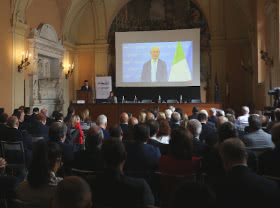
Group in collaboration with Edison and NextChem presented today
in the closed-door proceedings of the 52nd edition of the Forum of
Cernobbio.
The report explains that maritime transport accounts for 14%
of transport emissions in the EU-27 and 7% in Italy, but more than
95% of the European and Italian fleet still uses fuels
and highlights that decarbonisation is not
no longer just an environmental obligation, but a factor of
competitiveness, because regulation, cost of CO2,
Infrastructure availability and fuel volatility
are redefining the economics of the sector and the attractiveness of the
of ports. In particular, the report notes that ports are the
central hub of the transition: in Europe, decarbonisation is
the investment driver that recorded the highest growth of
relevance over the last five years and the ability to offer
alternative infrastructure and fuels at competitive conditions will be
increasingly decisive for attracting and preserving traffic.
The study shows how the energy transition of transport
will follow a gradual and multi-fuel trajectory.
In the "Industry driven" scenario developed by TEHA,
built on the basis of current signs of industrial evolution
and using ship orders as an indicator of the choices of
Shipowners' investment, alternative fuels reach 65.5%
of the energy mix by 2050, driven by biofuels (50.7%), while the
fossil fuels maintain a share of 34.5%, with a role in
liquefied natural gas. This evolution
would allow a 54% reduction in emissions by 2050 and
would require 36 billion euros of investment in
port infrastructures and upstream energy and industrial supply chains.
The report points out that the industrial benefits related to the
decarbonisation of maritime transport, those
environment: in the absence of further investment, the social cost
cumulative emissions would reach around €51.7 billion
in the period 2026-2050, compared to 40 billion in the "Industry
driven". Failure to adapt would therefore result in approximately
€11.7 billion in additional social costs for the
country-system.
"The evidence of this study - commented Fabrizio
Mattana, executive vice president of Gas Assets at Edison, in sight
of the presentation of the report - confirm the importance of the
decarbonisation of transport, in particular maritime transport,
and the role of ports as a lever for development and competitiveness
for the country". "The decarbonisation of transport
- observed Giovanni Sale, senior vice president Energy
Nextchem's Transition Strategy – is one of the most
of the energy transition, because it requires
combining security of supply, sustainability and
competitiveness on a global scale. There is no such thing as a technology
able to solve this challenge: we need an ecosystem
diversified low-emission energy carriers, where the
methanol is emerging as one of the most
concrete and scalable".
"The transition of maritime transport - underlined
Lorenzo Tavazzi, senior partner and board member of TEHA - is not
More a hypothesis, but a process that has already begun: fuel
Alternative vessels now account for 51% of ship tonnage
globally ordered. The long service life of the ships makes
but this necessarily gradual and multi-fuel path, and
precisely for this reason it requires a long-term industrial vision
period. For Italy, this is a challenge of competitiveness,
but above all of a concrete and measurable opportunity: the
TEHA scenario indicates that €36 billion of investments by 2050
can reduce emissions by 54%, activate 105 billion euros
of production value and generate €45 billion in value
more than half of which in the South. È
the sign that decarbonization and industrial growth can
move in the same direction. The real stakes are
this: to transform the decarbonisation of the sea into a lever of
industrial policy. Not to do so would mean giving up about
80 billion euros of added value and, with them, the centrality of
of Italy in the Mediterranean".
- Via Raffaele Paolucci 17r/19r - 16129 Genoa - ITALY
phone: +39.010.2462122, fax: +39.010.2516768, e-mail
VAT number: 03532950106
Press Reg.: nr 33/96 Genoa Court
Editor in chief: Bruno Bellio No part may be reproduced without the express permission of the publisher







 To develop port infrastructures and supply chains
energy and industrial upstream necessary for decarbonisation
of maritime transport in Italy, 36 billion euros are needed
of investments to 2050, including the development of
storage and bunkering infrastructures, of the units for
ship-to-ship refuelling and for the electrification of
docks, in addition to the national fuel production capacity
alternatives. These are investments capable of activating 105
billion euros in production value and generate 45 billion
of added value, equal to 1.24 times the investment
initial impact. The repercussions would affect the entire territory
with the South and the Islands intercepting 51.4% of the
added value generated by bunkering investments,
enhancing the position of the southern ports along the
main Mediterranean routes. These estimates are contained in the
strategic report "Decarbonising the sea, strengthening
Italy: maritime transport, energy carriers and ports, new
competitiveness in the Mediterranean" carried out by TEHA
Group in collaboration with Edison and NextChem presented today
in the closed-door proceedings of the 52nd edition of the Forum of
Cernobbio.
To develop port infrastructures and supply chains
energy and industrial upstream necessary for decarbonisation
of maritime transport in Italy, 36 billion euros are needed
of investments to 2050, including the development of
storage and bunkering infrastructures, of the units for
ship-to-ship refuelling and for the electrification of
docks, in addition to the national fuel production capacity
alternatives. These are investments capable of activating 105
billion euros in production value and generate 45 billion
of added value, equal to 1.24 times the investment
initial impact. The repercussions would affect the entire territory
with the South and the Islands intercepting 51.4% of the
added value generated by bunkering investments,
enhancing the position of the southern ports along the
main Mediterranean routes. These estimates are contained in the
strategic report "Decarbonising the sea, strengthening
Italy: maritime transport, energy carriers and ports, new
competitiveness in the Mediterranean" carried out by TEHA
Group in collaboration with Edison and NextChem presented today
in the closed-door proceedings of the 52nd edition of the Forum of
Cernobbio.








 - Via Raffaele Paolucci 17r/19r - 16129 Genoa - ITALY


