Independent journal on economy and transport policy
18:28 GMT+2
PORTS
Winners and losers of port connectivity: the long race between ups and downs of Italian ports
The UNCTAD indices tell of a changing Mediterranean: Italy slips to seventh place, La Spezia, Trieste and Vado Ligure grow, while the South loses ground
Ginevra
September 29, 2026
There is a number that sums up how Italy is
connected to the global network of maritime transport services of the
container: 282.8. This is the value, recorded in September 2026,
of the Line Transport Connectivity Index (LSCI)
calculated by UNCTAD, the UN agency for trade and
development. The index measures precisely how much a country is connected
to the regular routes traveled by container carriers and considers
how many ships call at each week, how much capacity is
deployed by the shipping companies, how many services and how many
carriers operate, how much is the capacity of the vessel more
and with how many countries there is a direct connection. The
value 100 corresponds to the average country in February 2023.
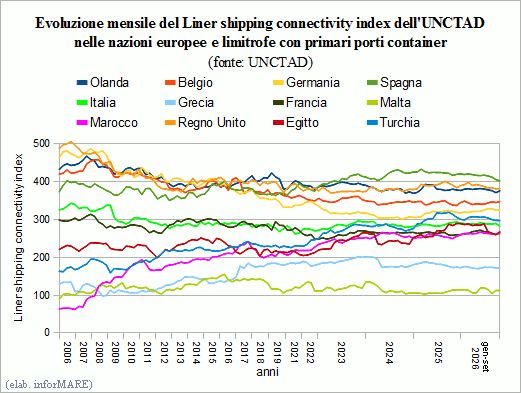
Twenty years ago, in February 2006, Italy was at 326. Today it is more
low by 43 points, or 13.4%. Put this way, it seems
A negative news, but the figure should be read in comparison with the
others. In fact, Northern Europe, which dominated the ranking in 2006
with its container ports, has been downsized. The
Germany went from 464 to 326 (-30%) touching the lowest
historic in August 2024, at 302. The United Kingdom fell
from 488 to 383 (-21.5%). Belgium and the Netherlands fell less,
-17% and -13% respectively. The result is that the
gap between Italy and Germany has narrowed from 138 to 43
points. In 2006, the Italian index was worth 70% of the German index,
today it is worth 87%. The relative advantage, however, is not
thanks to Italian growth: it is the result of decline
of the leading European maritime nations.
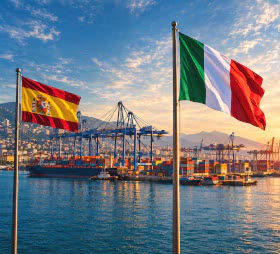
Those who have grown up are in the South and East. Spain, already ahead
Italy in 2006 with 374 points, is now at 402 and has reached
the record in January 2025 (433.6). It has surpassed all European countries
of the champion and has an advantage of about 120 points over Italy. The
Turkey almost doubled its index, from 163 to 298, and overtook
Italy for the first time in February 2024 and in a stable way from
December 2024. Morocco, which in 2006 was at 64, is now at
263 and is worth 93% of the Italian value. Egypt, in just one month,
January 2026, overtook Italy (288.6 against 287.7).
The result is that Italy, sixth out of twelve countries in 2006,
today it is seventh. In front are Spain, the United Kingdom, the Netherlands,
Belgium, Germany and Turkey. Behind, but a short distance away, Egypt,
France and Morocco. France and Italy have exchanged positions
several times: France was above Italy between 2013 and 2013.
2021, then Italy came back ahead.
The national index, however, is an average that hides
very different things. To understand what is happening inside the country, a
level of its ports, UNCTAD has developed the PLSCI index which
measures the connectivity of each individual port of call with the
same six components. The two scales are not comparable with each other,
because the reference averages are different. Genoa, for
For example, it has a 413 index for the third quarter of this year
while the whole of Italy has an index of 283 as of September 2026.
But the PLSCI reveals what is behind the country's number.
The first thing he says is that the ranking is very
concentrated. At the top there are three ports above 300: Genoa
(413), Gioia Tauro (310) and La Spezia (305). Salerno (190) follow,
Naples (169) and Livorno (160). After that, Trieste (147), Venice
(122) and Vado Ligure (121). The other ports are below 90, and
a dozen stopovers are under 30, often with only one or two services
of the line.
The history of the PLSCI shows that the center of gravity of the ports
moves northwards. La Spezia has gone from 200 in 200
2006 to 305 in the third quarter of 2026 and with the latest figure has
reached the top of its series. Trieste, which in 2006 was worth 71,
has more than doubled connectivity and remains stable
around 150. Vado Ligure is the most conspicuous data,
consequent to the inauguration in 2019 of its platform
container port: in 2013 the Ligurian port had an index of 16;
in 2025 it reached 144 and today it is at 121, eighth port
of Italy. Ancona, from 51, has risen to 83. Civitavecchia, which
in 2006 it was under 20, it reached 93 in 2018 and today it is
around 71-84. The port of Genoa remains in command, but without having
found its maximum: 457 in 2016 and 413 today. The Genoese port
has gone through a decline of up to 375 in the years of the pandemic and a
recovery that brought him back above 400.
In the South, the picture is more contrasted. The port of Salerno is
The positive exception: from 156 in 2006 to 205 in 2018, a collapse to
118 in 2020 and then the record of 212 in 2025, today at 190. Joy
Tauro, a transhipment port, is at 310 in the third quarter of 2015.
2026 and is more connected than in 2006 (298) but under the
peak in 2007 (358). Then there are cases of more
marked. The port of Cagliari started from 172 in the first quarter
2006 and again 184 in 2009: today, after losing the traffic of
transhipment, is at 29, one-sixth of the initial level, with a
minimum of 12 in 2021-2022. The port of Taranto, also penalized
from the loss of transhipment, it has gone from 122 to 27, with
an absence from the series between 2016, after the
Taiwanese Evergreen had left the handling of the container
terminal at the Multi-sector Pier, and 2019. The port of Livorno, which
in 2006 it was the third port in Italy with 287, it lost over 40%
and is now sixth.
From the historical reading of the two indices it is possible to
reasonably deduce that the decline in the Italian national index
reflects the loss of airports such as Cagliari, Taranto and Livorno. The
the fact that Italy has not fallen more depends on the resilience
of Genoa and Gioia Tauro and the growth of La Spezia, Vado, Trieste
and Salerno.
From the recent reading of the indices, however, it is possible to
the effects of ongoing geopolitical crises on the
Connections of European nations to the maritime services network
containerized. The Italian LSCI index is back
recently at 285-290 after the low of 2021, but in September it
down by more than seven points in a month, a figure that alone
is not trendy. Spain is also showing from mid-2025
a slow retreat (from 432 to 402), while Turkey and Egypt are
down from the highs. The Mediterranean game, therefore, is
still open as it is linked to the fate of the ongoing conflicts in
regions closely linked to the activities of the main
scheduled services that transit the basin.
For Italy, in particular, the current challenges seem to be two,
North and South. For the northern ports, the question is
consolidate and accentuate a growth that is already
occurred. With regard to the indices developed by UNCTAD, La Spezia
and Trieste are at or near the highest in their history, and
Vado Ligure has more than tripled its index in ten
years, but with wide fluctuations (144 in 2025, 81 just one year
before). Genoa, the country's first airport, has not yet found its
peak of 2016 (413 today against 457). Venice (122 against 175) and
Livorno (160 against 287 in 2006) are well below their levels
better. For these airports, the theme is to maintain and regain
services in a system where links move quickly
from one port to another. For the South, the challenge is one
different: broaden a base that is too narrow. The South can
central geographical position in the Mediterranean, which
rewards the transhipment activity which also has to face the
increasing competition from North African and Near Eastern ports,
but its connectivity rests in practice on two ports, Gioia
Taurus (310), which is a pure transhipment port, and
Salerno (190). Cagliari and Taranto, with the cessation of activity
of transhipments, lost five-sixths and four quarters respectively
fifths of the starting value. Meanwhile, on the opposite bank
of the Mediterranean, Morocco has raised its index to 93% of
the Italian one and Turkey has already surpassed Italy.
- Via Raffaele Paolucci 17r/19r - 16129 Genoa - ITALY
phone: +39.010.2462122, fax: +39.010.2516768, e-mail
VAT number: 03532950106
Press Reg.: nr 33/96 Genoa Court
Editor in chief: Bruno Bellio No part may be reproduced without the express permission of the publisher






 There is a number that sums up how Italy is
connected to the global network of maritime transport services of the
container: 282.8. This is the value, recorded in September 2026,
of the Line Transport Connectivity Index (LSCI)
calculated by UNCTAD, the UN agency for trade and
development. The index measures precisely how much a country is connected
to the regular routes traveled by container carriers and considers
how many ships call at each week, how much capacity is
deployed by the shipping companies, how many services and how many
carriers operate, how much is the capacity of the vessel more
and with how many countries there is a direct connection. The
value 100 corresponds to the average country in February 2023.
There is a number that sums up how Italy is
connected to the global network of maritime transport services of the
container: 282.8. This is the value, recorded in September 2026,
of the Line Transport Connectivity Index (LSCI)
calculated by UNCTAD, the UN agency for trade and
development. The index measures precisely how much a country is connected
to the regular routes traveled by container carriers and considers
how many ships call at each week, how much capacity is
deployed by the shipping companies, how many services and how many
carriers operate, how much is the capacity of the vessel more
and with how many countries there is a direct connection. The
value 100 corresponds to the average country in February 2023.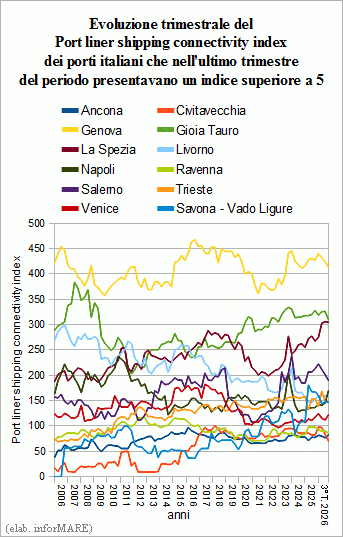















 - Via Raffaele Paolucci 17r/19r - 16129 Genoa - ITALY


