testata inforMARE
Cerca
14 de septiembre de 2026 - Año XXX
Periódico independiente sobre economía y política de transporte
12:49 GMT+2
LinkedInXFacebook
FORUM de lo shipping y
de la logística


The Tanker Market in 1998
  • Aframax

The increase in the capacities and the growing diversity of crude oil production sites, which keep getting closer to the consumption sites, are tending to reduce the tonne/mile ratio.

This might have been beneficial for the Aframax ships, whose characteristics allow greater flexibility of use. However, here again, the rates and their trend show the contrary.

This is clear proof that the period of slowdown in economic activity that we are going through not only concerns the countries of South-Eastern Asia but is also affecting the Western economies.
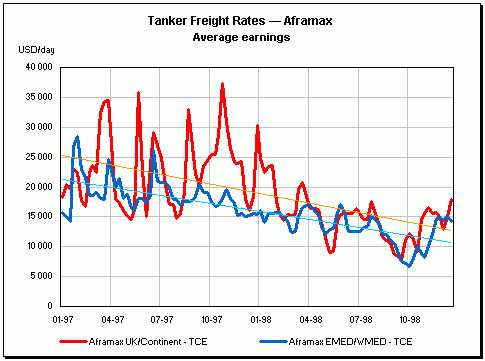
Aframax tanker freight rates

But the major factor explaining the slump in freight rates for this category of tankers is the high surplus tonnage, the consequence of a large influx of new ships.

Aframax fleet on Jan 1, 1995

50,056,763 dwt (612 ships)

Aframax fleet on Nov 25, 1998

62,811,253 dwt (730 ships)

Because of the good distribution of this ship category in the age structure of the tanker fleet, scrapping is not and cannot be the only solution to the problem.
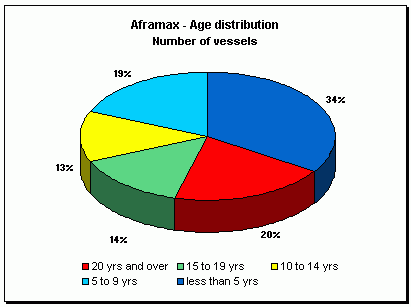
Aframax age distribution


The Aframax and Panamax second-hand market

By mid-December 1998, 29 Aframax ships had changed hands, about 20 less than in 1997. We think it interesting to emphasize the fact that the buyers were attracted by the most modern units, since 15 of these 29 ships were less than 10 years old and they were all sold with attached or charter back. For the most modern ships fitted with center line bulkheads, the buyers had to obtain a back charter or attached work in order to cover themselves against the risk related to the continuing fall in the prices of newbuilding. The buyers of ships built at the beginning of the 1990s and not fitted with center line bulkheads have wanted to cover and minimize their exposure on the residual value of their purchases in the long term, which is subject to great uncertainty. In practice, it seems to be accepted that this type of ship will not be among the favorites of the most important charterers. In this context the following sales have been noted: the M/T "Oriental Lady", 105,400 dwt (double hull), built in 1998 and sold for $40,000,000 against 10 years back charter at about $18,000/day; the M/T "Sanko Protector", 96,120 dwt, single hull, built in 1993 and sold for around $23,000,000 against five years back charter at $17,000/day. The rest of the Aframax sold, about 14 units, were built between 1975 and 1983. The striking fact concerning these sales is their concentration right at the beginning of the year. This can be explained partly by the constant degradation of the freight rates, but also by the increase in the orderbook coupled with a significant reduction in the average age of the fleet compared with the VLCCs and the Suezmax. For information, examples include the sale in January of the M/T "Nicolas", 88,260 dwt, built in 1981, for approximately $14,000,000 and the sale in March of the sister ships M/T "Atlantas" and M/T "Ouranos", 87,076 dwt, built in 1975, for $4,050,000 each.

The Panamax tankers benefited from relatively high interest, since 11 units were sold during the period. It is nevertheless essential to note that no less than six ships were bought by the same buyer, who had decided to take a predominant position in this specific market. During the year the M/T "Anella", 60,000 dwt, built in 1986, the sister ships M/T "Neapolis" and M/T "Antipolis", 60,525 dwt, built in 1981, the M/T "Nicopolis", 60,525 dwt, built in 1983, the M/T "Anette", 63,098 dwt, built in 1982, and the M/T "Mantinia", 65,745 dwt, built in 1983, joined the same fleet, forming a total investment of about $95,000,000 for the buyer. Other transactions included the sale in March 1998 of the M/T "Chiba Spirit", 60,875 dwt, built in 1980, for a price of $10,600,000, while in December the M/T "Eastern Alliance", 60,962 dwt, built in 1983, was sold for about $8,500,000. As for the other ship categories, the downward trend has steepened over the months.
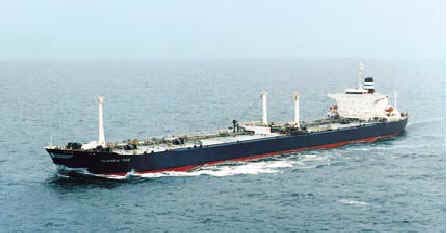
Alandia Tide, 99,958 dwt Alandia Tide
99,958 dwt, blt 1975
owned by Alandia Tanker,
on T/C to Total

©FotoFlite

The factors amplifying the crisis

As discussed above, the economic crisis originating in Asia during the second half of 1997 has overturned the often optimistic forecasts of certain experts. The worldwide repercussions of the crisis are undeniable today.

The table below compares the trends in percentage growth rates for two sets of countries, including forecasts for 1999/2000.


1996

1997

1998

1999

2000

OECD countries

2.6

2.8

2.1

2.3

2.4

South-East Asian countries

7.6

6.4

-0.4

3.5

4.0

In view of these figures, it is easier to understand the reasons why freight rates could hardly be maintained at such high levels as in 1997. Nevertheless, if the forecasts turn out to be accurate, the duration of the crisis may be short.

In fact, the main amplifying factor in the present rates crisis is attributable to the "unfortunate" combination of unfavorable economic factors and the arrival of a large number of new ships.

However, a still greater problem is the present situation in the two main shipbuilding countries (Japan and above all Korea). The devaluation of their currencies against the dollar and their high production capacity (in both size and productivity) have driven newbuilding prices into a worrying downward spiral, as shown in the table below.

New ship price trends

average prices in millions of US$
 

1996

1997

1998

VLCC

85

82

70

Suezmax

52

51

45

Aframax

42

41

34

Such decreases naturally attract a new influx of orders (too often speculative, as they are not "covered" by guaranteed long-term work) which will increase a tonnage supply which is still not offset either by sufficient demand or by scrapping of the oldest ships.

Once again a phenomenon characteristic of the shipping world is observed: at a time when there should be a slowdown in orders for new ships, everything is done to encourage the shipowners and speculators to fill the orderbooks!

It is therefore logical that the values of second-hand ships depreciated between the beginning and end of the year by more than 40% for ships built in the 1970s and by 25% to 30% for the most modern ships. The indicators for the year to come are not "in the green" and it is probable that the oldest ships will become increasingly difficult to sell, unless the sellers offer particularly attractive terms. Before values can recover, it is first necessary for the price per barrel to recover, the tonnage supply/demand ratio to become better optimized and, above all, those involved must regain confidence and hope. Very often we tend to believe that the elimination of the oldest ships is the ideal solution for ending the crisis. This is certainly a fundamental element, but it should be remembered that the oldest ships are not necessarily those in poor condition, and that shipowners often need them in their fleet to help finance the most modern units so requested by the charterers. We must therefore above all hope that speculative and exaggerated newbuild orders become less common practice; here the banks perhaps have an important role to play in preserving the value of their existing portfolio in this way.

Prospects and remedies

Having outlined this somewhat somber picture, it is now time to discuss, if not the immediate solutions, at least the areas of hope that are taking shape.

As far as economic factors are concerned, all indications suggest that the prospects for recovery are genuine and that growth in terms of energy consumption will be observed as we move into the new millenium.

The emergence of alternative energies so desired by some is taking its time, and everything confirms a continuing major role for oil as an energy source in the years to come. The present situation of production overcapacity, although far from helping the problem of the price per barrel, confirms the predominant role of oil.

As far as oil transport proper is concerned, the endemic tonnage surplus must be given full attention, as discussed above, all the more so because the trend to shorter routes will continue over the next few years. A particularly high proportion of tankers (77 million dwt) will reach the "critical" age of 25 years over the coming three years.

Although the shipowners, motivated by the high freight rates of 1997 and the beginning of 1997, delayed the scrapping of old units, their margin of maneuver is now becoming very small, and the various regulations in force should at last accelerate the retirement of these ships. At this point we shall mention only three complementary elements which should rapidly bear fruit and thus completely change the appearance of the transport market by 2000/2001.

It should first be remembered that when a ship passes 25 years of age its owner must obtain a fifth special survey certificate. For many of these ships which have not previously benefited from regular and thorough upkeep policies the cost will be prohibitive compared with the commercial prospects and above all compared with their residual value, which is falling continuously.

International regulations are being harmonized and they too play a decisive role in passing this notorious 25-year barrier. The MARPOL regulations stipulate that at this age an oil tanker must be fitted with an SBT (Segregated Ballast Tanks) system or must adopt an HBL (Hydrostatic Balance Loading) mode. Concerning HBL mode, apart from the fact that it reduces the transport capacity (particularly for the smallest ships), it is observed that some major charterers now purely and simply refuse to consider this type of method.

So it is once again the more-or-less consistent attitude of the charterers that will rationalize the basic balance of oil transport over the next two or three years. The selection policies implemented by the oil companies are becoming increasingly stringent and, even though the mesh of the net is still often too wide, it is obvious that, given the low freight rates market for at least the next 12 months, a decision to charter a ship 25 or more years old would be easy to criticize, particularly if an incident were to occur.


Shipping and Shipbuilding Markets 1999

I N D E X

›››Archivo
El tráfico de carga en el puerto de Singapur disminuyó un -4,9% en agosto.
Singapur
En los primeros ocho meses de 2026, el puerto gestionó 30,7 millones de contenedores (+4,2%).
Cochin Shipyard y Drydocks World desarrollarán conjuntamente un nuevo centro internacional de reparación naval en Cochin.
Bombay
Un buque mercante iraní fue alcanzado en el estrecho de Ormuz.
Teherán/Southampton
Un marinero falleció y otros cuatro miembros de la tripulación resultaron heridos.
En julio, el tráfico de mercancías en el puerto de Ravenna creció un +6,7%.
Rávena
Se espera un fuerte descenso del -21,2% en agosto.
Giulio Stoppa es el nuevo secretario general de Trasportounito
Roma
Una elección de continuidad que al mismo tiempo marca el comienzo de una nueva fase.
Meyer Werft comienza la construcción del crucero Carnival Tropicale.
Papenburg
Con un tonelaje bruto de 180.000 toneladas, podrá albergar a más de 6.000 pasajeros.
La ceremonia de botadura del Viking Astrea tuvo lugar en el astillero Fincantieri en Ancona.
Ancona/Los Ángeles
El Consejo de Administración de Viking ha autorizado un programa de recompra de acciones de hasta 1.000 millones de dólares.
VTG vende su filial británica VTG Rail UK al fondo de pensiones USS.
Hamburgo
La empresa opera en el sector del arrendamiento de vagones de mercancías por ferrocarril.
La Guardia Costera de Génova alcanza su inspección número 100 de Control del Estado del Puerto en 2026.
Génova
Hasta el momento se han detectado más de 250 deficiencias.
ABB y Oceanly colaboran para integrar y optimizar el rendimiento y las operaciones de los buques.
Génova
Acuerdo estratégico entre Federlogistica y el Puerto de Xiamen.
Génova
Estudio de viabilidad para una conexión marítima entre el puerto chino y Génova.
El tráfico de contenedores en el Puerto de Los Ángeles se mantuvo estable en agosto.
Los Ángeles
El aumento de garajes vacíos ha compensado la disminución de los garajes llenos.
Gulftainer adquirirá una participación en la terminal de Suksawat en Tailandia.
Sharjah/Bangkok
Está ubicado a orillas del río Chao Phraya, en Bangkok.
PROXIMAS SALIDAS
Visual Sailing List
Salida
Destinación:
- orden alfabético
- nación
- aréa geogràfica
Robo.ai crea una empresa especializada en seguridad marítima y submarina.
Abu Dabi
Al-Mansory: Produciremos localmente y ofreceremos soluciones para mercados de todo el mundo.
Kombiverkehr ha tomado el control total de la empresa española Combiberia.
Fráncfort del Meno
Las acciones fueron adquiridas de los otros 20 miembros.
Las fuerzas estadounidenses atacaron cinco petroleros iraníes.
Tampa
Ataques en el Golfo de Omán y cerca de la isla de Kharg.
Condiciones cumplidas para la adquisición de AD Ports por el fondo soberano de Abu Dhabi.
Abu Dabi
Han comenzado las obras de construcción del tramo en superficie del nuevo rompeolas de Génova.
Milán
La construcción de la barrera contra las olas está en marcha.
Por primera vez, una mujer dirige la Autoridad del Canal de Panamá.
Balboa
El mandato del ingeniero Ilya Espino de Marotta expirará en 2033.
Blu Navy ha adquirido una participación en Banca dell'Elba.
Portoferraio
Schenone: Somos un grupo unido por el deseo de contribuir al desarrollo económico y social de la isla.
HMM firma un contrato por un valor aproximado de 3.500 millones de dólares con Vale.
Seúl
Se trata del transporte marítimo de mineral de hierro en nombre de la empresa brasileña.
Kongsberg Maritime firma un acuerdo para comprar la finlandesa Steerprop.
Oslo
La empresa, con sede en Rauma, diseña y fabrica sistemas de propulsión marina.
Nueva incautación de drogas en el puerto de Livorno.
Livorno
53 kilogramos de cocaína pura en un contenedor procedente de Perú.
En los tres primeros meses de 2026, el tráfico de mercancías en los puertos belgas cayó un -4,0%.
Bruselas
Los desembarques y embarques disminuyeron un -2,0% y un -6,4% respectivamente.
Ha comenzado una serie de reuniones sobre el nuevo Plan Director del Sistema Portuario para los puertos de Génova y Savona-Vado.
Génova
Se ha finalizado el nuevo acuerdo de concesión con Amico & Co Spa.
Puerto de Ravenna: Se ha aprobado el mantenimiento extraordinario del tramo de Via Baiona accesible para camiones.
Rávena
MacGregor celebrará el 65 aniversario de su filial italiana en Génova.
Génova
La empresa tiene su sede en la zona de reparaciones navales del puerto de Génova.
El sistema de propulsión eólica Anemoi se instalará en un buque portacontenedores de Maersk.
Londres
El objetivo es aumentar la eficiencia energética del buque y reducir sus emisiones.
Ha comenzado el proceso de selección del nuevo Secretario General de la Autoridad Portuaria del Mar Adriático Central-Norte.
Rávena
Las manifestaciones de interés deberán presentarse antes del 21 de septiembre.
MacGregor inaugura un nuevo centro de asistencia técnica en Trieste.
Estocolmo
El principal foco de atención será el área europea, incluido el sector especializado de los megayates.
Un buque cisterna fue alcanzado por tres proyectiles en el estrecho de Ormuz.
Southampton
También se produjo un accidente en el Océano Índico.
Floriana Gallucci es la nueva secretaria general de la Autoridad Portuaria del Mar Jónico.
Taranto
El Comité Directivo de la institución ha aprobado el nombramiento.
Detienen a la tripulación del ferry que se hundió en el norte de Chipre.
Nicosia
Ocho personas murieron en el accidente. Otros 17 pasajeros están desaparecidos.
Las ganancias de Singamas se redujeron a la mitad en el primer semestre de 2026.
Hong Kong
La empresa china se está centrando en los contenedores de energía. Durante este periodo, las ventas de contenedores especializados superaron por primera vez las de los contenedores estándar.
CIMC vende más contenedores, pero las ganancias se desploman.
Hong Kong
El beneficio semestral de este segmento de negocio cayó un -81,2%.
En la primera mitad de este año, China
COSCO Shipping Ports registra ingresos récord tanto trimestrales como semestrales.
Hong Kong
Los ingresos netos durante los primeros seis meses de 2026 fueron de 276,6 millones de dólares (+23,2%).
En los primeros seis meses de 2026, los ingresos de CMPort crecieron un +13%.
Hong Kong
El beneficio neto aumentó un 7,4%.
Los ingresos de Meyer Werft crecerán un 107% en 2025.
Papenburg
El ejercicio financiero finalizó con una pérdida neta de -383,8 millones de euros.
Messina pondrá en marcha el nuevo servicio regular de la línea del Mediterráneo Occidental en septiembre.
Génova
Reunirá los servicios existentes para Argelia y Libia.
PUERTOS
Puertos italianos:
Ancona Génova Rávena
Augusta Gioia Tauro Salerno
Bari La Spezia Savona
Brindisi Liorna Taranto
Cagliari Nápoli Trapani
Carrara Palermo Trieste
Civitavecchia Piombino Venecia
Interpuertos Italianos: lista Puertos del mundo: Mapa
BANCO DE DATOS
Armadores Reparadores navales y astilleros
Expedicionarios Abastecedores de bordo
Agencias marítimas Transportistas
MEETINGS
La conferencia "Acuerdo UE-Mercosur: El papel de la economía marítima" se celebrará en Génova el 1 de julio.
Génova
Está organizado por la Fundación Casa América ETS y la Autoridad Portuaria de Liguria Occidental.
La asamblea de los Federagentes se celebrará en Civitavecchia el 3 de julio.
Roma
Pessina: No hablaremos de regulaciones, relaciones comunitarias ni de la búsqueda de teorías y burocracia, sino de los desafíos de la infraestructura portuaria italiana.
››› Archivo
RESEÑA DE LA PRENSA
Cosco Shipping arm readies China IPO to capitalise on global shipbuilding wave
(South China Morning Post)
Rosatom expects cargo traffic along Northern Sea Route to rise 14% in 2026 - CEO
(Interfax)
››› Reseña de la Prensa Archivo
FORUM de lo shipping y
de la logística
Intervento del presidente Tomaso Cognolato
Roma, 19 giugno 2025
››› Archivo
El lanzamiento del crucero de lujo Oceania Sonata se celebró en Marghera.
Trieste
Está previsto que la unidad se entregue en 2027.
Tarros incluirá el puerto de Salerno en su servicio exprés Italia-Libia.
La Spezia
El buque "Vento di Zefiro" se colocará en la ruta.
MPCC informa de una disminución en los resultados trimestrales como parte del plan de renovación de la flota.
Oslo
Ha fallecido el presidente honorario de Kuehne+Nagel.
Schindellegi
Klaus-Michael Kühne se había incorporado al negocio familiar en 1958.
En julio, los puertos españoles gestionaron 47,7 millones de toneladas de mercancías (-1,8%).
Madrid
Los contenedores ascendieron a 1.581.071 TEU (-5,6%)
En el puerto de Livorno se incautó un cargamento de 65 kilogramos de cocaína.
Livorno
Eso habría reportado a los criminales alrededor de 20 millones de euros.
Únete a nosotros en el Encuentro de Comunión y Liberación en Rimini.
Roma
Participación en el área de exposición del Ministerio de Infraestructura y Transporte.
Puerto de Rávena: Comienza el proyecto ejecutivo para la remodelación de la zona "Ex Carni".
Rávena
El objetivo es dotar de plena funcionalidad a un nuevo sector logístico e industrial en la zona portuaria.
El tráfico de contenedores en el puerto de Algeciras disminuyó un 11,4% en julio.
Algeciras
En los primeros siete meses de 2026, el descenso fue del -3,3%.
Hupac reforzará su servicio intermodal entre Basilea y Busto Arsizio.
Ruido
A partir del 7 de septiembre se introducirá una octava rotación semanal.
Sallaum crea una empresa de logística terrestre de automóviles en Europa.
Vilna
Inicialmente estará equipada con 50 transportadores de automóviles y la flota alcanzará los 300 vehículos en 2029.
En el segundo trimestre, el tráfico de mercancías en el puerto de Taranto creció un +6,7%.
Taranto
En julio se registró un aumento del +104,9%.
Viking Holdings Cruise Line registra ingresos trimestrales récord
Los Ángeles
Beneficio neto de 587,7 millones de dólares (+33,8%)
El tráfico de contenedores en el puerto de Los Ángeles disminuyó un 5,8% el mes pasado.
Los Ángeles
En los primeros siete meses de 2026 se registró un crecimiento del +1,8%.
El tráfico de contenedores en el puerto de Long Beach disminuyó un 1,7% en julio.
Playa larga
En los primeros siete meses de este año, el tráfico total fue de 5.758.086 TEU (+1,2%).
En el segundo trimestre, RCL registró un aumento en los ingresos que se vio contrarrestado por el aumento en los costos operativos.
Bangkok
El beneficio neto disminuyó un 1,1%.
Mejora el rendimiento financiero trimestral de la empresa danesa DFDS.
Copenhague
En el trimestre de abril a junio, el material rodante transportado por la flota aumentó un 1,1%. El número de pasajeros disminuyó un 8,9%.
El tráfico de contenedores en las terminales de HHLA disminuyó un -8,0% en el segundo trimestre.
Hamburgo
Los ingresos aumentaron un 2,5%. Los costes operativos aumentaron un 5,7%.
La Autoridad Portuaria de Livorno crea un grupo de trabajo interno para el proyecto Darsena Europa.
Livorno
El objetivo es garantizar una coordinación unificada con la estructura de comisionados que sigue el proyecto.
Costa Cruceros anuncia un cambio en la dirección de la región de las Américas.
Génova
Jorge Serrano Martín de Vidales reemplazará a Darío Rústico
MSC instala el sistema de limpieza proactiva del casco de Jotun en el MSC Daniela.
Sandefjord
Combina tecnología avanzada antiincrustante con inspección y limpieza robótica.
Wan Hai Lines reporta un aumento del 965,6% en sus ganancias trimestrales.
Taipéi
La empresa encarga seis nuevos buques portacontenedores con capacidad para 11.000 TEU.
En el segundo trimestre, el tráfico de carga en los puertos montenegrinos disminuyó un -5,8%.
Podgorica
El volumen de carga con origen y destino en Italia disminuyó un 40,6%.
El Grupo Grimaldi ha recibido el Grande Pacifico.
Nápoles
El buque es el primero de cinco nuevos buques PCTC gemelos con una capacidad de 9.800 unidades de transporte marítimo de pasajeros (CEU).
En 2025, los ingresos del grupo Fratelli Cosulich ascendieron a 1.900 millones de euros (-11,5%).
Génova
Beneficio neto de 20,0 millones de euros (-3,0%)
Ha fallecido Maurizio Longo, secretario general de Trasportounito.
Roma
Falleció en Roma tras una larga enfermedad.
Terminal Investment Limited abandona la adquisición de Tercat.
Bruselas
Preveía el control conjunto de la terminal de Barcelona con Hutchison Ports.
Se han finalizado los trabajos para activar el suministro eléctrico en frío en la terminal de cruceros de Porto Corsini en Ravenna.
Rávena
Aceleración del proceso de reurbanización de la antigua zona CIVAM en el puerto de Vibo Valentia Marina.
Vibo Valentia
La zona se transformará en nuevos patios para logística comercial.
Maersk Group vende Maersk Training y Maersk H2S Safety Services.
Copenhague
Serán vendidas a US Open Gate Capital, especializada en operaciones de escisión industrial.
En el trimestre de abril a junio, el puerto de Venecia gestionó 6,3 millones de toneladas de mercancías (-1,2%).
Venecia
El número de pasajeros de cruceros disminuyó un -15,3%.
En el segundo trimestre, el tráfico de mercancías en el puerto de Ravenna registró un fuerte aumento del +10,9%.
Rávena
En los primeros seis meses de 2026 el aumento fue del +5,9%.
DP World adquiere seis centros logísticos de GXO en el Reino Unido.
Dubái
186.000 metros cuadrados y 2.000 empleados cambian de manos: esta es la transferencia impuesta por la Autoridad Antimonopolio británica por la adquisición de Wincanton.
DHL se dispara en el segundo trimestre, pero no en todas partes.
Bonn
Ingresos y EBIT de dos dígitos. Express tuvo un buen desempeño, mientras que Supply Chain y Post & Parcel Germany no lo tuvieron tan bien.
Global Ship Lease registra ingresos récord trimestrales y semestrales.
Atenas
El aumento de los costes repercute en los beneficios.
DP World construirá un centro logístico con temperatura controlada en el puerto de Amberes.
Dubái/Kallo
- Via Raffaele Paolucci 17r/19r - 16129 Génova - ITALIA
tel.: +39.010.2462122, fax: +39.010.2516768, e-mail
Partita iva: 03532950106
Registrazione Stampa 33/96 Tribunale di Genova
Director: Bruno Bellio
Prohibida la reproducción, total o parcial, sin el explicito consentimento del editor
Búsqueda en inforMARE Presentación
Feed RSS Espacios publicitarios

inforMARE en Pdf
Móvil