testata inforMARE
Cerca
16 de agosto de 2026 - Año XXX
Periódico independiente sobre economía y política de transporte
03:08 GMT+2
LinnkedInTwitterFacebook
FORUM de lo shipping y
de la logística


The dry bulk market in 2001

Has the announced crisis happened?

 
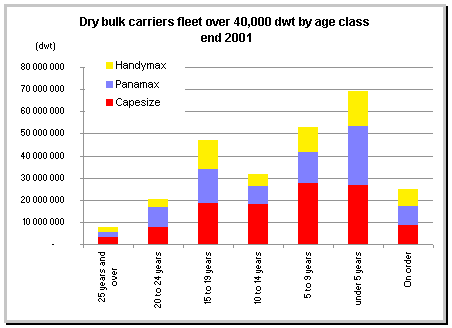
While the year 2000 was a colour print, 2001 was the negative. We should not however be surprised. The low prices for newbuildings, offered throughout 1999 and even in 2000 by Far Eastern shipyards led to a plethora of orders. Deliveries in the course of the year reached record levels of 6.6 million dwt for the Handysize (158 ships), 8.6 million dwt for the Panamax (116 ships), and 5.8 million dwt for the Capesize (34 ships), whilst at the same time the demolition figure was only 8.6 million dwt for all sizes.

bulk fleet

The freights
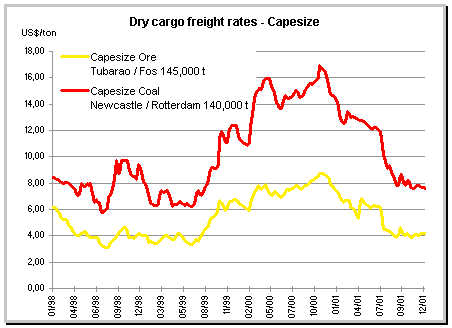
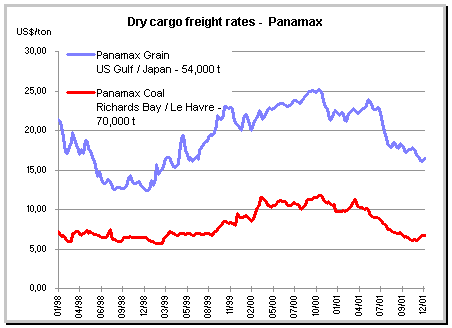
Already towards the end of 2000 a slowdown could be felt, the Baltic Dry Index closing at 1,600 points, below its maximum of 1,760 points reached in November, and expectations were clearly bearish. However against all likelihood, the market held up with mixed fortunes until the end of May when the number of ships delivered started to weigh heavily. Exports of Australian coal continued at a sustained rate to an extent that they were able to absorb in the initial months the deliveries of new Panamaxes.
 

Capesize freight rates

Panamax freight rates

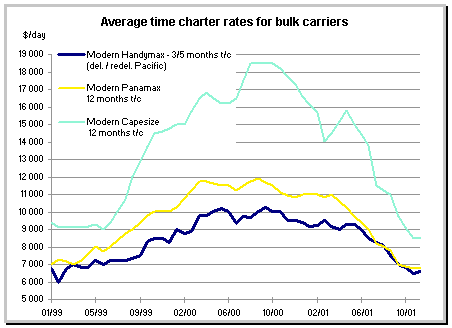
time charter rates

Demand
China started playing a more and more active role in this sector, overtaking South Africa in second place as largest coal exporter in the world. In the month of March alone, China exported nearly 10 million tons of coal. On the other hand, right from the start of the year, the demand of iron ore was in decline as compared to 2000 figures.

Although the Chapter 11 bankruptcy filing of a number of American steel companies of which Bethlehem Steel is the most noteworthy had a relatively small impact on the volume of ore transported by sea, the world economic environment dictates the rules for steel operators. According to the International Iron and Steel Institute, American production in 2001 has dropped back by 10.9 % as compared to 2000. Production in the E.U. was down by 2.7 % and the two heavyweights - France and Germany- were respectively down by 7.7 % and 3.4 %. At the same time India saw its production rise by 1.4 % and Japan's dropped by 3.4 %, but Asia registered a combined production of 332 million tons namely 4.0 % higher as compared to 2000. Once again China showed itself to be a major player with production reaching 141 million tons.

In 2001 world crude steel production totalled 823.9 million tons against 829.6 in 2000. Given the uncertainties in the international scene, the result is remarkable.

In the light of these figures one is tempted to conclude maybe a little hastily that the fall in freight rates was the result of an excess of tonnage on offer. This impression needs to be tempered somewhat. One of the highlights of this year was the merger, after that of British Steel and Hoogovens in 1999, of Usinor, Aceralia and Arbed to give birth to the number one steel company in the world with a production capacity of 45 million tons. Other steel companies are following as a merger between NKK and Kawasaki has been announced.

Whilst awaiting the outcome of the big merger, as well as doubts about the world demand, an important volume of contractual cargoes was not covered. Elsewhere the necessary adjustments to production and stocks were done at the last minute, on a step by step basis as the American economy slipped into recession, as Japan went deeper into its stagnation, and with the slowing-down of activity in Germany.

Finally, suffering from a double monetary constraint and the high freight rates of 2000, Japan and more especially China relocated their ore supplies from Australia at the expense of Brazil, thus reducing the volume in tonnes-miles transported. This situation prevailed right throughout 2001.

Elsewhere world demand for coal, despite rising regularly, has also seen some changes. As for ore, the Asian economies switched increasingly to Australian or Chinese coal, at the expense of South Africa and America. To illustrate this, in the first nine months of 2001 South Africa exported 5.9 million tons towards Asia as compared to 11.8 million tons for the same period in 2000.

Steel companies have not been the only ones to merge. The Australian mining company BHP and the South African Billiton have created one of the biggest world groups. In the cement industry the merger between Lafarge and Blue Circle has created the biggest world force in this sector with a production of 14 million tons. The German Heidelberg Cement with its purchase of Scancem are close on their heels. Grain companies got into the act with the purchase of the American Continental Grain by its compatriot Cargill in 1998. There are others who have been left aside in this consolidation as can be witnessed by the bankruptcy of the Swiss Andr'.

This process could not leave the shipowners totally indifferent. Their response came quickly as already in November 2001 the English ABC-Zodiac (ABC being already the product of a merger between P&O/Shougang) and the Belgian Bocimar announced their union, giving rise to the largest world Capesize owner with 80 ships (bearing in mind that the total Capesize fleet is 656 ships). The creation of very large Panamax or Handymax owners has not yet occurred, but it is true that these markets are much more dispersed.

We are therefore seeing a globalisation of the market with a small number of players but with increased influence. At the same time freight has become a commodity like others that one can buy and sell spot and term, giving birth to a new type of operator specialised in Capesize and/or Panamax in certain geographical zones or trades, such as SwissMarine or Enron (whose bankruptcy is only a blip in this evolution). The recent period when a contract was wide open, now seems something of the past. Nowadays for each charter, a dozen owners at least (luckily not always the same) propose variations of a theme. In this respect the growth in the market for buying and selling freight 'futures', provides a host of possibilities for hedging or making other alternative complex coverings.

The nearly instantaneous knowledge of ship's positions, the rapid circulation and the abundance of information paradoxically can complicate getting to the basic essentials. In order to remain in the game, it is now more than ever crucial to be part of the initiated few.

It is true that after an euphoric 2000, 2001 pales in comparison and the facts are there to back this up. However the rationalisation of the market, which began several years ago, has quickly accelerated and only a more positive economic situation will lead to improved freight markets.

The strong players of the future are formed in these times of crisis. Abundant, complex information requires specialists and also favours the development of new tools for its analysis and interpretation, and only the best armed will be able to survive.
 

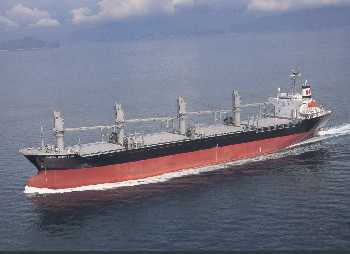
Bulk - Lake Maine Lake Maine
53,500 dwt, grab-fitted blt 2001by Imabari Shipbuilding, owned by Daio Kaiun Ltd (Japan) and on long time charter to Louis Dreyfus Armateurs (France)
The second-hand market
The Capesize second-hand market (80,000 dwt and over)
Last year we concluded our analysis by stating that it would be necessary to be prudent in 2001. In practice during the first quarter, the second-hand Capesize market continued to follow its downward trend already begun at the end of 2000.

Values then flattened out between March and April. They rose strongly up to the end of June when they literally collapsed until September, before steadying out at a level well below last year's. One only needs to look at the fluctuations in freight rates to find the reasons for these dramatic variations in prices.

As always the oldest ships were the most affected, whereas modern units tend to gain less in rising periods and lose less in falling ones.

There were some 26 sales for further trading (comprising 16 ships delivered from 1990 to 2001 and 10 built between 1981 and 1989.) Eight ships built between 1969 and 1978 were demolished this year amounting to 1,043,000 dwt, whilst 34 ships were delivered totalling 5,769,000 dwt.

For a fully classified ship and in good condition, the following values were applicable:

January 2001 December 2001
150,000 dwt built in 1995 about $26 / 27 m about $18 / 19 m
150,000 dwt built in 1990 about $19.5 / 20 m about $14 / 14.5 m

The consolidation in the market, reinforced by the setting up of the Cape International pool, does not prevent some strong crosswinds from blow-ing. Even if at year's end it seems to be calmer with a slight rise in the freight rates, the tendency for ship's values are declining as there are big uncertainties within the world's economies.

Construction prices should not rise next year which will have a direct repercussion on values of the most recent ships. In a poor market, it is always preferable to renew one's fleet by a newbuilding rather than by acquiring a modern second-hand ship with immediate availability.

The drop in the yen if it continues its path pursued at the end of the year, should incite Japanese sellers to be more flexible on asking prices for their ships financed locally. Values expressed in dollars should therefore suffer.

It will take a real and solid recovery in freight rates together with a renewed revival in growth prospects for second-hand values to be able to move up substantially. If the hopes are less muted at the end of the year, the reality remains stubbornly subdued even if in a thin market like the Capesize, changes in situations can sometimes be quicker than expected.

A glimmer of hope lies in the current modest orderbook. It represents about 9.3 % of the existing fleet. In 2002 only 25 ships should be delivered by shipbuilding yards for a total capacity of 4.2 million dwt.

The Panamax, Handymax & Handysize second-hand market
At the end of last year, we concluded our review for this segment of the sale & purchase bulk carrier market saying that players in the shipping industry could be "cautiously optimistic" for the near future only if an accelerated demolition activity is re-established coupled with positive industrial production and world trade figures, as this could be the only counter-balance to the massive number of deliveries both in the Panamax and Handymax segments. Let us look at what happened.

While deliveries took place, demolition was very slow to follow. The world economy did not continue with the same vigour, to say the least, Japan still cannot get out of its decade long recession, Far Eastern economies again walking a tightrope, the European Union slowing down and we now have an U.S. economy officially declared as being in recession since March this year, resulting in decreasing industrial production figures.

The effect of all the above was, as expected, a severe downward pressure on freight rates which, as one would anticipate, put ship values under pressure. Values softened across the board for all types and age segments of the dry bulk carrier market.

The youngest units too, experienced similar downward pressure on their values as the yards started to look for new business and were expected to become more aggressive, trying to secure new orders by offering attractive prices and terms.

All this was already happening when terrorists struck the U.S.A. on September 11th.

The uncertainty and speculation of what the future may bring, has become the number one preoccupation in everybody's mind which, in the shipping industry just as with every economic activity, translates itself into "inaction, do nothing, wait and see".

As one would anticipate, the above mentioned factors had a negative effect in the second-hand sale and purchase activity resulting in a lower number of successful transactions in all sizes. The number of reported sales during 2001, when compared to those for 2000, yield the following:

  • 26 % less Panamax sales (40 vessels in 2001 against 54 during 2000)
  • 31 % less Handymax sales (48 vessels in 2001 against 70 during 2000)
  • 23 % less Handy sales (77 vessels against 100 during 2000)

The Greek shipping community still had a leading role amongst buyers this year, although the number of reported bulk carrier sales to Greek buyers was half (59 ships) the one recorded in 2000 (120) and about one third of 1999's figure (158). The much publicised listing of shipowning companies on the Athens Stock Exchange did not happen this year although we understand that the legislation is in place. It may take a while before any company attempts such a listing and definitely not in an exchange, which after having gone through "a very drastic correction" has also been suffering from a long "bear" period.

Chinese buyers made their presence felt this year, by doubling the number of ships purchased, 19 ships as opposed to only nine during 2000. Similarly Norwegian buyers were reported to have purchased 17 vessels versus only seven in 2000.

As 2001 is drawing to an end, second-hand dry bulk carrier values continue their downward trend at a slower pace and many feel that we may be very near the bottom of this cycle. The result is an increase in the willingness of prospective buyers to inspect vessels, that are being offered for sale, even if most are of the opinion that prices may drop somewhat further before they pick up again. An apt example of this is the number of interested parties, 16, who inspected in Argentina (not on the Continent) earlier in December 2001 the 'Panagiotis A', a 1995-built 71,500 dwt Panamax bulker. She has been reported sold to Greek buyers, Angelicoussis, for a price in the region of $13.4 million. This is $100,000 more than the reported price for which the 'Maratha Memory', a 1997-built 72,000 dwt vessel, was sold only a week earlier! Is this a "blip"? Could it be the proof that we have indeed reached the bottom? Or, is it just because competition was fierce and not seen since 1999? We do believe that it is a mixture of all the above.

The Japanese yen has weakened further this year and at the end of 2001 has reached a three year low ($1 = yen127) if this trend continues, and according to exchange rate specialists, it may well do so considering the dire state of the Japanese economy, there may be a greater number of vessels being offered for sale from Japanese shipping companies. This together with the fact that prices will be considered as very near the bottom may well "kick start" second-hand sale & purchase activity.

Second-hand sale and purchase activity picks up as soon as there are healthy signs in the freight markets, but apart from world economy, international trade etc. the criterion of supply and demand is forever present in shipping.
 

The Panamax and Handymax scheduled deliveries for 2002 are at much lower levels (about 9 % and about 11 % of the active fleet respectively) than 12 months ago and the figures for Handysize scheduled deliveries remains very low (about 4 % of the active fleet).

Demolition this year picked up significantly and in terms of dwt removed from the market we note:

  • Panamax: about 2.2 million dwt were removed this year, 33 ships, representing an increase of about 400 % over the figures for 2000. However, this is only about 3.3 % of the active fleet.
  • Handymax: about 1.07 million dwt were removed this year, 25 ships, which is about the same figure as for 2000, i.e. no significant change. This is only about 2 % of the active fleet.
  • Handysize: about 2.5 million dwt were removed this year, 90 ships, which represents an increase of about 32 % over the 2000 figures. This is only about 3 % of the active fleet, but the scheduled deliveries for this size of vessels are only about 4 % of the fleet'

Panamax (55,000 to 75,000 dwt)

A total of 40 ships were reported sold during 2001 and some points worth noting are:

  • 52.5 % (21 vessels) built in the 90's of which eight were constructed after 1995.
  • 42.5 % (17) built in the 80's of which two were built in 1988-1989 the rest prior to 1985.
  • Only two vessels sold in 2001 were built in the 70's representing only 5 % of the sales.
  • More than half (24 vessels) involved en-bloc purchases ranging from two ships up to five or six vessels.
  • Some vessels had been reported "sold on subjects" several times during the course of the year, but had subsequently not been lifted and their owners re-marketed them until an eventual firm sale. This was true for younger ships as well as ships over 15 years old.
  • We noted several en-bloc sales of modern ships (less than five years old) involving long period time charter or bare boat back arrangements with sellers. This would appear to be the only way possible for a ship to be sold, in the view of the uncertainties of the freight markets, large orderbook, etc. One example is the sale of the 'Far Eastern Progress' and the 'Far Eastern Auspice' both of 72,000 dwt and 1996-built, at $15.6 million including a 10 year bare boat charter back to sellers, another one including a long period time charter back is that of 'Pacemperor' and 'Pacmonarch', both 74,000 dwt and 2000-built, sold for $22.0 / 23.0 million including a 12 year time charter back.
  • Transactions whereby owners were selling their entire Panamax fleet, some included long period employment and others were straight sales. The sale of the Lasco controlled Panamax fleet involved five vessels of which two were built in 1990 and three in 1994, the en bloc transaction included a 10 year bare boat charter back to the sellers and a purchase option. The en bloc charter-free sale of the Docenave Panamax fleet to Elcano of Spain, involved five vessels all 20 years old.
  • Some deals whereby the buyer would take a fairly modern vessel on bare boat charter with purchase options at predetermined prices during the course of the period and a purchase obligation at an agreed price at the end of the period: the 'Aspen', 'Hawthorn', 'Capella' and 'Polaris' all 1997-built and of 73,000 dwt were sold in pairs to two different buyers, but with the same reported structure, where the buyer takes the vessel on bare boat charter for five years at $5,250 per day with purchase option at the end of years three and four for $12.0 and 11.0 million respectively and a purchase obligation at the end of year five at $9.8 million.
  • The sale to Actinor Shipping of Norway of the 'Northern Venture' and 'Xinshi Hai' both 1995-built and of 68 000 dwt, for $15.0 million including a 12 year bare boat charter to Cosco and the en bloc sale of the A.P. Moller controlled 'Maersk Taikung', 'Maersk Tanjong' and 'Maersk Tukang' to Spar Shipping of Norway at $13.25 million each including a three year time charter back to the sellers including optional periods are also worth noting.

At the end of 2001 the value of a 10 year old Panamax bulk carrier stands at about $9.0 million, about 20 % less than what it was 12 months ago, whereas a 5 year old vessel of this size is worth about $13.0 / 13.5 million, about 16 / 17 % less than what it was valued at $16.0 / 16.2 million, in December 2000. In short, values have diminished back to their 1999 levels, if not somewhat lower.

Having said this, the reported sale at the end of December of the 'Panagiotis A' (mentioned earlier) would seem to indicate that values are no longer as low as mentioned just above, but this is only one sale. On the other hand, it takes very little (just one sale might prove to be enough') to change buyers' sentiment into deciding whether "the market has reached the bottom and that now is the time to buy", this could lead to a stampede, like the one experienced in the spring of 1999' To avoid this, our advice "in good faith but without guarantee" would be, if you are potential Panamax bulk carrier buyers, to buy now rather than later.
 

Among a total of 48 ships were reported sold during 2001:

  • 23 % (11 vessels) built in the 90's of which one was built in 1990 and the rest after 1994.
  • 54 % (26) built in the 80's of which 10 after 1985.
  • 23 % (11) built in the 70's.
  • As opposed to the Panamax sales, few en bloc deals were reported and even fewer involved long period charter back arrangements to the sellers.
  • Chinese buyers made their presence felt by inspecting and offering on 80's built ships calling to China.
  • This is the size of vessel that the former principal of Golden Ocean (the VLCC shipping company that was taken over by Frontline) chose to make his comeback in shipowning by purchasing the 'Bara', a 1998-built 42,000 dwt unit, from Louis Dreyfus Armateurs, for a reported price of $14.5 million including a four year time charter back to the sellers.

The value of a 10 year old Handymax bulk carrier 12 months ago was about $ 11.5 million, whereas at the end of 2001 it is estimated at about $8.75 / 9.0 million representing a 20 % drop in value, a five year old vessel of this size currently stands at about $12.5 million, about 19 % less than what it was worth ($15.5 million) in December 2000.

Our feeling is that for this size of ship we are very close to the bottom, however there have not been any recent end-of-the-year sales to indicate a reversal of this downward trend, but this may be just around the corner. So if one is considering investing in a Handymax bulk carrier, one should actively be inspecting such vessels in order to be ready to "move" once one feels "the time is right". It will not be too long'
 

A total of 77 vessels were reported sold during 2001:

  • 34 % (26 vessels) built in the 70's of which four were built prior to 1976.
  • 53 % (41) built in the 80's of which 18 units were built after 1985.
  • 13 % (10) built in the 90's, of which half were built in the second half of the decade.
  • Two of the 90's built ships sold, involved charterers exercising purchase options.
  • Very few en bloc deals were reported during 2001.
  • Far Eastern buyers proved to be more active during 2001 than in previous years, Greek buyers too were quite active and these two nationalities were reportedly involved in about 60 % of the total number of sales.

At the end of 2001 we estimate the value of a five year old Handysize bulk carrier at about $10.5 million, whereas 12 months earlier the same type of vessel was worth about $11.75 / 12.0 million. A 10 year old ship in December 2001 is estimated to be worth in the region of $7.0 / 7.25 million, whereas in December 2000 her value was closer to $8.25 / 8.5 million. The drop in value for the five and ten year old categories is about 10.6 % and 12 % respectively. It would seem that the drop was greatly decelerated due to the weak orderbook in this size. Again, the feeling is that values may have reached a bottom'

* * *

Concluding this year's review of the second hand bulk carrier market, the majority of the Panamax and Handymax deliveries is behind us and prices are at levels similar to those of early 1999. The world economy is experiencing a recession after many years of expansion, but economists are forecasting a recovery in the second half of 2002. The reasons evoked for this recovery include the level of interest rates, which are at record lows, generous financial stimulus in the U.S. (tax cuts, emergency spending following the 11th September attacks') amounting to about $375 billion and lower oil prices. The recovery may come more rapidly if all the above has a stronger impact. Confidence and sentiment will revive faster than expected.

Next year, we shall look back at what actually happened during 2002, but for the time being we are of the opinion that values have or are about to "bottom out" and therefore any investment in these sizes of bulk carriers should be undertaken sooner rather than later.
 

Bulk - Santa Christina Santa Christina 
25,378 dwt, blt 1996 by Imabari Shipbuilding, owned by Nissho Shipping (Tokyo) and on long time charter to Le Nickel SLN (Noum'a) Eramet Group


Shipping and Shipbuilding Markets in 2001

I N D E X

›››Archivo
DESDE LA PRIMERA PÁGINA
En el primer semestre de 2026, el tráfico de mercancías en el puerto de La Spezia creció un +2,0%.
La Spezia
In decisa crescita il traffico delle merci nei porti tunisini
Nel trimestre aprile-giugno è stato di 7,4 milioni di tonnellate (+8,8%)
El puerto de Koper registra un descenso del 5,6% en el tráfico de mercancías trimestral.
Liubliana
En junio el descenso fue del -18,9%.
La crisis del estrecho de Ormuz tiene un grave impacto en el desempeño financiero y operativo de DP World.
Dubái
El tráfico de contenedores en las terminales de CK Hutchison disminuyó un 1% en los primeros seis meses de 2026.
Hong Kong
Excluyendo las operaciones en Panamá, los volúmenes aumentaron un +5%.
En el primer semestre de 2026, el tráfico de mercancías en el puerto de Hamburgo disminuyó un -3,1%.
Hamburgo
Los contenedores ascendieron a cuatro millones de TEU (-3,7%).
Los ingresos de HMM aumentaron un 29,7% en el segundo trimestre.
Seúl
El beneficio neto disminuyó, lastrado por menores ingresos financieros.
El beneficio neto de Evergreen creció un 43,9% en el trimestre de abril a junio.
Taipéi
Maersk y Hapag-Lloyd se benefician de la recuperación del mercado de transporte marítimo de contenedores.
Copenhague/Hamburgo
La empresa danesa registró mejores resultados trimestrales que su socio alemán en Gemini Cooperation.
El tráfico de mercancías en los puertos de Génova y Savona-Vado se mantuvo estable en el segundo trimestre.
Génova
El número de pasajeros disminuye en ambos puertos.
En el segundo trimestre, Yang Ming registró un crecimiento del beneficio neto del +610,7%.
Keelung
Los ingresos se mantendrán estables en el primer semestre de 2026.
Dos barcos fueron atacados en el Golfo de Omán y frente a las costas de Yemen.
Southampton
Según los informes, un buque portacontenedores fue impactado por un helicóptero estadounidense.
La ruta marítima del norte no es en absoluto competitiva con la ruta marítima a través de Suez.
Basilea
Estudio realizado por dos investigadores de la Universidad Marítima Nacional de Mokpo.
Se espera que la subasta del 28 de agosto confirme el interés de Rheinmetall-MSC en el astillero rumano de Mangalia.
Bucarest
En el segundo trimestre, el tráfico marítimo en el Canal de Panamá creció un +9,6%, pero disminuyó significativamente en junio.
Panamá/Balboa
El ACP introduce nuevas limitaciones en el calado de los buques y no excluye reducciones en el número diario de tránsitos.
El contrato con Fincantieri para la construcción de un tercer crucero para Crystal ya está en vigor.
Mónaco/Miami
La entrega está prevista para 2034.
Más explosiones en la zona del estrecho de Ormuz
Southampton/Teherán
Las negociaciones entre Irán y Omán continúan, pero la reapertura al tránsito marítimo aún parece estar muy lejos.
Las asociaciones navieras reiteran su oposición a los peajes y aranceles obligatorios para el tránsito por el estrecho de Ormuz.
Dos barcos fueron atacados en el Mar Rojo.
Southampton/Saná/Nueva Delhi
El buque indio "Faize Noore Oliya" se hundió, los hutíes reivindican el ataque al "NCC Wafa"
Prologis presenta una oferta de 18.800 millones de dólares para comprar Segro.
San Francisco
Esta fusión creará un gigante europeo en la propiedad y gestión de inmuebles logísticos.
En el trimestre de abril a junio, ONE registró una mejora en su desempeño financiero.
Singapur
Durante ese período, la flota transportó casi 3,3 millones de contenedores (+2,9%).
Los ingresos de Global Port Holdings crecieron un 27% en el primer semestre de este año.
Estanbul
El margen operativo bruto aumentó un 22%.
En el segundo trimestre, el tráfico marítimo en el Canal de Suez aumentó un 16,5%.
El Cairo
En el primer semestre de 2026, el crecimiento fue del +14,0%.
En el segundo trimestre de 2026, el estrecho del Bósforo fue cruzado por 10.082 buques (+0,5%).
Ankara
En la primera mitad del año, el tráfico marítimo disminuyó un -0,5%.
Un informe de la Asamblea Nacional francesa destaca el declive competitivo del ecosistema portuario del Estado.
París
En el primer semestre de 2026, el segmento de transporte de mercancías de FS registró una caída del -2,7% en los ingresos operativos.
Roma
Los volúmenes de tráfico ascendieron a aproximadamente 8.800 millones de toneladas-km (-7,3%).
El Observatorio del RCDE UE confirma que el sistema de comercio de derechos de emisión está teniendo un impacto negativo en los puertos de la UE.
Madrid
Las correcciones propuestas consisten en la ampliación de los criterios para la designación de puertos de transbordo de contenedores vecinos y la aplicación de un factor de reducción porcentual al volumen de emisiones de CO2 procedentes de los buques.
Los ingresos de Norwegian Cruise Line Holdings aumentaron un 4,9% en el segundo trimestre de 2026.
Miami
Nuevo registro histórico de pasajeros que embarcaron en los barcos de la flota.
Los ingresos semestrales de Fincantieri se mantienen estables.
Trieste
El beneficio neto aumentó un 191,4%. Los nuevos pedidos disminuyeron un 58,5%.
En el segundo trimestre, el tráfico de mercancías en los puertos albaneses creció un +8,9%.
Tirana
El grupo de expertos estadounidense Open Markets Institute propone la creación de una empresa pública de transporte marítimo de contenedores.
Washington
Rao: Hoy Estados Unidos depende de un cártel de seis compañías navieras extranjeras.
Royal Caribbean registra ingresos récord para el trimestre de abril a junio.
Miami
Nuevo récord histórico de facturación en el primer semestre de 2026.
En el segundo trimestre, los ingresos del grupo CMA CGM aumentaron un +19,2%.
Marsella/Nueva York/Los Ángeles
Se ha completado la empresa conjunta entre United Ports y Stonepeak.
PortXchange: Para reducir de inmediato las emisiones del transporte marítimo, debemos centrarnos en los puertos.
Róterdam
En el puerto de Trieste, el tráfico de carga a granel está aumentando y el de mercancías diversas está disminuyendo.
Trieste
En los primeros seis meses de 2026, el tráfico en Monfalcone disminuyó un 24,9%.
Fermerci, la producción de transporte ferroviario de mercancías en Italia podría caer este año a los niveles de 2015.
Roma
Mapa: Nos encontramos ante datos que superan todas las expectativas.
El gobierno indio aprueba 7.200 millones de dólares en ayuda para la construcción naval nacional.
Nueva Delhi
Estrategia adoptada hoy para revitalizar el sector.
Dos astilleros indios incluidos en la nueva lista de la UE de instalaciones de reciclaje de buques propuesta por la Comisión.
Bruselas/Washington
Satisfacción de ECSA y del Consejo Mundial de Transporte Marítimo
Hyundai y Siemens firman un acuerdo para la construcción naval impulsada por IA.
Washington
El objetivo es un sistema de fabricación autónomo en el que todos los procesos, incluidos el diseño, la producción, la logística, la inspección y las pruebas, estén conectados digitalmente.
La Unión Africana condena los ataques contra petroleros en el Mar Rojo, reivindicados por los hutíes.
Addis Abeba
Youssouf: La seguridad de las rutas marítimas del Mar Rojo es de vital importancia estratégica para África.
En Génova, Fincantieri entregó el nuevo crucero Explora III a Explora Journeys.
Génova
"Explora IV" y "Explora V" llegarán en 2027, y "Explora VI" en 2028.
En el segundo trimestre de 2019, el volumen de carga a granel aumentó, mientras que el volumen de carga general disminuyó.
Róterdam
En el primer semestre de 2026 se movilizaron 212 millones de toneladas de mercancías (+0,4%).
En el segundo trimestre, los puertos españoles gestionaron 144,8 millones de toneladas de mercancías (+2,9%).
Madrid
Récord para mercancías y contenedores convencionales (en TEU)
La Comisión Europea abre una investigación exhaustiva sobre la fusión de Saipem y Subsea7.
Bruselas
Bruselas considera que los efectos de la operación son particularmente críticos, especialmente en el mercado SURF.
Medlog (Grupo MSC) adquiere una participación en Interporto Bolonia
Bolonia
Caliandro: Desarrollo industrial que nos permitirá alcanzar nuestros objetivos de tráfico de mercancías por ferrocarril.
La Autoridad Portuaria de Barcelona adquirirá el 40% de la Terminal Intermodal de Navarra.
Barcelona
El 60% restante del capital permanecerá en manos de Hutchison Ports Best.
En la primera mitad de este año, los puertos marítimos chinos gestionaron 5.870 millones de toneladas de carga (+3,0%).
Pekín
Nuevos récords históricos de tráfico de contenedores semestral y trimestral.
Puertos de Italia: La cuestión de las competencias divide la reforma.
Roma
En la conferencia Confitarma, Rixi defiende la nueva sala de control nacional, mientras que expertos y operadores piden claridad sobre las relaciones con los proveedores de servicios publicitarios (AdSPs) y sobre los recursos de la nueva empresa.
El sector marítimo está dividido entre el apoyo cauteloso y las críticas a la revisión del RCDE UE.
Bruselas/Washington/
Copenhague/El Pireo/Róterdam
Otro ataque más contra un barco en el estrecho de Ormuz.
Southampton
Un buque cisterna fue alcanzado y abandonado por su tripulación.
La ECSA considera que la revisión propuesta del RCDE UE es un primer paso, pero deberían seguir muchos otros.
Bruselas
Raptis: Es una buena idea destinar los ingresos del sistema, tanto a nivel de la UE como nacional, a apoyar los combustibles sostenibles.
ESPO: No a la reducción del umbral de aplicación del RCDE UE de 5.000 a 400 toneladas de registro bruto.
Bruselas
Agradecimiento por las medidas destinadas a reducir las escalas de buques evasivas.
T&E acoge con satisfacción algunas nuevas propuestas de Bruselas para el RCDE marítimo de la UE.
Bruselas
La asociación se muestra más crítica con las medidas estudiadas por la Comisión Europea para el sector de la aviación.
Para Assarmatori, la propuesta de la Comisión sobre el RCDE UE es tímida, mientras que se esperaban medidas más audaces.
Bruselas
RCDE marítimo de la UE: La Comisión Europea acepta parcialmente las solicitudes de los armadores.
Bruselas
Un nuevo fondo de 110 millones de euros para combustibles limpios, exenciones no permanentes prorrogadas hasta 2035, un mecanismo de deducción de la OMI y medidas enérgicas contra los puertos de transbordo "evasivos".
Otro barco fue alcanzado por un proyectil en el estrecho de Ormuz.
Southampton/Tampa
Infantes de Marina estadounidenses realizaron una inspección a bordo de un petrolero autorizado.
Puerto de Gioia Tauro: Primera conexión de un gran buque portacontenedores al sistema de conexión a la red eléctrica.
Gioia Tauro
El buque "MSC Mirja" tenía una potencia total de aproximadamente siete MW.
En el segundo trimestre de 2026, el tráfico de mercancías en el puerto de Amberes-Brujas disminuyó un -2%.
Amberes
Se recuperaron volúmenes de carga seca a granel y aumentó el material rodante. Otros sectores experimentaron descensos.
COSCO Shipping Ports establece nuevos récords trimestrales y semestrales de tráfico de contenedores.
Hong Kong
Las fuerzas estadounidenses atacaron el buque VLCC Belma , que navegaba hacia la isla iraní de Kharg.
Tampa
Está operada por la empresa emiratí Max Maritime Solutions, que está sujeta a sanciones estadounidenses.
En mayo, el tráfico de mercancías en el puerto de Génova se mantuvo estable, mientras que en Savona-Vado disminuyó.
Génova
En los primeros cinco meses de 2026, el volumen de contenedores ascendió a 1.199.914 TEU (-2,8%), de los cuales 999.228 (-1,4%) y 200.686 (-9,2%) fueron gestionados por los dos puertos respectivamente.
La empresa turca GIH adquiere las participaciones de Royal Caribbean en las terminales de cruceros de Kusadasi y Lisboa.
Estanbul
Las participaciones accionariales aumentaron al 99,99% y al 60% respectivamente.
En el primer semestre del año, los puertos rusos gestionaron 451,5 millones de toneladas de carga (+5,8%).
San Petersburgo
Tráfico récord en el segundo trimestre
Trump da marcha atrás en el impuesto del 20% a los barcos que transitan por el estrecho de Ormuz bajo protección estadounidense.
Washington/Southampton/Róterdam
Mientras tanto, otro buque cisterna, el "Stolt Magnesium", fue alcanzado por un misil cerca de Omán.
Los armadores europeos solicitan excepciones permanentes al RCDE marítimo de la UE después de 2030.
Bruselas
Exenciones para conexiones con islas y regiones ultraperiféricas, para buques de clase polar, para obligaciones de servicio público transnacional y para actividades de búsqueda y salvamento.
El sector ferroviario reclama que se reconozca su contribución a la descarbonización en la revisión del RCDE UE.
Bruselas
Dos superpetroleros operados por la empresa emiratí ADNOC fueron atacados en el estrecho de Ormuz.
Abu Dabi/Tampa
El Comando Central de Estados Unidos anuncia el restablecimiento del bloqueo al tráfico marítimo que entra y sale de los puertos iraníes.
Trump anuncia un impuesto sobre las mercancías que transitan por el estrecho de Ormuz, protegido por Estados Unidos.
Washington/Portsmouth
Se prevé que sea igual al 20% del valor de las cargas transportadas.
El tráfico marítimo semestral en los estrechos de Malaca y Singapur aumentó un +3,7%.
Puerto Klang
Solo en el segundo trimestre de este año se registró una disminución del -0,5%.
En mayo, el tráfico marítimo en el Canal de Suez aumentó un +15,0%.
El Cairo
En los primeros cinco meses de 2026, 5.696 buques pasaron por el puerto (+12,7%).
OOCL registra un fuerte aumento en los contenedores transportados por su flota.
Hong Kong
En el trimestre de abril a junio, los ingresos generados por esta actividad crecieron un +19,8%.
En el estrecho de Ormuz, un buque portacontenedores fue atacado cerca de la costa de Omán.
Mascate/Portsmouth/Nueva Delhi/Tampa
Incendio a bordo. Un miembro de la tripulación desaparecido. Otros 23 marineros rescatados.
Mejora el rendimiento financiero trimestral de la empresa danesa DFDS.
Copenhague
En el trimestre de abril a junio, el material rodante transportado por la flota aumentó un 1,1%. El número de pasajeros disminuyó un 8,9%.
El tráfico de contenedores en las terminales de HHLA disminuyó un -8,0% en el segundo trimestre.
Hamburgo
Los ingresos aumentaron un 2,5%. Los costes operativos aumentaron un 5,7%.
La Autoridad Portuaria de Livorno crea un grupo de trabajo interno para el proyecto Darsena Europa.
Livorno
El objetivo es garantizar una coordinación unificada con la estructura de comisionados que sigue el proyecto.
Costa Cruceros anuncia un cambio en la dirección de la región de las Américas.
Génova
Jorge Serrano Martín de Vidales reemplazará a Darío Rústico
MSC instala el sistema de limpieza proactiva del casco de Jotun en el MSC Daniela.
Sandefjord
Combina tecnología avanzada antiincrustante con inspección y limpieza robótica.
Wan Hai Lines reporta un aumento del 965,6% en sus ganancias trimestrales.
Taipéi
La empresa encarga seis nuevos buques portacontenedores con capacidad para 11.000 TEU.
En el segundo trimestre, el tráfico de carga en los puertos montenegrinos disminuyó un -5,8%.
Podgorica
El volumen de carga con origen y destino en Italia disminuyó un 40,6%.
El Grupo Grimaldi ha recibido el Grande Pacifico.
Nápoles
El buque es el primero de cinco nuevos buques PCTC gemelos con una capacidad de 9.800 unidades de transporte marítimo de pasajeros (CEU).
En 2025, los ingresos del grupo Fratelli Cosulich ascendieron a 1.900 millones de euros (-11,5%).
Génova
Beneficio neto de 20,0 millones de euros (-3,0%)
Ha fallecido Maurizio Longo, secretario general de Trasportounito.
Roma
Falleció en Roma tras una larga enfermedad.
Terminal Investment Limited abandona la adquisición de Tercat.
Bruselas
Preveía el control conjunto de la terminal de Barcelona con Hutchison Ports.
Se han finalizado los trabajos para activar el suministro eléctrico en frío en la terminal de cruceros de Porto Corsini en Ravenna.
Rávena
Aceleración del proceso de reurbanización de la antigua zona CIVAM en el puerto de Vibo Valentia Marina.
Vibo Valentia
La zona se transformará en nuevos patios para logística comercial.
Maersk Group vende Maersk Training y Maersk H2S Safety Services.
Copenhague
Serán vendidas a US Open Gate Capital, especializada en operaciones de escisión industrial.
En el trimestre de abril a junio, el puerto de Venecia gestionó 6,3 millones de toneladas de mercancías (-1,2%).
Venecia
El número de pasajeros de cruceros disminuyó un -15,3%.
En el segundo trimestre, el tráfico de mercancías en el puerto de Ravenna registró un fuerte aumento del +10,9%.
Rávena
En los primeros seis meses de 2026 el aumento fue del +5,9%.
DP World adquiere seis centros logísticos de GXO en el Reino Unido.
Dubái
186.000 metros cuadrados y 2.000 empleados cambian de manos: esta es la transferencia impuesta por la Autoridad Antimonopolio británica por la adquisición de Wincanton.
DHL se dispara en el segundo trimestre, pero no en todas partes.
Bonn
Ingresos y EBIT de dos dígitos. Express tuvo un buen desempeño, mientras que Supply Chain y Post & Parcel Germany no lo tuvieron tan bien.
Global Ship Lease registra ingresos récord trimestrales y semestrales.
Atenas
El aumento de los costes repercute en los beneficios.
DP World construirá un centro logístico con temperatura controlada en el puerto de Amberes.
Dubái/Kallo
GNV activará el sábado un tercer servicio marítimo a Argelia.
Génova
La línea Civitavecchia-Annaba complementará las rutas existentes desde Sète a Argel y Bejaia.
Danaos Corporation registra un crecimiento trimestral de sus ingresos del 4,7%.
Atenas
El segmento de buques portacontenedores se mantiene estable. Los graneleros siguen contribuyendo.
Un buque granelero alcanzado por un proyectil en el estrecho de Ormuz.
Southampton/Londres
Según los informes, un miembro de la tripulación está desaparecido.
Este año se espera la llegada de 800.000 pasajeros de cruceros a Messina.
Messina
Los pasajeros generan un gasto directo de casi 16 millones de euros en la ciudad.
El tráfico de contenedores en el puerto de Nueva York creció un 1,6% en el segundo trimestre.
Nueva York
En los primeros seis meses de 2026, se gestionaron 4,43 millones de TEU (+0,2%).
HZ Cargo y Railtrans forman una empresa conjunta para el transporte intermodal.
Zagreb
El objetivo es activar un tráfico de más de 500 mil toneladas entre los puertos de Croacia y los mercados de Europa Central.
ICTSI registra un beneficio neto récord de 363 millones de dólares (+24,2%) en el segundo trimestre.
Manila
Otro buque de GasLog sufrió un accidente al salir del Golfo Pérsico.
El Pireo/Southampton
Daños en la sala de máquinas
Finnlines registra ingresos trimestrales récord.
Helsinki
En el periodo de abril a junio, el beneficio neto fue de 42,9 millones de euros (+64,7%).
Spinelli Group aprueba su informe de sostenibilidad de 2025.
Génova
El valor de la producción creció un 5%. Las nuevas contrataciones aumentaron un 48%.
Fabrizio Marilli será el nuevo secretario general de la Autoridad Portuaria del Mar Adriático Central.
Ancona
El Comité de Gestión ha aprobado el ajuste presupuestario de la institución.
La Autoridad Portuaria del Mar de Liguria Occidental ha adoptado el Plan Portuario 2026-2028.
Génova
Las proyecciones para 2028 indican un aumento de aproximadamente 150 empleados en los puertos del sistema.
La Autoridad Portuaria del Sur del Mar Tirreno y Jónico ha aprobado el ajuste presupuestario.
Gioia Tauro
Registra mayores ingresos y mayores gastos de 1,69 millones de euros.
Un millón y medio de euros para formación en puertos toscanos.
Livorno
La Autoridad Portuaria del Tirreno Septentrional ha presentado su plan de formación para el periodo 2026-2028.
Terminali Italia gestionará la terminal intermodal de Orte a partir del próximo año.
Roma
Tiene aproximadamente 96.000 metros cuadrados de patios y tres pistas.
Italia y Túnez firman un acuerdo de colaboración en el sector del transporte y la logística.
Roma
Otro buque Bahri, propiedad de Arabia Saudí, fue atacado por los hutíes en el Mar Rojo.
Southampton/Saná/Riad
El portavoz de los militantes yemeníes reivindicó la autoría del ataque contra el buque cisterna de productos químicos "NCC Ghazal".
Hoy se ha logrado completar la perforación de los dos túneles principales del Túnel de Base del Brenner.
Bolzano
Las dos zonas de construcción están conectadas aproximadamente a 1.400 metros por debajo del paso del Brenner.
Los ingresos de UPS aumentaron un 7,6% en el segundo trimestre.
Atlanta
El beneficio neto ascendió a 604 millones de dólares (-52,9%).
En 2025, los ingresos de la empresa de logística italiana Nord Ovest crecieron un +13,6%.
Cuña
El beneficio neto disminuyó un 8,3%.
El tráfico de mercancías trimestral aumentó en los puertos de Algeciras y Barcelona. Valencia experimentó un descenso.
Algeciras/Barcelona/
Valencia
Aumento de contenedores en el puerto catalán
Fincantieri firma un acuerdo con los socios de reinversión de NextGeo.
Trieste
Esta operación forma parte de la estrategia de desarrollo en el segmento del buceo.
Se ha adoptado la actualización del DPSS de los puertos de Cerdeña.
Cagliari
Resolución del Comité de Gestión de la Autoridad del Sistema Portuario
ICTSI adquiere las terminales de carga a granel ATU12 y ATU18 en el puerto brasileño de Aratu.
São Paulo/Manila
Serán vendidos por SIMPAR por aproximadamente 355 millones de dólares.
PROXIMAS SALIDAS
Visual Sailing List
Salida
Destinación:
- orden alfabético
- nación
- aréa geogràfica
Konecranes informa de un descenso en su rendimiento financiero trimestral a medida que aumentan los pedidos.
Helsinki
El valor de los pedidos relacionados con equipos portuarios creció un 17%.
Catorce regiones están a favor y cinco en contra del proyecto de ley de reforma de la gobernanza portuaria.
Roma
Rixi: Continuemos ahora con el proceso institucional con el objetivo de lograr una reforma equilibrada.
Las ventas netas de Kuehne+Nagel aumentaron un 8% en el segundo trimestre.
Schindellegi
El rendimiento mejoró notablemente en el segmento de carga aérea.
El equipo directivo de Assagent ha sido renovado.
Génova
La composición del comité ejecutivo y los presidentes de las comisiones
DP World firma un acuerdo preliminar para construir dos terminales en el puerto de Fujairah.
Dubái
VIO - Renovación del Consejo de Administración del Interpuerto de Vado Ligure
Génova
Pierangelo Olivieri ha sido nombrado presidente
La facturación de Kalmar aumentó un 14% en el segundo trimestre.
Helsinki
El valor de los nuevos pedidos se mantiene estable.
Saipem gana un nuevo contrato de perforación en alta mar frente a las costas de Costa de Marfil.
Milán
Fue otorgado por Eni Costa de Marfil.
El rendimiento trimestral de DSV continúa creciendo, impulsado por la adquisición de Schenker.
Hedehusene
En el periodo comprendido entre abril y junio de 2026 se registró un beneficio neto de 2.600 millones de coronas danesas (+11,5%).
Falteri (Federlogistica) ha sido incorporada al Consejo de Administración de la Asociación Europea de Logística.
Génova
Protocolo de colaboración internacional sobre logística integrada con ACLI Terra
El Consejo de Cooperación del Golfo insta a la comunidad internacional a proteger el transporte marítimo contra las amenazas de los hutíes.
Riad
Reacciones al anuncio de un embargo marítimo contra Arabia Saudita.
Fincantieri firma un acuerdo en Qatar para la gestión operativa del Centro de Entrenamiento y Simulación.
Trieste
El centro está destinado a la formación del personal naval de la Armada de Qatar.
Wärtsilä registra un fuerte aumento en el valor de los nuevos pedidos en el segundo trimestre.
Helsinki
La facturación neta disminuyó un -2%.
Más de 770 kilos de cocaína incautados en el puerto de Vado Ligure.
Savona
Una vez comercializada, la droga habría garantizado a las organizaciones criminales beneficios de 250 millones de euros.
Yang Ming encarga a Hanwha Ocean la construcción de seis buques portacontenedores de doble combustible con capacidad para 13.000 TEU.
Keelung
Contrato valorado en más de 1.200 millones de dólares.
El número de víctimas de los ataques a barcos en el Mar Negro se agrava.
Odesa
Diez muertos a bordo de un barco que salía del puerto de Odessa.
Hoy se ha producido un nuevo ataque contra un barco en el estrecho de Ormuz.
Southampton
El buque cisterna Kavomaleas, de la empresa griega Dynacom Tankers Management, se incendió.
Confitarma se muestra decepcionada por la propuesta de la Comisión de revisar el RCDE UE.
Roma
Zanetti: La ausencia más notable es la competitividad del sector naviero italiano y europeo.
ALIS: Las propuestas de la Comisión sobre el RCDE UE son positivas, pero persisten problemas importantes.
Roma
El MIT adopta directrices para el planchado en frío.
Roma
El objetivo es garantizar criterios claros, uniformes y transparentes para todas las autoridades del sistema portuario.
En el primer semestre del año, el tráfico de cruceros en las terminales portuarias de GPH creció un +10,1%.
Estanbul
Solo en el segundo trimestre el aumento fue del +2,8%.
La Autoridad Portuaria de Liguria Occidental aprueba la actualización del presupuesto para 2026.
Génova
Assiterminal aclara sus dudas sobre las responsabilidades asignadas a Porti d'Italia Spa.
Génova
ABB compra British Rotork.
Zúrich/Londres
La empresa, con sede en Bath, está especializada en control de flujo y automatización industrial.
La Autoridad Portuaria del Adriático Central refinancia 100 millones de euros procedentes del Decreto de Infraestructuras.
Ancona
Los fondos se destinan a siete intervenciones estratégicas del sistema portuario.
El tráfico de contenedores en el puerto de Los Ángeles aumentó un 3,4% en el primer semestre de 2026.
Los Ángeles
En el segundo trimestre, el crecimiento fue del +11,5%.
La OMI y la ITF piden que cesen los ataques contra los marineros y los trabajadores del transporte.
Londres
Resurgimiento de incidentes en la región del Mar Negro, el Mar de Azov y el Estrecho de Ormuz.
El tráfico de contenedores en el puerto de Hong Kong creció un 0,2% en el segundo trimestre de 2026.
Hong Kong
En junio se registró un aumento del +6,5%.
PUERTOS
Puertos italianos:
Ancona Génova Rávena
Augusta Gioia Tauro Salerno
Bari La Spezia Savona
Brindisi Liorna Taranto
Cagliari Nápoli Trapani
Carrara Palermo Trieste
Civitavecchia Piombino Venecia
Interpuertos Italianos: lista Puertos del mundo: Mapa
BANCO DE DATOS
Armadores Reparadores navales y astilleros
Expedicionarios Abastecedores de bordo
Agencias marítimas Transportistas
MEETINGS
La conferencia "Acuerdo UE-Mercosur: El papel de la economía marítima" se celebrará en Génova el 1 de julio.
Génova
Está organizado por la Fundación Casa América ETS y la Autoridad Portuaria de Liguria Occidental.
La asamblea de los Federagentes se celebrará en Civitavecchia el 3 de julio.
Roma
Pessina: No hablaremos de regulaciones, relaciones comunitarias ni de la búsqueda de teorías y burocracia, sino de los desafíos de la infraestructura portuaria italiana.
››› Archivo
RESEÑA DE LA PRENSA
Empire buys back: After Tata, Adani can rewrite India's colonial past
(The Economic Times)
Govt does not interfere in port management appointments - Loke
(Bernama)
››› Reseña de la Prensa Archivo
FORUM de lo shipping y
de la logística
Intervento del presidente Tomaso Cognolato
Roma, 19 giugno 2025
››› Archivo
Uiltrasporti se opone firmemente a la creación de Porti d'Italia Spa.
Roma
Verzari y Gulli: los proveedores de servicios publicitarios deben estar coordinados por un organismo público que pueda proteger a los trabajadores portuarios.
CMPort establece nuevos récords mensuales, trimestrales y semestrales de tráfico de contenedores.
Hong Kong
En el primer semestre de 2026, se trasladaron 78,3 millones (+4,6%).
En el primer semestre de este año, el puerto de Singapur gestionó 22,7 millones de contenedores (+4,7%).
Singapur
Récord histórico en ventas de búnkeres durante el primer semestre
El tráfico de contenedores en el puerto de Long Beach aumentó un 10,3% en el segundo trimestre.
Playa larga
En el primer semestre de 2026 se registró un crecimiento del +1,7%.
Se ha nombrado al nuevo consejo de administración de Ferrovie dello Stato Italiane.
Roma
Tommaso Tanzilli confirmado como presidente. Gianpiero Strisciuglio es el nuevo director general.
Puerto de Gioia Tauro: se lanza la licitación para la finalización de las actividades de dragado.
Gioia Tauro
La duración prevista del contrato es de 60 días.
En el primer semestre de 2026, el tráfico de carga en los puertos turcos fue de 279,1 millones de toneladas (+1,5%).
Ankara
Los envíos con destino a Italia ascendieron a 23,4 millones de toneladas (-2,5%).
El primer corte de acero del crucero Carnival Destiny .
Monfalcone
Fincantieri y Carnival celebran el trigésimo aniversario de su colaboración.
NatPower Marine adquiere Aqua superPower para acelerar la electrificación de puertos y marinas.
Monje
Gestiona la mayor red internacional de puntos de recarga eléctrica de Europa.
Se ha creado el Observatorio Europeo de Logística.
Bruselas
El objetivo es reforzar la competitividad, la resiliencia y la sostenibilidad de la logística europea.
Acuerdo alcanzado en Mimit con JSW para relanzar la acería de Piombino.
Roma/Livorno
Gariglio: Fortalecimiento de la integración entre los muelles portuarios y las zonas industriales.
Acuerdo entre Fincantieri y los astilleros croatas Brodotrogir Cruise e Iskra Shipyard.
Trieste
Iniciativa enmarcada en el programa de dos corbetas promovido por el Ministerio de Defensa croata.
Evergreen, Yang Ming y WHL vuelven a registrar un crecimiento trimestral de sus ingresos.
Keelung/Taipéi
Ya han pasado cuatro trimestres consecutivos de declive.
Proyecto para una conexión ferroviaria directa entre el puerto de Gioia Tauro y el Interporto D'Abruzzo.
Pescara
Fraude fiscal en materia laboral en el sector logístico
Milán
Se han incautado 28 millones de euros a cuatro empresas milanesas.
PSA Genova Pra', el estado de agitación se ha levantado tras la finalización satisfactoria del procedimiento de enfriamiento.
Génova
- Via Raffaele Paolucci 17r/19r - 16129 Génova - ITALIA
tel.: +39.010.2462122, fax: +39.010.2516768, e-mail
Partita iva: 03532950106
Registrazione Stampa 33/96 Tribunale di Genova
Director: Bruno Bellio
Prohibida la reproducción, total o parcial, sin el explicito consentimento del editor
Búsqueda en inforMARE Presentación
Feed RSS Espacios publicitarios

inforMARE en Pdf
Móvil