
FOREWORD BY THE PRESIDENT
- The year 2006 showed again a healthy growth of world trade with,
as a result, an increase of 5.5 % in tonne-miles of maritime
transport - the main carrier of transport international trade.
European shipping maintained its key role in global transport with a
substantial share of 41 % of the global merchant fleet. For
2007/2008 a slightly lower increase in global merchandise trade of 6
% as against 8 % in 2006 is expected. Demand for shipping services
will be positive; however, high fuel costs, imbalances, particularly
in container services and congestion, together with the effects of
tonnage oversupply in some sectors, may have a negative influence.
-
- The key points that are on the agenda of the EU Institutions are
summarised in this annual report covering 2006/2007.
-
- A FUTURE MARITIME POLICY FOR THE UNION
-
- ECSA deeply appreciates the unique consultation process that has
been followed on a future maritime policy and supports a holistic
approach with, as basic points: ensuring the potential for growth in
Europe through adequate transport capacity, ensuring a stable and
competitive environment for EU shipping, keeping regulations global,
supporting a positive development of shipping in the EU, and, last
but not least, taking a proactive environmental approach. These key
points need to be part of the philosophy of the future maritime
policy and we look forward to a continued exchange of views with the
European Institutions and stakeholders in this respect.
-
- It is also essential for ECSA to continue to promote the image
of shipping to convince the public and the political world of what
we, shipowners, all know, i.e shipping is the safest and most
effective, economical, and environment friendly of all modes of
transport.
-
- EUROPEAN TRANSPORT POLICY
-
- A future European Port Policy was also subject to a useful and
constructive consultation process. ECSA and many other stakeholders
stressed the necessity of extension of port capacity and hinterland
connections as a priority item. At the same time we should get the
best from the existing capacity by increasing efficiency.This is of
particular importance for the ongoing promotion of short sea
services and the further development of motorways of the sea.
-
- ENVIRONMENT
-
- Care for the environment has become a key item on everybody’s
agenda. In particular air emissions and climate change are already
today subject to intensive discussions, in the EU as well as
globally. Shipping is by far the most environment friendly transport
mode with a good performance on emissions. However, this is not a
reason for complacency. The industry is and will be increasingly
proactive in looking at different options to further reduce air
emissions on all fronts. It has become clear that a holistic
approach is the only way forward since measures addressing one
emission may have an influence on another.
-
- Shipping being a global industry it goes without saying that a
global solution to air emissions is the sole way forward. The
shipping industry is fully committed to further international
reduction of air emissions in the shortest possible timeframe
through the IMO. It is essential that, following the analysis of all
the various options on the table to reduce air emissions (MARPOL
Annex VI) by the cross government/industry scientific group,
tangible measures are agreed upon by the IMO in 2008.
-
- While shipping only accounts for some 2% of global greenhouse
gas emissions, the industry is currently examining the options in
this regard. By definition, measures to reduce global warming need
to be taken at the global level to be effective.
-
- MARITIME SAFETY
-
- ECSA appreciates that the Council of Transport Ministers has
reached in June a political agreement on three proposals of the
Safety Package III notably dealing with Port State Control, Vessel
Traffic Monitoring including places of refuge and Accident
Investigation. The Council has rightly left the controversial
proposals aside, particularly the proposal on Civil Liability, which
would seriously distort the global maritime liability regime as well
as the insurance and compensation system. ECSA, instead, strongly
advocates the ratification and application of the relevant
international Conventions notably LLMC 1996, the HNS Convention and
Bunker Oil Spills Convention, which will give a proper liability and
compensation system on a global basis.
-
- The European Maritime Safety Agency (EMSA) is increasingly
playing an important role in the areas of safety and environment.The
Board of ECSA had very useful exchange of views with EMSA at its
meeting in Lisbon in June 2007. There is a clear commitment to
working closely with EMSA in the future.
-
- A HECTIC AGENDA AHEAD
-
- Taking over the Presidency of ECSA from Lennart Simonsson, I
would like again to thank and congratulate him for leading ECSA in
such an active and efficient way. The coming period will be hectic
with quite some policy issues on the table. Already in October we
will have Commission papers on a future maritime policy, European
ports policy, logistics, and on motorways of the sea.We will also
have a further consultation process on future guidelines for the
application of EU Competition Rules on maritime transport. The
social partners ECSA/ETF hope to reach an agreement towards the end
of the year on transferring part of the MLC Convention into EU law.
As I mentioned above, the environment and in particular ship
emissions will rightly be a key item on our agenda, in Europe as
well as globally.
-
- I look forward to a continued cooperation with the European
Institutions: the Commission, Member States and the European
Parliament.
-

- I know that the ECSA membership will support me in my
challenging task.
-
- Philippe Louis-Dreyfus
EUROPEAN SHIPPING IN A GLOBAL MARKET
- Economic and trade developments show progress
-
- The year 2006 again showed a healthy expansion of world trade in
real terms and in dollar value by 15% to $11.76 trillion. Global GDP
accelerated by 3.7%. The on average high oil prices well into 2007
have not had a serious impact on merchandise trade or on inflation.
To a large extent this can be attributed to the shift of production
to very competitive manufacturers in Asia, while at least in the EU
the oil consumption remained stable or even decreased. According to
a WTO report a large part of the trade acceleration can be
attributed to the marked recovery in Europe’s external trade.
-
- Although the US trade deficit continued to grow, the US
merchandise export growth expanded faster than imports for the first
time in a decade. China’s merchandise exports again increased
at a staggering level of 27% and second half 2006 exceeded US
overall exports for the first time, while India also showed an
outstanding economic and trade growth.
-
- Shipping developments very positive
-
- As a result, maritime transport as main transport mode in
international trade showed in 2006 an overall increase of 5.5% in
tonne-miles. The dry bulk sector performed particularly well
throughout the year while the oil tanker trade was still good, but
subject to more volatile market conditions. LNG trades went up by
another 12% and the fleet expanded to 225 units (139 end 2005) with
141 more units on order. Car carriers enjoy high demand while
conventional and specialised vessels continue to perform well in
their particular markets. The much published and feared threat of
overcapacity by massive new container vessel newbuildings was
absorbed by another strong growth in world container trades by 10.4%
to 129 million full TEU.The Far East – north Europe /
Mediterranean trade was particularly strong with a 16.9% increase
and continued well into first half 2007.World ports handled 426
million TEU, including transhipments and empties.
-
- Outlook encouraging
-
- Although mostly more positive provisional data for first half
2007 may prove this wrong; a consensus among forecasters and the WTO
favours a moderate deceleration in world economic growth in 2007,
with a growth in GDP of close to 3% and an increase in global
merchandise trade slowing down to 6% as against 8% in 2006. The
outlook for demand for maritime transport is equally positive, but
high fuel costs, continuing imbalances especially in container
trades and on-land transport congestion may take their toll.
-
- * Detailed fleet and trade statistics will
be found in the statistics section
-
- EU/EEA SHIPPING
-
- Maintaining a strong share
-
- European shipping operating in global markets fared well as
described above. The EEA registered merchant fleet showed a 3%
increase in GT with a 1,6% increase in the number of vessels. The
EEA share against the World fleet reduced from 23,7 to 23%; the EU
registered share is 20%. However, looking at the EEA beneficially
controlled fleet, the very substantial share of over 41% is
maintained.
-
- European shipping continues to be a staunch contributor to
foreign exchange earnings. Based on EUROSTAT data the contribution
of EU maritime transport services to the current account balance of
payment is €13.6 billion - for comparison, the overall EU-27
BoP deriving from external trade for 2006 shows a deficit of €
-92 billion.
FUTURE MARITIME POLICY FOR THE UNION
- A unique consultation process
-
- ECSA very much appreciates the unique consultation process that
has been followed since the publication of the Green Paper on a
future maritime policy in June 2006. At its meeting on 23 November
2006 the ECSA Board had a constructive exchange of views with
Commissioner Joe Borg on the follow up to the Green Paper.
-
- The ECSA comments and suggestions to the Green Paper as well as
the replies to the questions raised in the consultation are evidence
of the benefit that ECSA sees in the initiative towards an
integrated maritime policy. ECSA reiterated that the five themes
brought forward in its submission of June 2005 should remain the
basic goals:
-
- Ensuring the potential for growth in Europe through adequate
transport capacity.
-
Ensuring a stable and competitive environment for EU shipping.
-
Keeping regulation global.
-
Supporting a positive development of shipping in the EU.
-
Taking an environmental approach with a global perspective.
- The indispensable role of maritime services for European and
global trade and for the daily life of European citizens should be a
fundamental premise in the search for the right balance between the
economic, social and environmental dimensions of sustainable
development.
-
- The global character of shipping services has to be taken into
account on all fronts, particularly with regard to the competitive
position of the European shipping industry, safety and environment
issues, and a policy for maintaining maritime know how in Europe.
-
- Ratification of international Conventions is a fundamental
element to protect the global environment and the people working on
ships, and at the same time the simplest way to avoid substandard
shipping. ECSA therefore suggests that the Commission and Member
States should play a more active role in the ratification of the
international Conventions in the EU as well as outside the EU. A
regular monitoring process on the ratification of the relevant IMO
Conventions by Member States at Transport Council meetings is
recommended. Ratification and application of international
conventions should also be part of the EU external relations policy.
-
- The Lisbon Policy aiming at making of Europe the most
competitive trading entity in the world, should be a constant theme
in the holistic approach towards a future European maritime policy.
-
- By its mere existence, the Green Paper has the benefit of
stressing the importance of the maritime industries for European and
global trade as well as underlining its global character. ECSA
strongly believes that the Green Paper should lead to an EU maritime
policy aiming at maintaining and enhancing in the EU the world’s
biggest maritime clusters. To achieve this ambitious goal, the
follow up to the Green Paper should not necessarily result in new
rules but rather in some principles to guide the policy in the
coming years.
-
- ECSA looks forward to the Commission Communication that will be
issued in October 2007. The industry hopes that the future maritime
policy will support a further growth of European shipping.
EUROPEAN PORTS POLICY
- EUROPEAN PORTS POLICY
-
- Expansion of Ports and Hinterland connections key
-
- ECSA appreciates the Commission’s initiative in launching
a consultation on an overall European Ports Policy. This is an
essential element of a European transport policy, especially taking
into account that 90 % of European trade is transported by sea. A
continuous improvement towards more efficient services is a key
element for the maritime services that Europe relies on.
-
- Throughout the process of discussions ECSA has reiterated that,
whilst we should get the best from existing capacity by increasing
efficiency, the priority item within a European Port Policy should
be the extension of port capacity and hinterland connections.
Otherwise maritime transport would not be able to contribute to the
building of a sustainable transport system at the growing pace which
is expected for it in the EU Transport Policy. In this context a
fair balance between environmental concerns, port development and
the wider economy has to be established.
-
- Ports are fundamental handover points within the supply chain.
Improving supply chains is one of the key elements of the Lisbon
Policy to make the European economy the best in the world. It would
be difficult to explain and to understand why one specific sector in
a maritime supply chain should be an exception to this policy.
-
- All port services should be involved in an ongoing approach
towards improvements. Safety is a key prerequisite - but the safety
argument should not be abused in order to maintain or to introduce
protectionist measures - a contestable safety risk assessment is
essential. Technical progress should be encouraged instead of being
opposed; qualification of all involved in port services is essential
but should not be abused with protectionist measures.
-
- ECSA shares the view expressed by the vast majority of
stakeholders that rather than introducing a new Directive “soft
law” should have the preference as a first step. The fact
remains that the Treaty and in particular the four freedoms and the
competition rules apply to port services. The European Commission is
the guardian of the Treaty and should ensure that it is properly
applied. A “soft law” framework could be helpful in this
respect.
-
- The shipping industry hopes that the above views will be
reflected in a Commission policy paper that will be issued in
October 2007.
-
- SHORT SEA SHIPPING
-
- Marco Polo
-
- In March 2007, the European Commission launched a first call
under the Marco Polo II Programme with proposals for projects to be
submitted by 6 July 2007.
-
- The Marco Polo II Programme, adopted in May 2006, will grant
Community financial assistance for start-up, catalyst or common
learning actions with an aim at reducing road congestion and
enhancing intermodal transport. In addition, the Marco Polo II
Programme will also grant Community funding to Motorways of the Sea
actions and Traffic Avoidance actions. Projects must relate to
Member States but may include neighbouring countries.
-
- The Marco Polo II Programme runs from 1 January 2007 to 31
December 2013 and has an overall budgetary envelope of € 400
million.
-
- TEN-T
-
- In November 2006, a Trans-European Transport Network Executive
Agency was set up in Brussels.
-
- The main tasks of the Agency include technical and financial
management of projects co-financed under the TEN-T budget,
management of Community funds available for the promotion of the
TEN-T and providing the Commission with expertise.
-
- Motorways of the Sea
-
- Mr Luis Francisco Valente de Oliveira, who held different
Ministerial functions in previous Portuguese Governments, was
appointed as European Coordinator for Motorways of the Sea (MoS).
-
- In April, a joint French-Spanish call for tender for Motorways
of the Sea projects was published. The two countries have worked
together to provide funding to maritime links between French and
Spanish ports at the Atlantic side.
-
- The objective of the initiative is to reduce the circulation on
the road network between Spain and France by 100 000 to 150 000
lorries annually, and shift them to maritime transport. To that end,
France has a budget of € 41 million whilst Spain plans a budget
of maximum of € 15 million for each Motorways of the Sea
project.
-
- The selected projects should, amongst others, improve existing
connections as well as create new shipping lines.
-
- In July 2007, the North Sea Motorways of the Sea Task Force
issued a joint call for the submission of project proposals allowing
consortia of at least ports and transport operators to develop
Motorways of the Sea connections starting in the North Sea region.
-
- The main focus of the call is related to an improvement and
development of sea transport based multimodal logistic chains and a
realisation of modal shift towards short sea shipping by
establishing appropriate infrastructure and facilities. This is very
much in line with project launched by the Baltic Sea MoS Task Force.
-
- The North Sea Task Force comprises Belgium, the Netherlands,
Germany, Denmark, Sweden, the United Kingdom and Norway.
-
- LOGISTICS
-
- In June 2006, the European Commission issued a Communication on
freight transport logistics, addressing areas of actions to improve
transport logistics. Actions included the establishment of Focal
Points to identify and solve bottlenecks hampering the development
of or promotion of freight transport logistics.
-
- The Commission is expected to issue a Communication in October
2007 including an action plan on logistics.
-
- In the meantime, the Commission has launched a consultation
process inviting stakeholders to identify a set of bottlenecks
hampering freight transport logistics. Some 500 bottlenecks have
been identified, comprising bottlenecks of an operational,
infrastructural or administrative nature.
-
- In June 2007, a first meeting of the Freight Transport Logistics
Focal Points was held to appoint coordinators for each individual
bottleneck so as to facilitate possible solutions.
-
- MARITIME INDUSTRIES FORUM (MIF)
-
- A cluster approach of the maritime industries
-
- The 13th plenary meeting of the Maritime Industries Forum took
place in Oslo on 5/6 October 2006. There were some 300 participants.
The occasion was marked by speeches from the Norwegian Prime
Minister and the Minister of Trade and Industry. For the Commission,
Vice President Günther Verheugen, Commissioner Joe Borg and DG
TREN Deputy Director General Zoltan Kazatsay participated.
-
- In view of the timing the main theme of the plenary meeting was
the Green Paper on a Future Maritime Policy. It allowed MIF
participants to have a first exchange of views on a holistic
maritime policy. Specific attention was drawn to the importance of
the European maritime clusters for the EU economy. It was stressed
that the future holistic policy should promote their further growth.
-
- On transport issues the MIF parties continued the constructive
and useful exchange of views. The MIF is pleased to see that a
solution for the 45 ft containers was found following its
suggestions. The Group Transport of the MIF submitted suggestions on
the bottleneck exercise on Freight Transport Logistics and will
contribute to the Communication on logistics that the Commission
will issue in October 2007. A submission was also made to the Green
Paper on a Future Maritime Policy stressing the necessity of
expansion of ports and hinterland connections and drawing attention
to the problems encountered in this respect.
-
- The next plenary meeting of the MIF will take place in Malta in
October 2008.
APPLICATION OF COMPETITION RULES
- Following discussions and consultation starting in 2003 the
Council of Economy Ministers agreed on 25 September 2006 with the
Commission proposal to repeal the block exemption for liner
conferences and to lift the exclusion of Commission implementing
powers for tramp shipping and cabotage.
-
- LINER SHIPPING
-
- As from 18 October 2008 the block exemption covered by Council
Regulation 4056/86 will be lifted. Consequently liner conferences
will be prohibited in EU trades.
-
The Commission will issue guidelines on the application of
Competition Rules on liner shipping prior to 18 October 2008.
- Following a submission by the European Liner Affairs Association
(ELAA) the Commission published an “Issues Paper”
covering the post Conference regime for consultation with
stakeholders. The aim of the paper was to create a basis for the
Guidelines covering information exchange between operators and
forecasting of supply and demand. ELAA is in further discussion with
the Commission in order to have clear and workable guidelines for
the future.
-
- The publication of draft Guidelines for a further consultation
round is expected in September 2007.
-
- TRAMP SHIPPING
-
- EC Competition Rules have always applied on tramp shipping;
however, the enforcement powers were with Member States.
-
As from 18 October 2006 the exclusion of tramp shipping and cabotage
from Regulation 1/2003 has been lifted giving also enforcement
powers to the Commission in addition to Member States.
- The Commission will also issue Guidelines on the application of
EU Competition Rules on tramp shipping together with the Guidelines
for liner shipping. Since tramp shipping is not comparable to liner
shipping and terra incognita for many, ECSA supplied the Commission
with quite some background information including a study made by
Clarkson, examples of pool agreements and responses to different
questions as brought forward.
-
- A consortium of consultants made a report for the Commission on
the tramp market covering economic facts and figures on the supply
and the demand side as well as a legal assessment of tramp shipping
versus EU Competition Rules.
-
- In general the consultants share the view that tramp shipping is
a global industry operating/bidding in a global market of ships and
cargoes. It was furthermore confirmed that shipping pools have
limited market shares and have not been in a position to be dominant
or to make abuse of their market position. The consultants stressed
that “ the evidence did not indicate that pools have
historically ever been able to use their joint resources and
combined market power to push prices up at any time in any segment
of the industry. Far from it.”
-
- On the legal side, it was felt that guidance would be helpful on
assessment of shipping pools under EC Competition Rules. Depending
on the qualification of shipping pools under these rules, an
assessment of shipping pools needs to be carried out either under
Article 81 (1) or Article 81 (3). Shipping pools could also qualify
for application of the specialisation Block Exemption Regulation. In
any event, if shipping pools would fall under Article 81 (3), the
consultants confirmed that shipping pools would meet the cumulative
requirements under this article and could therefore be maintained
under EC Competition Rules. Furthermore, it was felt that
specialised services could fall under the Liner Consortia
Regulation, provided that the scope thereof would be enlarged.
Finally, certain clauses in pool agreements, in particular non
competition clauses, termination clauses and lay up clauses, need
further examination under EC competition law (sic).
-
- Following the open and constructive exchange of views with the
Commission services, ECSA is confident that a realistic approach in
the Guidelines will confirm a good working market system.
SECURITY
- EU CUSTOMS CODE
-
- Industry advocates a workable system with added value for
security
-
- Discussions on security in the European Institutions still
concentrate on advance cargo declaration and the status of an
Authorised Economic Operator (AEO).
-
- The industry, including ECSA, has been involved in a number of
consultation meetings and industry comments. Key points are
clarification on who should file, particularly on the liability for
filing of NVOCCs/forwarders doing their own notifications and the
AEO status.
-
- Joint industry submissions have been made to the Commission and
Member States on the initiative of the World Shipping Council (WSC)
and ECSA. The contributions of industry aimed at having an efficient
security checking system avoiding thereby unnecessary bureaucracy.
-
- On 19 December 2006 Regulation 1875/2006 laying down provisions
for implementing the Customs Code (on security issues) was published
in the Official Journal. The Regulation will take effect on
01/01/2008 (AEO status) and on 01/07/09 (Advance Cargo Declaration).
-
- The exchange of views between the Commission, Member States and
industry on Guidelines on the interpretation of the Customs Code
Implementing Provisions is continuing. Hopefully this will result in
workable rules with the maximum effect on security. In this respect
it has to be reiterated that advance cargo declaration can only take
place in an efficient way and with added value for security if it is
done through an electronic exchange.
-
- EU DIRECTIVE 65/2005 AND REGULATION 725/2005
-
- EU Member States had to adapt laws, regulations and
administrative measures to comply with Directive 65/2005 on Port
Security (whole port area) by 15 June 2007. The Commission has
started discussions with Member States and stakeholders on best
practice application of the Directive as well as of Regulation
725/2005 applying the ISPS code on ship and immediate ship/port
interface security. The Commission Joint Research Centre (JRC) is
assisting the Commission and Member States in this respect. Results
and possible suggestions are expected second half 2008. ECSA is
involved in the exercise with other EU stakeholders.
-
- US
-
- 100% Scanning unworkable
-
- Developments on security measures in the US are closely followed
in cooperation with the World Shipping Council. Stakeholders and the
European Commission have expressed strong concerns about the
possible introduction, by the US, of the requirement of 100 %
scanning of containers. The industry hopes that such an unworkable
intention will be withdrawn. The present system of advance cargo
declaration linked to intelligence gives a sound basis for proper
action on security.
SAFETY
- MARITIME SAFETY PACKAGE III
-
- Progress on safety related proposals
-
- In June Member States reached political agreement on three out
of the seven proposals of the 2005 Third Maritime Safety Package;
notably, on a proposed amending Directive establishing a Community
vessel traffic monitoring and information system, on a proposal for
a Directive on Port State Control (PSC) and on a proposal for a
Directive establishing fundamental principles governing the
investigation of accidents in the maritime transport sector. This
followed the adoption of the first reading reports on all seven
proposals by the European Parliament some months earlier.
-
- On the Community vessel traffic monitoring and information
system Directive, the Council proposed to establish specific
measures to enhance maritime safety in case of ice conditions, to
establish the rules for the acceptance or refusal of ships in need
of assistance in places of refuge and to enhance ship monitoring
through the SafeSeaNet information exchange system. The issue of the
independence of the authority designating the place of refuge has
proved the most controversial point; ECSA has continued to press for
the need for independent decision making in this regard.
-
- On Port State Control, the Council agreed with the establishment
of a new inspection regime to ensure better and more targeted
inspections by Member States, particularly with regard to
substandard vessels, whilst alleviating checks on quality vessels.
Substandard ships will be, amongst others, evaluated in relation to
the Flag State and access to Member States' ports may be
indefinitely refused. The developments in the Paris Memorandum on
PSC are reflected in the EU context, an approach welcomed by ECSA.
-
- The proposed Directive on Accident Investigation establishes
guidelines on technical investigations to be carried out following
maritime casualties and incidents. The Council accepted mandatory
investigations only in very serious cases, and the investigative
body will decide whether or not a safety investigation of other
marine casualty or incidents will be undertaken; the seriousness of
the casualty or incident and the possible lessons to be learned will
be taken into account.
-
- Following formal adoption of its “Common Positions”,
the Council will forward them to the European Parliament for a
Second Reading in the framework of the Co-Decision procedure.
-
- Other Safety related proposals
-
- In March 2007, the European Parliament voted in Plenary on the
proposed Directive on Flag State Compliance, supporting the
Commission’s proposal whilst providing Member States with more
flexibility as to how to implement IMO Conventions at national level
in line with IMO. For the time being, the Council has abstained from
discussing the proposal due to its controversial content in relation
to the perceived encroachment into national competence.
-
- In regard to the proposal relating tightening the rules on
Classification Societies, the European Parliament supported the
proposal for the establishment of an assessment committee to be
responsible for monitoring the work and the quality of
classification bodies.The EP also lowered the cumulated amount of
fines and penalties imposed on companies found guilty of
infringements to 5% of their total turnover. In relation to mutual
recognition, they strike a balance by stating that mutual
recognition should only take place in particular cases after the
development of demanding and rigorous models as a reference. A 3
year review on progress made is also advocated.
-
- Discussions in Council on the Commission’s proposals will
continue under the Portuguese Presidency and into 2008.
-
- EUROPEAN LONG RANGE IDENTIFICATION AND TRACKING
-
- In June 2007, the Council held a policy debate on the
establishment of a regional European Long Range Identification and
Tracking (LRIT) data centre, with broad support being expressed. It
requested the Commission to provide further detailed information on
technical, legal and financing issues, in order to take a firm EU
position prior to the meeting of the IMO Maritime Safety Committee
in October 2007.
-
- EUROPEAN MARITIME SAFETY AGENCY
-
- ECSA fully recognises the increasingly important role of EMSA in
the areas of maritime safety and the environment; notably, it
provides valuable technical support and advice to the European
Commission and Member States in a number of key safety areas, and
monitors the ways in which different Member States and organisations
are monitored. Its additional operational task in the field of oil
pollution response is equally significant.
-
- The fact that the ECSA Board visited EMSA in June 2007 is an
acknowledgment by European shipowners of its important contribution
to safer and cleaner waters and of ECSA’s commitment to
constructively working closely with EMSA in the future.
LEGAL ISSUES
- CIVIL LIABILITY AND FINANCIAL GUARANTEES FOR SHIPOWNERS
-
- An unnecessary and counterproductive proposal
-
- The controversial Commission proposal for a Directive on civil
liability and financial guarantees for shipowners was issued in
November 2005 as part of the Third Maritime Safety Package.
-
- The draft Directive aims at incorporating the 1996 version of
the international Convention on the Limitation of Liability for
Maritime Claims (1996 LLMC) into EC law and at introducing a regime
of compulsory financial guarantees for shipowners, evidenced by a
Member State certificate and notified when a ship is entering waters
falling under the jurisdiction of Member States. Furthermore, the
draft Directive aims at applying a more severe liability regime to
ships flying the flag of a state that is not party to the 1996 LLMC,
with “gross negligence” as conduct barring limitation.
-
- The draft Directive was discussed in the European Parliament and
an opinion was adopted in March 2007, supporting the Commission's
approach. In addition, the European Parliament called upon Member
States to ratify soonest the international Convention on Liability
and Compensation for Damage in Connection with the Carriage of
Hazardous and Noxious Substances by Sea (HNS), the international
Convention on Civil Liability for Bunker Oil Pollution Damage, 2001
(BOC) and the recently adopted international Convention on wreck
removal.
-
- The Council of Ministers has - time being - not yet started a
discussion on the draft Directive, mainly because of its
controversial content.
-
- ECSA supports a ratification and incorporation into EC law of
the 1996 LLMC and favours a regime of compulsory civil liability and
financial guarantees for shipowners but in line with applicable
international law. ECSA, however, strongly questions proposals such
as the obligation to evidence financial guarantees by means of a
Member State certificate and the deviation of the LLMC Convention
undermining the international regime on liability and
compensation.As the European Parliament, ECSA is a demanding party
for a prompt ratification of the international conventions on
hazardous and noxious spills (HNS) and on bunker oil spills (BOC).
-
- LIABILITY OF CARRIERS OF PASSENGERS BY SEA IN THE EVENT OF
ACCIDENTS (2002 ATHENS CONVENTION)
-
- The Commission proposal for a Regulation on the liability of
carriers of passengers by sea and inland waterways in the event of
accidents was issued in November 2005 as part of the Third Maritime
Safety Package.
-
- The draft Regulation lays down a Community regime of uniform
liability for the carriage of passengers by sea and inland waterways
and proposes to incorporate the provisions of the 2002 Athens
Convention relating to the carriage of passengers and their luggage
by sea into Community law. In addition, the draft Regulation also
aims at applying the Athens Convention to domestic carriage by sea
as well as to international and domestic carriage by inland
waterways. Furthermore, it is proposed to provide specific
compensation to disabled passengers in case of loss suffered to
their mobility or medical equipment and to pay a sum in advance in
the event of death of or personal injury to a passenger.
-
- The European Parliament discussed the Commission proposal and
adopted an opinion in April 2007, supporting the Commission's
approach with certain restrictions, in particular regarding the
scope of application of the draft Regulation and advance payment.
-
- Discussions have also started in the Council of Ministers with
two progress reports being adopted in December 2006 and June 2007.
Council discussions are concentrated on the same issues as in the
European Parliament, in particular the scope of application of the
draft Regulation and the incorporation of the IMO scheme on
carrier's liability for terrorist acts into Community law.
-
- ECSA supports a ratification of the 2002 Athens Protocol by
Member States and its incorporation into EC law but suggested some
improvements to the proposed Regulation, such as on advance payment.
-
- DIRECTIVE ON ENVIRONMENTAL LIABILITY FOR PREVENTING AND
REMEDYING ENVIRONMENTAL DAMAGE
-
- International Conventions to be ratified soonest
-
- EU Member States were obliged to transpose Directive 2004/35/EC
of 21 April 2004 on environmental liability with regard to the
prevention and remedying of environmental damage into national law
by 30 April 2007.
However, only few of them have done so within
the requested timeframe.-
- The Directive establishes a framework of environmental liability
based on the ‘polluter-pays' principle to prevent and remedy
environmental damage. Environmental damage includes damage to water
resources, natural habitats, animals and plants as well as
contamination of land which causes significant harm to human health.
-
- As regards shipping, the Directive provides that environmental
damage caused by incidents covered by the international Conventions
listed in Annex 4 is excluded provided that these conventions have
entered into force. Furthermore, the Directive is without prejudice
to the right of the operator to limit his liability in accordance
with national legislation implementing the Convention on Limitation
of Liability for Maritime Claims (LLMC), 1976, including any future
amendment to the Convention.
-
- In practice, oil spills are covered by the international
Convention on Civil Liability for Oil Pollution Damage, 1992 (CLC)
and the international Convention on the Establishment of an
International Fund for Compensation for Oil Pollution Damage, 1992
(IOPCF). Hazardous and noxious spills as well as bunker oil spills,
on the contrary, will fall within the scope of Directive 2004/35/EC
as long as the international Convention on Liability and
Compensation for Damage in Connection with the Carriage of Hazardous
and Noxious Substances by Sea, 1996 (HNS) and the international
Convention on Civil Liability for Bunker Oil Pollution Damage, 2001
(BOC) have not entered into force. ECSA together with the
International Chamber of Shipping (ICS) is urging Member States to
ratify these Conventions soonest.
ENVIRONMENT
- AIR EMISSIONS
-
- Global solutions necessary if regional solutions to be
avoided
-
- The reduction of air emissions from ships has become a major
focus of regulatory attention both in the international and European
context, and it will no doubt continue to be so in the coming
years.What is clear is that if significant measures are not taken
through IMO in the near future, the EU will come forward with
regional proposals. This would be very regrettable as it could well
lead to a myriad of different rules around the world, to the
detriment of the efficient ship operations, and the environment
generally.
-
- REVIEW OF MARPOL ANNEX VI
-
- In relation to Sulphur all the EU bodies - Member States,
Commission and European Parliament - are looking to the discussions
in IMO on the revision of MARPOL ANNEX VI to come forward with
measures to reduce air emissions by mid 2008.
-
- Specifically, the Council Conclusions of June 2007 sought
ambitious emission limits going significantly beyond current
regulations and requested the Government/industry IMO Scientific
Group established in July to consider, in a holistic approach, all
the options on the table and to take into account all the possible
side effects.
-
- The options include reducing the current sulphur limit in
Sulphur Emission Control Areas (SECAs) from the current 1.5%,
lowering the global cap, the creation of additional SECAs, the use
of distillate fuel over time, the use of distillate fuels in defined
coastal areas and the promotion of exhaust scrubbing technology.
This approach of seriously examining all the options in such a
manner is very much in line with the position taken both by ECSA and
its sister organisation in the global context, ICS.
-
- The Commission also wishes to see an international solution and
it could well be that they consider that, for the shorter term, a
reduction of the 1.5% in SECAs to at least 1%, together with the
possible creation of additional SECAs around the EU, would be a
minimum acceptable outcome. Anything less would certainly lead to
the EU coming forward with their own proposals, and there is a clear
mechanism for doing so as the 2005 Sulphur Directive is due for
review in 2008.
-
- The third player in Brussels is the European Parliament and they
are almost certain to wish to go further than the Commission or
Member States; as an indication, their Report for the Green Paper on
a future Maritime Policy refers to lowering the sulphur limit in
SECAs to 0.5%, to creation of Mediterranean and North East Atlantic
SECAs, Nox and Sulphur taxes, shore side electricity and
differentiated habour dues favouring vessels with low SOx and Nox
Emissions.
-
- The industry has advocated a goal based approach to emission
reductions whereby emission limits are set according to
environmental needs, thus leaving the market and technology to find
appropriate solutions. A single solution and its mandatory
application to all ships could only serve to stifle innovation;
rather, means to achieve and exceed limits can be found by
innovation and marketled solutions. What is vital is that any new
regulations result in an overall net environmental benefit and
ensure that solutions that may make a difference to the
environmental footprint of shipping do not have a disproportionate
and negative effect on the global environment.
-
- REDUCING CARBON EMISSIONS
-
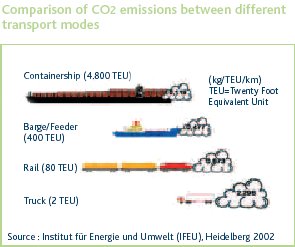
- In the climate change debate, shipping should be regarded as the
best available solution to the global need for transportation, it
being the most energy efficient form of transport and the backbone
of global trade - it produces less greenhouse gases per tonne
kilometre than any form of transport and carries some 90% of the
world's goods by volume. (See graph on the right). Seen in the light
of the enormous volume of goods carried by sea, the CO2 emissions
from shipping is small, various independent sources estimating that
it accounts for some 2% of global greenhouse gas emissions.The
reason for this is that for many decades shipping has had a strong
market driven incentive to focus on reduction of fuel consumption,
and the consistently high bunker prices will ensure that this will
continue.
-
- It is of course recognised that both in Europe and globally the
key political issue is for action on climate change and, in the
context of shipping, the industry is committed to playing its role
in taking action to reduce its CO2 emissions. The debate on the most
appropriate measures to
-
take in the maritime field is at a relatively early stage and ECSA
is actively involved in a holistic consideration of all alternative
options.
-
- While in the maritime context, Member States and the Commission,
as with ECSA, are also looking to IMO for global measures to the
global issue of climate change, the Commission will almost certainly
be pursuing EU initiatives in parallel. In particular, in early 2008
they will be undertaking a study on the options they consider most
promising to reduce emissions. These are likely to include CO2
indexing, differentiated harbour dues, and emission trading.
Moreover, it could well be that shipping (as with aviation) will be
included in the European Emission Trading Scheme at some stage, and
ECSA will be analysing the practical possibilities in cooperation
with the Commission.
-
- SHIP RECYCLING
-
- In May, the Commission published a Green Paper on Ship Recycling
as part of its goal of developing an EU strategy on the issue, with
a number of options being put forward for the consideration of
stakeholders. The shipping industry will be responding in detail to
the paper.
-
- The industry, coordinated and led by the ICS, has long been
involved in the international efforts to achieve the much needed
improvement in the working and environmental standards in many of
the recycling yards, mostly located in Asia. In particular, it is
closely involved in the development of the new IMO Convention on
Ship Recycling which addresses such legitimate concerns and which it
is anticipated will be adopted in 2009. It is encouraging that the
Commission acknowledges in the Green Paper that it is the adoption
of this Convention which will have the single most beneficial impact
on the problem and it is hoped that EU Member States, together with
the Commission, will use their considerable political influence to
ensure the timely adoption of the Convention.
-
- It is recognised, however, that it will inevitably be some years
before the Convention enters into force and the industry has
consequently recently developed interim measures that should be
taken by shipowners intending to sell ships for recycling. These
involve, in particular, encouraging owners to select only those
yards which have stated they are willing to undertake operations
compatible with the measures, notably in relation to having ship
recycling plans and to conducting gas-freeing in their operation.
The measures inter alia also encourage shipowners to complete an
inventory of hazardous materials and to inform their Flag
Administration of the steps taken in accordance with the
recommendations. Detailed guidance material is being developed to
provide practical advice in relation to the interim measures.
-
- ECSA has also advocated that the political/economic position of
the EU and Commission is such that the priority action at the EU
level should be conclusion of cooperation agreements/development aid
arrangements with the countries concerned; through such mechanisms,
financial and technical assistance can be provided to ensure that,
in practical terms, the working and environmental standards are
improved.
THE HUMAN ELEMENT
- IMPLEMENTATION OF THE 2006 MARITIME LABOUR CONVENTION IN THE
EU
-
- A unique Convention to be ratified soonest
-
- Bringing together and updating more than 60 ILO instruments, the
MLC uniquely covers on a global basis such areas as conditions of
employment, working hours, accommodation, medical treatment, minimum
age and recruitment. It is widely regarded as the ‘fourth
pillar' of the international regulatory system following the SOLAS,
STCW and MARPOL Conventions.
-
- Initiated and fully supported by industry, the Convention now
requires ratification of 30 states representing 33% of world tonnage
for its entry into force. In the EU context, the Social Partners
(ECSA and the European Transport Federation) have jointly urged
Member States to ratify as soon as possible, and the Council
Decision of June encouraging them to do by 2010 is to be welcomed.
-
- In addition, at the time of adoption of the MLC, the Commission
has indicated its clear wish that the Convention should as far as
possible be transposed into EU law and invited ECSA and ETF to
negotiate a Social Partners Agreement to this end, to be applied via
a Council Directive. ECSA together with ETF has entered into such
negotiations and, since October 2006, has been heavily and
constructively involved in this process. In entering these talks,
ECSA has been anxious to stress in particular that the MLC involves
the establishment of global standards and that this should not be
undermined by any substantive additional elements being introduced
in the EU context.
-
- To date, good progress has been made in the negotiations and
ECSA is hopeful of a successful conclusion being reached by around
the end of 2007.
-
- DEVELOPING SKILLS AND MAINTAINING EMPLOYMENT IN THE MARITIME
INDUSTRIES
-
- ECSA fully recognises the importance of maintaining European
maritime know-how. Such expertise is relevant and crucial not only
for the shipping industry itself but for the entire maritime
clusters, which in turn are vital to the economic and social
interests of the Community. In this respect, it should be noted that
most European maritime jobs are ashore, such as in: maritime
administrations, ports, shipping offices, financial institutes,
shipbuilding, production and development of maritime equipment, etc.
Education and qualification should take the high quality
requirements ashore into account.
-
- The need to ensure that European shipping can continue to
effectively and fairly compete in the global market must always be
the cornerstone of the EU policy in this global labour market. Such
an approach is fully consistent with the EU Lisbon Agenda.
-
- Labour flexibility is a key element for shipping operating in a
global competitive environment with a global labour market for
seafarers. The alternative approach of promoting restrictive
measures in an attempt to preserve the jobs of European seafarers
would have the opposite effect to that intended. It would lead to
lack of competitiveness, loss of markets, a shrinking of EU fleets
and, inevitably, to loss of European jobs.
-
- European shipping companies should also continue to be able to
employ residents of other Member States reflecting the cost of
living, taxes etc. in that other Member State. It is moreover
important that European seafarers from Member States with lower
costs of living are not deprived of their right to compete within
the Community. This is a basic right for nationals of all EU Member
States.
-
- Many of the clusters have common concerns on skills. In some
cases these are shared with land based industries - for example, the
constant shortage of quality engineers. As with other parts of the
maritime clusters, shipping needs to highlight to young people
Europe's maritime heritage as well as the dynamic and forward
looking characteristics of today's shipping industry.
-
- Such challenges are being addressed, and a number of initiatives
have been taken and should be enhanced, consistent with Transport
Council Conclusions of December 2005 on maritime employment, such
as:
-
- Career planning in the maritime clusters: In this
context, the social partners - ECSA/ETF - Career Mapping project
should be helpful in demonstrating the possible career planning
opportunities for European seafarers in order to make shipping an
attractive career option. The concept should be promoted and used
nationally. However, ship operators should not be charged with the
full burden of training and the emphasis on shore-based
opportunities provides a strong argument for advancing to 100%
public funding of maritime training.
- A stable and competitive environment for EU Shipping: The
right approach should be to provide incentives through positive
measures for the employment of EU seafarers through the State Aid
Guidelines instead of imposing restrictions to the employment of
non/EU personnel.
- National Action Promoting a Seafaring Career: In
different Member States promotion actions for a seafaring career
have been launched. The results are there: in many Member States the
number of candidates for the Maritime Academies have increased. This
is particularly so in countries where the national merchant fleet
has grown through a flexible application of the State Aid
Guidelines.
There is also scope for EU action. Further improving
the awareness and the perception of shipping by appropriate
campaigns, for instance by organising a European maritime Day, is an
integral part of this process.
MARITIME EXTERNAL RELATIONS
- What is good for international trade is good for shipping
-
- Operating in global markets means being dependent on
developments in international trade, third countries' policies and
operating conditions, a reason enough for closely following and
where possible supporting trade negotiations by the EU in the WTO
and on bilateral basis with third countries and regions.
-
- WTO-DDA
-
- The WTO negotiations as launched in November 2001 under the
heading of the Doha Development Agenda should have been finalised
end 2006. Maybe no-one expected this time-span to be realistic, but
the suspension of the Round in July 2006 was certainly a
disappointment to many who saw not only a potential for an increase
in Global trade, but also the need for new rules adapted to changing
balances in World trade. After a sparkle of new ambition in
November, a global business coalition called for unison and
emphasized that failure was not an option. While the benefits for an
ambitious conclusion of the Round are great, a failed Round could
lead to challenges to the WTO and a strong multilateral rules-based
trade system; to increased regionalism and protectionism.
-
- The G-4 Ministers (EU, US, India, Brazil) play a central role
and repeatedly have stated their commitment to finding solutions,
particularly on agriculture access and subsidies, for tariffs for
manufactured goods, all proving to be the main stumbling blocks.
Various high level meetings took place around the world and repeated
and sometimes rather dramatic calls have been made to resume the
negotiations, regrettably without a necessary breakthrough.
-
- A NEW EU TRADE POLICY
-
- Although a new WTO agreement remains the priority, the European
Commission launched consultations with EU stakeholders in external
trade and in early 2007 came out with a report and recommendations
for a new EU trade policy. In a pragmatic approach, the Commission
recognised that regulatory restrictions “behind the border”
have become increasingly important in determining the access to
market. The new approach includes a much enhanced cooperation
between Commission, Member States and business, also delegating more
initiative to EU Market Access Teams in the third countries
concerned. Also mentioned is the demand for a better involvement by
industry in the negotiation process with third countries.
-
- Having focussed much on the WTO negotiations, the EU risked
being bypassed by many other countries in concluding free trade and
regional agreements, setting EU trade interests at a disadvantage.
Therefore, a new trade policy with parallel approaches is very
welcome.
-
- FREE TRADE AGREEMENTS
-
- Negotiations on Free Trade Agreements have been launched first
half 2007 with South Korea, India, the ASEAN, as well as on
revisions of the Association Agreements with the ANDEAN and Central
America. This is an ambitious and challenging task in which ECSA
intends to offer maximum support by offering local knowledge and
also identify obstacles to national treatment and efficient maritime
transport services by EU operators.
-
- BILATERAL RELATIONS AND INTERVENTIONS
-
- The bilateral maritime agreement with China and the related
annual implementation meetings continues to enhance mutual
understanding and benefits. Negotiations with India on a similar
bilateral maritime agreement started with much delay and are
demanding more time on the detail, despite high level commitment.
The delay is disappointing as, at least as a minimum, only a firm
commitment to the de-facto already liberal operating conditions is
sought.
-
- ECSA looks forward to the materialising of the new EU trade
policy as described and particularly also to the effective setting
up of locally based EU Market Access Teams between the EU
delegations, embassies and business representatives. In practice
ECSA and member companies have had positive experiences with
similar, ad-hoc, initiatives for solving issues. There are some
concerns though that the initiative will remain restricted to a too
small number of emerging economies only, while most EU Delegations
and in developing countries also Member States' embassies are not
well staffed for dealing with trade issues.
-
- In the meantime ECSA will continue to cooperate closely with the
Commission services and Member States on occurring problems and as
appropriate also address these directly with third country
authorities. The case has not yet presented itself, but ECSA
certainly intends, when necessary, to call on the European
authorities and the WTO for enforcing the standstill clause adopted
at the end of the Uruguay Round's maritime negotiations in 1996.
This clause binds all 150 WTO member countries.
INNOVATION BY RESEARCH AND DEVELOPMENT
- CONTINUING INNOVATION FOR COMPETITIVENESS
-
- Research & development stands as the basis for the
continuous innovation of products, services, whole sectors and
thereby the competitiveness of the economy as a whole. Reason enough
for the EU to have placed intensified R&D efforts high under the
Lisbon Strategy.
-
- As identified and reported before, the many maritime related
initiatives and projects at national and at EU level are not easy to
follow, especially not the outcomes, the effectiveness and direct
benefit to maritime transport. ECSA continues its efforts for
enhancing the transparency for its membership, also for a better
judgement on a beneficial engagement in R&D.
-
- Meanwhile, respecting the responsibilities and competitive edges
of individual companies, the benefit of addressing R&D in a
broad maritime cluster approach has been recognised. In this context
the Maritime Industries Forum's R&D group transformed in the
Technology Platform Waterborne, with support of Commission and
Member States is aimed at further focussing of common interests in
innovation. It was gratifying to note that much of the content and
priorities were taken over in the December 2006 launched 7th R&D
Framework Programme.
-
- The Commission sponsored four year Flagship project on safe
maritime operations - with ECSA as coordinator - effectively started
in January 2007, bringing together 49 partners from shipping
companies and associations, shipyards, equipment manufacturers,
classification societies, research institutes and universities.
INTERNAL MARKET ISSUES
- ENLARGEMENT
-
- On 1 January 2007 Bulgaria and Romania became members of the
European Union and completed the sixth enlargement, increasing the
EU membership to 27 Member States. Two new Commissioners have been
appointed, Mrs Meglena Kuneva (Bulgaria) and Mr Leonard Orban
(Romania) for the portfolios of Consumer Protection and
Multilingualism respectively. The mandate of the two new
Commissioners will expire at the same time as that of all other
Commissioners, i.e. 31 October 2009.
-
- On 8 November 2006 a Commission progress report was published on
Turkey and all the other candidate and potential candidate
countries. One of the main stumbling blocks in the progress report
for Turkey remains the obligation to fully implement the Ankara
Protocol. In this context the boycott against Cyprus shipping should
be abolished, as requested repeatedly by the Commission and ECSA.
-
- As it stands Croatia will probably be the 28th EU Member State
as of 2010.Turkey and the Former Yugoslav Republic of Macedonia are
considered candidate countries with no specified timetable whereas
Albania, Bosnia Herzegovina, Montenegro and Serbia including Kosovo
are potential candidate countries where formal negotiations have not
begun.
-
- REFORM TREATY
-
- On 25th March 2007 the EU celebrated the 50th anniversary of the
Treaty of Rome at an informal Summit of Heads of State and
Government in Berlin. On that occasion the so called “Berlin
Declaration” was adopted. The declaration stated that “50
years after the signing of the Treaties of Rome, we are united in
our aim of placing the European Union on a renewed common basis
before the European Parliament elections in 2009”.
-
- A road map for a new treaty was presented at the EU Summit on
21-23 June 2007.
-
- The European Council agreed to replace the rejected European
Constitution by a Reform Treaty. A draft version of the Reform
Treaty is being prepared by an Intergovernmental Conference (IGC) in
line with the terms of the mandate agreed upon by the European
Council. The IGC should come forward with a draft Reform Treaty by
the end of 2007 allowing Member States to ratify the Treaty text
before the next elections of the European Parliament (June 2009).
-
- In general, the content of the Reform Treaty will be much in
line with that of the European Constitution, which was rejected
following referenda in France and theNetherlands in 2005.
-
- In short the Reform Treaty will include the following key
principles:
-
- The existing Treaties of the European Community and European
Union will not be repealed but will be modified by the Reform
Treaty.
- The current “pillar” system, consisting of the
Community Pillar and the Pillars relating to foreign affairs/defence
and to cooperation on justice/home affairs will be replaced by one
single European Union.
- The European Union will become a legal person.
- European legislation will continue to be based upon
“Regulations”, “Directives” or "Decisions".
- As of 1 November 2014, Council decisions will be adopted based
on double majority, representing 55% of the Member States and 65% of
the EU population. However, until 31 March 2017 a Member State may
still request that Council decisions are based on a qualified
majority.
- Decisions with regard to police and judiciary matters will be
taken on the basis of a qualified or double majority instead of
unanimity. However, the UK will opt out of criminal matters and
police co-operation.
- The six-month rotating Council Presidency regime will be
replaced by an EU President of the European Council, who will be
elected by the EU leaders for a two-and-ahalf-year term.
- A High Representative, assisted by a European External Action
Service with national and European diplomats, will permanently chair
ministerial meetings and serve as Vice-President of the European
Commission. He/She will combine the jobs of the current High
Representative and of the Commissioner of External Relations.
- As from 2014, the European Commission will no longer consist of
one Commissioner per Member State. Instead, the number of
Commissioners will be reduced to two-third of the number of Member
States. Commissioners will then be selected on the basis of a
rotation system and serve five-year terms.
- As of 2009, the European Parliament will consist of 750 Members.
- The Reform Treaty will include a cross-reference to the Charter
of Fundamental Rights making it thereby legally binding on European
legislation. However, the UK has opted out of the Charter and Poland
has made a unilateral declaration that the Charter will not affect
the right of Member States to legislate in certain fields, such as
family law.
ECSA SEMINAR ON EUROPEAN SHIPPING
- On 6 March 2007, ECSA organised a seminar in the Residence
Palace in Brussels, entitled “European Shipping a Global
Industry Serving European and Global Trade”.The seminar aimed
at explaining the global nature of shipping, including European
shipping, and its importance to global trade as well as to the
European economy.
-
- More than 160 people attended, including Vice
President/Transport Commissioner Jacques Barrot, the German
Presidency, Ministers and Secretaries of State from Member States,
the Commission services and many stake holders. The seminar was
considered a great success by ECSA President Mr Lennart Simonsson,
who moderated the debate, and by participants.
-
- All government speakers agreed that shipping is a global
industry, which requires a global regulatory framework through IMO
and ILO and not regional solutions. They also acknowledged the
importance of European shipping for global and European trade.
Furthermore, they expressed support for the Commission’s aim
of treating the oceans and seas in a holistic way in the context of
the Green Paper on a Future Maritime Policy for the EU.
EUROPEAN CRUISE COUNCIL STUDY & SEMINAR
- The ECC has since its inception in 2004 felt that the European
cruise sector can play a significant role in Europe but considered
that a comprehensive analysis of the contribution of cruise tourism
to Europe was first required. Undertaken by the ECC together with
Euroyards and the cruise port associations, the results were
published and launched at a Conference and Reception in February
2007. The following findings can be highlighted:
-
- The cruise industry’s direct expenditure in Europe is €8.3
billion and expected to increase to €12.7 billion by 2010.
-
Europe is the world leader in cruise ship construction and
refurbishment, with orders worth more than €18 billion up to
2010.
-
The cruise industry is major source of employment - up to a quarter
of a million by 2010.
-
Cruising is a major source of inbound tourism. Over 2.8 million
cruise passengers embarked on their cruises from European ports in
2005.
-
On average, passengers spent €100 each in every port visited on
their cruise during 2005.
-
European travel agents were paid an estimated €500 million in
commission from sales of cruises in 2005.
- While clearly a significant economic sector and a major direct
and indirect source of employment, it is notable that cruise lines
view Europe as the market that offers the greatest potential for
growth. It is in this context that the ECC has welcomed the
Commission’s intention through its Green Paper to develop an
integrated EU maritime policy. It is particularly encouraging that
at the heart of the initiative is a recognition of the importance
and potential of the EU maritime dimension and the need to promote
the growth of sustainable tourism as a major economic driver in
Europe.
PASSENGER RIGHTS
- Initiatives expected
-
- Over the last year, the Commission has been undertaking a
consultation exercise on the issue of maritime passenger rights in
relation to both the ferry and cruise sectors. This follows
legislation being enacted in other EU transport modes, notably
aviation. The passenger rights issues under consideration include
delays, cancellations, compensation, complaints procedures,
information to passengers and the rights of persons of reduced
mobility (PRM).
-
- Both ECSA and the ECC have made comprehensive written and oral
submissions and arranged for the Consultants/Commission to visit
cruise and ferry vessels in this context. A Commission paper is
expected in the autumn on what, if any, legislative or other
initiative is in their view required; further discussions between
the industry and Commission on the most appropriate way forward will
no doubt follow.
ECSA INTERNAL
- NEW PRESIDENCY
-
- The ECSA General Assembly held in Lisbon on 15 June appointed Mr
Philippe Louis-Dreyfus as the new President for a period of two
years, succeeding Mr Lennart Simonsson.
-
- Mr Philippe Louis-Dreyfus holds a masters’ degree in
economics and is the President of Louis Dreyfus Amateurs and
Managing Director of Louis Dreyfus S.A.S. He has other different
mandates, notably member of the supervisory board of Bureau Veritas,
director of the UK P&I Club, vice president of Armateurs de
France, director of the French Foreign Trade Council and director of
the French Business Confederation.
-
- The General Assembly also appointed Mr Marnix van Overklift,
Chairman of the Seatrade Group of companies, as Vice
President/President elect of ECSA for a period of two years.
-
- ECSA MEMBERSHIP
-
- ECSA welcomed the Bulgarian Shipowners Association as new ECSA
member at the ECSA June 2007 Board and General Assembly meetings in
Lisbon.
|














 - Via Raffaele Paolucci 17r/19r - 16129 Gênes - ITALIE


