Independent journal on economy and transport policy
03:05 GMT+2
SHIPPING
A study highlights the significant costs and counterproductive effects of the application of the EU ETS to maritime connections with western Sicily
For the Naples-Palermo and Genoa-Palermo routes, the annual cost varies between 2.9 million and 19.9 million euros
Palermo
July 8, 2026
The annual cost for ferry services on the routes
Naples-Palermo and Genoa-Palermo which is determined
from the application of the European ETS to maritime transport
emissions trading ranges between 2.9 million and 19.9 million
of euros. This is explained by a study by Giovanni Satta, professor
associate professor of Economics and Business Management at the
Department of Economics (DIEC) and member of the CIELI Council
(Italian Centre of Excellence on Logistics, Transport and
Infrastructure) of the University of Genoa, which is
was commissioned by the Port System Authority of the
Western Sicilian Sea to T.I.M. 10 Srl and which measures the impact
European legislation on emissions on maritime connections
that keep western Sicily united to the mainland and the
smaller islands.
This annual cost varies according to the percentage of transfer
of the cost of the EU ETS, i.e. the share of this cost that
shipping companies decide to charge customers.
With regard to the Naples-Palermo service, the annual cost is
€2.9 million if the transfer percentage of the cost
of the ETS is 75% and rises to 11.5 million if this cost
is not transferred. The study specifies that these two figures
represent respectively 1.59% and 6.38% of the share of a
Newly built Ro-Pax Green vessel worth 180 million
euro that is "not financeable" due to
of the ETS charge.
With regard to the Genoa-Palermo route, the annual cost for the ETS
is almost five million euros if the percentage of
This transfer cost is 75% and over 19.9
million if the cost is not passed on. In this case, the two
figures represent 2.27% and 11.08% of the share respectively
of the new "non-financeable" Ro-Pax Green.
The study also takes into account the Porto route
Empedocles-Lampedusa, treated as a theoretical case because today
is not subject to the ETS, where the value of the vessel of
reference is much smaller and equal to 37.5
million and for which the annual costs of the ETS are between
314 thousand and almost 1.3 million euros in the case of percentages of
cost transfer of 75% and 0% respectively.
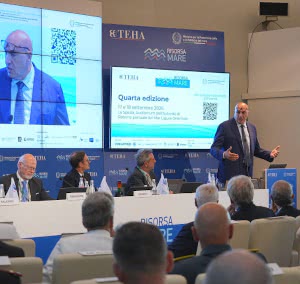
The study, entitled "The EU ETS and the cost of
of insularity: the effects on maritime connections between the
ports of the Western Sicilian Sea, the mainland and the islands
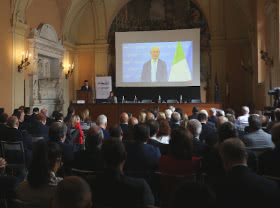
minors", was presented this morning in Palermo by the Port Authority
of the Western Sicilian Sea and Professor Satta, who spoke
in connection to illustrate the project, in view of the
presentation by the European Commission of the proposal for
revision of the ETS directive which is expected for the next 17
July.
To understand how the EU ETS really affects the prices of
ferry tickets, the study has built a methodology in
five phases. First the entire travel offer was mapped
declared by the shipping companies in July and
November, chosen respectively for the high and low periods
season, by detecting the rates for three different user profiles: a
Adult without vehicle, two adults with car, two adults and two children
by car. In parallel, the "deployment" was reconstructed
of each line to estimate CO2 emissions
and the related ETS cost of each trip. The heart of the model is
a matrix of sixteen scenarios, built by crossing four levels
load factor (ship fill rates of 25%, 50%, 75%,
100%) with four levels of ETS cost transfer to the customer
(25%, 50%, 75%, 100%). For each scenario, the
average ETS cost per unit of travel, the average cost per load
of the company and, projecting the results on a distribution
annual of four months of high season and eight months of low season,
the overall impact on an annual basis.
The study finds that ETS weighs the most precisely where the
line is already economically more fragile, i.e.
on routes with weak demand, low average fares and loads
factor factors, because in this case the additional cost is
distribution on a smaller number of paying passengers. In addition,
notes that as the filling of the vessel decreases, the ETS cost does not
increases in absolute value, but becomes structurally more
difficult to absorb and shows that the load factor is
therefore a key variable to evaluate the capacity of the
to absorb or redistribute the ETS burden without compromising
the economic balance of the service.
The study then focuses on mitigation technologies
highlighting that the adoption of liquefied natural gas instead of
Conventional marine fuels significantly reduce
exposure to the ETS cost, both for the passenger and for the
company, thanks to a lower emission profile, but
it does not cancel it. In the Naples-Palermo business case, for example, the
"full LNG" scenario lowers the impact of ETS in
all combinations of load factor and cost transfer, while
leaving the area of maximum risk intact: low demand combined with
high rate transfer. For the Genoa-Palermo line, it emerges,
In addition, a further theme, that of modal competition:
Route presents conditions of potential "contestability"
than the all-road alternative, which means that
An increase not compensated by the maritime service could push
shares of traffic towards the road, with effects opposite to those that
environmental legislation would like to produce.
The study also addresses the implications of the EU ETS
on accessibility and territorial cohesion, noting that
the percentage incidence of the ETS matters more than the value
as even an ETS allowance contained in euro can be
weigh heavily on the final price when the starting fare is
low, and it is precisely this ratio, and not the isolated amount,
to measure the real pressure on users. It should also be noted that the
most exposed subjects are households with a vehicle at the
Below, due to the multiplier effect of the cost on several units,
as well as travelers in the low season, users with
non-tourist needs and, above all, island territories
where there is a lack of mobility alternatives.
The study therefore traces a transmission mechanism that from
emissions from the ship reaches territorial cohesion,
noting that the increase in the price of the ticket may
result in a reduction in the frequency of trips and a
increase in the economic burden on family budgets, in particular
for the medium-low income brackets. Although these are connections
market value, not attributable to the public transport service
local or protected by a formal right to continuity
- the study underlines - in fact carry out a
equivalent function for the economic and social integration of the
Sicily with the rest of the country.
Finally, the study highlights a further risk, noting
whereas if the cost of the ETS is not passed on in full to the
passengers but remains the responsibility of the shipping company, the
operating margins are compressed, reducing the ability to
self-financing and, in turn, the resources available to invest
precisely in decarbonisation technologies that the legislation
would like to incentivise, with a consequent possible slowdown
of the energy transition triggered by the legislation designed to
accelerate it.
On the occasion of today's meeting, the System Authority
Port of Western Sicily announced that, in light of the
results of the study, will bring to the attention of the
European institutions in the context of the revision of the ETS Directive
a proposal: to exempt from the application of the system the
connections with the major islands and extend until 2032 the
derogation already provided for those with the smaller islands, avoiding
that the ecological transition will result in a further increase in the
cost of insularity.
"The current application of the ETS - commented the
president of the Port Authority, Annalisa Tardino - determines an increase in the
costs that risk falling on citizens, families and businesses,
penalizing above all residents and travel related to the
work, study and health. At the same time, it subtracts resources
shipowners, reducing their ability to invest in
new ships and low-emission technologies, with an effect that
risks being in contrast with the very objectives of the
ecological transition. For this reason," he added, "we ask that the
revision of the Directive is an opportunity to introduce
by extending the system of
derogation already provided for minor ones and extending its
validity until at least 2032. Let's put this study to
government and Minister Matteo Salvini, and the
European institutions, so that it can make a contribution to the
decision-making process and promote a more
between environmental sustainability, competitiveness and
maritime transport and protection of island communities".
- Via Raffaele Paolucci 17r/19r - 16129 Genoa - ITALY
phone: +39.010.2462122, fax: +39.010.2516768, e-mail
VAT number: 03532950106
Press Reg.: nr 33/96 Genoa Court
Editor in chief: Bruno Bellio No part may be reproduced without the express permission of the publisher






 The annual cost for ferry services on the routes
Naples-Palermo and Genoa-Palermo which is determined
from the application of the European ETS to maritime transport
emissions trading ranges between 2.9 million and 19.9 million
of euros. This is explained by a study by Giovanni Satta, professor
associate professor of Economics and Business Management at the
Department of Economics (DIEC) and member of the CIELI Council
(Italian Centre of Excellence on Logistics, Transport and
Infrastructure) of the University of Genoa, which is
was commissioned by the Port System Authority of the
Western Sicilian Sea to T.I.M. 10 Srl and which measures the impact
European legislation on emissions on maritime connections
that keep western Sicily united to the mainland and the
smaller islands.
The annual cost for ferry services on the routes
Naples-Palermo and Genoa-Palermo which is determined
from the application of the European ETS to maritime transport
emissions trading ranges between 2.9 million and 19.9 million
of euros. This is explained by a study by Giovanni Satta, professor
associate professor of Economics and Business Management at the
Department of Economics (DIEC) and member of the CIELI Council
(Italian Centre of Excellence on Logistics, Transport and
Infrastructure) of the University of Genoa, which is
was commissioned by the Port System Authority of the
Western Sicilian Sea to T.I.M. 10 Srl and which measures the impact
European legislation on emissions on maritime connections
that keep western Sicily united to the mainland and the
smaller islands.









 - Via Raffaele Paolucci 17r/19r - 16129 Genoa - ITALY


