
In his incessant flood of statements, in the past few hours
Donald Trump has made it known that the actions of the armed forces
in support of ships transiting the Strait of
Hormuz have allowed more than 100 million barrels of oil to
cross the Strait and reach the free market. « More
of 200 merchant ships - highlighted the American president -
they crossed the Strait safely. This extraordinary
success - he added - is due to the fact that the Member States
The United States of America control the Strait of Hormuz, not Iran. The
their army - he underlined - has been defeated and their
economy is lost. It's over for Iran!" Few
hours later Trump announced that he had decided, taking note "that
discussions with the Islamic Republic of Iran have been
brought to the highest levels of Iranian leadership and approved,"
to cancel "the attacks and bombings against Iran
scheduled for this evening. Discussions and loose ends - he
- have been approved, both conceptually and in the
details, from all parties involved, including the United States, Israel,
Saudi Arabia, United Arab Emirates, Qatar, Turkey, Pakistan,
Bahrain, Kuwait, Jordan, Egypt and others. The naval blockade
will remain in full force until finalisation of
this agreement. Date and place of signing will be announced at
short".
Waiting like everyone else to know if the communication of an agreement
with Iran, repeatedly announced by Trump, will result in
this time in the signing of a pact that even today the
seems far from wanting to sign, the French
AXSMarine also raises some doubts about the latest statements of the
U.S. President on the success of the operation to
restore maritime traffic in the Strait of Hormuz. The
shipping intelligence and naval market analysis companies
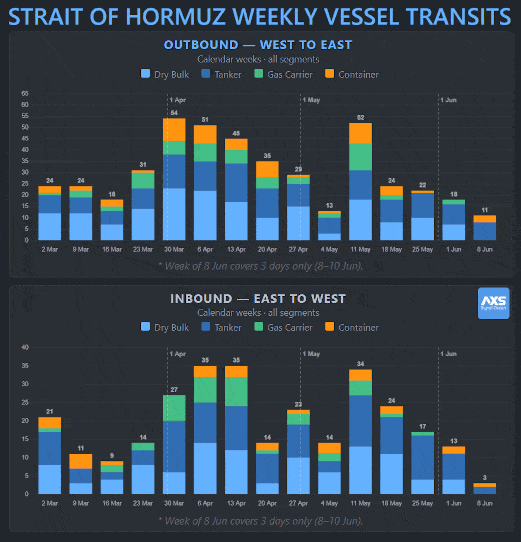
announced that, on the basis of its AIS data, in the period between
May 4 and June 10, 2026 the Strait of Hormuz was
crossed by 140 commercial ships from the Persian Gulf,
which, including ships entering the Persian Gulf, rises to
about 220 ship transits. However - AXSMarine specified -
the latter figure does not relate only to the ships assisted in the
transit from the Freedom Project initiated by the US administration
to restore maritime traffic in the region, but includes
all commercial transits, including ships using
routes of the naval corridor in the Strait under the control of the
Islamic Revolutionary Guard Corps.
In addition, AXSMarine highlighted that, in order to assess the success of the
actions for the restoration of ship traffic in the Strait of
Hormuz, a year-on-year comparison is essential from which it is possible to
whereas in the same 38-day period in 2025,
2,155 crossings of commercial ships leaving the Strait of
Hormuz, equal to an average of 56.7 outbound crossings at the
day. The company pointed out that therefore in the 38 days
by 2026, outgoing traffic is therefore only 6-7% of the
levels of a year ago.
In addition, AXSMarine noted that if it was registered
a clear peak in outbound crossings during the week
immediately following 4 May, reaching the total
weekly since the beginning of April, however the
traffic decreased in the following weeks and in the first
ten days in June was below the levels
of April and March. The data - the company noted -
therefore suggest that the increase in early May is due to
considered as a brief recovery in demand, suppressed after
weeks of reduced traffic, rather than as a reopening
lasting of the Strait.





















 - Via Raffaele Paolucci 17r/19r - 16129 Genoa - ITALY


