Independent journal on economy and transport policy
15:50 GMT+2
This page has been automatically translated by Original news
ASSOCIATIONS
Geopolitical uncertainty has become the main risk for shipping
Lillelund (Allianz Commercial): we have gone from decades of relative stability to an increasingly complex and volatile context
Monaco di Baviera
June 24, 2026
Geopolitical uncertainty has become the risk
for the maritime transport sector. He highlighted this
Allianz Commercial, the global division of the insurance group
Allianz, presenting its latest report "Safety
and Shipping Review 2026" which notes that incidents such as the
closure of the Strait of Hormuz represent only the latest of
a series of recent outages that have impacted the
maritime sector and signal a transition to a "new
maritime order" defined by increasing risks to the
security along strategic shipping lanes.
The report points out that, in addition to geopolitical uncertainty,
Traditional risks for shipping remain one of the main
concerns, although in recent years the total number of
ship losses and ship accidents are steadily decreasing. The damage
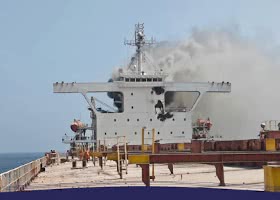
o Machinery breakdowns and fires are among the main causes
of accident, with consequent economic and insurance losses
significant ones.
"Our analysis - commented
the CEO of Allianz Commercial, Thomas Lillelund -
shows that the maritime transport sector has increased in recent years
made significant progress in terms of safety. However,
It has also undergone a fundamental transformation, passing through decades
of relative stability, characterised by trade flows
and widely predictable operating conditions, at a
an increasingly complex and volatile context. The conflict in
Middle East and the closure of the Strait of Hormuz represent
Just the latest in a series of serious disruptions that have affected
shipowners and operators in the freight sector. Resilience, geopolitics and
efficiency must be balanced in an increasingly
where the cost of uncertainty is reshaping the
maritime transport sector'.
Data from Allianz Research shows that as a result of the conflict
in the Middle East, which has paralyzed the Strait of Hormuz, about
1,150 merchant vessels, with an estimated value of ships and cargo equal to
about 125 billion dollars, a volume of 29 million tons
of gross tonnage and about 20,000 seafarers, are located in the Gulf
Persico waiting to resume operations following the recent
diplomatic progress. Highlighting that the insurance coverage
for ships was available throughout the conflict,
although with higher premiums for hull and cargo, Allianz
Commercial specified that, however, the real problem for the
was more linked to the risk for
crew and for the ship during transit in a transit area
conflict, rather than mere insurance considerations and has
noted that, even if the agreement between the United States and Iran were to
and the Strait of Hormuz to be reopened, it will be necessary to
strong safe transit guarantees, with the involvement of the
international community, especially if we want the
traffic return to pre-war levels of traffic of up to 140 ships
per day.
The report highlights that, despite the difficulties of the
shipping sector, the total number of accidents and accidents is in
decline, with over 900 total ship losses reported in the last few years.
ten years. Between 2016 and the end of 2020, there were
555, with an average of 111 per year. This number has dropped to
350 between 2021 and the end of 2025, with an average of 70 (down by
37% compared to the previous five years), as evidence
of the positive effect of a greater focus on
security. In 2025, 43 total losses were reported, of which
over 30 relating to ships of more than 500 gross tonnage
tons.
Globally, the number of
has decreased by about -16% (2,818 in the
2025 compared to 3,353 in 2024). The Mediterranean region
and Black Sea recorded the highest number of
of accidents (622), followed by the British Isles (619), which is
also the area with the highest number of accidents in the last
decade. Damage or breakdowns to machinery were the cause
of maritime accidents globally,
accounting for more than half (1,505), followed by
collisions between ships (260).
- Via Raffaele Paolucci 17r/19r - 16129 Genoa - ITALY
phone: +39.010.2462122, fax: +39.010.2516768, e-mail
VAT number: 03532950106
Press Reg.: nr 33/96 Genoa Court
Editor in chief: Bruno Bellio No part may be reproduced without the express permission of the publisher







 Geopolitical uncertainty has become the risk
for the maritime transport sector. He highlighted this
Allianz Commercial, the global division of the insurance group
Allianz, presenting its latest report "Safety
and Shipping Review 2026" which notes that incidents such as the
closure of the Strait of Hormuz represent only the latest of
a series of recent outages that have impacted the
maritime sector and signal a transition to a "new
maritime order" defined by increasing risks to the
security along strategic shipping lanes.
Geopolitical uncertainty has become the risk
for the maritime transport sector. He highlighted this
Allianz Commercial, the global division of the insurance group
Allianz, presenting its latest report "Safety
and Shipping Review 2026" which notes that incidents such as the
closure of the Strait of Hormuz represent only the latest of
a series of recent outages that have impacted the
maritime sector and signal a transition to a "new
maritime order" defined by increasing risks to the
security along strategic shipping lanes.









 - Via Raffaele Paolucci 17r/19r - 16129 Genoa - ITALY


