
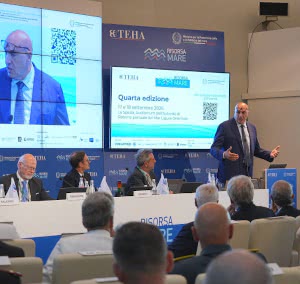
Speaking today in Rome at the annual meeting of Assarmatori,
referring to the rules for the decarbonisation of industry
and in particular the European ETS for the trading of
applied to shipping, the administrator
delegate of the GNV shipping company of the MSC group, Matteo
Catani, highlighted the importance "that the tools
are designed to accompany the change
without creating competitive distortions. Today - he noted -
the application of the ETS risks producing effects that are not
intentional: on the one hand, it penalizes the Motorways of the Sea compared to
road transport, which is not subject to the same charges,
on the other hand, it weakens the competitiveness of European ports of
transhipment with respect to non-EU hubs, favoring the possible
movement of traffic and investments out of Europe. For
prevent the transition from resulting in a loss of
competitiveness of the European logistics system - noted
Catani - it is necessary to introduce corrective measures that guarantee
balanced conditions of competition between the different modalities
and between European airports and those of third countries. The
sustainability must be a factor of growth and development
not an element that risks reducing the attractiveness of the
of Europe as a global logistics platform".
"The decarbonisation of maritime transport -
continued the CEO of GNV - requires a vision
and concrete investments throughout the
energy supply chain. As MSC Group we are already investing in
new generation ships and in solutions capable of accompanying the
pathway to low-emission fuels, from LNG to
biofuels up to synthetic fuels. However, why
This transition can accelerate, it is essential that
and an increasing availability of alternative fuels to
competitive costs. In this context - Catani underlined - the
revenues from the ETS should be used as a real lever
by allocating resources to the development of supply chains
production of synthetic fuels, port infrastructures and
the reduction of the cost differential with respect to fuels
traditional ones. Only by transforming the ETS from a mere cost tool to a
investment engine it will be possible to combine sustainability
environment, business competitiveness and greater autonomy
energy for Europe".















 - Via Raffaele Paolucci 17r/19r - 16129 Genoa - ITALY


