Independent journal on economy and transport policy
07:59 GMT+2
This page has been automatically translated by Original news
SHIPPING
Dominguez asks the IMO Council for non-formal deliberations and the definition of practical measures to unlock the Hormuz crisis
I would like to thank the rapporteur for his excellent report
Londra
March 18, 2026
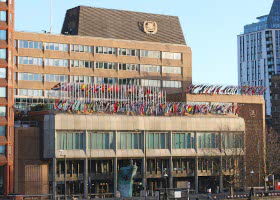
From the extraordinary session of the Council of the International Maritime Organization started today in London to discuss the impact of the crisis in the Middle East, navigation and marine in the region of the Arabian Sea, Mar d'Oman, Persian Gulf, and in particular in the Strait of Hormuz, the secretary general of the IMO, Arsenio Dominguez, awaits unformal deliberations and the definition of practical measures. Or, at least, this is his omen.
Recalling that the recent attacks against merchant ships in the Hormuz Strait region caused the death of at least seven seamen and the wounding of many others and that currently about 20,000 seamen remain stuck in the Persian Gulf on board the ships, facing high risks and a remarkable psychological stress, Dominguez exhorted the 40 States representatives in the IMO Council "to work for the de-escalation of the conflict and to allow these members of the safety". "During this meeting of the Council - it has said opening the extraordinary session - you will have the opportunity to dialogue and concentrate on acceptable solutions for all parties in order to protect all innocent seafarers, as well as the safety of navigation and the marine environment. I urge you to focus on non-formal deliberations and practical measures relating to the proposals submitted to you. The time tightens and we all have a serious responsibility towards the seafarers involved".
A rather formal proposal seems to be that requested by the IMO by the proposal for a Council declaration submitted by the largest number of nations that are part of it, i.e. by 97 states, including 33 European States including Italy, 11 Middle Eastern States (Saudi Arabia, Bahrain, United Arab Emirates, Jordan, Kuwait, Lebanon, Qatar, Syria, Turkey and Yemen), eight Asian nations (excluding, among others, China and Indonesia) and 11 United States. The proposed statement asks "the Islamic Republic of Iran to refrain immediately, in accordance with international law, from any action or threat aimed at closing, hindering or otherwise interfering with international navigation through the Strait of Hormuz or against merchant or commercial ships in the Strait of Hormuz and in the surrounding areas, in order to ensure the safety and well-being of seafarers and the security of international navigation and the marine environment, and to respect its international obligations". In addition, it urges 'the IMO committees to assess how to strengthen the efforts of the Member States and observer organisations in support of the seafarers and commercial vessels affected, to consider the implications of this situation for the implementation of the instruments of the Organization, to adopt appropriate measures and to report to the Council'.
Reaffirming that "the Islamic Republic of Iran strongly reiterates that the current deterioration of the maritime security context in the Persian Gulf region is a direct consequence of the continuing acts of aggression against Iran by the United States and the Israeli regime" and that "the negative effects on the marine sector currently affecting the navigation and the marine ones are a direct and inevitable consequence of these illicit actions and cannot be considered isolated At the same time - the statement continues - Iran remains firmly convinced that the conflict must cease and that an urgent return to stability and diplomacy in the Persian Gulf region is necessary".
In addition, Tehran denounces that "during the ongoing war of aggression against Iran, numerous accidents have been reported that have affected ships for marine safety, merchant ships, fishing fleets and marine infrastructure in the Iranian waters and adjacent marine areas of the Persian Gulf. On March 1, 2026 - it is specified - the Iranian ship of search and rescue "NAJI 10", engaged in operations of response to marine emergencies, has been hit in the port of Jask and is subsequently sunk. On 11 March 2026, the hospital ship "Soroush Tandorosti", stationed at the island of Hormuz in the Persian Gulf, was struck and destroyed while it was moored. The ship served as a dedicated platform for marine medical care, providing emergency medical services to coastal and insular populations". "Among other incidents reported in the same period - the Iranian declaration continues - there are damages to the boats anchored in the anchorage area of Assaluyeh, fires that have affected more than one hundred vessels in Jask, damage to the landing medium "Baberkhtaran" with consequent victims and wounded among the crew members, damage to a ship support offshore (C110) to support of the offshore operations, the sinking of the half Maritime safety infrastructure has also been affected, with interruptions to the facilities of naval traffic control services (VTS) and to the monitoring systems of the operating marine traffic in some areas of the Persian Gulf, in particular in the province of Hormozgan. In addition to the accidents that directly affected the ships, the prevailing security situation has generated a series of operational challenges that affect marine activities in the Persian Gulf".
Highlighting the situation of grave difficulty, the statement of Tehran states that despite this "the Iranian authorities have continued to provide humanitarian assistance and operational support to seafarers and ships in difficulty in the Persian Gulf and in the Strait of Hormuz". "In the light of the above developments - the Iranian declaration concludes - it is important that the Council recognize the implications of recent incidents arising from the illegitimate use of force against Iran by the United States and the Israeli regime, which hit the marine safety vessels, commercial marine transport and maritime infrastructure in the Persian Gulf region".
Among the other important statements of the actors at stake in the crisis in the Middle East which were presented on the eve of the extraordinary session of the Council of IMO, stands out the absence of a declaration of the People's Republic of China, while that of the Russian Federation dwells on alleged violations of the procedure of convocation of the session of the Council, derogating "to the rule of notice of a month" and places the attention "on Article 21(c) of the IMO Convention, which it establishes, which it only Referring to attacks on two oil tankers in 2019 in the Gulf of Oman(of 13 June 2019), Moscow recalls that "the Council has gained its own "adequacy" experience in managing sensitive issues, as happened, in particular, during the 122th session of the Council on maritime safety measures for vessels operating in the Strait of Hormuz and the Sea of Oman. The question was examined by the competent committee (Committee for Maritime Safety) before being submitted to the Council, following the path prescribed by Article 21 of the IMO Convention". Moscow then denounces that "another worrying aspect is the idea of affecting Council decisions when other Member States are not even aware of such developments. This is not an inclusive and non-transparent management, contrary to the practices of this Organization. In this regard, it should also be noted that the IMO does not provide for the adoption of decisions by correspondence".
A statement presented by Bahrain, United Arab Emirates, Kuwait and Lebanon "invites Member States to ensure the continuous supply of water, food, fuel and other essential goods to ships currently unable to leave the region. Moreover, it encourages States to facilitate, where necessary, the exchange and renewal of the crew in accordance with international standards, in order to safeguard the health, safety and well-being of the seafarers affected by this situation". Then, "it is necessary that, given the scope of the impact on the global marine transport, an extraordinary session of the Assembly is convened as soon as possible to address further the repercussions on the navigation and the marine of the situation in the Arabian Sea, in the Sea of Oman and in the Gulf region, in particular in the Strait of Hormuz and in the surrounding areas".
- Via Raffaele Paolucci 17r/19r - 16129 Genoa - ITALY
phone: +39.010.2462122, fax: +39.010.2516768, e-mail
VAT number: 03532950106
Press Reg.: nr 33/96 Genoa Court
Editor in chief: Bruno Bellio No part may be reproduced without the express permission of the publisher







 From the extraordinary session of the Council of the International Maritime Organization started today in London to discuss the impact of the crisis in the Middle East, navigation and marine in the region of the Arabian Sea, Mar d'Oman, Persian Gulf, and in particular in the Strait of Hormuz, the secretary general of the IMO, Arsenio Dominguez, awaits unformal deliberations and the definition of practical measures. Or, at least, this is his omen.










 - Via Raffaele Paolucci 17r/19r - 16129 Genoa - ITALY


