
The Port Authority of Genoa has published its
latest annual report on inspection activities for
the fight against naval air pollution, which highlights how
In 2025, 228 inspections were carried out on 146 ships
foreign and 82 Italian companies to verify the levels of emissions of
nitrogen oxides (NOx), for a total of over 2,600 checks
individual. The outcome of this activity led to the
detection of 31 deficiencies and the provision of eight
ship detention measures in the most critical cases.
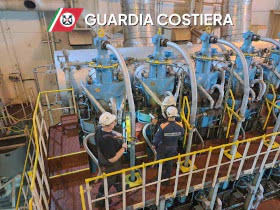 A significant part of the inspection work was
focused precisely on emissions of nitrogen oxides, with
controls - specified the Harbour Master's Office - which are not limited to
simple bureaucratic checks, but involve physical inspections,
even invasive, on engines. In particular, inspectors shall verify
that every part of the engine (such as injectors, pumps, turbine heads)
has the correct IMO ID marking, ensuring compliance
to the approved Technical File. On this front - he
specified the Genoese Harbour Master's Office - a recent sentence of the TAR
Liguria confirmed the correctness of the Guard's actions
Coastal, establishing that: "the Technical File is a
a binding compliance parameter, not an indicative guide;
the absence of IMO marking of the components is in itself
sufficient to justify the detention."
A significant part of the inspection work was
focused precisely on emissions of nitrogen oxides, with
controls - specified the Harbour Master's Office - which are not limited to
simple bureaucratic checks, but involve physical inspections,
even invasive, on engines. In particular, inspectors shall verify
that every part of the engine (such as injectors, pumps, turbine heads)
has the correct IMO ID marking, ensuring compliance
to the approved Technical File. On this front - he
specified the Genoese Harbour Master's Office - a recent sentence of the TAR
Liguria confirmed the correctness of the Guard's actions
Coastal, establishing that: "the Technical File is a
a binding compliance parameter, not an indicative guide;
the absence of IMO marking of the components is in itself
sufficient to justify the detention."
Regarding the emission controls of sulphur oxides
(SOx), and therefore on the sulphur content of marine fuels, in the
2025 in the port of Genoa, a total of
32, of which 12 with sampling and analysis in the laboratory, and
an irregularity of a
which was immediately corrected.
As for the monitoring of CO2 emissions, the controls
as part of the European Union's MRV system for monitoring,
The communication and verification concerned 196 ships and
They did not find any irregularities.
The annual report recalls that 2025 marked a
important change: from the first of May, in fact, the Mar
Mediterraneo is officially a SECA (Sulphur Emission
Control Area), with the obligation to use fuels with sulfur
not exceeding 0.10%. Genoa had already anticipated this
measure with the voluntary Genoa Blue Agreement protocol.
Alongside the inspection activity, the Harbour Master's Office has
continued the monitoring of visual emissions and the comparison
direct with the shipping companies, obtaining a progressive
reduction of the most recurrent critical issues. The
Capitaneria highlighted that "the most
significant are not only in numbers, but in the ability to
concretely affect those situations of greatest suffering
with simultaneous reduction of smoke and better
engine efficiency".

















 - Via Raffaele Paolucci 17r/19r - 16129 Genoa - ITALY


