
In the first quarter of this year, the trend continued
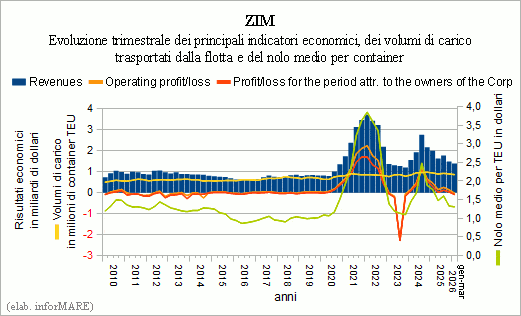
reduction in the shipping company's revenues
containerized ZIM which in the period amounted to 1.40 billion
of dollars, down -30.4% on the first three months of 2025, of which
1.13 billion generated by ocean container shipments
(-32,3%). In particular, transatlantic containerized services
produced revenues of €507.2 million (-33.9%) against
cargo volumes transported equal to 391 thousand TEUs (+1.6%); Revenues
generated by Asia-Europe services amounted to 142.9 million
dollars (-32.0%) and were transported to this market
66 thousand TEUs (-22.4%); revenues from transatlantic services
amounted to €143.2 million (-23.6%) and volumes transported on
These routes totaled 114 thousand TEU containers (-18.6%); i
intra-Asian services generated revenues of €157.4 million
(-16.2%) against transported volumes of 198 thousand TEUs (+2.6%);
revenues from services with Latin America amounted to 121.4
million (-47.1%) and these maritime lines transported 97 thousand
TEU (-31.2%).
Overall, in the first quarter of 2026, ZIM ships
transported 866 thousand TEUs (-8.3%) and in the period the average value
of freight rates amounted to 1,310 dollars/TEU (-26.2%).
The latest quarterly financial statements of the Israeli company show
EBITDA of $313.0 million (-59.9%)
and an operating result and a net economic result both of
negative sign and equal to -18.3 million and -86.3 million respectively
million, against positive results of 464.3 million and
296.1 million in the first three months of 2025.
ZIM President and Chief Executive Officer Eli Glickman,
highlighted that the economic performance of the first quarter of 2015
2026 are broadly in line with expectations and -
specified - "reflect a context of more
together with a weakening of demand".
Regarding the short-term outlook, Glickman noted
that "the conflict in the Persian Gulf has caused a strong
increase and significant volatility in the costs of
bunkering. While the impact on first-quarter results was
minimal state - he specified - we expect a more
significant in the second quarter, before our actions to
offset these costs, including the increase in the
transport and bunkering specific surcharges, start to
produce their effects. Furthermore - specified Glickman - it is
It is important to underline that the ZIM is likely to benefit from
Additional benefits from our early adoption of technology
LNG and the long-term agreements with Shell that guarantee the
supply of liquefied natural gas at competitive conditions. With
a fleet made up of about 40% LNG-powered ships, the
ZIM not only offers freight forwarders a route to a
significant reduction in carbon emissions, but maintains
efficient and cost-effective fleet from the point of view of
fuel consumption."
"Although market fundamentals remain challenging
along the main trade routes of the ZIM - continued
Glickman - we have recently observed a positive change
in the trend of transpacific trade, with a strengthening of freight rates
in line with demand. If this momentum continues,
We believe it will support our financial results, in particular
in the second half of the year. In parallel,
we have concluded the negotiations for the annual contracts, which have entered into
effective on May 1, maintaining contract volumes similar to
those of last year, with about 65% of our volume
transpacific exposed to spot freight rates. This approach is at the
our agile business strategy and allows us to
Remain flexible and proactive in capacity allocation
based on the evolution of demand trends".
Glickman also focused on the merger procedure
with the German Hapag-Lloyd currently underway which has been
announced last February and was approved
unanimously by the Management Board of the ZIM and
ratified by the shareholders at an extraordinary shareholders' meeting held on
last April 30
 (
of 16
February 2026). The president and CEO of ZIM recalled that
the completion of the transaction that remains subject to
the approval of several regulatory authorities, including
State of Israel.
(
of 16
February 2026). The president and CEO of ZIM recalled that
the completion of the transaction that remains subject to
the approval of several regulatory authorities, including
State of Israel.



















 - Via Raffaele Paolucci 17r/19r - 16129 Genoa - ITALY


