Independent journal on economy and transport policy
06:19 GMT+2
This page has been automatically translated by Original news
TRADE
Trump is trying to circumvent the Supreme Court's ruling by introducing temporary tariffs
An executive order confirming the suspension of the "de minimis" regime was also signed
Washington/Suitland
February 23, 2026
If Friday's ruling by the Supreme Court of the United States
has declared illegal the new tariffs introduced from
last spring by the federal administration led by Donald
Trump because this would be beyond emergency powers
conferred on the President by the International Emergency Economic Powers
Act (IEEPA), a 1977 law that Trump had indicated as the foundation
for the application of the new commercial tariffs, the
The American government, however, has no intention of giving up.
If Trump initially called the sentence "a
disgrace for the nation" deliberated by a majority (six against
three) by judges that the U.S. president labeled as
"unpatriotic" who would have played into the hands of
"foreign interests", a few hours after the Office of the
United States Trade Representative (USTR), the government agency that
deals with international trade policies, announced
the Trump administration's willingness to "continue to
implement the President's trade policy, which has been
at the center of his campaign and his program."
The USTR then announced several measures "to ensure
continuity in the achievement of these objectives and
agreements negotiated with a number of partners
that were immediately introduced by Trump,
from the immediate imposition of a temporary duty of 10%
on items imported into the United States. Specifying, moreover,
that the Supreme Court's decision 'only addresses the
question of the constitutionality of "reciprocal duties"
and on fentanyl imposed by President Trump", the agency
has specified that "the "extended duties" that
President Trump has imposed on other provisions
regulations will remain in force. For example, the USTR pointed out
existing duties under Section 301 on China varying
from 7.5% to 100%, depending on the product, and sectoral duties
existing under Section 232 ranging from 10% to 50%, to
depending on the product. These measures cover 30% of the current
US imports".
The proclamation on temporary tariffs signed on Friday by Donald
Trump explains that the measure is aimed at "addressing the
problems of international payments and to continue the
work of the administration to rebalance our relations
for the benefit of workers, farmers and
American producers". The temporary nature of these duties is
limited to a period of 150 days starting tomorrow.
Announcing the new measures, the USTR highlighted that "the
President Trump has also used the IEEPA to address
trade deficit, which has skyrocketed to
stars of 40% during the Biden administration and has favored the
Relocation of manufacturing and agricultural production
while lining the pockets of countries, companies and
foreign workers. In the second half of 2025 -
Federal Agency Said - Trade Deficit Showed
a clear downward trend, particularly because other
countries have agreed on trade arrangements which have maintained the
US protective tariff while opening up their markets
to U.S. exports. Between April 1, 2025 and 31
December 2025 - the USTR underlined - the trade deficit
of goods decreased by 17%. Regardless of the
Today's decision of the Court, these challenges, and the enormous progress made by the
- the federal agency ruled - remain".
The USTR's statements on the evolution of the deficit
U.S. trade followed, and was denied,
from the analysis presented the previous day by the U.S. Bureau of
Economic Analysis (BEA) of the U.S. Department of Commerce
led by Howard W. Lutnick who was appointed minister by
Donald Trump to whom he has become closely linked in recent years
supporting his campaign for his return to the White House. The
BEA document explains that in 2025 the balance deficit
of American goods and services was 901.5 billion
dollars, or 2.1 billion less (i.e. a decrease equal to
only at -0.2%) of the 903.5 billion in 2024. In particular, the
exports amounted to 3,432.3 billion dollars, in which
growth of 199.8 billion over 2024, and exports have
totaled 4,333.8 billion, with an increase of 197.8 billion.
In addition, the analysis specifies that the decrease in 2025 of the
deficit in the balance of goods and services reflects - contrary to the
according to the USTR - a growth of 25.5 billion in the
deficit in the balance of goods, equal to +2.1%, to 1,240.9 billion
and an increase in the surplus of the balance of services of 27.6
billion, or +8.9%, to 339.5 billion.
Then there is the huge increase of +40% in the trade deficit
during the Biden administration highlighted by the USTR, the same
U.S. Bureau of Economic Analysis had previously confirmed the
increase between 2020 and 2022 and determined by a
significant growth in imports for economic recovery
following the Covid-19 pandemic driven by domestic demand
much higher than export growth
trade deficit, which, however, after this period has fallen
it is stabilized and so it was also in 2025.
Meanwhile, Trump also signed an order on Friday
Executive confirming the suspension of the "de minimis" regime
granting exemption from duties for shipments of low-value goods
(
of 31
July 2025).
- Via Raffaele Paolucci 17r/19r - 16129 Genoa - ITALY
phone: +39.010.2462122, fax: +39.010.2516768, e-mail
VAT number: 03532950106
Press Reg.: nr 33/96 Genoa Court
Editor in chief: Bruno Bellio No part may be reproduced without the express permission of the publisher







 If Friday's ruling by the Supreme Court of the United States
has declared illegal the new tariffs introduced from
last spring by the federal administration led by Donald
Trump because this would be beyond emergency powers
conferred on the President by the International Emergency Economic Powers
Act (IEEPA), a 1977 law that Trump had indicated as the foundation
for the application of the new commercial tariffs, the
The American government, however, has no intention of giving up.
If Friday's ruling by the Supreme Court of the United States
has declared illegal the new tariffs introduced from
last spring by the federal administration led by Donald
Trump because this would be beyond emergency powers
conferred on the President by the International Emergency Economic Powers
Act (IEEPA), a 1977 law that Trump had indicated as the foundation
for the application of the new commercial tariffs, the
The American government, however, has no intention of giving up.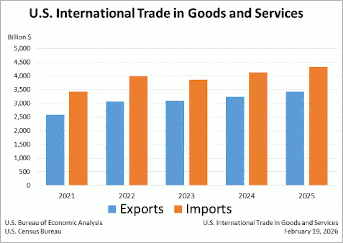
 (
(


















 - Via Raffaele Paolucci 17r/19r - 16129 Genoa - ITALY


