Independent journal on economy and transport policy
20:30 GMT+2
This page has been automatically translated by Original news
PORTS
The EU-ETS Observatory in Puertos del Estado confirms the risk of loss of container traffic shares in European ports
Santana: We believe that some aspects of the ETS need to be monitored and, where necessary, revised
Madrid
February 23, 2026
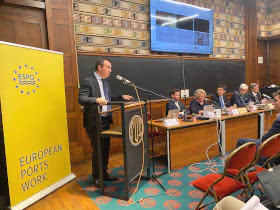
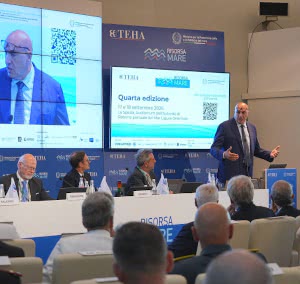
The EU-ETS Observatory promoted by the Spanish government agency
Puertos del Estado presented in Brussels, at the headquarters of the
of the European Sea Ports Organisation, the results of its
analysis of the impact on European container ports resulting from
the inclusion of maritime transport in the EU-ETS, the
emissions trading of the European Union, which took place on
January 1, 2024. Compared to the first results presented at the end of 2025
(
of 16
December 2025), the Observatory provided additional data that
confirm a reduction in container traffic connections to
long distance in EU ports compared to the ports of the countries
not subject to European environmental regulations. In
In particular, the data show a decline in the share of activity
of the main European ports measured in teu-miles, i.e. the
TEU container transport capacity of incoming ships
in ports multiplied by the distance traveled, which has dropped
from 67% in 2023 to 56% in 2025, with the most significant declines
significant in Northern Europe and the
Eastern Mediterranean.
The first results presented at
December had already revealed an increase in activity
in non-EU ports located near Europe, such as those in the UK
United in Northern Europe and Egypt and Turkey in
Mediterranean. Data shows that, in 2023, UK ports
accounted for 17.5% of the total teu-miles of the United Kingdom,
Germany, France, Belgium and the Netherlands combined, while in July
by 2025 this percentage had almost doubled to 32.1%.
This difference of 15 percentage points in two years - he noted
the Observatory - corresponds almost exactly to the losses
recorded overall by the Netherlands and Germany. In the Mediterranean
Egyptian ports recorded the highest growth in the
TEU-miles share, rising from 35% in 2022 to 52% in 2022
2025, while Greece recorded a strong
drop from 45% to 12%.
The Observatory recalled that the situation of the
Suez, where maritime traffic has been reduced due to the
crisis situation in the Red Sea region, combined with the change in the
maritime alliances, has led to a reorganization of the
sea lanes that took place almost
at the same time as the entry into force of the ETS Maritime,
thus generating a profound disturbance of the market.
However - the Observatory noted - even if the closure of the
Egyptian channel is an absolutely relevant factor, this
Factor alone does not explain the growth in connectivity
currently observed in countries such as the United Kingdom and
Egypt, nor can it be attributed to usual factors
as a significant increase in economic activity, a
Reduced operating costs or congestion problems in ports
neighboring European Championships.
In addition, the Observatory recalled that this growth in the
traffic, measured in teu-miles, is accompanied by a
increase in planned investments which are expected to increase by
+21% port capacity in UK ports, while
in the Eastern Mediterranean, in particular in Israel, Turkey and
Egypt, planned investments will allow for an increase in
+43% of capacity measured in millions of TEUs handled
per year. Given that port expansion must be based on projections
in the long term, the Observatory noted, it follows that
investments of these countries are not driven by short-term factors
but rather by structural changes in traffic
maritime.
Commenting on these data, and specifying that "the support of
Puertos del Estado to the decarbonization process is
absolutely steadfast", the president of the government agency
Gustavo Santana, specified that, "however,
we believe that some aspects related to the application of the ETS to the
maritime sector must be monitored and, where necessary,
revised in order to improve the system and contribute to the objective
to reduce greenhouse gas emissions, while preserving
competitiveness and control of our supply chain
supply'.
- Via Raffaele Paolucci 17r/19r - 16129 Genoa - ITALY
phone: +39.010.2462122, fax: +39.010.2516768, e-mail
VAT number: 03532950106
Press Reg.: nr 33/96 Genoa Court
Editor in chief: Bruno Bellio No part may be reproduced without the express permission of the publisher







 The EU-ETS Observatory promoted by the Spanish government agency
Puertos del Estado presented in Brussels, at the headquarters of the
of the European Sea Ports Organisation, the results of its
analysis of the impact on European container ports resulting from
the inclusion of maritime transport in the EU-ETS, the
emissions trading of the European Union, which took place on
January 1, 2024. Compared to the first results presented at the end of 2025
The EU-ETS Observatory promoted by the Spanish government agency
Puertos del Estado presented in Brussels, at the headquarters of the
of the European Sea Ports Organisation, the results of its
analysis of the impact on European container ports resulting from
the inclusion of maritime transport in the EU-ETS, the
emissions trading of the European Union, which took place on
January 1, 2024. Compared to the first results presented at the end of 2025
 (
(












 - Via Raffaele Paolucci 17r/19r - 16129 Genoa - ITALY


