
If in the last three days the series of attacks had ceased
ships in the Strait of Hormuz region attributed to the
Directly or indirectly linked military and paramilitary forces
Iran after the Middle Eastern nation was attacked
from the USA and Israel, for the past 24 hours there has been a
resumption of accidents in the area. After announcing yesterday the
report by the captain of a bulk carrier placed at 36
nautical miles north of Abu Dhabi, United Arab Emirates,
of the sighting of an impact in the water and a loud roar in the
The ship's immediate vicinity, today the British United Kingdom
Maritime Trade Operations (UKMTO), the Royal Navy body that
analyses the state of commercial shipping safety, has
reported a new intensification of attacks.
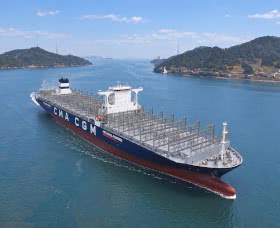
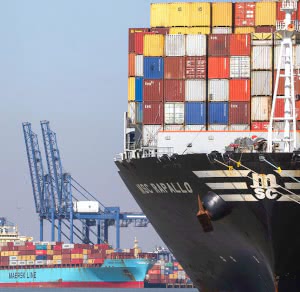
The first report is related to an attack suffered by
a container ship near the Strait of Hormuz that has
damage caused by a bullet, a device that did not
caused injuries among the ship's crew members.
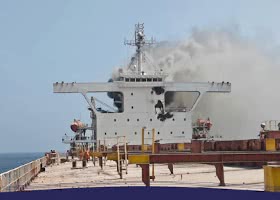
Subsequently, another cargo ship reported that it had been
hit by a shell in the Strait of Hormuz which caused a
fire on board as a result of which the captain requested
assistance and announced the evacuation of the crew.
The UKMTO reported that from 28 February to date
received 17 reports of accidents involving ships
operating in the Arabian Gulf, the Strait of Hormuz and the Gulf
of Oman, of which 13 related to attacks suffered by ships and four
of ships that have reported suspicious activity.
Meanwhile, the United Nations Conference on Trade and the
(UNCTAD) has published a summary analysis of the
implications of the recent disruptions to maritime traffic in the
Strait of Hormuz caused by attacks on ships. The document
highlights that the Strait of Hormuz is one of the most important
bottle of the world's most critical maritime traffic in
about a quarter of the world's trade in
seaborne oil and significant volumes of liquefied natural gas
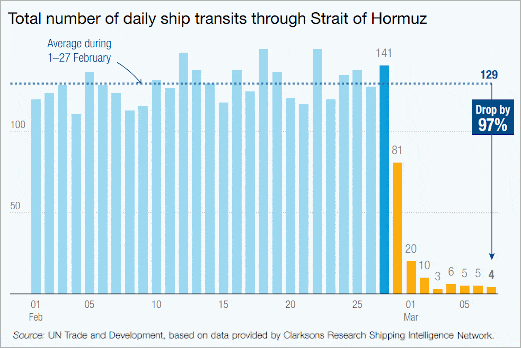
and fertilizers. The analysis finds that the current military escalation
in the region has stopped maritime transits through this
narrow passage and that the resulting knock-on effects must be
far beyond the region, influencing energy markets, the
shipping and global supply chains.
The UN agency for trade and development explained
that oil markets have reacted quickly, with prices
Brent crude oil rose to over $90 a barrel, and
specified that the increase in the costs of energy, fertilizers and
transport, including rentals, bunker prices and insurance premiums,
could lead to an increase in food prices and
increasing cost-of-living pressures, in particular for
the most vulnerable. The analysis specifies that the repercussions
Similar shocks have been observed during recent global shocks, including
the Covid-19 pandemic and the start of the war in Ukraine, which
have shown how disruptions in the energy,
agricultural production can be propagated through
interconnected markets.

















 - Via Raffaele Paolucci 17r/19r - 16129 Genoa - ITALY


