
Like the European shipowners' association, the World
Shipping Council (WSC), the association representing the main
global container shipping companies, appreciated the
Strategies for the maritime industry and ports proposed by the
European Commission
 (
(
of
4
March 2026). Among the measures and actions announced, the WSC
particularly welcomed the strong emphasis on combating
organised crime and door protection
by supporting partnerships
and two-way sharing
of information between authorities, shipping companies and
other industry partners. "Ports and supply chains
- noted the president and CEO of the WSC, Joe
Kramek - they are only as sure as their weakest link. Without
a strong public-private partnership and coherent implementation in
all Member States, criminal activity will shift
simply elsewhere. Recent events have once again
recalled that Europe's maritime and trade resilience is
extends far beyond its shores. Strategies rightly recognize
the importance of ensuring safe passage along the main roads
maritime routes to keep trade moving".
In addition, the WSC appreciated the support for decarbonization
maritime in both strategies presented yesterday. «The commitment
towards a global measure through the International
Maritime Organization - Kramek noted - is essential and
support action to review EU measures to avoid
double payments". For the WSC it is also positive
The focus of the port strategy is on the availability of
of renewable marine fuels, to an approach based on the
availability of different types of fuels and
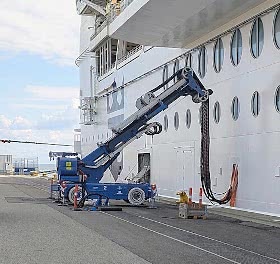
the acceleration of the implementation of facilities in ports to
provide shore-side electricity to ships. 'The transport of
liner shipping - Kramek pointed out - has invested over 125
billion euros in more than 1,100 dual-fuel ships
delivered or ordered. Port infrastructure must be
up to the investments in the fleet, the supply of
fuels and electrification".
According to the WSC, recognition in the strategy
maritime industrial of the need to simplify the
ETS Emissions Trading System requirements
EU Maritime Regulation and the FuelEU Maritime Regulation is very
appreciable.
However, the World Shipping Council has also identified weaknesses
in the two strategies which, according to the association, are not
sufficiently attentive to the simplification of trade
to support the EU's competitiveness agenda.
"Liner maritime transport services - explained the
WSC - around €2.5 trillion in trade every year
EU trade unions, yet ships can still be
required to submit up to 1,200 pieces of information for a single
port calls, many of which are imposed by national requirements.
The full implementation of the EU Maritime Single Window,
scheduled for last August, could save about
2.2-2.5 million hours of work per year. Maritime trade
- the association noted - still clashes with
customs barriers at the external borders, making trade
trade within Europe more difficult than the
necessary". "In a true single market - he underlined
Kramek - the transport of goods by ship within Europe
It should be as smooth as road transport. Reduce
customs barriers and intra-EU administrative burdens would be one of the most important
faster ways to strengthen competitiveness
and we would welcome clearer action in this area.
field".















 - Via Raffaele Paolucci 17r/19r - 16129 Genoa - ITALY


