Independent journal on economy and transport policy
04:50 GMT+2
PORTS
Last year, cargo traffic in German ports was 284.4 million tons (+3.8%)
Imports increased by +5.3%
Wiesbaden
March 10, 2026
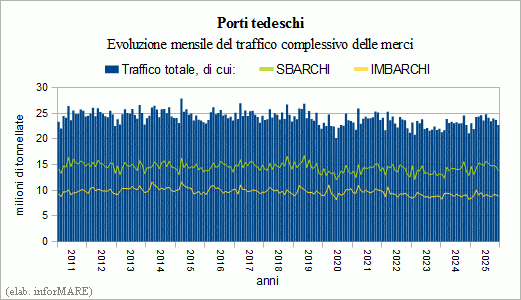
Last year, German ports handled
284.4 million tonnes of goods, with a total of 284.4 million tonnes of goods,
Progression of +3.8% over 2024 driven by cargo volumes at the
which amounted to 175.9 million tonnes, with a
increase of 5.6% on 2024, while the growth in freight volumes
boarding was lighter as they were
108.5 million tons handled (+1.1%). In addition, the goods
in imports increased by +5.3% to 171.1
million tons, while export goods are
increased by only +0.5%, rising to 103.7 million tonnes and the
domestic traffic, despite an increase of +15.7%,
represented only a small part of the total volume of goods
standing at 9.6 million tons.
The German statistical institute Destatis announced today that
in 2025 Hamburg confirmed itself as the German port with the
largest volume of traffic, having handled 99.8
million tonnes of cargo (+2.9% compared to the previous year) (it should be noted that the Port Authority of Hamburg
Traffic of 114.6
million tons, ed.),
followed by Bremerhaven (46.9 million tonnes, +10.4%) (it should be noted that the Bremen Port Authority
announced traffic for the year 2025 of 9.3 million tons for the port of Bremen and 56.0 million tons
million tons for the Bremerhaven plant, ed.),
Wilhelmshaven (35.5 million tonnes, +2.7%), Rostock (24.9 million tonnes, +2.7 million tonnes)
million tonnes, +7.2%) and Lübeck (15.8 million tonnes,
-0,4%).
Destatis explained that
in 2025, non-identifiable goods, consisting mainly of
loads from containerized goods without detailed information on the
product, represented by far the category of
largest in German maritime transport, with a volume of
of 87.9 million tons, equal to 30.9% of total traffic. I
fossil fuels - coal, oil and natural gas - follow the
second place with 40.5 million tonnes, or 14.2% of the
total goods handled. In third place are minerals,
stones and earth with 31.1 million tons (10.9%) and therefore the
chemicals with 20.2 million tons (7.1%).
The institute explained that in 2025 the United States will have
the dominant share of maritime traffic in
fossil fuels in German ports, with coal landings,
oil and natural gas amounted to 39.8 million tonnes,
with a slight decrease of -1.2% compared to 2024. Destatis has
pointed out that, however, 2025 has seen a new trend
different energy sources and countries
suppliers: oil imports decreased by -10.8%
falling to 25.4 million tonnes, while imports of
increased by +2.6% to 7.0 million
tons and those of natural gas increased by +49.1%
rising to 7.4 million tons. In 2025, the main
Germany's seaborne natural gas supplier were the
United States with 6.5 million tons (+51.8%). In addition,
despite the fact that in 2025 shipments of crude oil from the United States
United with Germany have decreased significantly by -23.6%
standing at just over 5.6 million tons, the USA
remained the main supplier of crude oil by sea
of Germany, thus overtaking Norway in first place as it
last year the volume of crude oil shipped from ports
to the Germans decreased by -27.7%
standing at just under 5.6 million tons. The decline in
oil shipments by sea from Norway was then
even more pronounced than that of shipments from the United States
United. In 2025, the USA was also the leading supplier of
seaborne coal with 2.0 million tons (+0.1%) and this
- observed Destatis - means that shipments of
seaborne fossil fuels from the United States to Germany are
increased even in the absence of an agreement on tariffs between the United States and the United States.
European Union, which has not yet been ratified, which
would allow for greater energy imports from the US.
Overall, in 2025, the United States, Norway and the
Sweden was the most important trading partner
of Germany in maritime transport. If last year the
freight traffic between German and US ports is
decreased by -3.6% to 28.7 million tonnes, however
the United States confirmed itself as the most important trading partner
important part of Germany. The ranking of the other countries is also
remained unchanged: Norway ranked second
place with a total of 26.3 million tons (+1.8%), followed by
Sweden with 24.6 million tons (+3.6%). The Republic
Chinese People's Degree ranked fourth with 19.7
million tons (+3.1%). Together, these four countries have
accounted for just over a third of total freight traffic.
Freight traffic with EU Member States was
99.4 million tons (+3.3%).
Regarding container traffic in ports only
German countries, reached a total of 15.0 million TEUs in 2025
(+12.4%), of which about a fifth (3.0 million TEUs, +12.1%) is
attributable to China, followed by the United States with 8.7% (1.3
million TEUs, -2.4%). Container traffic with states
EU member states, amounting to 4.1 million TEUs, has grown
significantly by +13.1% and represented just over
a quarter of the container traffic of German seaports.
In light of the growing state of crisis in the Middle East,
The Institute of Statistics specified that port traffic
in direct trade with the Gulf States
Largemouth bass is relatively low: about 4.0 million
tonnes, accounting for 1.4% of total freight traffic in 2025, are
attributable to the coastal states of Bahrain, Iraq, Iran, Qatar,
Kuwait, Oman, Saudi Arabia and the United Arab Emirates. In 2025, a
Total of 1.4 million tons of cargo were transported
by sea to Oman, 1.2 million tons to the United Arab Emirates
United States and 0.9 million tons in Saudi Arabia. In 2025
no goods were transported by sea to Iran. Destatis
highlighted that, however, many goods from the Member States
of the Persian Gulf reach Europe through primary ports
including those from Holland, France, Italy and Belgium, and then
are transported to other European countries, including Germany, and
therefore the naval blockades currently in place in the Middle East can
indirectly affect the supply of
Germany.
In the fourth quarter of 2025 alone, the total traffic of the
goods in German ports amounted to 70.34 million
tons, with an increase of +2.9% over the same period of the year
of which 43.25 million tonnes of cargo per year
unloading (+2.9%) and 27.09 million tons at loading (+3.0%).
- Via Raffaele Paolucci 17r/19r - 16129 Genoa - ITALY
phone: +39.010.2462122, fax: +39.010.2516768, e-mail
VAT number: 03532950106
Press Reg.: nr 33/96 Genoa Court
Editor in chief: Bruno Bellio No part may be reproduced without the express permission of the publisher






 Last year, German ports handled
284.4 million tonnes of goods, with a total of 284.4 million tonnes of goods,
Progression of +3.8% over 2024 driven by cargo volumes at the
which amounted to 175.9 million tonnes, with a
increase of 5.6% on 2024, while the growth in freight volumes
boarding was lighter as they were
108.5 million tons handled (+1.1%). In addition, the goods
in imports increased by +5.3% to 171.1
million tons, while export goods are
increased by only +0.5%, rising to 103.7 million tonnes and the
domestic traffic, despite an increase of +15.7%,
represented only a small part of the total volume of goods
standing at 9.6 million tons.
Last year, German ports handled
284.4 million tonnes of goods, with a total of 284.4 million tonnes of goods,
Progression of +3.8% over 2024 driven by cargo volumes at the
which amounted to 175.9 million tonnes, with a
increase of 5.6% on 2024, while the growth in freight volumes
boarding was lighter as they were
108.5 million tons handled (+1.1%). In addition, the goods
in imports increased by +5.3% to 171.1
million tons, while export goods are
increased by only +0.5%, rising to 103.7 million tonnes and the
domestic traffic, despite an increase of +15.7%,
represented only a small part of the total volume of goods
standing at 9.6 million tons.










 - Via Raffaele Paolucci 17r/19r - 16129 Genoa - ITALY


